
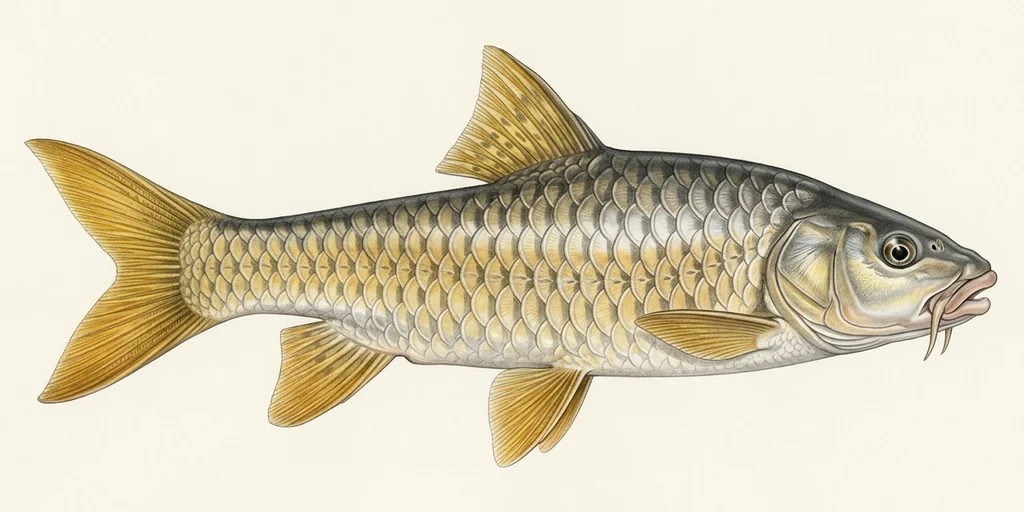
Knowledge – Fish
Golden mahseer (mahseer): Features, habitat, conservation status
The golden mahseer (Tor putitora) is a large member of the carp family from the Himalayan rivers, from Afghanistan and Pakistan to Bhutan and Myanmar. It is regarded as a characteristic species of cool, clean mountain rivers and was long a famous sport fish. Today it is listed as endangered on the IUCN Red List.
In short: Endangered according to the IUCN Red List. Not a target fish; a hooked golden mahseer is released gently in the water straight away. What to do with a bycatch: Golden mahseer as bycatch.
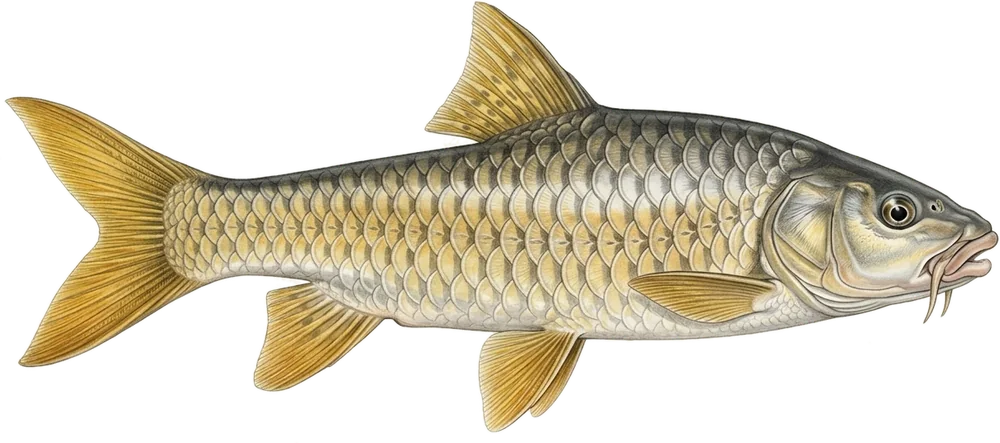
- Large scales, only 24 to 28 along the lateral line
- Fleshy lips and two pairs of barbels at the mouth
- Golden-yellow fins, dark grey back, flanks silvery to golden
Catch chances through the year
- Hardly any chance
- Possible
- Good
- Peak season
- Spawning (observe the closed season)
Editorial assessment for the home water (Himalayan rivers (India, Nepal, Pakistan, Bhutan)), not a measured value and not a guarantee. The rules of the country you travel to are binding.
How to recognise it
The golden mahseer is a powerful, laterally flattened member of the carp family with conspicuously large scales: only 24 to 28 are counted along the lateral line. The mouth has fleshy lips and two pairs of barbels.
Fish examined in Pakistan had a dark grey back, light grey to silvery flanks, a silvery white belly and golden-yellow fins. That is where the name golden mahseer comes from.
FishBase gives the greatest published weight as 54 kg and a maximum length of 275 cm. According to FishBase, fish over 5 kg are now caught only rarely.
Side by side: golden mahseer or Tor tor? (The species are hard to tell apart.)
| Feature | Golden mahseer | Tor tor |
|---|---|---|
| Head | pointed, longer than the body is deep | shorter than the body depth |
| Body shape | slim, back almost straight | high-backed, back strongly arched |
| Fins of live fish | golden-yellow, only the dorsal fin grey | all bright red |
Mahseer is a collective name. In South and Southeast Asia at least 47 species from three genera carry it, and 23 alone belong to the genus Tor. The species are hard to tell apart, and the taxonomy is disputed.
The golden mahseer of Pakistan’s Indus system was partly listed as a separate species, Tor macrolepis. A study from 2023 assigns it to Tor putitora. FishBase also points out that some researchers regard Tor mosal as a separate species.
Where it lives
The golden mahseer lives in Afghanistan, Pakistan, India, Nepal, Bangladesh, Bhutan and Myanmar. It inhabits fast-flowing streams with a stony bottom, river pools and lakes.
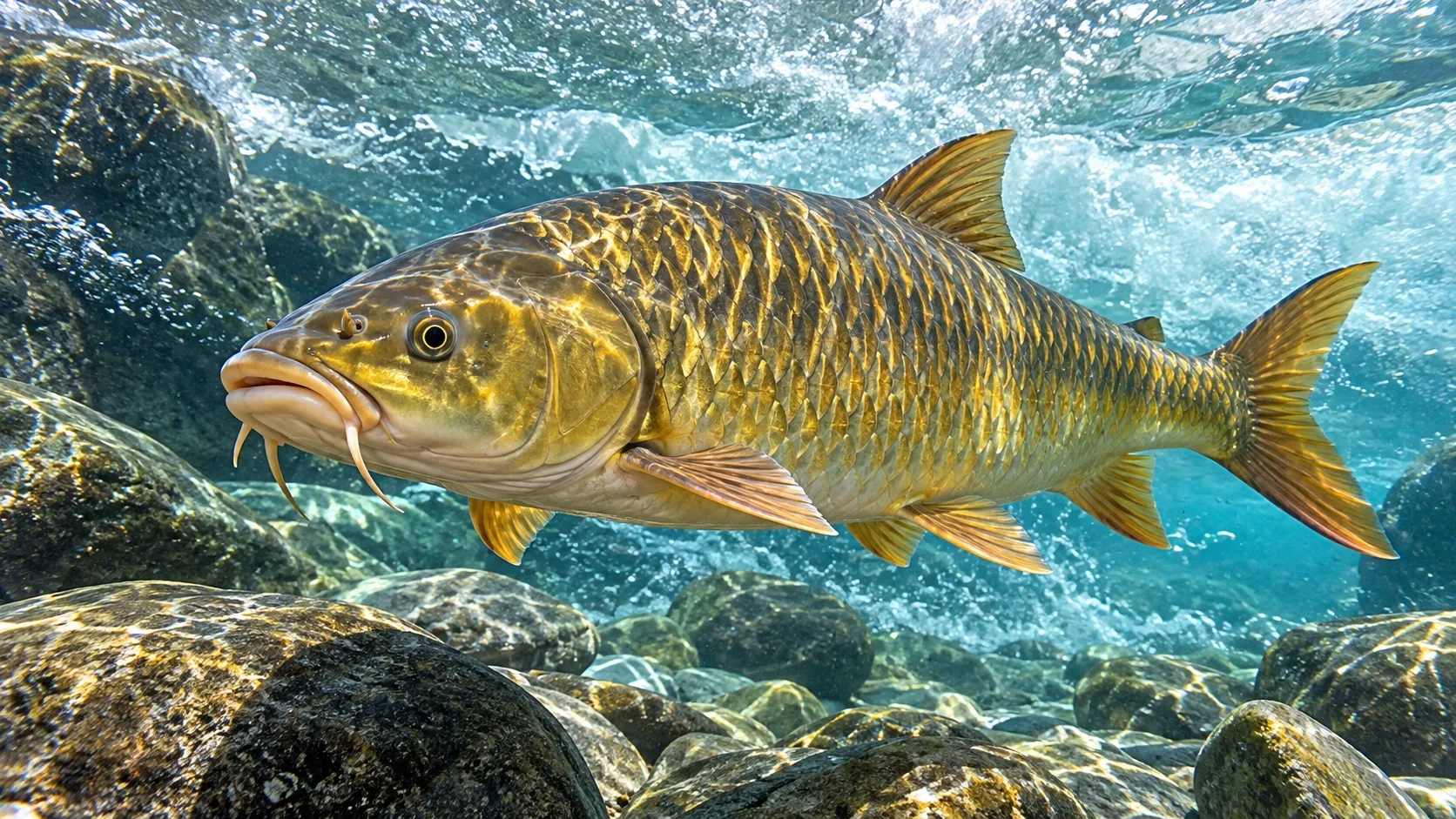
It is a cold-water fish: water temperatures of 11 to 24 °C are given, and 11 to 30,5 °C at spawning sites at the foot of the Himalayas. Because it depends on clean, flowing rivers, it is regarded as an indicator of healthy waters.
Dams and weirs cut up its rivers. In tributaries of the Ganges researchers found genetically separate sub-populations and migrations almost only in one direction. They recommend small protected areas at spawning sites and fish passes.
Holding spots in the picture
Choose the time of day: the picture shows where the species holds. We do not show German seasons for travel fish; the bars give the chance of a catch for each month. Tap a fish or a spot in the list to bring it closer. The picture is schematic and AI-generated, and every water is different.
In the river
Slack water behind rocks
Golden mahseer (mahseer) is found here all year round.
Gravelly shallow (riffle)
Golden mahseer (mahseer) is found here all year round.
Pools, deep spot
Golden mahseer (mahseer) is found here all year round.
The golden mahseer inhabits cool, clean mountain rivers of the Himalayas: fast-flowing streams with stony beds, river pools and lakes. Outside the spawning season it stays in deep pools that hold water all year round. In the monsoon it moves into the middle stretches and spawns there over gravel and stones, while the young fish live among stones along the bank.
Size comparison: AI-generated drawing, schematic.
How it lives and spawns
The golden mahseer is an omnivore. It eats fish, zooplankton, mosquito larvae and plants. Juveniles live on plankton, and slightly larger fry mainly on algae.
To spawn, the fish migrate from the lower reaches into the middle sections of the river and spawn over gravel and stones. Afterwards they return to pools and lakes that hold water all year round. Spawning takes place in one distinct season a year, and the females release their eggs in batches. There is no brood care, and the young fish stay among stones at the bank.
When it migrates and spawns
According to the data collected in FishBase, spawning mostly falls between July and September, that is, in the monsoon. In Nepal it runs from June to October, and on some rivers in India it begins as early as April or May.
Spawning takes place as the flood water recedes. During this time the fish depend on undisturbed gravel bars in the middle sections of the river.
What to do with a bycatch
As bycatch: Fishing for golden mahseer? – why the species is not a target fish and what you do with a bycatch.
If you hook a golden mahseer while fishing for other species, leave it in the water, unhook it quickly and let it swim off. Do not lift it out of the water for a photo.
It is precisely during the spawning season from July to September that the fish stand on gravel bars. Avoid such places completely then, even where fishing for other species is allowed.
Avoid spawning grounds: Researchers recommend small protected areas at the spawning sites. In the monsoon season keep your distance from gravel bars in the middle reaches.
Report illegal methods: Fine nets, plant poisons, electricity and explosives threaten the stocks. Anyone who sees such things reports them to the authority or the local communities.
Suitable lures
We deliberately show no baits for this species.
Endangered according to the IUCN: do not target it, release a bycatch gently in the water straight away; follow the national rules.
Protection and rules
The IUCN Red List has listed the golden mahseer as endangered since 2018. The causes are overfishing, dams, the extraction of water and gravel, and illegal fishing methods using fine nets, plant poisons, electricity and explosives.
Catch rules, licences and protected areas are set by the individual states. Information from the competent local authority is the one that counts. Researchers in India argue for consistent release when fishing for mahseer (Pinder und Raghavan 2013).
In Nepal a conservation project on the Babai and Sharada rivers trained young people from the villages, who patrol as river guards against illegal fishing.
Frequently asked questions (FAQ)
Is the golden mahseer protected?
It is listed as endangered on the IUCN Red List. Which catch rules apply is set by the individual countries; the authority on the spot is the one that counts.
When does the golden mahseer spawn?
Mostly from July to September in the monsoon season, and from June to October in Nepal. To do so it migrates to the middle sections of the river and spawns over gravel.
How big does a golden mahseer get?
FishBase gives up to 54 kg and a maximum length of 275 cm. Fish over 5 kg are now caught only rarely.
Sources
The rating of catch chances is an editorial assessment. The facts come from these sources, and the text is worded in our own words. The illustration is an original design by Angel Momente in the style of a natural history plate (AI-generated, see the AI notice).
- FishBase: Tor putitora
- FishBase: Spawning List – Tor putitora
- FishBase: Reproduction of Tor putitora
- Wildlife Institute of India, PLOS ONE (2020): Longitudinal connectivity and population genetic structure of endangered golden mahseer in Himalayan rivers
- Pinder & Raghavan (2013), Current Science: Conserving the endangered Mahseers (Tor spp.) of India
- Yousaf et al. (2023), Brazilian Journal of Biology: An overview of the taxonomic instability of endangered Golden and Zhobi mahseer in Pakistan
- Oryx (2025): Community-led conservation for the Endangered golden mahseer in Nepal
- Johnson et al., PLOS ONE (2023): Redescription of an endemic mahseer, Tor mahanadicus (Vergleichstabelle der Tor-Arten)
- Dinesh et al., Indian Journal of Animal Sciences (2010): Mahseers in India – a review with focus on conservation and management
Created with AI support from the sources listed. Figures only appear in the text if a source gives them. Last updated: 27 October 2026. Found a mistake? Write to us. Who is behind this site: About me.
More in the lexicon
- All fish species at a glance
- Catch calendar – month, water temperature and profile for 93 species
- Line calculator – breaking strain after the knot, drag guideline, backing
- Angling methods