
Knowledge · Tackle
Landing net: Mesh, size and handle
A landing net is the net on a handle that you use to lift a played-out fish safely out of the water. Which head, which mesh and which handle length suit you depends on the target fish and the swim. Then there is netting technique: you lead the fish to the net, not the net to the fish.
Design and types
Every landing net has three parts: the hoop, which is the frame of the opening, the mesh hanging from it and the handle. In the exam catalogues it is called an Unterfangkescher and is used to land the fish. The basic choice is the folding net with an extendable handle, which will land most fish. There are also models with a detachable head, the short wading net for anglers standing in the water, and the piling net (Spundwandkescher). It works with a rope system and brings fish up from sheet piling or bridges, where no handle reaches any more.
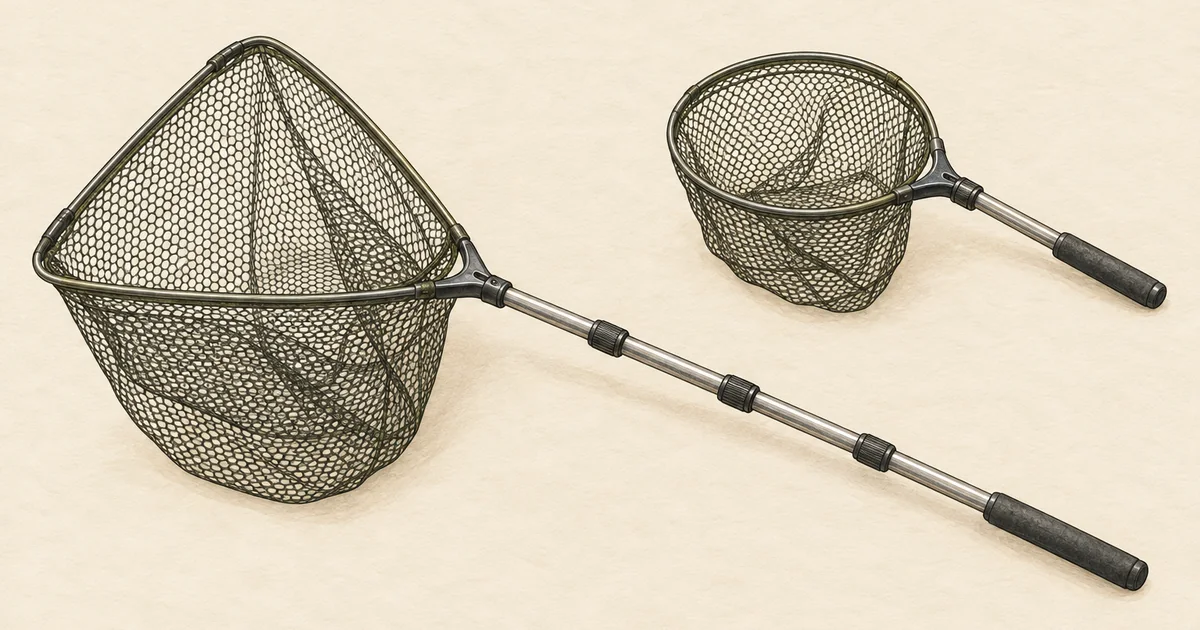
Mesh material: rubberised, knotless or knotted
In the Saxony-Anhalt exam question catalogue, the net bag should be deep and roomy and made of strong, knotless mesh. A small, narrow bag of knotted mesh is the wrong answer there. The Bavarian catalogue calls rubber nets especially gentle on the fish, and hooks hardly penetrate the rubber surface. You touch fish only with wet hands, as the Austrian Environment Agency advises. Why mucous membrane and fins benefit from rubber is explained under Landing and unhooking fish.
- Rubberised: The coating absorbs little water and dirt, rinses out easily and smells less. Treble hooks on crankbaits snag less often and come free faster.
- Knotless nylon: The standard for decades. However, water and slime collect in the weave, which can smell unpleasant.
- Monofilament mesh: Hooks do not sit as deep in it and come out more easily. In the Alps it is used when fishing for whitefish.
There is a trade-off with mesh size. A fine-mesh net stops fins slipping through the mesh and being cut. Large meshes, on the other hand, glide through the water with less resistance, which is why they may be larger for predator anglers, while fine nets suit coarse fish and juveniles. With pike, a fine-mesh, plastic-coated net protects the fish noticeably better than the thin, wiry mesh of an ordinary landing net.
Nets and fish welfare: what studies and the exam say
No net is entirely harmless. In 2016, fish biologists from Canada and the USA summarised the state of research in the journal Fisheries Research. According to them, every type of net damages the fish’s outer skin somewhat, but rubberised nets seem to keep this damage to a minimum. Blinker refers to trials with bluegills and barramundi: the slime layer suffered in every net, but least in soft, knotless mesh and in rubberised mesh. Another Blinker article compares net knots to a grater on the skin, and an unhooking mat, which only comes afterwards, offers no protection against that.
Mesh size alone does not make a net gentle. In the Bavarian question catalogue, ‘very fine-meshed’ and ‘wide-meshed and shallow’ are both wrong answers. The correct one is a deep, roomy net bag made of strong material without knots. The Landesfischereiverband Baden-Württemberg highlights rubberised mesh especially for undersized fish or fish in their closed season that go back into the water. The review in Fisheries Research gives another reason for a generously sized net. If it is large relative to the target fish, the fish can stay briefly in the net under water while you get the pliers and tape measure ready. That way it spends less time in the air.
Head shape and size by target fish
There are three common head shapes. Round heads are regarded as all-rounders for coarse fish. Elongated ones take long fish such as pike safely and are handier in a current. Square ones offer plenty of area for pole fishing.
On size, the Saxon exam answer is brief: better too large than too small. A large head also takes small fish, a small one cannot take a large fish. The training material of the Landesfischereiverband Baden-Württemberg sorts landing nets by fish size: small, handy ones for fly fishing and wading, large, roomy ones for carp fishing. Guide values according to Blinker for the diameter or width of the head:
| Type of net | Target fish | Special feature |
|---|---|---|
| Head 40–50 cm | Perch, trout | usually enough |
| Head 50–55 cm, long handle | large bream | when pole fishing |
| Head around 60 cm | Zander, mixed predators | all-round for spinning anglers |
| Head from 70 cm, deep mesh | Pike | 1 m hoop length also suffices for large pike |
| Carp net from 70 cm | Carp | rubberised, fine mesh, sturdy |
| Wading net | Trout, perch when wading | short handle, worn on the belt |
With a carp net, according to Rute & Rolle, sturdiness counts most: many ordinary nets fail at the latest when lifting the weight of big carp.
The big carp net comes at a price when you have to carry it. Fisch & Fang describes it with arms usually over a metre long, heavy and with a 1,80 m handle: right for a static swim, unwieldy when stalking. According to the article, if you stalk carp on the surface you sometimes have to poke around in water lilies and cannot choose your bank. For that it recommends a lighter, handy predator net with a rubberised mesh. More on the method under Carp fishing.
Handle: length, construction and head connection
The length depends on the difference in height and the distance between you and the fish. The following overview matches the usual designs to the places; the lengths are guide values from angling magazines.
| Position | Landing net | Handle | Note |
|---|---|---|---|
| Boat | short landing net | short | you sit close to the water |
| bank with a short way to the water | folding or telescopic landing net | 50 to 150 cm | for bank and boat anglers |
| Steep bank, rock revetment | telescopic handle | for pike 1,50 m | a short handle makes landing harder |
| Whip fishing | long handle | 3 to 4 m | reaching far over the water |
| Jetty, groyne, harbour | extra-long landing net | up to about 4 m | often does not reach high walls |
| High sheet-pile wall | Sheet-pile landing net | net ring on a rope | see next section |
| Standing in the water | Wading net | short handle | sling to hang over the shoulder |
Telescopic handles can be pushed together for carrying, and folding heads save even more space. For spinning anglers, quick set-up counts above all, whether plug-in, folded or flipped open. Light nets for spinning anglers are often made of aluminium or carbon, and carbon weighs less.
The weak point is the joint where the hoop arms fold together. If it is made of plastic only, it will eventually break according to Rute & Rolle; aluminium or metal lasts longer. The Saxon exam asks exactly this: when buying an Unterfangkescher, the span of the hoop arms and the quality of the folding system count, not price, manufacturer or mesh colour.
A long net handle also helps during the fight. For carp fishing with the match rod, Blinker recommends a long handle and a bigger net than for ordinary float fishing for small fish. With the long handle you reach the fish sooner, and the angle between rod tip and fish does not get too steep. According to the article, it is precisely in this last phase that many fish are lost.
With very heavy fish from a boat, the handle has its limits too. Using halibut as an example, Blinker describes how the fish is not lifted into the boat by the net handle. Instead, after netting, the frame is tipped upright and pulled to the side of the boat, and several people lift frame and fish on board together.
High banks and sheet-pile walls: working out the reach
If you stand far above the fish on a jetty, groyne or quay wall, you need more than a normal handle. For such places there are extra-long landing nets from the street-fishing scene, which suit most spots in harbours and along sheet-pile walls, even if you stand somewhat raised.
The length needed is made up of three distances: the height from your hand to the water, the distance of the net from the wall and the immersion depth. Because the handle lies at an angle, its length is the hypotenuse of height and distance. An example from geometry: if your hand is 2 m above the water, the net should dip in 0,3 m and sit 1 m away from the wall, the result is a length of around 2,5 m, that is the square root of 2,3 squared plus 1 squared. Measure the height on site and remember that the water level can change with tide, locks or wind.
If even the longest handle is not enough, that leaves the sheet-pile net: a net ring without a handle that is lowered on a rope. It spans height differences of a few metres. The Deutscher Angelfischerverband recommends it on steep harbour walls, and the Bavarian angling exam lists it as a special landing net for steep banks and sheet-pile walls. Net baskets on a rope are also mentioned for steep, slippery piers. If you lay the rope ready before the first fish bites, you do not have to search for it during the fight.
Plan the landing so that you do not have to lean over the edge. According to the German Social Accident Insurance, a fall into the water is often preceded by a trip, slip or fall accident. According to the DLRG, algae and kelp on stones and structures form a very slippery surface with water. A helper who guides the fish or holds the landing net is useful, because alone at the water you need the longer net. Your equipment at the water also includes the lifejacket, more under Boat and lifejacket and Bank and waders. The text does not replace safety instruction.
Netting correctly
- Play the fish out first. You never net a pike by force while it still has strength: wait until it tires. Do not chase it with the net.
- Lower the net, guide the fish in. The net lies still under the water. You guide the fish head first over the frame and only then lift. Do not stab at the fish with the net, otherwise you scare it or tangle the line.
- Do not lift with the rod. In the Bavarian question catalogue you land a larger fish after the fight with the landing net. Lifting it out with the rod or pulling it out of the water by the line are wrong answers there. According to Petri-Heil, pulling on the bait strains the skeleton, which is not built for it.
- Lift level. A flat net bottom lets the fish lie stretched out and spreads its weight.
- Avoid netting fish you intend to release. Under the water regulations of the Landesanglerverband Brandenburg they should stay in the water if possible, see Releasing fish.
- At night: a triangle of glow sticks on the landing net lets your helper find it faster and makes landing easier.
You set the drag so that the fish comes to the net quickly but without a jerk, more under Setting the reel drag.
Landing net in a boat and in a belly boat
In a boat you sit close to the water, so according to Blinker short landing nets are usually enough. On a belly boat there is no protective gunwale at the front. Blinker therefore advises landing pike from the side of the belly boat so that the fish does not jump into your lap with the lure. That favours a short landing net kept at hand, with a rubberised mesh that trebles do not get caught in. More on the kit under Belly boat.
Whether you may fish from a boat or belly boat is regulated by the water regulations and the fishing permit. On the Mittellandkanal, by its wording, the Anglerverband Niedersachsen prohibits fishing from watercraft and floating devices, expressly including belly boats.
Net floats and net holders
Two small accessories keep the net within reach and above water. The net float is a buoyancy aid on the net. Rute & Rolle shows a simple solution for this: a piece of pipe insulation on the net that makes it float. This is handy wherever the net might slip into the water, i.e. in a boat, on a jetty and in a belly boat. A report in Rute & Rolle shows a carp angler in a belly boat with a net fitted with floats, with which, according to the caption, the landing worked without problems. Blinker also often considers floating nets sensible for fly fishing. The best way to check whether your net stays on the surface with a wet mesh is to try it in shallow water before you need it from the boat.
The net holder saves you searching during the fight. A feeder angler in Angling Times lays the net on a second rear rest with the head already pointing towards the lake. That way he does not have to swing it round when landing, net and handle do not lie on the ground where they can get damaged, and they are still within reach. For pole fishing, another article advises against laying the net across the side tray: there it blocks the bait tubs and gets in the way of the pole. Better is a separate, firmly fixed rest next to it that you can find without taking your eyes off the fish. More on the setup under Seat box and Rod rest.
For the roving angler there are smaller solutions. According to Rute & Rolle, some models, mostly folding nets, have a clip on the handle. It clips into the D-ring, a metal ring for attaching kit to a wading jacket or chest pack. Magnet, belt holder and lanyard for the short net are explained on the page Wading net. Before the first cast, a quick check is worthwhile:
- Net fully assembled, head towards the water, on its own rest
- nothing lying across the side tray, bait tubs or rod
- Float on the handle if you fish from a boat, jetty or belly boat
- at night, glow sticks on the frame so that you can find it in the dark
Care and transport
- Drying: let the landing net dry after every trip, otherwise it goes mouldy. Rinse rubberised nets with fresh water.
- Handle: free it regularly of sand and dirt. Tighten the joints and screws of telescopic models only with feel, otherwise the handle jams.
- Transport: telescopic handles and folding heads shorten the transport length. With detachable heads the net can be swapped.
Changing waters: the Land of Tyrol advises cleaning the landing net before moving to another water, because invasive species and pathogens such as crayfish plague often travel unnoticed with equipment.
Net requirement: water rules and fishing permit
Fisheries law is state law. Only Bremen and Hamburg explicitly require a landing net; in all other states such duties only appear in the water regulations or on the fishing permit (Erlaubnisschein). A few examples:
- Bremen: the Bremische Binnenfischereiverordnung (§ 7 Abs. 3) requires a landing net in addition to a measure, a priest, a disgorger and a knife. Fish are to be landed with it where the location allows.
- Hamburg: the implementing regulation of the Hamburgisches Fischerei- und Angelgesetz (§ 4 Abs. 3) requires a landing net that suits the fishing spot and the expected catch, only with a rubberised mesh and together with an unhooking mat. For a quay wall the specialist authority names the sheet-pile landing net.
- The Landesverband Sächsischer Angler requires, in its water rules (2024 edition), among other things that you carry a landing net.
- On the Mittellandkanal the Anglerverband Niedersachsen prescribes an Unterfangkescher or Spundwandkescher, preferably rubberised.
- The Landesanglerverband Sachsen-Anhalt requires landing aids with which the fish to be expected can be landed safely.
- For angling ponds in North Rhine-Westphalia, the notes published by the Landesamt für Verbraucherschutz und Ernährung NRW (LAVE) require that caught fish be lifted out quickly and gently with the Unterfangkescher.
- Conversely, under the water rules of the Landesanglerverband Brandenburg, fish that are to be returned should if possible not be netted at all.
The exam question catalogues of Saxony and Saxony-Anhalt list the landing net as angling accessory. That is exam material, not a regulation. What your state requires is under Mandatory equipment at the water; what applies at your water is in your papers, see Fishing permit (Erlaubnisschein) and water map.
Common mistakes
- Head too small. If the target fish does not fit in, the best mesh does not help. When in doubt, reach for a slightly larger model.
- Textile mesh when spinning. If the trebles of a crankbait hang in the fabric, freeing them takes a long time and the fish waits. A rubberised net saves this time.
- Handle too short. On a steep bank, rock revetment or from a jetty you can otherwise only reach the fish with difficulty. Work out the length beforehand.
- Leaning over the edge. Anyone who leans far over a sheet-pile wall risks a fall; a longer handle or the sheet-pile net is safer.
- Lifting the fish out by the fine tip. When feeder fishing, fish from about 400 g belong in the landing net, otherwise the tip of the feeder rod breaks.
- Packing the landing net away wet. In a damp bag the net goes mouldy.
Frequently asked questions
Is one landing net enough for everything?
To start with, a folding net with a telescopic handle and rubberised mesh is enough. Rute & Rolle does not consider a single net for every occasion sufficient in the long run, though. If you fish specifically for carp or pike you need a large head, if you wade, rather a wading net.
What is the difference between an Unterfangkescher and a Setzkescher?
The Unterfangkescher is for landing. The Setzkescher is a long net tube in which caught fish are kept alive. In the exam catalogues of Bavaria and Saxony-Anhalt, keeping fish in an Unterfangkescher is the wrong answer. Whether you may keep fish at all is governed by state law and the water rules.
When do you use a gaff instead of a landing net?
The gaff is a pole with a hook that is pushed under the gill cover. The Baden-Württemberg training material calls it a landing aid for very large fish and stresses that the fish must then be stunned and killed without delay. It is therefore out of the question for a fish that is to go back in the water. In the waters of the Landesverband Sächsischer Angler, gaffs and grabbers are banned altogether under its water rules. How killing is done is explained under Stunning and killing a fish.
How long does the landing net need to be at a sheet-pile wall?
That depends on the height to the water and the distance of the net. The handle lies at an angle, and its length is the hypotenuse. Extra-long models go up to about 4 m; beyond that the sheet-pile net on a rope remains.
When is the right moment to net a fish?
When the fish is played out. You lower the net, guide the fish over it head first and only then lift. Stabbing at the fish with the net scares it.
Related
- Landing and unhooking a fish: wet hands, mat and disgorger after netting
- Returning a fish: when it is compulsory and how the fish is protected
- Unhooking mat: the surface for the fish after landing
- Wading landing net: the small landing net for wading
- Fishing in harbours and on the mole: landing at the high quay edge
- Bank and waders: a secure footing by the water
- Setting the reel drag: so the fish reaches the net quickly
- Line calculator: breaking strain of the line matched to the target fish
Sources
- Blinker: Kescher fürs Angeln, der unterschätzte Helfer am Wasser (Bauarten, Netze, Maschen, Kopfformen, Stiele, Pflege) und Blinker: Kescher: Am besten gummiert! (gummierte Netze, Größe, Stiel bis 4 m, Pflege, Knicklichter, schwimmende Kescher)
- Blinker: Welcher Kescher zum Spinnfischen? (Größen nach Zielfisch, Stiel, erhöhte Standorte, Spundwandkescher) und Blinker: Hecht landen, risikofrei zum Fisch (Bügellänge, Stiel, Netz, Technik)
- Blinker: Fische landen, Kescher, Lip-Grip und Co. (Maschen, Netzboden, Studien zu Netzarten), Blinker: Karpfen-Kickstart (Karpfenkescher ab 70 cm), Blinker: Brassen angeln, alle Grundlagen und die 4 besten Methoden (Brassenkescher) und Blinker: Feederangeln, Friedfische füttern und fangen (Kescher ab 400 g)
- Blinker: Brandungsangeln, alles, was man über diese Angelmethode wissen muss (Landehilfen an steilen Molen) und Blinker: Belly-Boot (Landung vom Bellyboot)
- Rute & Rolle: Welcher Kescher passt zu mir? (Allroundkescher, Gelenkstück, Karpfenkescher)
- Bayerische Landesanstalt für Landwirtschaft: Prüfungsfragen zur Fischerprüfung 2023/2024 (PDF) (Gumminetz, Netzsack, Landen, Spezialkescher), Land Sachsen-Anhalt: Fragenkatalog zur Fischerprüfung (PDF) (Netzsack, Zubehör) und Saxony, LfULG: Prüfungsfragen Gerätekunde (PDF) (Größe, Kauf, Zubehör)
- Landesfischereiverband Baden-Württemberg: Gerätekunde (PDF) (Kescher nach Fischgröße, gummierte Maschen, Gaff) und Fischereiverein Löningen: Gerätekunde (PDF) (Gaff als Stab mit Haken, Watkescher)
- Bremische Binnenfischereiverordnung vom 30. September 2011 (§ 7 Abs. 3: Unterfangkescher und weiteres Gerät) und Verordnung zur Durchführung des Hamburgischen Fischerei- und Angelgesetzes (HmbFAnGDVO) (§ 4 Abs. 3: Unterfangkescher mit gummiertem Netz, Abhakmatte)
- Freie und Hansestadt Hamburg, Fachbehörde: Angelrecht (Unterfangkescher, Spundwandkescher, gummierte Kescher), Landesverband Sächsischer Angler: Gewässerordnung 2024 (PDF), Anglerverband Niedersachsen: Mittellandkanal, LAV Sachsen-Anhalt: Gewässerordnung (PDF) und Landesanglerverband Brandenburg: Gewässerordnung (Vorgaben zu Kescher, Gaff und Setzkescher)
- LAVE NRW: Hinweise und Empfehlungen zum Betrieb von Angelteichen in NRW (PDF) (Unterfangkescher am Angelteich)
- Deutscher Angelfischerverband: Fisch des Jahres 2017, Flunder (PDF) (Spundwandkescher an steilen Wänden)
- Deutsche Gesetzliche Unfallversicherung: Sturz ins Wasser (PDF) (Stolper-, Rutsch- und Sturzunfälle) und DLRG: Gefahren am Meer (PDF) (rutschige Algen auf Bauwerken)
- Fisheries Research: Best practices for catch-and-release recreational fisheries, angling tools and tactics, 2016 (PDF) (Netzarten und Oberhaut, großer Kescher und Zeit an der Luft), Blinker: Im Schonverfahren (Netzknoten und Schleimhaut) und Fisch & Fang: 13 Karpfen-Mythen auf dem Prüfstand (Karpfenkescher und Pirschkescher)
- Blinker: Karpfenangeln mit der Matchrute im Baggersee (langer Kescherstab) und Blinker: Heilbutt angeln, 10 Tipps vom Profi (nicht am Stiel heben)
- Rute & Rolle: Kescher, Einnetzen! (Rohrisolierung als Schwimmer, Klammer am Griff) und Rute & Rolle: Mit dem Belly Boat auf Bartelbrummer (Kescher mit Auftriebskörpern)
- Angling Times: How to set up properly for feeder fishing und Angling Times: Pole fishing masterclass, Teil 3, Set your seatbox (Kescher auf eigener Auflage)
- Petri-Heil: Vom Haken zurück ins Wasser (Fisch nicht am Köder hochheben), Umweltbundesamt Österreich: Nachhaltig fischen (PDF) (nasse Hände) und Land Tirol: Schutz heimischer Gewässer (Kescher vor dem Gewässerwechsel säubern)
Text AI-assisted, drawings AI-generated. Sources opened and checked in November 2026, no graphics taken from the sources.
All figures are guide values without guarantee. Which landing net requirement applies at your water is stated in the water rules and the fishing permit.