
Knowledge · Fish welfare and practice
Landing and unhooking fish
If you want to land a fish, you should know where it can be harmed: the net, hands, ground, hook and time in the air all help decide whether it stays unharmed. This page shows what fisheries research and the authorities say about landing nets, handling, unhooking and measuring.
Playing the fish: tackle to suit the fish
The longer the fight lasts, the more the fish is stressed afterwards. A review in Fisheries Research (2016) reports a frequent link between fight duration and stress and recommends tackle of suitable strength so that the fight stays short. With the usual tackle for the target species, however, several studies on smaller species found hardly any link between playing time and condition. With very large species and fights over 20 minutes, sharks, tunas and spearfish are named, duration becomes more important. At high water temperatures a long fight increases the stress.
The Austrian environment agency advises matching mainline, hooklength, rod and reel to the largest fish you can expect. More on the drag is under Setting the reel drag, on breaking strain in the line calculator. Landing net, forceps and tape measure should be ready before the bite; according to Blinker they should be within reach and ready for use so that nobody rummages in a bag while the fish lies in the air.
Landing net: material, size, mesh
The net material makes the difference. According to the review, all net types damage the skin somewhat, and rubberised nets seem to limit the effects most. Blinker sums up studies on sunfish and barramundi like this: soft, knotless mesh and rubberised nets cause the least damage to the slime layer and scales. A fine-meshed net stops the fins slipping through the mesh, a flat bottom keeps the fish stretched out and level so that its weight is spread over a large area.
The landing net must be large in relation to the fish. The review requires the fish to lie comfortably and as straight as possible in it, and describes the net in the water as a resting place while forceps or tape measure are prepared. The Austrian environment agency likewise recommends sufficiently large, knotless nets.
Legally this is a matter for the states. The Hamburg authority prescribes a drop net and also requires unhooking mats and rubberised nets in order to reduce mortality of released fish. What applies at your water is set out in state law and in the fishing permit (Erlaubnisschein). Designs are explained under Fishing landing net and Wading net.
| Landing aid | What the sources say |
|---|---|
| Rubberised, knotless net | According to Blinker the least damage to slime layer and scales, hooks come out of the mesh easily |
| Net with knots | Every net type disturbs the slime layer, knotless material spares the fins markedly more, says Blinker |
| Landing by hand with wet hands | According to Blinker fairly gentle, but it takes practice |
| Lip grip | According to Blinker, injuries to the lower jaw in 80 to 100 per cent of the test fish |
Hands, posture and mat
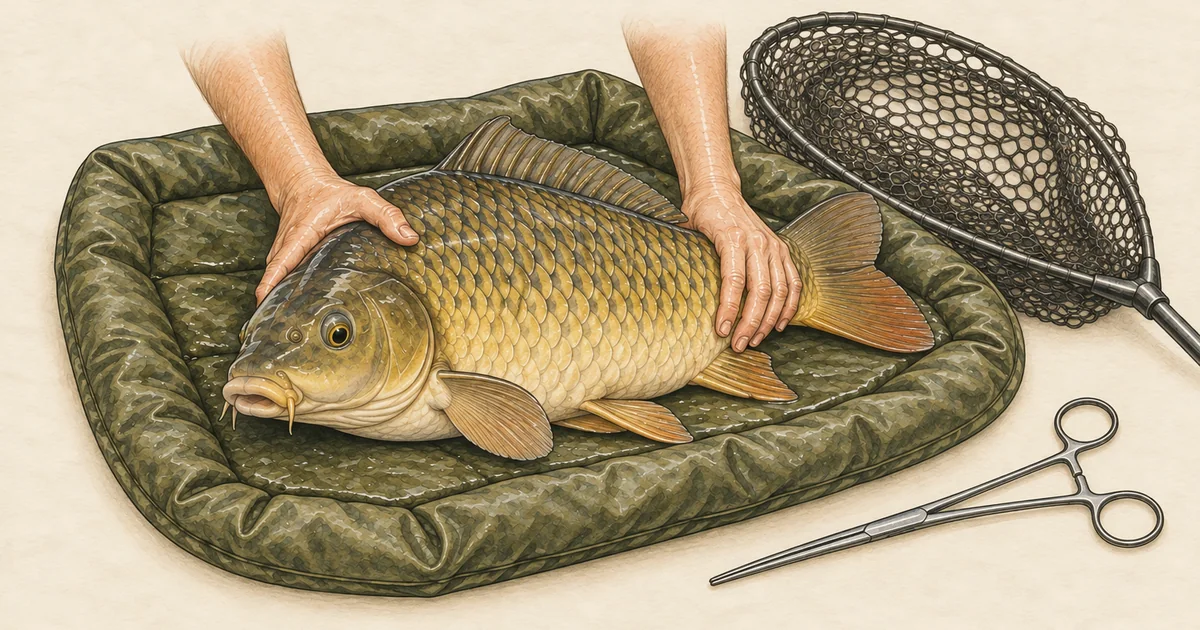
In its leaflet, the Ministry of Agriculture of Mecklenburg-Western Pomerania writes that fish should only ever be touched with wet hands so that the slime coat is not damaged. The Austrian environment agency puts it the same way. You also wet the mat before laying the fish on it; Blinker gives the slime layer as the reason.
Gloves are not a shortcut. The review found no study in which gloves reduce slime loss compared with bare hands, and one study showed similar loss. Blinker points out that rough landing gloves injure the mucous membrane, and considers them justifiable only where a hook could otherwise go into the fingers. In an experiment with bonefish, hands coated with sun cream triggered markedly more fungal infections than wet hands.
Lift the fish level and with both hands: if it hangs vertically, according to Blinker its whole weight rests on the neck vertebrae, especially with heavy fish. The review also names damage to organs and vertebrae with a vertical hold and displaced vertebrae in barramundi that hung from a lip grip. Petri-Heil warns against lifting a fish by the lure, because the skeleton is not built for that strain.
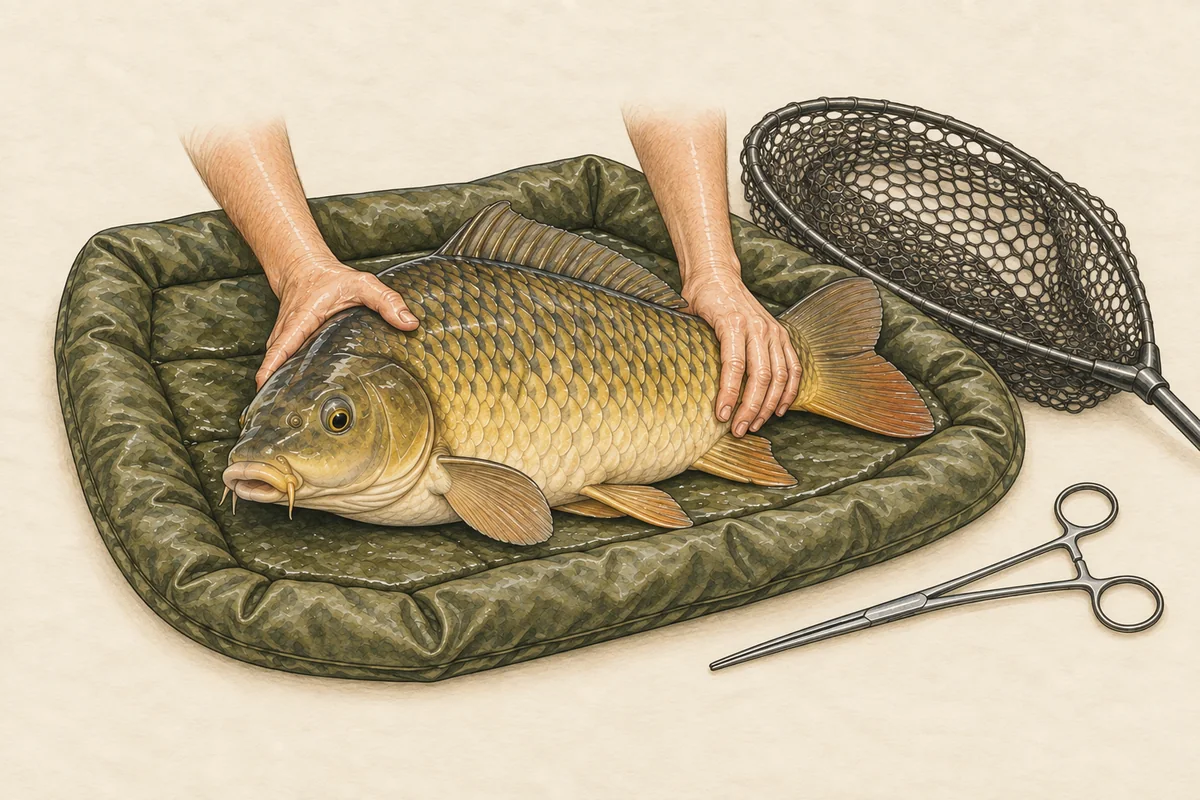
As a surface: sand, stones or boat carpets scrape the skin, as the review writes about abrasion. A wet mat is the substitute when the fish has to be laid down on land.
Removing the hook
The Austrian environment agency advises unhooking fish while they are still in the water so that protected fish return as unharmed as possible. Blinker requires this in principle for undersized fish and fish caught in the closed season (Schonzeit). According to the review, forceps and unhooking aids are mainly useful with teeth and deeply lodged hooks; choice and handling are covered under Disgorger.
If the hook sits deep, for example in the gullet, cutting the hooklength can be better than pulling it out. The review cites an experiment with sunfish. After 48 hours, 40 per cent of the fish whose hook was removed had died. With a cut hooklength it was 9 per cent, and 46 per cent expelled the hook themselves. A field trial by New South Wales fisheries research with silver perch reached the same conclusion: of the deeply hooked fish, over 70 per cent died when the hook was pulled out, with a cut line it was 18 per cent after one week. Whether such a fish may be kept is governed by law, see Releasing fish.
On hook design the picture is not clear-cut. The review sees shorter unhooking times and less injury with barbless hooks, but little evidence of lower mortality. It also names fewer hooks of a suitable size, for example a single hook instead of a treble, as a way to fewer injuries. Petri-Heil reports from an analysis of studies that barbed hooks do markedly more damage.
Lip grip: Blinker reports on two experiments with bonefish and barramundi in which 80 to 100 per cent of the fish suffered injuries to the lower jaw, from bruising to split jaws. The review advises against it if the fish is to go back into the water.
Measuring, weighing, photographing and the time in the air
There is no safe maximum time. An experiment with zander under 50 centimetres at around 10 degrees water temperature: researchers chased the fish for 120 seconds and then held them in the air for 0, 60, 120 or 240 seconds. Statistically, mortality and growth did not differ significantly. Without air time, however, mortality was lowest, and the authors advise avoiding it with zander that are to be released.
So measuring is done in the water or on a damp measuring mat, see Tape measure and measuring mat. The review describes how to weigh in the net: grip the net at the top, zero the scales to the weight of the net. As for photos, Petri-Heil says it is better to forgo them altogether with fish that are released; otherwise hold the fish briefly, level and just above the water, not above the ground. Waiting in a retainer sack does not help either: carp showed more stress in it, with longer duration more fin damage, but no deaths.
Warm water
Petri-Heil cites an analysis showing that in some salmonids mortality rises from 0 per cent at 8 degrees water temperature to over 80 per cent at 20 degrees; oxygen dissolves less well in warm water. The Austrian environment agency lists not fishing at high water temperatures or very low flow as a voluntary measure. Background is under Water temperature and oxygen.
Common mistakes
- Lay the fish on sand, stones, a boat carpet or a dry mat.
- Grab it with dry hands or rough gloves.
- Use a net with knots, wide mesh or one that is too small.
- Lift the fish vertically, hanging by the jaw or gills.
- Look for forceps and tape measure only at the moment of the catch.
- Pull a deeply lodged hook out by force instead of cutting the hooklength.
- Do measuring, weighing and photo one after the other in the air.
When the fish stays
If the fish is to be kept, the Austrian environment agency recommends: land it in the net, hold it down on the ground, stun it with a firm blow just behind the eyes, turn it on its side and kill it with a gill cut or a stab to the heart. The procedure with the check is under Stunning and killing fish. The basis is § 1 Animal Welfare Act (Tierschutzgesetz): nobody may cause an animal pain, suffering or harm without a reasonable cause.
On the figures: The values come from experiments with particular species such as zander, sunfish, silver perch, bonefish and barramundi. They show orders of magnitude, not a guarantee for the individual fish at your water.
Frequently asked questions
Does the landing net have to be rubberised?
In Hamburg, yes: the authority prescribes rubberised nets and unhooking mats. In other states it depends on the fishing regulations and permit conditions. Rubberised, knotless nets are regarded as the gentlest anyway.
Are landing gloves better than wet hands?
The review found no evidence for that, in one experiment slime loss was similar. Blinker takes a critical view of rough gloves and recommends them only where there is a risk of injury from hooks or teeth.
How long may the fish be out of the water?
None of the sources gives a fixed time. With zander, mortality was lowest without air time, and even short periods of 60 to 240 seconds showed no significant difference. Keep the time as short as possible.
What do I do if the hook sits deep?
Cut the hooklength instead of pulling on the hook. In the experiment with sunfish, 9 instead of 40 per cent of the fish died that way. Note what your state law prescribes for keeping or releasing.
Related
- Fishing landing net: net, size and handle in detail
- Unhooking mat: lay down softly, unhook gently
- Disgorger: removing hooks quickly and gently
- Tape measure and measuring mat: measure the minimum size reliably
- Releasing fish: legal position and handling when letting a fish go
- Stunning and killing fish: procedure under the Animal Welfare Act
- Water temperature and oxygen: why warmth stresses the fish
- Fishing permit and water map: which tackle requirements apply at the water
- Gaff and landing hook: what is allowed and what is not
Sources
- Fisheries Research: Best practices for catch-and-release recreational fisheries, angling tools and tactics (Übersichtsarbeit 2016: Kampfdauer, Netzmaterial, Kescher im Wasser, Handschuhe, Sonnencreme, Kiefergreifer, senkrechtes Hängen, Tiefsitzer, Widerhaken, Wiegen im Netz, Hälterung)
- Blinker: Fische landen, Kescher, Lip-Grip und Co. (Netzmaterial, Maschenweite, flacher Boden, Landehandschuhe, waagerechtes Heben, Matte, Abhaken im Wasser, Kiefergreifer-Verletzungen)
- Fisheries Management and Ecology: Luftzeit und Sterblichkeit untermaßiger Zander bei niedriger Wassertemperatur (Versuch mit 0, 60, 120 und 240 Sekunden an der Luft)
- Freie und Hansestadt Hamburg, Fachbehörde: Angelrecht (Unterfangkescher, gummierte Kescher und Abhakmatten vorgeschrieben)
- Land Mecklenburg-Vorpommern: Angeln in MV, aber richtig, Faltblatt (Fische nur mit nassen Händen anfassen)
- Umweltbundesamt Österreich: Nachhaltig fischen, Tipps für Angler:innen (nasse Hände, Abhaken im Wasser, knotenlose Kescher, Gerät, Wassertemperatur, Ablauf der Entnahme)
- Petri-Heil: Vom Haken zurück ins Wasser (Temperatur und Sterblichkeit, Widerhaken, Fotos, Heben am Köder)
- Tierschutzgesetz § 1 (Verbot vermeidbarer Schmerzen, Leiden und Schäden)
- Asian Fisheries Science: Hakensterblichkeit zurückgesetzter Silberbarsche in New South Wales (Fischereiforschung NSW 2005, Schnur durchtrennen bei tief sitzendem Haken)
Text AI-assisted, drawing AI-generated. Sources opened and checked in October 2026; no graphics taken from the sources.
All information is indicative, without guarantee, and does not replace legal advice. What counts is the law of your federal state and the water regulations. Study values come from experiments with particular species and cannot be transferred to every fish.