
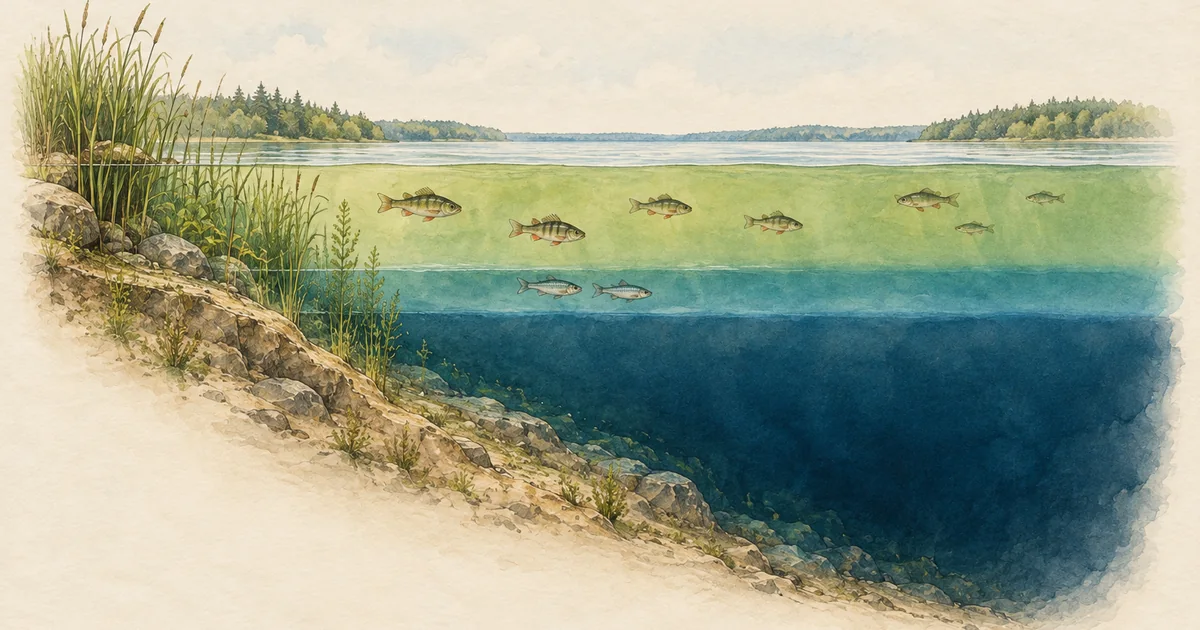
Knowledge · Waters and fish behaviour
Water temperature and oxygen
The water temperature determines how much oxygen is dissolved in the water and how active fish are. For most species, stress begins long before the temperature becomes lethal, and in summer deep, nutrient-rich lakes often lack oxygen below the thermocline.
Fish follow the water temperature
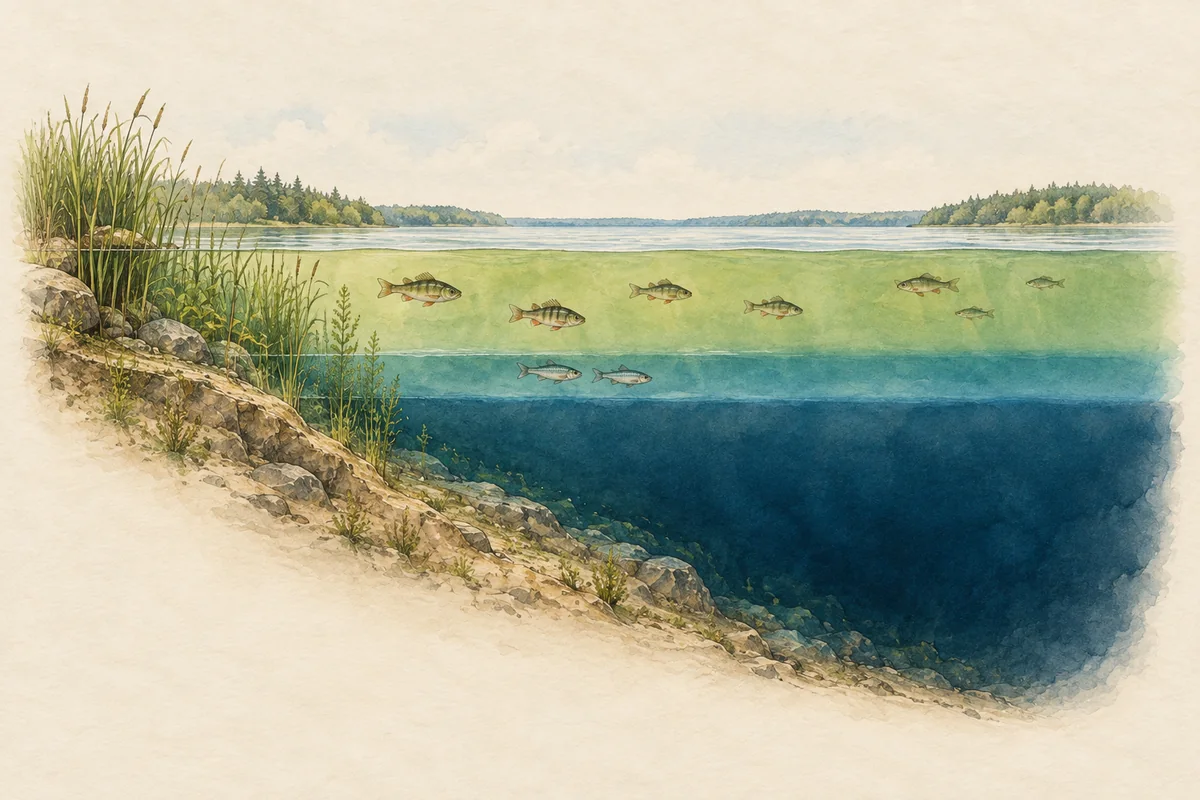
Fish are cold-blooded, so their body temperature follows the water. Metabolism, hunger and swimming activity therefore depend on water temperature. According to the Landesanglerverband Brandenburg (LAVB), fish show activity and hunger only when several requirements are met at the same time: temperature, dissolved oxygen and pH. Which values suit them differs by species and age.
The LAVB gives examples. Trout are active and hungry at 12 to 18 °C, and stressed and off their feed at higher temperatures. For carp, more than 20 °C counts as favourable for feeding. Burbot are hungriest in the depths of winter. For pike the catch rate falls with rising water temperature, and below-average catches are to be expected during heatwaves.
Temperature ranges of important target fish
How far the range extends upwards is shown by an expert report from the Leibniz-Institut für Gewässerökologie und Binnenfischerei for the Bund/Länder-Arbeitsgemeinschaft Wasser (LAWA/IGB). According to it, stress sets in even before lethal temperatures: breathing then costs more energy than the food provides, and the animals waste away. The last column gives the upper lethal temperature of adults, above which death inevitably occurs. The other values come from literature reviews and magazines; the source is given in brackets.
| Species | Favourable range | Spawning | Upper lethal temperature |
|---|---|---|---|
| Brown trout | 12 to 18 °C (LAVB), 10 to 17,6 °C (NRW) | 1 to 13 °C (NRW) | 27 °C |
| Pike | catch rate falls between 14 and 24 °C (LAVB) | 5 to 10 °C (NRW) | 34 °C |
| Zander | no reliable figure found | 12 to 15 °C (Blinker), 10 to 14 °C (FishBase) | 35 °C |
| Perch | tolerates 8 to 27 °C (NRW) | 7 to 14 °C (NRW) | 35 °C |
| Carp | over 20 °C (LAVB), 15 to 33 °C (NRW) | 17 to 20 °C (NRW) | 41 °C |
| Tench | 12 to 26 °C (Wikipedia) | 19 to 25 °C (NRW), 18 to 20 °C (Blinker) | 39 °C |
| Roach | 8 to 25 °C (NRW) | 10 to 18 °C (NRW) | 38 °C |
| Eel | 8 to 30 °C, avoided below that (NRW) | in the sea, not in our waters | 39 °C |
| Wels catfish | growth 25 to 27 °C (DAFV), no feeding below 4 to 7 °C (Blinker) | over 18 °C (DAFV) | 35 °C |
NRW stands for the temperature profiles of the Flussgebiete NRW portal, a draft that evaluates figures from the literature. It gives the range in which most figures overlap, and for adults sometimes only the tolerance range. The values are guide values, and fish also feed outside these ranges.
The sources measure different things (activity, growth, survival, spawning) and partly contradict each other. For bream, the lethal temperature starts at 28 °C according to the NRW draft, but only at 36 °C according to LAWA/IGB. Grayling (26 °C) and brown trout (27 °C) tolerate the least warmth. According to the report, many species still tolerate up to 30 °C as juveniles and as adults; the spawning season and egg development are the most sensitive stages.
Oxygen: warm water holds less
Dissolved oxygen is given in milligrams per litre (mg/l). It enters the water through the surface and through the photosynthesis of aquatic plants and algae. Consumers are fish, crayfish and other animals; the decomposition of dead organisms uses up especially a lot. As temperature rises, solubility falls, writes the Lower Saxony Water Management, Coastal Defence and Nature Conservation Agency (NLWKN). An example from its parameter sheet: at the Verden monitoring station the concentration is about 7 to 7.5 mg/l in the summer half-year and 11.45 to 11.7 mg/l in winter.
At 4 mg/l and below, fish kills can occur according to the NLWKN. The surface waters ordinance sets no fixed legal limit; assessments use guide values by water type. The Landesamt für Umwelt Bayern (LfU) considers it harmful for lake trout, whitefish and char when the content at 20 °C falls from an average of 8 to below 5 mg/l. According to Blinker (article on the thermocline), most fish cope well with more than 6 mg/l, and trout need more than carp. How current brings in oxygen is explained on the page Reading the current.
Oxygen per degree: the saturation table
The maximum amount of oxygen water can take up is called the saturation value. Temperature shifts it the most; salty water also takes up less (Universität Rostock, Biologische Station Zingst). Values at full saturation, converted from ml/l using the factor of 1,428 given there.
| Water temperature | Fresh water | Brackish water, salinity 8 PSU |
|---|---|---|
| 0 °C | 14,6 mg/l | 13,8 mg/l |
| 5 °C | 12,8 mg/l | 12,1 mg/l |
| 10 °C | 11,3 mg/l | 10,7 mg/l |
| 15 °C | 10,1 mg/l | 9,6 mg/l |
| 20 °C | 9,1 mg/l | 8,7 mg/l |
| 25 °C | 8,2 mg/l | 7,9 mg/l |
Christian Wolter of the IGB gives almost the same figures for 10, 20 and 25 °C. At 25 °C even fully saturated water is only just over 4 mg/l above the NLWKN threshold at which fish kills become possible. Stress often starts earlier: for the burbot Wolter gives a figure as low as 20 °C.
In the water, according to the Universität Rostock, photosynthesis and respiration often run faster than exchange with the air can balance out. According to Wolter, saturation falls steadily at night and reaches its lowest point shortly before sunrise. Small still waters then lack the input from moving water, whereas in a near-natural river, current, dead wood and stones mix in oxygen even at night.
The saturation table is therefore an upper limit, not a measured value for your own fishing spot.
Layering in the lake
According to the LfU, lakes in our latitudes are mostly dimictic: the water circulates fully twice a year, in spring and autumn. In between, deep standing waters become layered because water has different densities at different temperatures. It is densest at 4 °C, as the Charlottenburg-Wilmersdorf district office in Berlin explains; this is why a lake freezes from the top. In summer there are three storeys:
- Epilimnion: the warm surface water. According to the LfU, only this layer circulates in summer.
- Metalimnion: the thermocline, in which the temperature drops sharply.
- Hypolimnion: the cold deep water below.
Shallow lakes behave differently. Blinker describes waters under four to five metres deep that the wind keeps mixing. There the oxygen stays spread through all depths, and fish can hold anywhere. Where wind does not turn the water over, even shallow lakes sometimes become layered again.
Low or high in nutrients
Whether any oxygen is left below the thermocline depends on nutrient content. In a nutrient-poor (oligotrophic) lake, according to the LfU, there is still enough oxygen at depth at the end of summer. In a nutrient-rich (eutrophic) lake the hypolimnion becomes very low in oxygen in summer, while the epilimnion can even be supersaturated through photosynthesis. With over-fertilisation (hypertrophic), the oxygen at depth is largely used up by the end of summer, and fish kills can occur.
For anglers this means, according to Blinker: in a classic whitefish lake, whitefish sit below the thermocline in summer, and even big pike hunt at these depths for a while. In a cloudy, nutrient-rich lake, by contrast, the thermocline can lie as shallow as five metres. A lure at six metres waits a very long time for a bite there, because the fish stay above.
The position of the thermocline can be measured. Blinker describes a temperature and depth gauge that you cast out like an artificial lure and let sink; it records the temperature every two metres. Very powerful echo sounders also show the layer. Anglers report that they present one lure a metre above the thermocline and one at its level. How weather and wind affect this is covered under Weather, air pressure and wind.
Heat, ponds and small waters
Small and shallow waters warm up fastest. The veterinary office of the Recklinghausen district (Merkblatt Fischteich im Sommer) describes the signs of oxygen shortage in a pond: affected fish look sluggish and gasp at the surface, or they stay where oxygen is still available, for example by a waterfall. The largest fish therefore get into trouble first, because they need the most oxygen.
The NLWKN expects hotter and drier summers to lead to critical oxygen levels more often in future. In summer, the breakdown of dead biomass uses up more oxygen. How to handle fish gently in warm water is explained on the page Releasing fish.
Winter and ice
In winter, according to the Charlottenburg-Wilmersdorf district office, fish adapt to temperatures between 0 and 4 degrees. Heartbeat, breathing, feeding and digestion are then greatly reduced, and the animals live off reserves. Under a closed ice cover the oxygen content can keep falling if there are too many fish, and rotting gases cannot escape. According to the district office, chopping ice holes achieved little and disturbed the fish in their winter rest. More on the method is under Ice fishing, on safety under Walking on ice.
Common mistakes
- Reading the upper lethal temperature as a comfort value. According to the LAWA/IGB report, stress begins long before.
- Fishing below the thermocline in a nutrient-rich lake because the water is cool there. Oxygen is often missing there.
- Treating every lake alike. Shallow lakes mostly do not stratify, deep ones almost always do.
- Overlooking warning signs: sluggish fish at the surface point to oxygen shortage.
Note: the figures on this page are example values from individual reports, monitoring stations and lakes. The depth of the thermocline differs from lake to lake and from year to year, so there is no blanket figure.
Frequently asked questions
At what water temperature does it become critical for fish?
That depends on the species. According to the LAVB, trout are active at 12 to 18 °C and stressed above that. According to LAWA/IGB, the upper lethal temperature is 27 °C for brown trout, 34 °C for pike and 41 °C for carp. Stress begins earlier.
How much oxygen do fish need at minimum?
The NLWKN gives 4 mg/l and below as the range in which fish kills are possible. For lake trout, whitefish and char, the LfU Bayern already considers values below 5 mg/l harmful. According to Blinker, most fish cope with more than 6 mg/l.
How much oxygen does water contain at 20 degrees?
Fully saturated fresh water holds around 9 mg/l at 20 °C, brackish water with a salinity of 8 PSU about 8,7 mg/l. In the water itself the value can be higher or lower.
Why are there sometimes no fish below the thermocline in summer?
In summer the deep water does not mix with the surface water. In nutrient-rich lakes, the breakdown of sunken algae and other organisms uses up the oxygen there. The fish are then left with only the water above the thermocline.
How do I find the thermocline in a lake?
Blinker describes a temperature and depth gauge that you cast out and let sink. It measures the temperature every two metres. A very powerful echo sounder can also show the layer.
Related
- The year at the water: how temperature and layering change through the seasons
- Fish zones in a river: why cool upper reaches have different species from warm lower reaches
- Reading the current: where water takes up oxygen and where fish hold
- What fish eat: what plankton and plants have to do with oxygen
- Weather, air pressure and wind: what weather changes do at the water
- Fishing a lake: shore zones, depths and structure in still water
- Releasing fish: gentle handling when the water is warm
- Catch calendar: chances of a catch by species and month
Sources
- Landesanglerverband Brandenburg, Beitrag des Instituts für Binnenfischerei: Beeinflusst das Wetter den Fangerfolg? (Temperaturansprüche von Forelle, Karpfen, Quappe, Hecht, Fangrate)
- Leibniz-Institut für Gewässerökologie und Binnenfischerei für die LAWA: Temperaturempfindlichkeiten der Fischgemeinschaften, Abschlussbericht 2021 (Stress vor der Letaltemperatur, obere Letaltemperaturen aller Arten der Tabelle)
- NLWKN Niedersachsen: Parameterblatt Sauerstoff 2021 (Löslichkeit, Messwerte Sommer und Winter, 4 mg/l)
- Landesamt für Umwelt Bayern: Der See im Jahreszeitenzyklus (Zirkulation, Schichten, Sauerstoffwerte für Salmoniden und Renken)
- Landesamt für Umwelt Bayern: Ökosystem See, Lebensräume (Sauerstoff in oligotrophen, eutrophen und hypertrophen Seen)
- Bezirksamt Charlottenburg-Wilmersdorf von Berlin: Fische im Winter (Dichte bei 4 Grad, Winterruhe, Sauerstoff unter Eis)
- Kreis Recklinghausen, Veterinärwesen: Der Fischteich in der Sommerhitze (Anzeichen von Sauerstoffmangel)
- Blinker: So beeinflusst die Sprungschicht das Angeln (flache und tiefe Seen, Messen der Sprungschicht, Praxis)
- Universität Rostock, Biologische Station Zingst: Arbeitsanweisung Sauerstoffsättigung (2016) (Sättigungswerte nach Temperatur und Salzgehalt, Über- und Untersättigung)
- Christian Wolter (IGB): Temperaturtoleranz einheimischer Fischarten der unteren Oder, Nationalpark-Jahrbuch Unteres Odertal 15 (Sauerstoff bei Sättigung, Minimum vor Sonnenaufgang, Quappe)
- Flussgebiete NRW: Temperatur-Steckbriefe Fischarten, Entwurf (Laich- und Vorzugsbereiche, Toleranz)
- Deutscher Angelfischerverband: Fisch des Jahres 2026, Europäischer Wels (Broschüre) (Laichtemperatur, Wachstumsoptimum)
- Blinker: Steckbrief Wels (Nahrungsaufnahme bei Kälte)
- Blinker: Steckbrief Zander (Laichtemperatur)
- Blinker: Steckbrief Schleie (Laichtemperatur)
- FishBase: Sander lucioperca (Laichtemperatur Zander)
- Wikipedia: Schleie (günstiger Temperaturbereich)
Text AI-assisted, drawing AI-generated. Sources opened and checked in October and November 2026, no graphics taken from the sources.
All information is guidance without guarantee. Temperature and oxygen values come from individual reports, monitoring stations and magazine articles and do not apply to every water.