
Knowledge · Waters and fish behaviour
Fish food
The food of fish is whatever a water provides: plankton in open water, small creatures on the bottom, insects at the surface and other fish. What a species eats changes with its age and with the season. You can base your choice of bait on that.
The food chain in a water
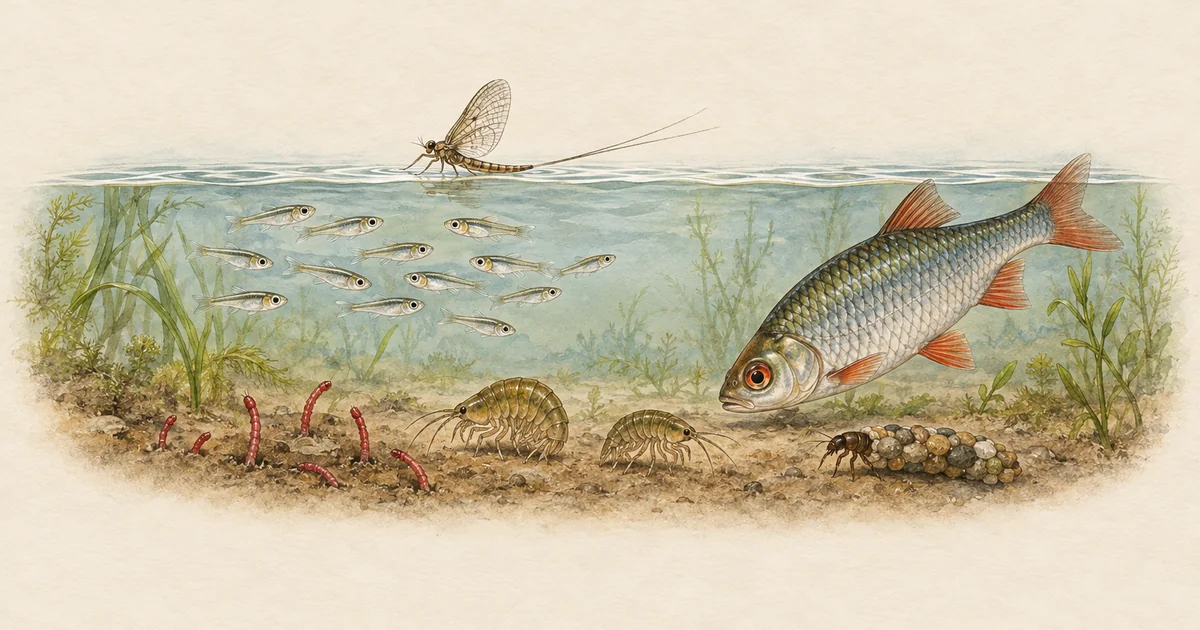
At the start are algae. Together with cyanobacteria they float in open water as phytoplankton and feed the zooplankton, in fresh water mostly rotifers and small crustaceans. Many fish in turn live on zooplankton (Kompaktlexikon der Biologie).
The second food source lies on the bottom. That is where the macrozoobenthos lives: invertebrates visible to the naked eye, such as worms, leeches, mussels, snails, crustaceans and water insects. They process fallen leaves, plant remains and algal growth, and themselves serve fish as food (International Commission for the Protection of Lake Constance).
Coarse fish eat plankton, insects and plants and sit below the predatory fish in the food chain (Lexikon der Ernährung). A clean chain is rare; usually the species are linked into a food web. From level to level, a lot of energy is lost as waste and heat (Lexikon der Biologie). Predatory fish are therefore usually less numerous than their prey.
The most important food animals
The small animals that fish live on are called fish food organisms in fisheries. Which species eats them is listed in the fish encyclopaedia of the Landesfischereiverband Bayern (LFV).
- Zooplankton: Water fleas and copepods are tiny crustaceans that float in open water. Young perch and zander live on zooplankton, young ide eat animal and plant plankton, and pelagic whitefish filter zooplankton from the water.
- Midge larvae: The larvae of most species live in the mud of still and slow-flowing waters. The board on the fish trail at the Rothsee gives up to 5000 animals per square metre (Landratsamt Roth). They are very important as fish food (Kompaktlexikon der Biologie).
- Mayfly larvae: The mayfly spends most of its life as a larva in the water. Species of strong currents are flat in build, others burrow through the mud.
- Stonefly larvae: They need a lot of oxygen and therefore live mainly in cold, fast-flowing streams. There they are an important food for fish.
- Caddis larvae: Most build themselves a case from saliva, grains of sand and bits of wood. Some carry it with them, others anchor it to the bottom.
- Freshwater shrimps and water lice: You find the freshwater shrimp in almost every stream and smaller river in Germany, a related species in larger rivers and lakes. According to the Lexikon der Biologie the water louse grows up to 16 millimetres long and also copes in nutrient-rich, polluted pools, ponds and rivers. Both break down fallen leaves. Brown trout eat freshwater shrimps, young burbot water lice.
- Snails and mussels: Snails rasp off algal growth and plants, mussels filter their food from the water. Roach, bream and barbel eat both.
- Worms: Tubifex worms sit in the top layer of mud and eat the organic material that decays there.
- Insects landing on the water: This is what insects are called that fish take from the water surface. The bleak waits just below the surface for them, and brown trout, grayling and rudd also take them.
- Spawn and fish fry: Young perch eat fish spawn and fry. The LFV names roach and bleak as important food fish for predatory fish.
Coarse fish, predatory fish, omnivores
The classification helps with sorting, but rarely holds for a whole fish life. Depending on species and stage of development, fish have very different feeding habits, writes the Leibniz Institute of Freshwater Ecology and Inland Fisheries. For many species the LFV fish encyclopaedia gives two menus.
| Species | As a young fish | Later |
|---|---|---|
| Perch | zooplankton, water insects, bottom animals, spawn and fry | mainly fish, including its own kind |
| Zander | zooplankton, small bottom animals | mainly slender fish |
| Chub | small invertebrates, plants | also fish, crustaceans, amphibians |
| Asp | small animals | fish, occasionally frogs and mice |
In many lakes, the change in perch happens in two steps. According to a dissertation at the University of Cologne, the newly hatched perch lives on zooplankton and switches to bottom animals at the end of its first or second year. At two to three years, at about 15 centimetres in length, it becomes a fish eater. In some lakes it skips the middle stage: fish were found in the stomachs of young perch only 28 millimetres long.
The chub counts as a coarse fish and yet eats almost everything; the magazine Blinker calls it an omnivore. The asp is a toothless member of the carp family and, according to the LFV, still a true predator. Its main food is, according to the Federal Agency for Nature Conservation, the bleak. For the eel the LFV fish encyclopaedia distinguishes two types: narrow-headed eels eat worms, snails, small crustaceans and insect larvae, while broad-headed eels hunt mostly small fish and crustaceans.
Food through the year
The year starts with the algae. They grow in early spring. Because their eaters are still scarce then, a spring bloom can occur. Then the zooplankton catches up, multiplies strongly and filters the water clear. This phase is called the clear-water stage (Commission for the Protection of Lake Constance). If your lake turns noticeably clear after the green phase, a lot of zooplankton is about.
How much a fish eats depends on the water temperature. When it gets too cold for a species, its circulation slows, it needs less energy and has less appetite (Landesanglerverband Brandenburg). The carp feeds and grows mainly in the summer half of the year (Bayerische Landesanstalt für Landwirtschaft). Water above 20 degrees Celsius increases its food intake, according to the Landesanglerverband. The chub, on the other hand, partly switches to plant food in summer when a lot of weed grows, according to Blinker, and then sometimes bites poorly.
According to the LFV fish encyclopaedia, bream spend the winter dormant in deep, sheltered spots, tench buried in the mud, and the wels catfish also rests without feeding. The burbot does the opposite: it feeds mainly in the cold season and takes longer breaks in summer. Temperature and layering through the year are shown on the page The year at the water.
At sea
On the North Sea and Baltic Sea the same applies with different animals. Plaice live mainly on thin-shelled mussels and bristle worms, flounders add crustaceans and small fish (Thünen-Institut, Fischbestände online). Bristle worms include the lugworm (Wattwurm) and the ragworm (Seeringelwurm). The North Sea shrimp, too, is eaten in large numbers by fish, birds and crabs (Landesportal Schleswig-Holstein).
The cod lives near the bottom and as a predator eats fish and invertebrate bottom animals. Sand eels are rich in fat and therefore an important food for many predatory fish. The herring eats mostly small crustaceans and is itself prey for many sea animals.
What this means for your choice of bait
A natural bait is a piece of this food on the hook or looks like it. Before baiting up, think about what the species eats at its size and in which layer of water it takes it.
- On the bottom: Bream, tench, barbel and roach look for bottom animals. Worms and maggots and larvae suit this, fished with bottom fishing or feeder fishing.
- At the surface: For fish that rise to insects landing on the water, insects or the dry fly are an option. The nymph imitates the larval stages of water insects (Wikipedia: Fliegenfischen).
- Fish eaters: Pike, zander, large perch and asp hunt fish. You offer them a dead deadbait or an imitation such as streamers and soft plastic (shad).
- Snails and crustaceans: Eel and barbel eat snails, eel and large chub also crustaceans. See also: snails and crustaceans and mussels.
- At the sea: Lugworm and ragworm are bristle worms of the kind flatfish eat. Fish strips match the fish food of the predators.
Note: Which baits are allowed and which species are protected is set by your federal state (Bundesland), the fishing permit (Erlaubnisschein) and the water rules. More on this under Fishing permit and water map and Closed season and minimum size explained.
Frequently asked questions
What do fish eat in a lake?
Plankton, bottom animals such as insect larvae, snails and worms, insects from the surface and other fish. Which of these a species takes depends on its age.
At what size does a perch eat fish?
In many lakes at two to three years and about 15 centimetres in length, according to a dissertation at the University of Cologne. In some lakes perch switch to fish in their first year.
What are insects landing on the water?
Insects that fish eat from the water surface. These can be water insects that land on the water to lay eggs, and also land insects such as grasshoppers, ants or beetles.
Related
- Natural animal baits and all baits at a glance.
- Water temperature and oxygen: which species like it cool or warm.
- Fly fishing: the method that imitates insects and their larvae.
- Catch calendar: catch chances by species and month.
- Mouth position: how to tell from it in which layer a species feeds.
Sources
- Landesfischereiverband Bayern: Fischlexikon (Nahrung und Lebensweise der Fischarten).
- Spektrum, Lexikon der Biologie: Nahrungskette, Nahrungspyramide, Ernährungstypen in Gewässern, Eintagsfliegen, Steinfliegen, Köcherfliegen, Flohkrebse, Wasserassel, Schlammröhrenwürmer, Borstenwürmer, Nereidae, Seeringelwurm (Nahrungskette, Lebensweise der Nährtiere).
- Spektrum, Kompaktlexikon der Biologie: See, Plankton, Chironomidae, Wattwurm; Lexikon der Ernährung: Friedfische (Plankton als Nahrungsgrundlage, Zuckmückenlarven, Begriff Friedfisch).
- Landratsamt Roth: Fischlehrpfad am Rothsee, Tafel 2 „Fischnährtiere“ (PDF, 12 MB; Zuckmückenlarven, Kleinkrebse, Schnecken).
- Internationale Gewässerschutzkommission für den Bodensee: Datenblatt Makrozoobenthos, Datenblatt Plankton (Bodentiere als Fischnahrung, Klarwasserstadium).
- Universität zu Köln: Peter Beeck, Dissertation zum Flussbarsch, Zusammenfassung (Nahrungswechsel mit dem Alter).
- Leibniz-Institut für Gewässerökologie und Binnenfischerei: Naturnahe Gestaltung von Uferzonen an Baggerseen (Ernährung je nach Art und Entwicklungsstadium).
- Landesanglerverband Brandenburg: Beeinflusst das Wetter den Fangerfolg?; Bayerische Landesanstalt für Landwirtschaft: Merkblatt Karpfenteichwirtschaft (Temperatur und Nahrungsaufnahme).
- Bundesamt für Naturschutz: Artenporträt Rapfen; Blinker: Steckbrief Döbel (Hauptnahrung des Rapfens, Döbel als Allesfresser).
- Thünen-Institut, Fischbestände online: Plaice, Flunder, Dorsch, Sandaal, Hering (Nahrung der Meeresfische).
- Landesportal Schleswig-Holstein: Small Five des Weltnaturerbes (Nordseegarnele als Nahrung von Fischen).
- Wikipedia: Fliegenfischen (Begriff Anflugnahrung, Nymphe und Streamer; ergänzend).
Text AI-assisted, drawing AI-generated. Sources opened and checked in October 2026; no graphics taken from the sources.
All figures are guide values without guarantee. What fish eat depends on the water, the stock and the season.