
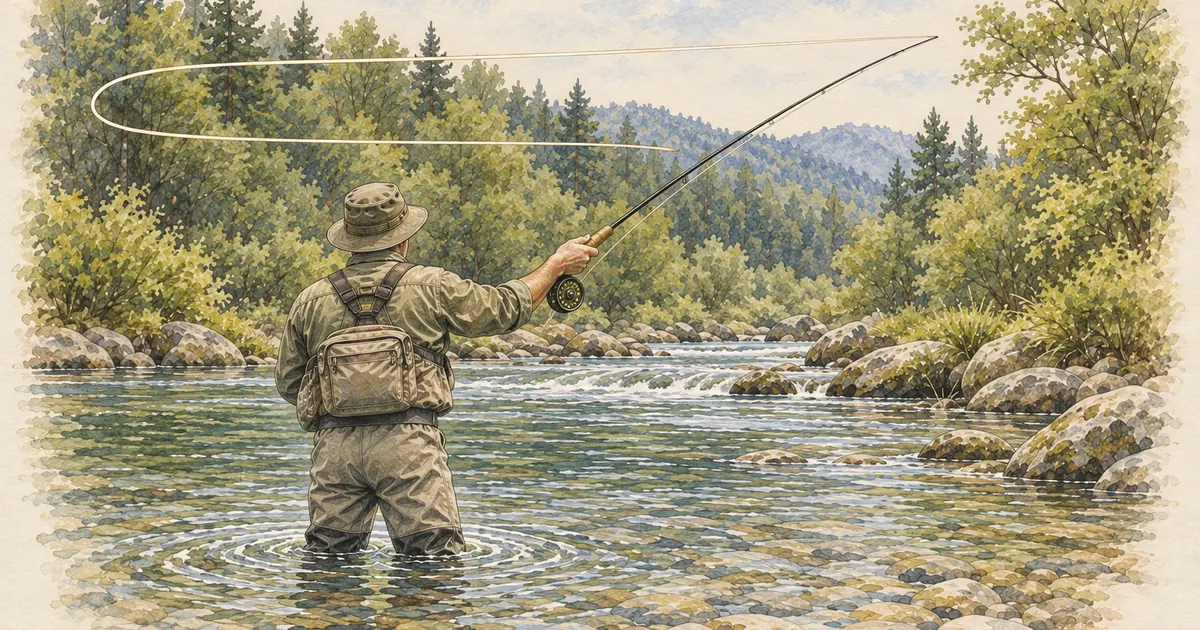
Knowledge · Fishing methods
Fly fishing
In fly fishing the line carries the casting weight, not the bait. The artificial fly weighs almost nothing and only flies along because the accelerated fly line pulls it. That is why you choose rod, line and reel as a set of the same class.
The principle

With most methods a lead, a float or a heavy lure weights the cast. In fly fishing it is the other way round: according to Wikipedia, the angler uses only the weight of the line to get a dry fly, wet fly, nymph or streamer to the target. In its training material the Landesfischereiverband Baden-Württemberg points out that the baits weigh only a few grams and the line therefore has a relatively high weight of its own. The rod accelerates the line, and the line pulls the leader and the fly after it.
The tackle has pages of its own: fly rod, fly line and fly reel. Here the subject is how you use it at the water.
The overhead cast
The overhead cast is the basis of the other casts. At the start the arm is bent and the rod tip points at the water. Then you lift the tip in one smooth movement and take it back and forward again. Wikipedia describes the stops by a clock face: the back cast ends at about 1 o’clock, the forward cast at 10 to 11 o’clock, then you lower the rod slowly to 9 o’clock (Fig. 2). The wrist opens, if at all, only after the stop. At the end the line must roll out completely, otherwise the fly does not land on target.
For more distance the line hand holds extra line ready in large loops. On the forward cast you let it go and the accelerated line pulls it out of your hand. With conventional tackle, according to Wikipedia, casting distances of up to 30 m are possible. Blinker advises having casting shown to you by a professional; fly-fishing schools and specialist shops offer courses.
Tackle in figures
The values come from articles in the magazine Blinker and are guide figures. As the line class number rises, the line gets heavier and the rod stronger.
- Rod: For dry fly, nymph and wet fly for trout, grayling, perch or whitefish, Blinker advises class 5. As a strong all-rounder the magazine names class 6 at 9 ft (270 cm); it shows its strength with weighted nymphs and small streamers. Anyone who mainly fishes streamers for pike, sea trout or at a trout lake is recommended class 8, and for pike a Blinker article names class 8 to 10.
- Line: According to Blinker, beginners fish a floating weight-forward line, so WF 5 F for the 5-weight rod. At the start it may be one class higher, which makes casting easier. Very wind-prone streamers, too, are often cast with one class more, according to Blinker.
- Leader: It tapers towards the tip, according to the training material of the Fischereiverein Löningen. Blinker advises beginners to use tapered monofilament leaders the length of the rod, so 270 cm for 9 ft, with a tip of 0.18 mm on the 5-weight rod and not less than 0.25 mm on the 8-weight. For streamers another Blinker article names lengths of three to four and a half metres, with 4.5 to 5 m as a starting point and a tip of 0.25 to 0.32 mm.
If the leader does not straighten in the cast, you shorten it in steps of 30 cm, according to Blinker. If you overdo the shortening, you feel the line slapping in the cast.
Match it properly. A rod with the wrong line casts badly. Choose rod, line and reel as a set of the same class.
Fly types and how to fish them
Flies are grouped by what they imitate and where they work. The details follow the training material of the Fischereiverein Löningen and Wikipedia.
| Type | Imitates | Where it works |
|---|---|---|
| Dry fly | adult insect | floats on the surface |
| Wet fly | dead insect | below the surface |
| Nymph | larva or rising insect | weighted, close to the bottom |
| Streamer | small fish, beetles | is stripped |
Dry fly
A dry fly floats because it is greased or made of a material such as deer hair, says Wikipedia. It catches mainly fish that take food falling onto the surface. For the LFV Bayern, such insects are part of the diet of brown trout and grayling. Material that soaks up a lot of water is not suitable for dry flies, according to Blinker. For short, precise casts with densely hackled flies in fast water, the leader may be stronger according to Blinker, 0.20 to 0.25 mm, because the tip hardly shows on the surface.
Nymph
A nymph is, according to Wikipedia, usually weighted with a gold head, tungsten bead or lead wire. Blinker gives the reason: salmonids take around 80 per cent of their insect food under water, mostly close to the bottom. The nymph therefore belongs close to the bottom. If its weight is not enough, you pinch a small split shot onto the leader about 20 cm in front of it. As a rule of thumb for leader length, Blinker gives the estimated water depth plus 50 per cent; at 1 m depth that would be 1.5 m.
The classic routine according to Blinker: a roll cast at an angle upstream, let the nymph drift towards you and take in the incoming line at the same speed. Otherwise the strike fizzles out on the slack line. A small strike indicator at the join to the leader shows the bite: it stops, jerks or pulls against the current. Then you lift the rod and tighten the line. In Czech nymphing you fish heavy nymphs on a short line close above the bottom. Wikipedia notes that some fly anglers no longer count this as fly fishing, because there the nymph provides the casting weight.
Streamer
A streamer is stripped, that is, pulled in with jerks of the line hand (Landesfischereiverband Baden-Württemberg). In small waters, according to Blinker, you should usually strip fast, because the fly is close to the fish anyway. For your first pike, Blinker describes shallow, still water up to 1.5 m deep: after casting, let the streamer sink for three to five seconds, then two fast pulls of 30 to 40 cm, a one-second pause, three brisk pulls. The pike often takes the streamer in the pause. Synthetic streamers are easier to cast because they take on no water. A predator trace is compulsory here too, see pike trace.
- Sinking: Once the streamer has landed on the water, wait three to five seconds so that it gets down.
- Two strips: With your line hand, strip it in twice, short and fast, about 30 to 40 centimetres each time.
- Pause: Hold still for a second. It is in this very pause that a following pike often strikes.
- Three strips: Then move the streamer on with three brisk strips.
Where the fish lie
Fish save energy. According to Blinker, trout-like fish prefer to stand close to the bottom, behind stones, flow breakers or at bank edges, because the water at the surface flows fastest. According to the LFV Bayern, the brown trout is faithful to its lie, defends its territory and needs richly structured watercourses with many hiding places. It describes the grayling as a fish of the open water that loves current. How to read currents is explained under Reading the current. A fly angler advises in Blinker to watch for two or three minutes before the first cast, until it is clear that the trout really is feeding.
Warm water. According to Blinker the brown trout’s optimum temperature is 8 to 16 °C, and it does not tolerate more than 20 °C for long. Playing and returning the fish then put extra strain on it.
Common mistakes
- Rod and line do not match. According to Blinker, the 5-weight rod needs a WF 5 F, the 8-weight a WF 8 F.
- The wrist opens before the stop (Wikipedia).
- The leader is too long or shortened too much: in the first case it does not straighten, in the second the line slaps (Blinker).
- With the nymph there is too much slack line on the water and the strike fizzles out (Blinker).
- The streamer is fished without pauses, although the pike often grabs in the pause (Blinker).
- Taking the first pike straight away in flowing water. Blinker advises beginners to start in shallow still water; the current makes it too complicated.
Rules at the water
Trout and grayling waters are often specially managed. Fisheries law is state law, and the water rules and fishing permit can prescribe baits, hook type and what you may take. Read them before your first cast: Fishing permit and water map, Closed season and minimum size, Catch calendar. According to the Löninger training material, hooks with no barb at all are called barbless hooks, and for fly hooks spear-point hooks. Whether you must use them is stated in the water rules. For wading, see Bank and waders.
Frequently asked questions
What does WF mean on fly lines?
WF stands for Weight Forward. The line is thicker towards the front. According to Wikipedia it is the most widespread today and easier for beginners to cast and to cast further; according to Blinker it also carries weighted flies well.
Why do I need no lead in fly fishing?
The casting weight is in the line. The fly weighs only a few grams and is pulled along by the accelerated line. If it should go deeper, a weighted nymph or a split shot on the leader helps.
Which rod class should I start with?
Blinker advises class 5 for dry fly and nymph for trout and grayling. A class 6 at 9 ft is the stronger all-rounder. Anyone casting streamers for pike or sea trout is better off with class 8.
Can I only catch trout with a fly?
No. Trout and grayling are the classic targets, but pike, chub, asp or perch can also be caught with suitable flies, provided the water rules allow it.
Related
- Fly rod: choosing line class, length and action
- Fly line: reading classes, profiles and sink rates
- Fly reel: backing, drag and spool
- Flies, fur and feather lures: dry fly, wet fly, nymph and streamer at a glance
- Fly tying: tools and accessories
- Knots for fly tackle: nail knot and perfection loop between fly line and leader, blood knot and surgeon’s knot for leader and tippet, Turle knot at the fly
- Reading the current: where fish lie behind stones and edges
- Bank and waders: standing safely in the water
- Returning a fish: unhooking gently and releasing
Sources
- Wikipedia: Fliegenfischen (Wurfprinzip, Zifferblatt, Weiten, Fliegentypen)
- Blinker: Fliegenfischen für Anfänger, die besten Geräte-Tipps (Rutenklassen, Schnur, Vorfach für Einsteiger)
- Blinker: So fangen Sie den Hecht mit Streamer und Fliegenrute (Gewässer, Rute, Führung beim Hechtstreamer)
- Blinker: Nymphenfischen, so setzen Sie Bissanzeiger ein (Nymphe am Grund, Schrotblei, Rollwurf, Schnur aufnehmen)
- Blinker: Fliegenfischen mit Bissanzeiger, welche Nymphtechnik passt? (Nahrungsaufnahme am Grund, Standplätze, Vorfachlänge, Czech-Nymphing)
- Blinker: Angeln mit Streamer, so fängst du kapitale Forellen (Streamerklassen, Vorfachlänge und Spitze)
- Blinker: Erfolg mit Trockenfliegen am See (Material und Vorfachstärke bei Trockenfliegen)
- Blinker: Bachforelle im Steckbrief (Temperaturansprüche der Bachforelle)
- Landesfischereiverband Bayern: Fischlexikon (Lebensweise und Nahrung von Bachforelle und Äsche)
- Fischereiverein Löningen: Gerätekunde (Lehrmaterial zur Fischerprüfung) (Fliegentypen, Vorfach, Schonhaken)
- Landesfischereiverband Baden-Württemberg: Gerätekunde, Arbeitsblätter zur Fischerprüfung (Fliegenschnur als Wurfgewicht, Streamer und Strippen)
Text AI-assisted, drawings AI-generated. Sources opened and checked in October 2026; no graphics taken from the sources.
All information is a guide only and given without guarantee. Follow the water rules of the water concerned, especially on salmonid stretches.