
Knowledge · Tackle
Bite indicators: Electronic, mechanical, bell
A bite indicator tells you when bank fishing what is happening at a bait you cannot see on the bottom. It comes as a bleeping unit with a sensor, as a bell or glow stick on the tip, and as a weight hanging in the line. Which one suits depends on the water, target fish and time of day.
At the front on the tip or at the back on the line
Every bite indicator works on the same principle: the fish takes the bait, swims off and pulls on the line as it goes. That is how the tackle guide for the angling exam (Fischerprüfung) of the Fischereiverein Löningen explains it. Touch legering, where the line lies between thumb and forefinger, works entirely without a device.
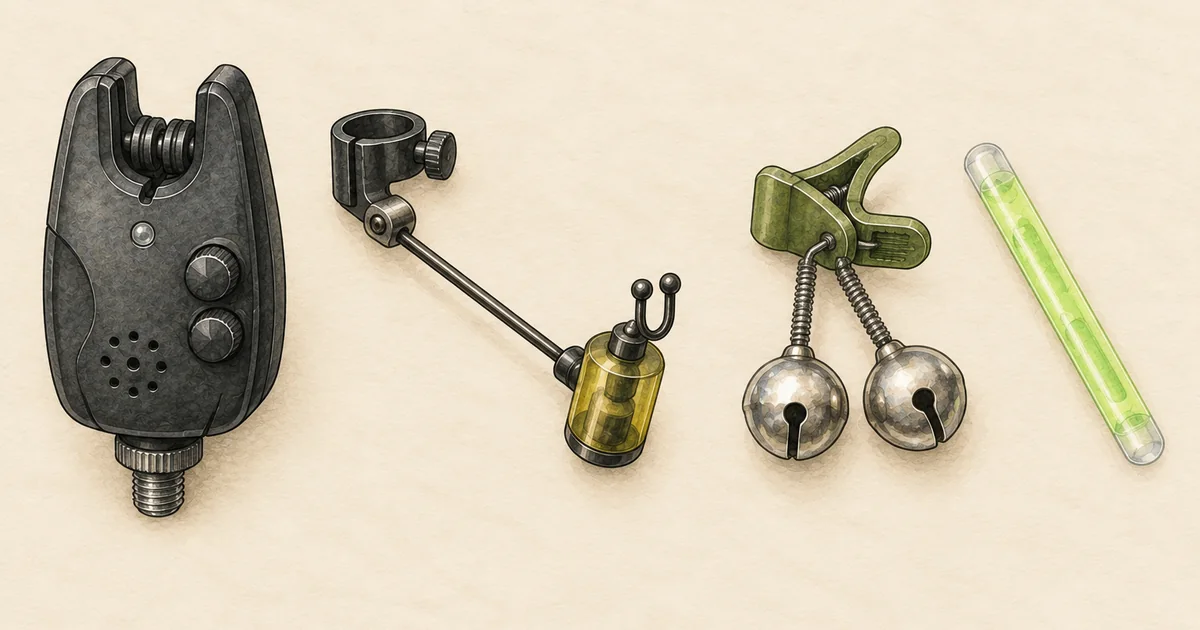
Float, swing tip and quiver tip sit at the front of the rod, bell and glow stick at its tip. The electronic alarm, swinger, hanging indicator and monkey climber, on the other hand, sit at the back, between the reel and the first rings. Löningen counts the monkey climber and the electronic alarm among the line indicators and recommends them for still waters. The front indicators are considered much more sensitive (Fisch & Fang). With the rear ones the line first slides through the rings, and this friction can make a cautious fish spit out the bait.
Electronic bite alarm: roller, sound and light
The unit is also the front rest for the rod (Löningen). According to Rute & Rolle it fits the standard thread of banksticks, as do cross bars for two or three rods, the buzzer bars. On stone, concrete or jetties you mount the alarms on a rod pod.
Inside the unit the line runs over a small roller monitored by a sensor. When it turns, the alarm bleeps and lights up. Simple units have only a switch, better ones let you adjust volume, pitch and sensitivity. When night fishing for pike you also come across a wireless alarm with a receiver in the bivvy. Löningen also mentions alarms built straight into the reel.
The unit can only signal if the line is free to run: Löningen requires the bail arm open, a freespool reel is more convenient. When bank fishing with the unit, besides carp, bream, tench, eel, trout, pike and zander come into question. According to Blinker the unit was invented in England in the early 1950s.
Swinger, hanging indicator and monkey climber
So that the electronic indicator also picks up fine twitches and drop-backs, almost always something is added that keeps the line under tension behind it. Bank anglers combine the audible indicator with almost any visual one.
- Swinger and hanger hang in the line behind the electronic indicator. The swinger carries a sliding weight with which you adjust the tension to wind and current (Fisch & Fang). The page Swinger and hanger explains the designs.
- Hanging indicator: a plastic ring between two rod rings that rises or drops. It stays on the line while playing the fish, so Blinker advises against it on rods with delicate rings and calls it prone to wind. According to Rute & Rolle it should dangle roughly halfway between the rod and the ground, so that it has room to move up and down.
- Monkey climber: a plastic body on a metal rod. When a fish pulls line, it climbs up, tips over at the end and releases the line. It works without sound, also indicates in wind and is only suitable for passively presented baits. Anglers use it with self-hooking rigs, also for bream, tench, barbel and chub (Fisch & Fang).
Bell, eel bell and glow stick on the tip
By day the rod tip gives away the bite by trembling or a deflection, in the dark you cannot see it. The tackle guide of the Landesfischereiverband Baden-Württemberg names three solutions: a bell or glow stick on the tip, or an electric bite alarm. Attaching and handling the light is covered under Glow sticks, setting up the rod under Bottom rod.
The eel bell belongs right at the top, on the tip. Halfway down the rod, where it is easier to grab in the dark, it only signals violent bites. Clip-on bells come off quickly, screw-on ones do not fall off when casting. When several rods stand side by side, bells with different sounds or an extra glow stick show which tip has moved.
One eel angler describes his set-up: rods angled up at about 40 degrees, the line so tight that the tip bends slightly, bail arm closed. If the bell only rings softly, he lowers the tip and strikes only at the second ring. The drawback: at the bell the fish feels resistance early and cannot take line.
Telling drop-backs from runs
On a run the fish swims away from the bank with the bait. The line pulls out, the hanging indicator rises, the electronic alarm bleeps. On a drop-back the fish comes towards you, the line goes slack, and the hanging indicator or swinger sinks. Swingers and hangers pull the slack line backwards through the alarm. Only then does a drop-back become audible.
There are two typical causes of drop-backs. If the rig lies close to the far bank, the hooked carp cannot flee into open water and usually swims towards the angler; when you pick up the rod, there is often no contact. One carp angler had more drop-backs with sagging line, because a fish usually flees against the pull of the line. How the self-hooking rig works is covered under Carp fishing.
Which indicator for what
| Species | Display | Use |
|---|---|---|
| Electronic bite alarm | Sound and light, with radio also on the receiver | Bank fishing on the bottom, also at night |
| Swinger or hanger | rises and falls, makes drop-backs audible | together with the electronic alarm |
| Monkey climber | climbs the rod, no sound | passive bait, also in wind |
| Hanging indicator | rises or drops | sturdy rods, calm weather |
| Bell, eel bell | ringing at the tip | River with the rod set steeply, eel at night |
| Glow stick | glowing point on the tip or float | Dusk and night |
| rod tip, feeder tip | trembling, deflection | current, feeder rod also in wind |
Law: the indicator is no substitute for paying attention
Fisheries law is state law. The Saxon fisheries regulation (Sächsische Fischereiverordnung) requires in § 4 that hand lines are supervised constantly, and states that electronic bite alarms do not replace supervision. Brandenburg’s Fischereiordnung requires constant and direct supervision in § 7. In the official exam questions of Bavaria, constant supervision is the correct answer, and the Saxony-Anhalt catalogue denies that rods left out may go unsupervised. What applies at your water is set out in the fishing permit (Erlaubnisschein) and in your state’s regulation (Bundesland); rules for the night are under Night fishing.
Clutch locked tight: anyone fishing with a bell and the bail arm closed stays with the rod. The eel angler advises slackening the clutch, opening the bail arm or reeling in the baits before every time you leave. Otherwise a strong eel can pull the tackle into the water.
Common mistakes
- The bell sits too low. Halfway down the rod fine twitches get lost.
- The line cannot run. Anyone fishing a running lead with a hanging indicator or electronic alarm leaves the bail arm open, loosens the clutch or switches on the freespool. Otherwise the fish feels resistance at once.
- The tension does not suit the weather. One carp angler leaves his hangers half slack and tightens the line only in wind or current, so that it does not bleep constantly.
- Ignoring single bleeps. In cold water often only a few tones come, and the swinger rises only a little. The same carp angler advises striking even then.
- Buying a bell with a serrated metal clamp. It soon scratches the rod and slips when casting.
Frequently asked questions
Do I need a freespool reel for the electronic bite alarm?
Not necessarily. The fish only needs to be able to pull line, and Löningen names the open bail arm for this. With the self-hooking rig the carp is usually already hooked when it bleeps. A freespool is more a matter of preference there.
May I sleep with a wireless receiver in the bivvy?
Your federal state (Bundesland) decides. In Saxony electronic bite alarms expressly do not replace supervision, in Brandenburg rods left out must be supervised constantly and directly. Whether sleeping within earshot is enough, you clarify with the fisheries authority (Fischereibehörde) or the water manager.
Which bite indicator suits a river?
Usually the rod tip, at night with a bell or glow stick. On a river you set the rods steeply so that little line lies in the pull of the current. Anyone fishing with a swinger balances the current with the sliding weight.
Related
- Freespool reel: releasing line with the bail arm closed
- Swinger and hanger: designs and setting up drop-back indicators
- Banksticks and rod pod: what the rod and indicator stand on
- Glow sticks: light on float and tip, what to do if one breaks
- Bottom rod: length, casting weight and set-up
- Carp fishing: fixed lead, feeding spot and fight
- Line calculator: breaking strain after the knot and line quantity on the spool
Sources
- Blinker: Bissanzeiger richtig nutzen und mehr fangen (Kletteraffe, Einhänger, Feederspitze, Erfinder, Zielfische, Ruten im Fluss)
- Blinker: Aalglocke, der schönste Klang beim Angeln (Klemme, Aufstellung, Anschlag, Weggehen) und Blinker: Aal-Glocken zum Nachtangeln (Sitz der Glocke, Klang, Knicklicht)
- Blinker: Brassen angeln (Fallbiss hörbar), Blinker: Hanger statt Swinger (Spannung) und Blinker: Nachtangeln auf Hecht (Funk)
- Blinker: Karpfenangeln, Fangstrategie und Blinker: Karpfenangeln in klaren Gewässern (Ursachen von Fallbissen), Blinker: 10 Mythen zum Karpfenangeln im Winter (wenige Piepser), Blinker: Karpfen-Kickstart (Rod Pod, Freilauf) und Blinker: Grundangeln (Bügel offen)
- Fisch & Fang: Achtung, Biss! (Reibung in den Ringen, Swinger, Kletteraffe)
- Rute & Rolle: Grundangeln, so gelingt der Einstieg (Einhänger, Fallbiss, Glocke) und Rute & Rolle: Rutenhalter (Gewinde, Buzzer Bars, Rute am Fluss)
- Fischereiverein Löningen: Gerätekunde zur Fischerprüfung (PDF) (Prinzip, Schnurbissanzeiger, elektronischer Anzeiger) und Landesfischereiverband Baden-Württemberg: Gerätekunde (PDF) (Anzeige in der Dunkelheit)
- Freistaat Sachsen: Sächsische Fischereiverordnung (§ 4), Land Brandenburg: Fischereiordnung (§ 7), LfL Bayern: Prüfungsfragen 2023/2024 (PDF) (Frage 5.139) und Sachsen-Anhalt: Fragenkatalog zur Fischerprüfung (PDF) (Aufsicht)
- Wikipedia: Bite indicator (Laufrolle mit Sensor, Einstellungen; nur ergänzend)
Text AI-assisted, drawing AI-generated. Sources opened and checked in October 2026; no graphics taken from the sources.
All figures are rough guides without guarantee. Which bite indicator suits and how supervision is regulated depends on the water, method and the law of your federal state.