
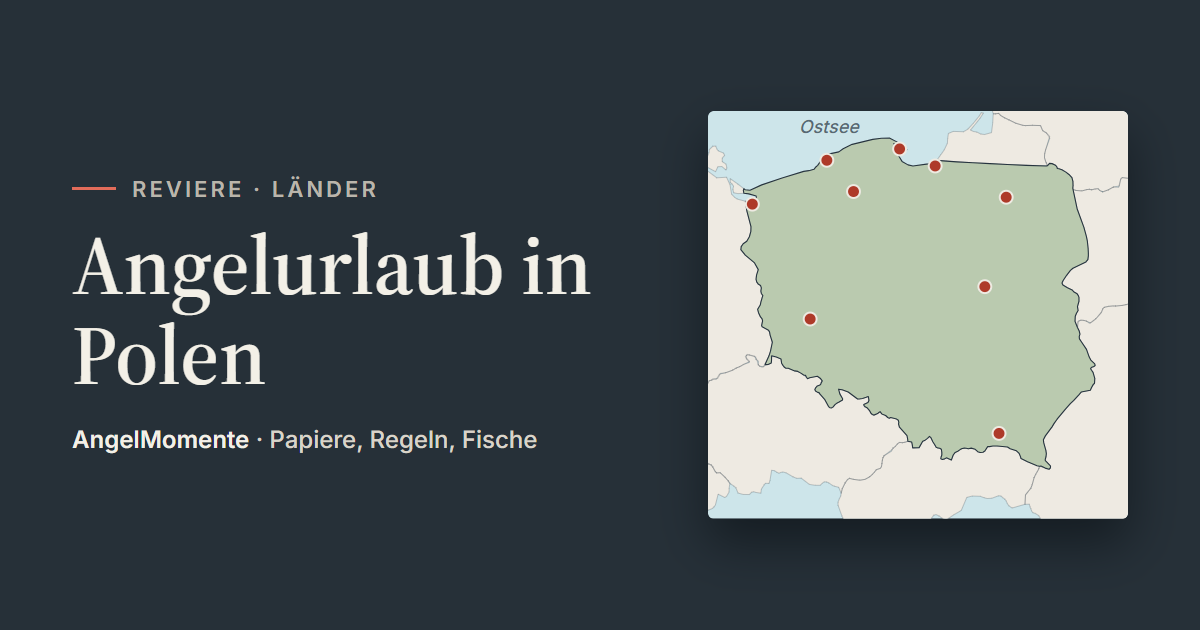
Destinations · Poland
Fishing holiday in Poland
An angling holiday in Poland inland mainly requires the permit of the water manager. On the Baltic and the lagoons a state fee is enough.
- Rivers
- 1.783
- Streams
- 7.363
- Lakes and reservoirs
- 8.477
- Canals
- 584
- Regions in the water atlas
- 16
As of October 2026 · waters with a name in OpenStreetMap, as of 3 October 2026
The key points in brief
Inland
You need the permit (zezwolenie) of the water manager. With it, foreign guests are exempt from the state angling card (karta wędkarska).
Baltic and lagoons
Instead of a permit you pay a state fee, from 15 złoty for a week.
Cod and eel
protected all year in the sea. You may keep salmon only with the adipose fin cut off, one per day.
Children under 14
without an angling card, but only with an adult at the water.
Online
You buy the permit of the PZW angling federation online, and it arrives by email.
Boat
Boating licence above 10 kW, alcohol limit 0.2 per mille.
As of: October 2026. Sizes and closed seasons (Schonzeit) change, and the EU rules for cod and salmon apply for 2026 only. The linked regulations and the water manager’s permit are authoritative, not this overview.
Which papers where?
On the left is where you fish, on the right what you need for it. The details are further down this page.
- InlandPermit (zezwolenie) from the water manager. As a guest from abroad, this exempts you from the state angling card.
- Baltic and lagoonsNo permit, but a state fee instead. At the water you show ID and proof of payment.
- Children under 14No angling card, but only with an adult at the water.
Find fishing ponds
278 angling ponds and 19 fish farms offering fishing for guests in Poland, 195 of them individually confirmed. Enter a postcode or place and the pond finder sorts all sites by distance. All 48 checked fish farms, including those without fishing, are in the fish farm finder.
At sea
Baltic and lagoons: fee instead of permit
- Where maritime law applies: besides the open Baltic also in the Polish parts of the Szczecin Lagoon and the Vistula Lagoon, on the Oder between the lagoon and the port of Szczecin, in the inner part of the Gulf of Gdańsk and in the harbours (Gesetz über die Meeresgebiete, Artikel 4).
- Fee: 15 złoty for a week, 25 for a month, 65 for twelve months from the day of payment. With the Polish Large Family Card (Karta Dużej Rodziny) twelve months cost 50 złoty. You pay to the Main Inspectorate of Sea Fisheries (Główny Inspektorat Rybołówstwa Morskiego, GIRM) in Słupsk. There is no permit on paper. At the water you show ID and proof of payment (Seefischereigesetz, Artikel 90 und 92).
- Tackle and distances: two rods, one when spinning or fly fishing. On the shore 20 m from your neighbour, 50 m when spinning, 100 m from bathing spots. Artificial light is prohibited (regulation of 27 December 2023).
- Daily limits: one salmon with a cut adipose fin or two sea trout, pike and zander together two, two wels catfish, five tench and five bream each, ten garfish, 15 perch, 6 kg of herring, and 7 kg in total of all other species.
- Closed seasons (Schonzeit): salmon and sea trout from 15 September to 15 November in the strip of four nautical miles off the coast. In seven harbours, on Lake Dąbie and in the inner sea waters west of 15°23′ East their closed season lasts until 31 December. Zander and pike have their own spring closed seasons depending on the stretch of coast, zander east of 19°21′ East for example from 20 April to 10 June.
- Harbours in autumn and winter: In Darłowo, Dźwirzyno, Kołobrzeg, Łeba, Mrzeżyno, Rowy and Ustka spinning is prohibited from 15 September to the end of February, and any fishing from 5 pm to 7 am.
- From a boat: only outside fairways and anchorages and at 100 m from nets and wrecks. On the open Baltic, in the Bay of Puck and the Gulf of Gdańsk you report the trip by email to GIRM at least two hours beforehand. Catches of species for which the EU sets fishing opportunities are logged in the RecFishing app.
- Keeping the catch: alive in a keepnet in the water or kill it at once. Everyone keeps their fish separate.
Regions and waters
Individual coasts, lakes and rivers have their own profiles: where they are, which fish are documented there, who issues the permit and which local rules apply on top.
Polish Baltic coast
Surf, harbours and charter boats from Świnoujście to Hel
Gulf of Gdańsk and Hel
Gulf, peninsula and reporting duty for boats
Szczecin Lagoon and the lower Oder
Where the sea fee is enough and where inland law begins
Vistula Lagoon
The Polish part of the lagoon, a sea water
Oder
The river up to the Szczecin Lagoon
Vistula
The river with its own closed seasons (Schonzeit) for salmon and sea trout
Masuria
The large lakes and who issues the permit there
Pomeranian Lakeland
Kashubian lakes, Wdzydze, Drawsko and the Drawa
San and Dunajec
Mountain rivers with brown trout, grayling and huchen
Location maps: AI-generated, outlines from Natural Earth (public domain)
Fishing without a fishing licence
Anyone fishing freshwater in Poland needs the angling card (Angelkarte) and, in waters of a fishing rights holder, additionally that holder’s permit (Binnenfischereigesetz, Artikel 7). The following are exempt from the card:
- Foreigners who are staying in Poland temporarily and hold the permit (Landkreis Świebodzin auf gov.pl). Without a permit the exemption does not apply.
- Children under 14 who fish only under the supervision of an adult with an angling card.
- Anglers at farm and pond facilities if the operator has given permission.
At sea there is no angling card. The proof of the fee paid is enough there. The angling card itself is issued by the district head (starosta) at your place of residence if you have passed the exam before a commission of an angling federation. It is issued from the age of 14 and officially costs 10 złoty (regulation of 12 July 2023, § 5). It is valid for life (PZW). More on the principle: Fishing licence and angling exam.
Who issues the permit inland
- Polish Angling Federation (Polski Związek Wędkarski, PZW): The fishing rights holder is in each case the board of a district (okręg). It sets methods, protection rules and catch limits in its permit. Under the federation’s angling regulations (Regulamin Amatorskiego Połowu Ryb, RAPR for short), non-members and foreigners may also fish on federation waters with this permit. It is thus the PZW’s guest permit (Gastkarte).
- State water management Wody Polskie: The regional directorates issue permits in the angler’s name for their own fishing districts, in Gdańsk (Wody Polskie Gdańsk) via the online system WIR.
- Private rights holders: Each fishing district has exactly one rights holder. It can also be a private person or a business.
The permit comes on paper or electronically. It states the manager’s conditions, above all sizes, catch limits, time, place and technique, and may require a catch log. The manager may tighten the state rules. So read it before the first cast. On the term: Fishing permit and water map.
Buy the permit and fee online
- PZW: On the federation’s permit page you choose the district, fill in the form and pay by BLIK, online transfer, card or Google Pay. The permit arrives by email within five minutes. Prices and rules are given with each water.
- Wody Polskie: You buy the permit electronically in the WIR system (Wirtualny Informator Rzeczny), in the browser or via the app.
- Sea: You transfer the fee to the account of the sea fisheries authority. As the payment reference you give the period and your name (GIRM).
Children and young people
Children under 14 fish without an angling card, but only under the supervision of an adult with an angling card. The managers settle the details themselves:
- On PZW waters: Children without membership fish only next to an adult with an angling card and permit, at that person’s spot and within their daily limit. Baitfish, live or dead, are not allowed for them. Under seven only one rod. Young people up to 16 fish at night only under supervision (RAPR).
- At Wody Polskie Gdańsk: The child carries ID, and the adult stays at the water the whole time. Together they fish with two rods at most and within the limits of a single permit.
The law requires an adult with an angling card as supervision. If you have none as a guest, ask the issuer of the permit before buying whether your child may fish with you.
Rules on inland waters
- Rods and hooks: at most two rods at once, one for salmonids and grayling. One hook with bait on the line, up to two hooks with artificial insect imitations, or one artificial lure with three hooks at most.
- Distances: 50 m from dams, from set fishing gear and from the manager’s marked spawning grounds.
- Prohibited: artificial light for locating and luring, and continuously raising and lowering the bait, except for ice fishing.
- Baitfish: catching with a lift net up to 1 × 1 m and a mesh size of at least 5 mm, only at the fishing spot. Baitfish may only be released into the water they come from.
- Boat: Whether and when you may fish from a boat is stated in the permit. Wody Polskie Gdańsk allows it only by day from 1 May to 31 December and prohibits trolling.
Night fishing
Inland, the permit sets the time of fishing. So you read there whether you may fish at night. Wody Polskie Gdańsk, for example, prohibits fishing on trout waters from dusk to morning. On the coast, in seven harbours, all fishing between 5 pm and 7 am is suspended from 15 September to the end of February (see below).
Minimum sizes (Mindestmaß) and closed seasons (Schonzeit) inland
Fish are measured from the closed mouth to the end of the longest ray of the tail fin. The manager may be stricter (regulation of 12 July 2023).
- Pike: 45 cm, protected from 1 January to 30 April
- Zander: 45 cm, 1 March to 31 May
- Wels catfish: 70 cm, 1 January to 31 May
- Eel: 50 cm, 1 December to 31 March, at most two per day
- Brown trout: 30 cm, 1 September to 31 December, different in the south (see regions)
- Grayling: 30 cm, 1 March to 31 May
- Tench: 25 cm, no closed season
- Perch and carp: no state size and no closed season. Wody Polskie Gdańsk requires 20 cm for perch.
If the first or last day of a closed season falls on a public holiday, the season is shortened by that day. You release undersized and protected fish at once, and you kill non-native species such as the brown bullhead. The terms are explained in Closed season and minimum size.
Cod and salmon 2026
Cod and eel are protected all year in Polish sea waters. The EU adds to this: Regulation (EU) 2025/2454 prohibits recreational fishing for cod in the Baltic in 2026, and every cod goes straight back (Article 10). Fishing for salmon is also basically prohibited there (Article 11). It remains allowed only in this way: you keep one salmon per day with a cut adipose fin and then stop fishing for salmon for that day. You bring kept fish ashore whole. You release salmon without a fin clip. The EU rules apply until 31 December 2026.
National parks and protected districts
Fishing is prohibited in national parks and nature reserves, except at places designated by the protection plan or the protection tasks of the area (Naturschutzgesetz, Artikel 15). You find out where those are from the park administration. In protected districts (obręb ochronny) fishing is always prohibited. You recognise them by blue signs or buoys with yellow lettering.
Taking fish home
You may not sell your catch, neither from inland waters (Artikel 10) nor from the sea (Artikel 96). At sea you do not pass on caught fish before the end of your fishing day, and sea fish caught from a boat stay whole until landing. At German customs, goods from an EU country remain duty-free if they are intended for your own use (zoll.de).
In the boat
- Motorboats above 10 kW require a qualification certificate (patent). Boats up to 75 kW and 13 m hull length that are structurally limited to 15 km/h are exempt, as a hire boat after a safety briefing. Foreign licences are valid within their scope (Binnenschifffahrtsgesetz, Artikel 37a).
- Boats without a registration document should carry safety equipment for every person on board. Non-swimmers wear a life jacket or buoyancy aid (regulation of 8 November 2013).
- After drinking alcohol you may not skipper a boat, with an engine (Kodeks wykroczeń, Artikel 87) or without (Wassersicherheitsgesetz, Artikel 7). This state begins at 0.2 per mille in the blood (Gesetz, Artikel 46).
More on this: Boat and life jacket.
The parts of the country
- Baltic coast with lagoons and the Gulf of Gdańsk: Maritime law applies everywhere here, with a fee instead of a permit. For trips on the open sea and in the bays, the report to GIRM is added.
- Pomeranian Lakeland: Each fishing district has a single rights holder. In its districts Wody Polskie Gdańsk allows only pike from 50 to 75 cm.
- Oder and Vistula: In the Vistula below the Włocławek barrage, salmon and sea trout are protected from 1 December to the end of February, and from March to August also from Friday to Sunday. The Oder between the Szczecin Lagoon and the port of Szczecin counts as sea.
- Mountain rivers in the south such as the San and Dunajec: In the upper Vistula up to the mouth of the San, on the San and on the upper Oder up to the Bystrzyca, 25 cm is enough for brown trout, and its closed season runs until 31 January. The huchen measures at least 70 cm and is protected from 1 March to 31 May.
Related
- Water atlas: Poland with all rivers, streams and lakes on one map
- Find angling ponds in Poland: fishing grounds and fish farms by postcode, voivodeship and fish species
- Other countries: Germany, Denmark, Sweden and Austria
- Fishing on a lake, Fishing on a river, Fishing on the coast and in the surf and Fishing in the Bodden and fjord
- Spinning, Fly fishing and sea fishing with Float rig or Surf rig
- Returning fish, bank and waders and the Catch calendar
Sources
- Binnenfischereigesetz (ustawa o rybactwie śródlądowym), einheitlicher Text Dz. U. 2022 Pos. 883, Stand 21.04.2026
- Verordnung über Schutz und Fang der Fische in Binnengewässern, Schonmaße und Schonzeiten (12.07.2023)
- Seefischereigesetz (ustawa o rybołówstwie morskim), einheitlicher Text Dz. U. 2025 Pos. 590, und Verordnung über das Freizeitfischen im Meer (27.12.2023)
- Główny Inspektorat Rybołówstwa Morskiego: Freizeitfischerei und RecFishing (abgerufen 04.10.2026)
- Verordnung (EU) 2025/2454: Fangmöglichkeiten Ostsee 2026
- Wody Polskie Gdańsk: Regulamin für 2026 (26.06.2026)
- Polski Związek Wędkarski: Regulamin Amatorskiego Połowu Ryb, Erlaubnis online und Angelkarte
- Naturschutzgesetz (ustawa o ochronie przyrody) und Gesetz über die Meeresgebiete
- Binnenschifffahrtsgesetz, Verordnung über die Sicherheit im Wassertourismus, Wassersicherheitsgesetz, Kodeks wykroczeń und Gesetz über die Erziehung zur Nüchternheit
- Landkreis Świebodzin auf gov.pl: Angelkarte und Zoll: Reisen innerhalb der EU
Guide without guarantee, as of October 2026. The Polish regulations, the EU regulations and the water manager’s permit in their current version are authoritative.