
Knowledge – Fish
Perch: Stripes, swims, bait and cooking
The perch (Perca fluviatilis) lives in nearly all types of water in Europe, from rivers to the brackish water of the Baltic Sea. Young perch travel in shoals, while large ones hunt more in small groups or alone. In 2023 it was Fish of the Year in Germany.
In short: The best time to catch perch is from September to October, in the morning, during the day and in the evening. Good spots in a lake: a jetty and a weed bed; in a river: rock rip-rap. Proven baits: small soft plastics, twisters and spinners; also lobworm or a small baitfish. Step by step: Perch fishing.
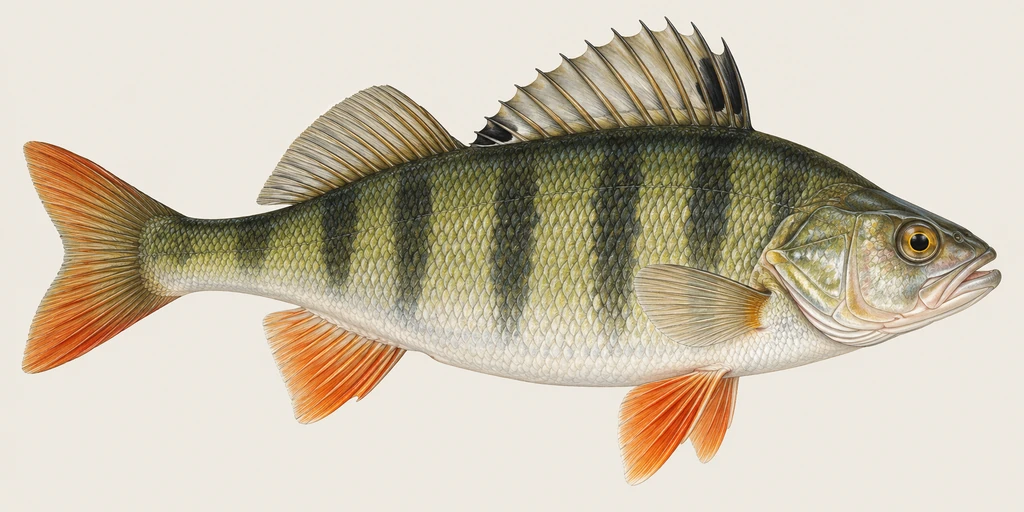
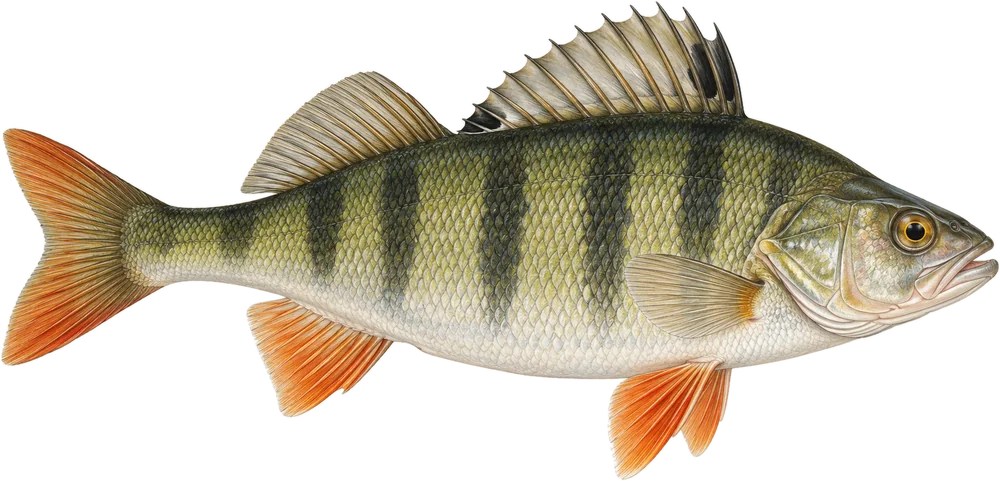
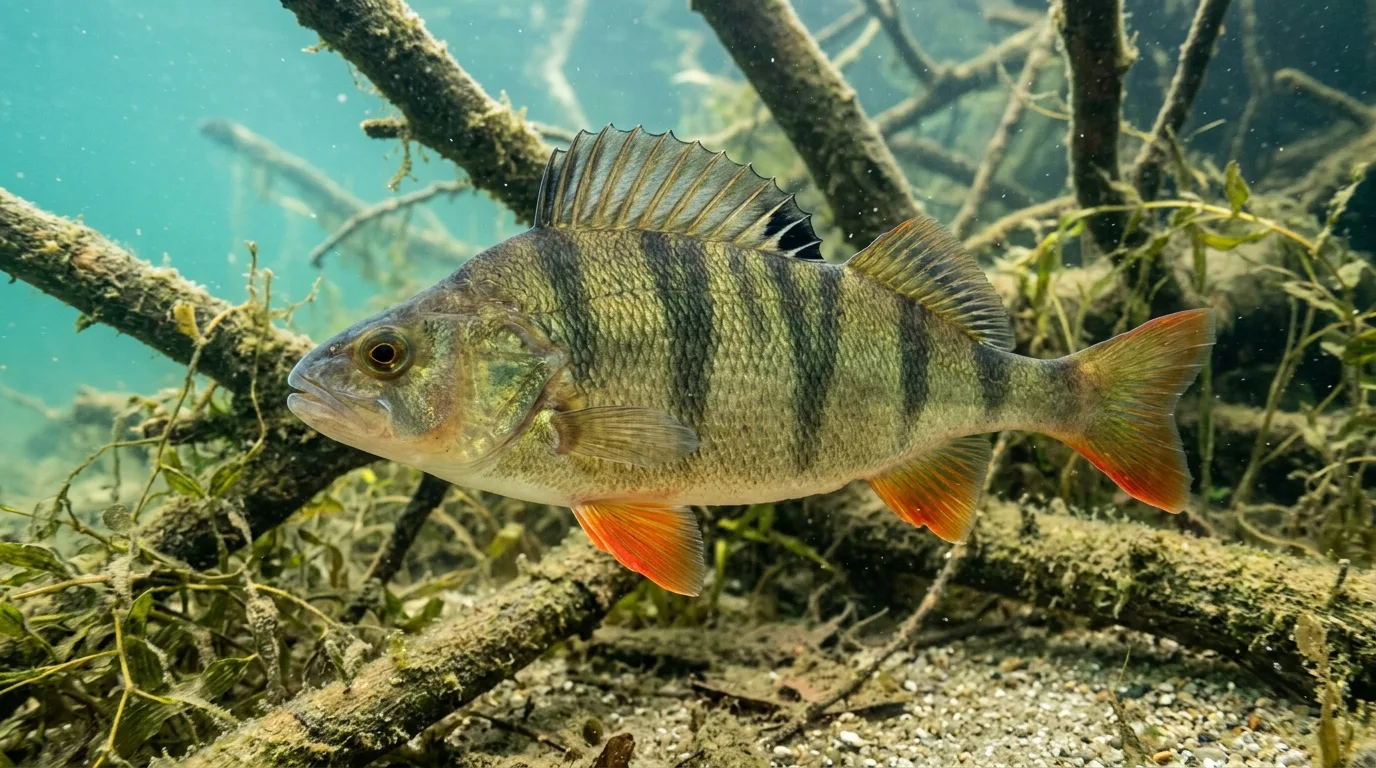
- Six to eight vertical stripes on a grey-green body
- Reddish pectoral and pelvic fins
- Divided dorsal fin, the front part with pointed spiny rays
Catch chances through the year
- Hardly any chance
- Possible
- Good
- Peak season
- Spawning (observe the closed season)
Editorial assessment for waters in Germany, not a measured value and no guarantee. Spawning time is not the same as the legal closed season.
Species profile and sources in the catch calendarAll species compared month by monthThe rules of your federal state
How to recognise a perch
The perch has a deep back, though less markedly than the bream, for example, and behind the head the back rises in a hump. The dorsal fin is in two parts: at the front with 14 to 20 spiny rays, at the back with 13 to 16 soft rays. At the end of the first dorsal fin sits a black spot, which is not always visible because the fish can fold the fin down. The gill cover ends in a spine, hence the nickname “spiny knight”. The mouth is terminal to slightly upturned and carries small teeth.
Usually the perch is yellowish green with six to eight black cross bars, and the LFV Bayern gives five to nine. The pelvic, pectoral and tail fins are red. There are also bluish or very pale fish, because it adapts its colour to its surroundings. The ctenoid scales sit firmly and the skin feels rough.
With good nutrition up to 60 centimetres and 4,8 kilograms are possible. In most waters the average is 20 to 35 centimetres and up to 500 grams. From 35 centimetres perch count as large, from 40 as specimen-sized, and over 50 centimetres are exceptions. The highest reported age is 22 years.
Perch or zander?
| Feature | Perch | Zander |
|---|---|---|
| Dorsal fins | two, separate, with a black spot at the end of the first | two, briefly separate, the first with spiny rays |
| Teeth | only small teeth | large fangs next to small brush-like teeth |
| Markings | five to nine dark cross bars, red fins | blurred cross bars, fins marked with black |
The ruffe is speckled black instead of striped, and its two dorsal fins are joined together. The zander is more elongated and has large fangs.
Side by side
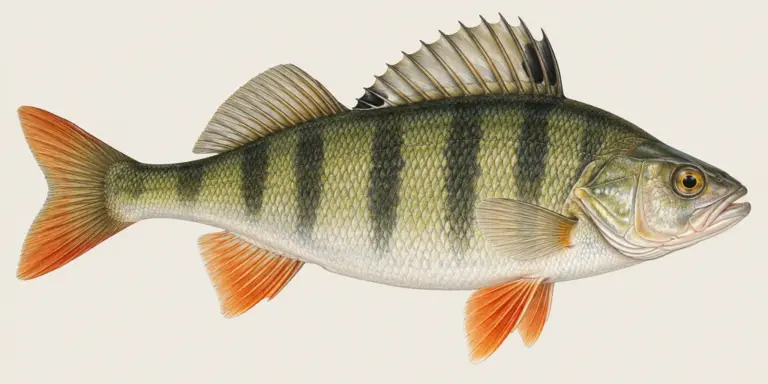
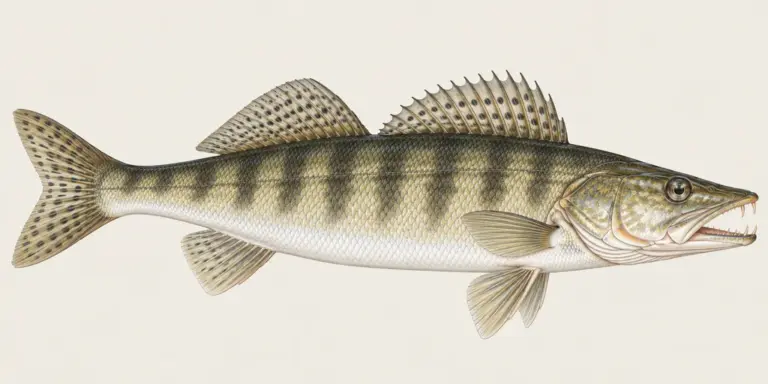
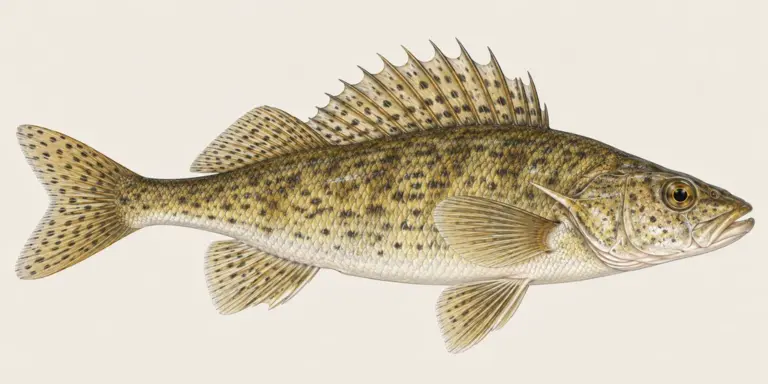
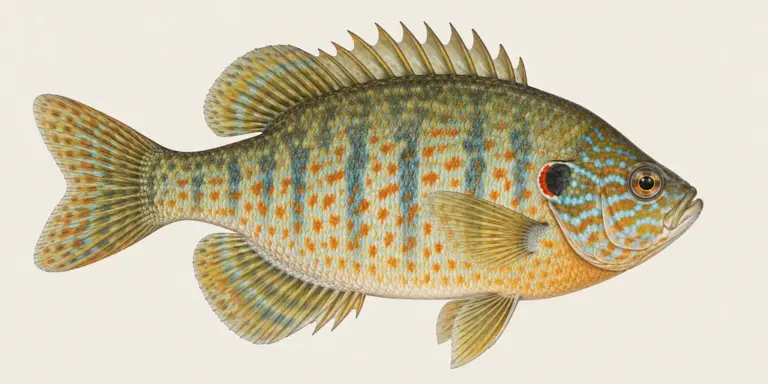
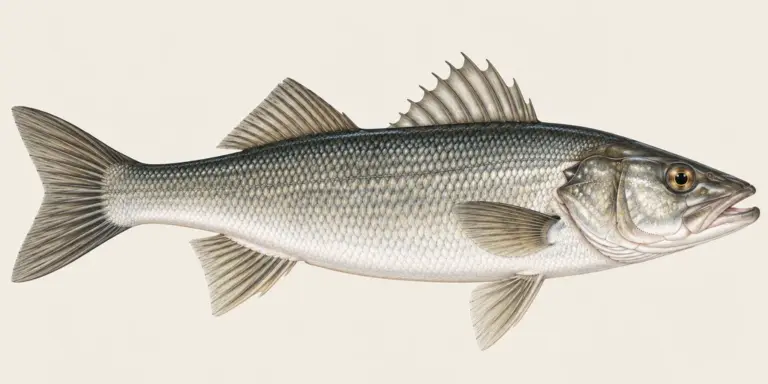
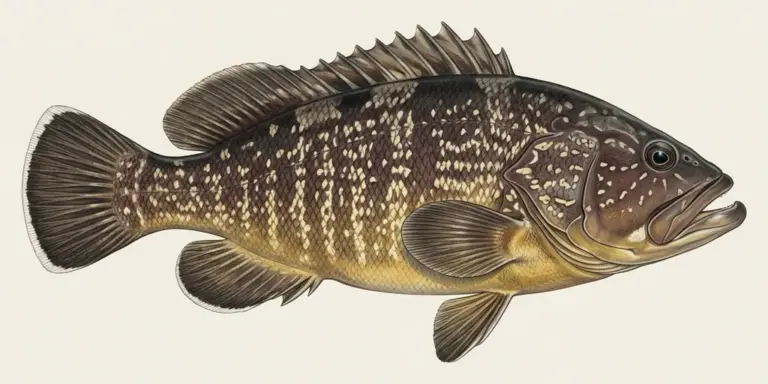
AI-generated illustrations.
Where the perch holds
The perch is not demanding. It lives in running waters as well as still waters and tolerates slightly salty water, and in the Baltic lagoons (Bodden) it is widespread. It is also common in canals poor in structure and in gravel pits, and colonises new waters fairly quickly. You find small perch under jetties, along sheet piling and in harbours.
In lakes adult fish like to stay in open water, above all at the transition from the bank to open water on drop-off edges. For large perch, dead wood is the most important structure along the bank. Particularly large perch usually live in clear, deep and moderately nutrient-rich lakes, while turbid shallow lakes hold smaller fish on average. In summer they hold deeper by day and move into the shallows in the evening, and in autumn the shoals move out into deeper water as the temperature falls. More on these waters under Harbour and mole and Canal.
A LAWA report gives the upper limit of the lethal temperature of adult perch as 35 °C. According to FishBase the temperature range is between 10 and 22 °C.
Holding spots in the picture
Choose the season and time of day: the picture shows where the species stands then. Spots outlined in red apply only in the chosen season. Tap a fish or a spot in the list to bring it closer. The picture is schematic and AI-generated, every water is different.
Catch chance in springpossibleSpawning season, observe closed seasons
Catch chance in summergood
Catch chance in autumnPeak season
Catch chance in winterpossible
- J
- F
- M
- A
- M
- J
- J
- A
- S
- O
- N
- D
Spawning season
Active time The perch hunts during the day and at dusk.
Active time The perch hunts during the day and at dusk.
Active time The perch hunts during the day and at dusk.
Not the main time The perch hunts during the day and at dusk.
In the lake
Water lilies and weed bed
Perch are found here all year round.
jetty, sheet piling, harbour
Perch are found here all year round.
Deep bottom
Perch are found here only in winter.
Open water
Perch are found here only in autumn.
Just below the surface
Perch are found here only in autumn.
Perch sit under jetties, at sheet piling and in harbours and like to stay near plant growth. Young perch live in shoals near the bank, big fish mostly alone and deeper.
Spring: catch chance according to the catch calendar possible. This is when the spawning season falls, observe closed seasons.
Summer: catch chance according to the catch calendar possible in June, good in July and August.
Autumn: catch chance according to the catch calendar peak season in September and October, good in November. On big lakes perch often hunt close under the surface in open water in autumn. Circling gulls show where small fish are being pushed up.
Winter: catch chance according to the catch calendar possible. In the cold months many perch withdraw to deeper, calmer areas, though big fish also stay shallow depending on the water. They keep feeding, but are less active.
In the river
riprap, sheet piling, harbour
Perch are found here all year round.
In rivers you find perch at sheet piling, rock armouring and in harbours.
Spring: catch chance according to the catch calendar possible. This is when the spawning season falls, observe closed seasons.
Summer: catch chance according to the catch calendar possible in June, good in July and August.
Autumn: catch chance according to the catch calendar is peak season in September and October, good in November.
Winter: catch chance according to the catch calendar possible.
Size comparison: AI-generated drawing, schematic.
How it hunts and spawns
Young perch feed mainly on zooplankton and bottom animals. On average they switch to fish at twelve centimetres. Cannibalism is widespread. If food is lacking in youth, the stock becomes stunted: perch of five to eight centimetres can then already be sexually mature.
Perch suck in their food greedily, so with worm and other natural baits the hook is often deep. Even ten-centimetre perch chase artificial lures of the same length. They often hunt in packs and drive small fish together. In autumn they push shoals to the surface, and screeching gulls give the spot away. They are not very site-faithful and often roam widely.
Spawning takes place from March to June, and a female lays up to 300.000 eggs in egg ribbons on plants. Usually two males nudge the female with their mouths. The larvae hatch after about 140 degree-days. According to the Anglerverband Niedersachsen they often spawn at night on reeds or dead wood, and some clubs sink fir trees as spawning aids. Males usually mature in their second year, females in their second to fourth year.
When it bites
The perch can be caught in almost any season. As a visually oriented predator it is particularly catchable by day, and the best chances come early in the morning and at evening dusk.
In the summer and autumn months, according to DAFV evaluations, less time is needed to catch perch. In spring, by contrast, there are clearly more fishing days without perch. As possible reasons the DAFV names cold water, lower swimming activity and slower digestion. In autumn the food supply falls while temperatures are still high, so they bite well then.
According to Blinker, until the end of September the shoals hold close to the bank at trees, jetties and water lilies, and as temperatures fall they hold clearly deeper. Large perch often stay shallow in winter, at one to three metres in the Rhine delta. Harbours and gravel pits with a river connection are, according to Fisch & Fang, a magnet for big perch from October.
Today’s catch index needs JavaScript. Season and spawning time are in the catch calendar.
You will find the monthly overview of all species and the water temperature check in the catch calendar.
From the blog: The first fishing trip with children: plan briefly, set up safely, check the rules · Fishing in November: which fish bite now and where I look for them · Fishing spots in autumn: where I cast the spinning rod first
What you catch it with
Step by step: Perch fishing: tips on bait, rigs and tackle – season, swims, bait, tackle and rules on one page.
In summer you catch with soft plastics of 3 to 7 centimetres on jig heads of 2 to 7 grams. Small plugs of 3 to 5 centimetres with a running depth of up to 1,5 metres are among the best lures from late spring to autumn. In the DAFV trial, soft plastics tended to catch more and larger perch than a spinner. Small lures can be eaten by far more sizes of perch and bring more bites, while large lures catch larger perch on average. On the dropshot, the baits close to the bottom caught significantly more.
With a worm you catch on a float, even when it gets colder, because worms are usually more effective than lures in the cold season. The bait must not hang rigid: the weight does not sit close to the hook, and an occasional twitch adds movement. A freshly caught, dead small perch is also a good baitfish. Many federal states (Bundesland) expressly ban live baitfish.
In winter you work soft plastics of 8 to 12 centimetres on a lead head close to the bottom. Fast-retrieved plugs hardly catch, and hard baits without a diving lip and small spoons run slowly along the bottom. If perch are hunting at the surface, you cast straight into the churned water.
Because perch have a soft mouth, many are lost in the fight. Do not choose a rod that is too stiff, and do not set the drag too hard. Where pike are present, you also use a steel leader when fishing for perch. For the perch grip you put your thumb into the mouth and press it against your index finger on the lower jaw. More on the right perch rod and on landing and unhooking can be found in the encyclopaedia.
Change spot when you get small perch: Smaller perch avoid the big ones, which are dangerous to them. If you catch one or two small ones, it is worth moving to a new spot.
Recognise shoals driven to the surface: When small fish splash at the surface, several perch are often driving the shoal up. Cast the bait straight into the churned water.
Do not wind up from great depth: Perch and zander have no swim bladder duct and are prone to barotrauma. Do not fish for them deeper than 10 metres, even in winter, and add pauses during the fight.
Suitable lures
Small soft plastics, twisters and spinners; also lobworm or a small baitfish.
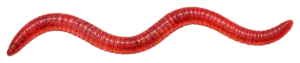 Worms
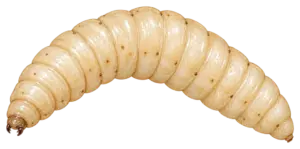 Maggots & larvae
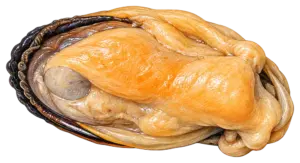 Crustaceans & mussels
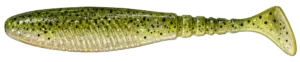 Soft plastic (shad)
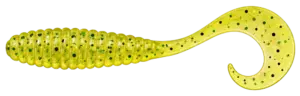 Twister
 Pintail (No-Action-Shad)
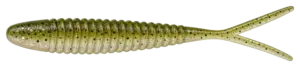 V-Tail
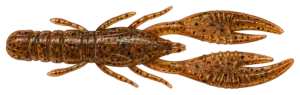 Soft plastic crab
AI-generated illustrations. A click opens the lure’s page.
Also suitable: Softworm, Crankbait, Twitchbait, Stickbait, Popper, Lipless crankbait, Spinner, Spinnerbait, Bladed jig, Tailspinner, Streamer.
Rigs for these baits: Dropshot rig, Jig head rig, Texas rig, Carolina rig, Running lead rig.
What perch tastes like
The perch has firm, low-bone and lean flesh and is popular in the kitchen. In Switzerland, as Egli, it ranks after whitefish and trout among the most eaten freshwater fish. An angler in the DAFV magazine likes to fillet it best and fries breaded skinned fillets golden brown in the pan. When filleting, the dorsal fin and the gill spine like to leave marks on your fingers. You remove the firm scales as described under Scaling and skinning.
What you need to observe
Closed seasons (Schonzeit), minimum sizes (Mindestmaß) and harvest windows are set by the federal states (Bundesland), and on many waters additionally by the club or leaseholder. They differ depending on the water and the time of year. We give figures only with a date and a source; always binding are the fisheries regulation of your federal state and your fishing permit (Erlaubnisschein). You will find a list of links to the official sources in the catch calendar.
A fish of legal size that you want to keep you stun and kill at once, in line with animal welfare rules. Protected, undersized fish or fish too large under a harvest slot you unhook, if possible still in the water and with wet hands, and release gently. What exactly applies is regulated by state law and your fishing permit (Erlaubnisschein).
A minimum size (Mindestmaß) for perch exists only in some of the federal states (Bundesland). In many waters a predator closed season (Schonzeit) also applies, during which fishing with lures and baitfish is often banned. Check the current rules for your water. Many federal states expressly ban live baitfish; in Brandenburg the fisheries authority (Fischereibehörde) can allow an exception in an individual case. The IUCN lists the perch as not threatened.
What closed season, minimum size and harvest slot mean and where to find them is explained on the page Closed season and minimum size explained.
What state law says about the closed season and minimum size for this species can be found in the “At a glance” box on the state pages for Bavaria, Berlin, Brandenburg, Bremen, Hamburg, Mecklenburg-Western Pomerania, Lower Saxony, Saxony, Saxony-Anhalt and Schleswig-Holstein. For the other states our overview does not list this species, and the state fisheries regulation is what counts there.
Frequently asked questions (FAQ)
Where do you find perch?
Almost everywhere: in rivers, lakes, canals and gravel pits, also in brackish water. Small perch hold under jetties, along sheet piling and in harbours, larger ones at dead wood, drop-off edges and underwater plants.
How big does a perch get?
On average 20 to 35 centimetres. From 35 centimetres a perch counts as large, from 40 as specimen-sized. Up to 60 centimetres and 4,8 kilograms are documented, but over 50 centimetres remain exceptions.
What do you catch perch with?
With small soft plastics, plugs, spinners and twisters, with a lobworm under a float or with a small perch as baitfish. Movement in the bait is what matters.
Sources
The rating of catch chances is an editorial assessment. The facts come from these sources, and the text is worded in our own words. The illustration is an original design by Angel Momente in the style of a natural history plate (AI-generated, see the AI notice).
- Landesfischereiverband Bayern: Fischlexikon (Laichzeit, Lebensraum, Nahrung, Aktivität)
- FishBase: Perca fluviatilis (Höchstalter, Jagdzeiten)
- Blinker: Steckbrief Barsch (Nahrung, Schwarmverhalten, Köder)
- Deutscher Angelfischerverband: Fisch des Jahres 2023, der Flussbarsch (Broschüre)
- Deutscher Angelfischerverband: Fisch des Jahres 2023, der Flussbarsch (Faltblatt)
- Anglerverband Niedersachsen: Flussbarsch (Fische in Niedersachsen)
- Blinker: Barschangeln, zehn Tipps für deinen Erfolg
- Blinker: Barschangeln im Sommer (Standorte, Köder)
- Blinker: Barschangeln im Herbst, drei fängige Methoden
- Blinker: Barschangeln im Winter, so findest und fängst du die Räuber
- Fisch & Fang: Fünf Winter-Barsch-Mythen
- Blinker: Der Barsch-Griff, wie fasse ich einen Barsch richtig an
- Blinker: Barotrauma bei Fischen, wie tief darf ich angeln (Zander und Barsch)
- Land Brandenburg: Fischereiordnung des Landes Brandenburg (BbgFischO), Köder
- LAWA-Projekt O 10.20 (Leibniz-IGB, 2021): Temperaturempfindlichkeiten der Fischgemeinschaften
- Wikipedia: Flussbarsch
Created with AI support from the sources listed. Figures only appear in the text if a source gives them. Last updated: 3 November 2026. Found a mistake? Write to us. Who is behind this site: About me.
More in the lexicon
- All fish species at a glance
- Catch calendar – month, water temperature and profile for 93 species
- Line calculator – breaking strain after the knot, drag guideline, backing
- Angling methods