
Knowledge · Rigs & setups
Drop-shot rig
In a drop-shot rig the weight sits at the end of the leader and the hook with the bait some distance above it. This keeps the bait free above the bottom, and you can move it in one spot without it travelling. How high the bait really sits depends not only on the distance to the weight but also on the angle of the line.
What you need
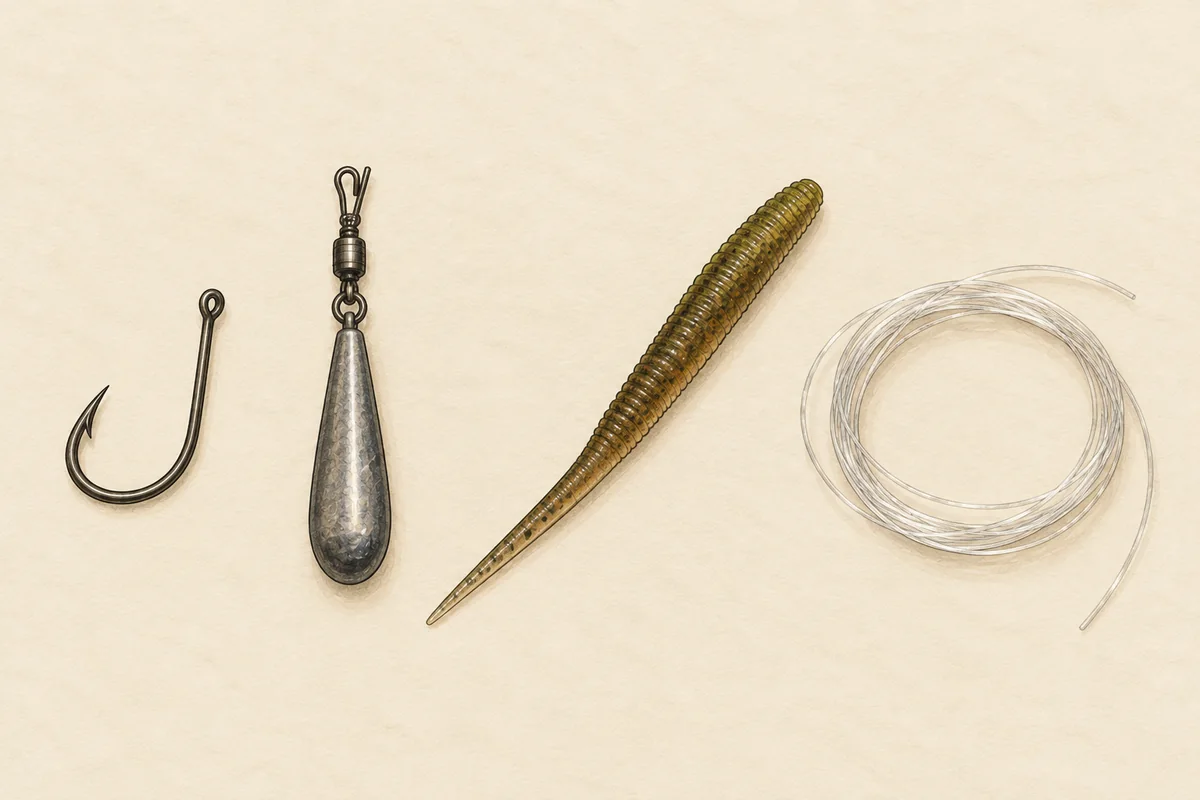
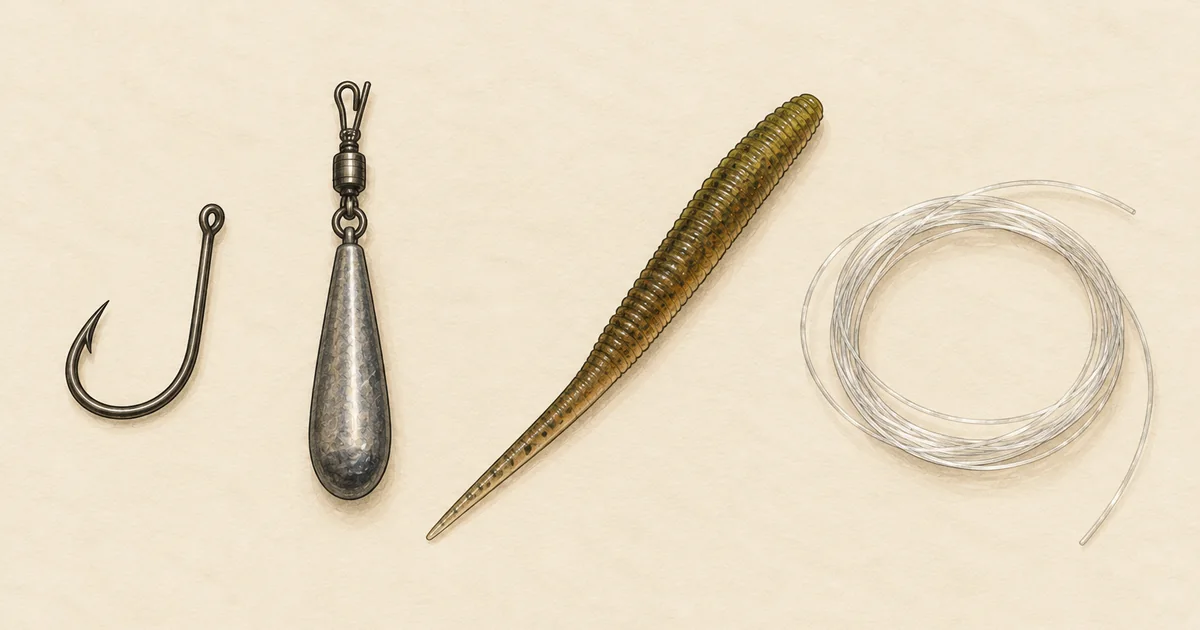
- a hooklength of fluorocarbon, which according to a Blinker expert is somewhat more abrasion-resistant than monofilament
- a short-shank hook with a wide gape, which you tie horizontally to the hooklength with the Palomar knot
- a drop-shot weight in ball, stick or pear shape, depending on the bottom of the water
- a soft plastic bait or worm, such as a soft worm, V-tail or pintail
- a soft spinning rod that transmits twitches, with braided line
You choose the weight to suit depth and current. Because weight and bait are separate, the weight can, according to Blinker, be as heavy as needed without changing how the bait moves. An angler in the Blinker article uses 15 grams for long casts on a canal.
Note on lead: The EU has adopted the restriction on lead in fishing tackle with Regulation (EU) 2026/2501, which applies from 3 December 2026 (as of November 2026). It governs sales, not recreational angling. Weights and lures containing lead up to 50 grams may no longer be sold from 3 December 2029. The German official text does name “Drop-Shot-Gewichte” with an earlier cut-off date, 3 June 2027, but by that it means weights intended to be released deliberately while fishing.
Layout, distance to the weight and rigging
The hooklength runs vertically downwards, with the weight at the end. The hook is tied on above it so that it stands out at a right angle. The distance between hook and weight determines how high the bait sits above the bottom. As a rule of thumb Blinker gives 30 to 50 centimetres.
The hook distance, however, is not the height above the bottom. With a taut line, the hook sits only the distance times the sine of the line angle above the bottom: at 30 degrees, 50 centimetres become 25 centimetres. With very long casts, the line runs at an acute angle to the bottom. Blinker then recommends increasing the distance to up to 1,5 metres so that the bait still sits at a catching height above the bottom (Fig. 2). At 30 degrees that would be about 75 centimetres of height.
The rig originated for vertical fishing: according to Blinker it was used to search fish spots that were taboo for the classic jig head because of the risk of snags. Blinker does not see it as a method for small fish only, because it can be used to target big zander, pike and perch.
Rigging the drop-shot rig in four steps
- Cut the hooklength. Blinker cuts off 75 to 100 centimetres of fluorocarbon and ties a loop at the top, through which a snap makes the connection to the main line.
- Tie on the hook. Tie a Palomar knot and pass the lower end through the hook eye from above. Only then does the hook stand out horizontally. The steps are shown on the page for the drop-shot knot.
- Attach the weight. The clamp on the dropshot weight holds the lower end of the hooklength, 30 to 50 centimetres below the hook. If it snags, the weight slips off the hooklength, according to Blinker.
- Attach the bait. See the next section.
The guide values differ depending on the bait. The table compares Blinker (mainly soft plastics) with Rute & Rolle (article on the lobworm). Hook sizes are not standardised, and the manufacturers‘ figures vary, according to a Blinker expert.
| Part | Spoon | Rute & Rolle (lobworm) |
|---|---|---|
| Hooklength | 75 to 100 cm | about 1,20 m |
| Hooklength strength | 0,20 to 0,23 mm | 0,30 to 0,40 mm |
| Hooks | size 6 as an example, for worms size 3 to 1/0 | short-shank, size 1/0 to 1 |
| Rod | 2,10 to 2,70 m, 10 to 30 g | 1,80 to 2,10 m, from the bank up to 2,40 m, up to 30 g |
| Braid | 0,12 to 0,16 mm | 0,12 to 0,14 mm |
A rod over 2,70 metres bounces too much at the tip, Blinker warns, which makes bait control and bite detection harder. The line calculator works out the breaking strain of main line and hooklength.
Attaching and working the bait
For soft plastics, Blinker describes three ways. With a short-shank hook, you push the bait through the head from underneath, upwards. Hooked across the head, it swings from side to side, which is supposed to help on heavily fished waters. On a dropshot hook with the point coming out in the middle, Blinker recommends it for hesitant fish. Longer lobworms can be halved to reduce missed bites; a Blinker author threads two worms on lengthways and crossways so they do not tangle.
A French editor fishes baits of only 2 to 5 centimetres in great heat and in long cold spells, when predators are sluggish. While you work the bait, the weight stays on the bottom. According to a Blinker author, the most important thing at the start is to keep contact with it: the better you feel how it lies, the more control you have over the bait. Small twitches make it dart back and forth and sink again.
Plan in pauses: According to Blinker, bites often come when the bait sits still above the bottom. On some days he catches better with longer pauses, so vary your presentation at the start.
In winter, a calm presentation usually brings more bites than a soft plastic shad on a jig head, according to Blinker. Fisch & Fang writes of big winter perch that they sometimes like it even slower and that the dropshot rig then has a clear advantage. On worm, the fish swims off with the bait, according to a Blinker author. You feel tentative bites if you hold the line lightly between thumb and forefinger.
Variant with a side arm
In the original, the hook sits directly on the vertical line. Blinker also describes a variant in which the hook is tied into a loop (side-arm loop): 80 to 100 centimetres of fluorocarbon and an arm of 5 to 15 centimetres, elsewhere a few centimetres to 50. The more cautiously the fish bite, the longer the arm should be.
The advantage lies in the bait’s action. It swings in the current instead of hanging stiffly on the line, and according to Blinker it is easier to suck in, presumably because the fish takes only one strand instead of two. In the USA the rig is fished exclusively vertically from a boat, according to Blinker, mostly on lakes with little current. From the bank in moderate to strong current, a side arm may catch better. Blinker’s rhythm there: two quick twitches, a pause, lift the weight on the third and move the rig about 20 centimetres against the current. The side-arm rig explains the design in general.
When the rig fits and for whom
- Hot spots can be fished for longer, according to Blinker, because the bait stays in place.
- According to Blinker, the risk of snagging is lower than with a soft plastic shad on a jig head, and missed bites are rarer.
- Rute & Rolle fishes it from the bank, from a jetty and from a boat.
The rig most often takes perch and zander, and according to Blinker also chub and trout. According to the Landesfischereiverband Bayern, river perch prefer spots with lush vegetation; a Blinker author fishes the margins between reeds and water lilies directly under the rod tip, once in only 1,20 metres of water. According to the association, zander stand in larger, deep and murky waters with a firm bottom. A Blinker editor mostly dropshots for them in murky water.
Pike also take the rig. A Fisch & Fang author repeatedly lost entire rigs while perch fishing because pike bit through the fluorocarbon. According to the Landesfischereiverband Bayern, the pike has several strong, very sharp canine teeth, and the Bavarian exam questions name a bite-proof hooklength, for example steel. The author replaces the upper section with about 20 centimetres of soft steel and ties the part to the weight in fluorocarbon: if a pike bites through there, only the weight is lost. More under pike hooklength.
Common mistakes
- No contact with the weight: If you cannot feel how it lies, you control the bait less well.
- Distance too short for long casts: The line runs flat, and the bait sits too low (calculation and guide value above).
- Constantly moving: Without pauses you give away the phase in which the bites come.
- Rod too long: The tip bounces, which makes bait control and bite detection harder.
- Pike in the water, only fluorocarbon: The hooklength can be bitten through.
Lots of missed bites. Check in this order:
- Hook horizontal? After the Palomar knot, the lower end runs through the eye; according to Rute & Rolle, that is the only way the hook stands out from the line. According to a Blinker expert, it should be sharp and short-shanked with a wide gape.
- Bait free? If the hook is tied directly into the main line, bait and hook have hardly any movement of their own, according to Blinker. With a tight line the fish also feels the resistance of lead and rod immediately; with perch, this led to an above-average number of missed bites there. The remedy is the version with a side arm.
- Bite spotted? A pike that only nudges the bait gives itself away just by the line going briefly slack, according to Fisch & Fang. A brightly coloured main line makes this visible.
Frequently asked questions
How long should the hooklength be?
Blinker gives 75 to 100 centimetres of fluorocarbon, and Rute & Rolle ties about 1,20 metres for lobworms. Below the hook there must still be room for the weight spacing of 30 to 50 centimetres.
Which knot holds the hook horizontal?
The usual one is the Palomar knot, in which the lower end of the line runs through the hook eye from above. In the side-arm variant, the hook is tied into a loop of the hooklength.
Is the rig also suitable in current?
Yes, according to Blinker the weight can be as heavy as you like without affecting the bait. From the bank in moderate to strong current, a side arm may catch better, according to Blinker, because the bait swings there.
Do I need a different hooklength for pike?
Yes. Where pike occur, a bite-proof hooklength belongs in the rig; the Bavarian exam questions name steel. What applies at the water is set out in the fishing permit (Erlaubnisschein).
How high does the bait sit above the bottom?
That depends on the distance to the weight and the angle of the line. With a flat line the hook sits only part of that distance above the bottom, which is why Blinker gives up to 1,5 metres for long casts.
Related
- Dropshot knot: the hook at a right angle, step by step
- Side-arm rig: bait on its own arm above the weight
- Carolina rig: weight and bait worked separately on the bottom
- Texas rig: soft plastic in weed and wood
- Spinning: working the bait at a glance
- Perch rod: light and sensitive for small baits
- Pike leader: steel, titanium or hard mono
Sources
- Blinker: Drop-Shot, alles über die Montage (Bleiabstand, Vorfach, Knoten, Anködern, Gerät, Seitenarm)
- Blinker: Dropshot-Montage mit Seitenarm (Strömung, Einsaugen, Zupfrhythmus)
- Blinker: Dropshotting direkt im Wohnzimmer der Barsche (Hakenhöhe, Kontakt zum Blei, Uferzone)
- Blinker: Experten-Tipps zum Dropshotangeln (Haken, Fluorocarbon, Mini-Köder, Tauwurm)
- Blinker: Dropshot-Angeln mit Wurm auf Barsch und Zander (Wurmhaken, Gewicht, Wurm quer, Biss)
- Rute & Rolle: Barsch 3.0, Tauwurm mit Finesse Rigs (Rute, Rolle, Haken, Vorfach, Bleiformen)
- Fisch & Fang: Dropshotten auf Hecht (Stahl- und Fluorocarbonvorfach)
- Fisch & Fang: Fünf Winter-Barsch-Mythen (Winterbarsche)
- Landesfischereiverband Bayern: Fischlexikon (Barsch, Zander, Hecht)
- Landesanstalt für Landwirtschaft Bayern: Prüfungsfragen Fischerprüfung 2023/2024 (beißsicheres Vorfach)
- EUR-Lex: Verordnung (EU) 2026/2501 der Kommission vom 12. November 2026, Blei in bestimmtem Fischereigerät und Berichtigung vom 17. November 2026 (Stichtage, Begriff Drop-Shot-Gewicht, Verkauf statt Verwendung)
- Deutscher Angelfischerverband: EU-Bleibeschränkung für Angelgeräte (Stand Mai 2026)
Text AI-assisted, drawing AI-generated. Sources opened and checked in October and November 2026, no graphics taken from the sources.
All figures are guide values without guarantee. Which weight spacing, which hooklength and which rig are allowed at your water is governed by state law and the water’s rules.