
Knowledge · Rigs & setups
Texas-Rig
The Texas rig is a rig for soft plastics: a bullet weight slides freely on the line, behind it sits an offset hook whose point is hidden in the bait. This way the bait snags less often in weed, branches and water lilies. The page covers the components, guide values for weight and hook, the sequence from twitching to striking, and the particulars of fishing for pike.
What you need
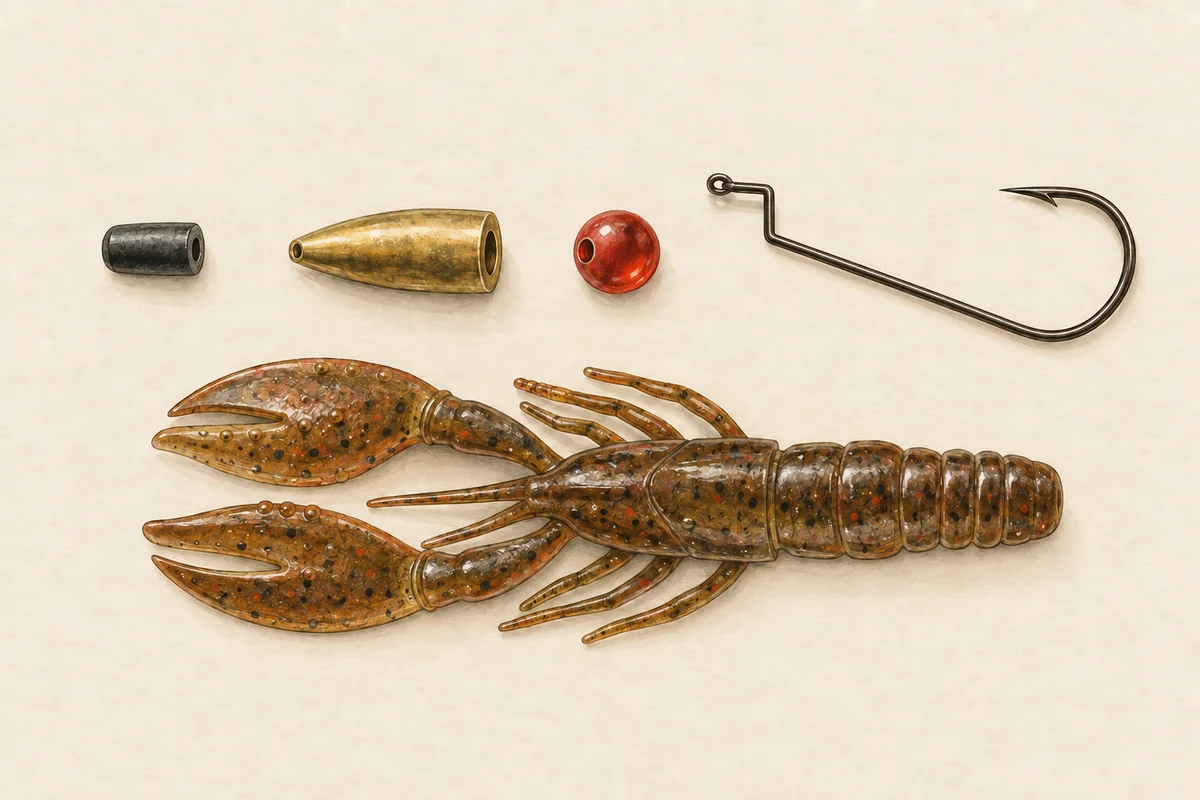
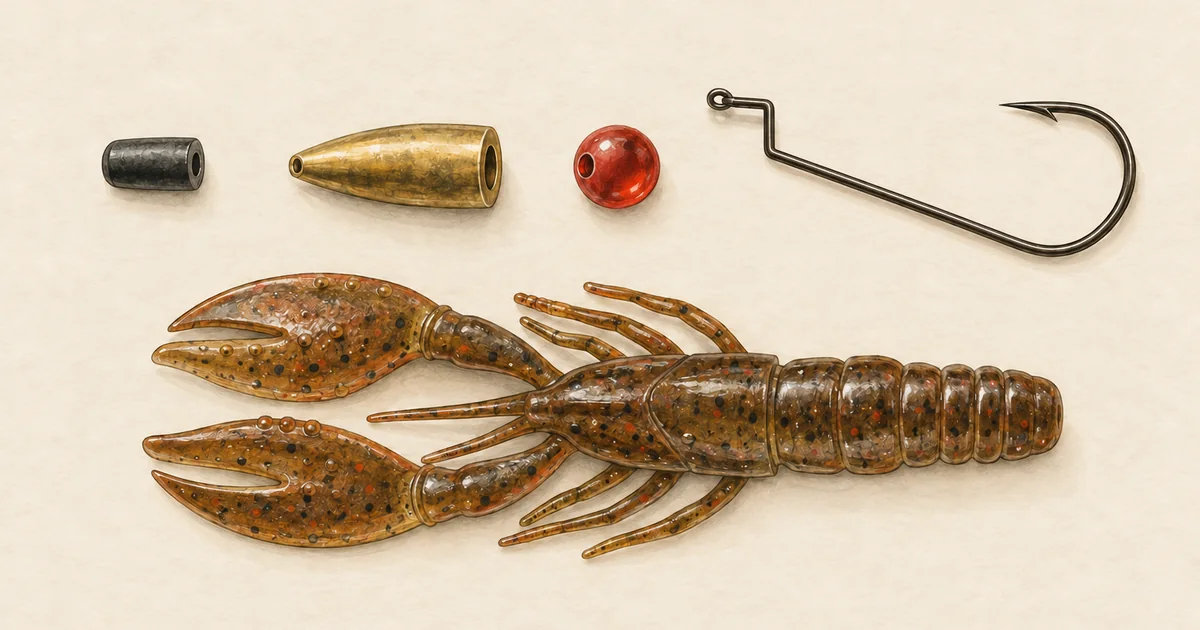
- a bullet weight that runs freely on the line; its weight depends on depth and current
- a bead between weight and hook, made of plastic or, better, glass according to Blinker; it also protects the knot
- an offset hook whose eye is bent in a Z shape, or, depending on the bait, a wide-gap hook
- a soft plastic bait into which the hook can be buried, for example a soft worm or soft plastic crayfish; the overview of soft baits shows more
- a hooklength, preferably fluorocarbon according to Blinker, and steel or titanium for pike
What the loose weight does
When you pull, the weight hits the bead. According to Fisch & Fang, the harder the bottom, the louder the clack. On the drop, the heavy weight goes first and the bait follows slowly, according to Blinker. If a fish sucks in the bait, the weight gives way on the line: the fish feels less resistance than with a jig head. Blinker adds that after a missed bite, fish more often grab again because they did not feel the hook.
Because bait and weight lie close together, the rig casts more accurately than a Carolina rig, according to Rute & Rolle. Both magazines therefore describe it as a rig for searching larger areas. A short or long drop phase also reveals the depth: short points to shallow water, long to deeper areas or drop-offs.
Guide values for weight and hook
Both specialist magazines grade the weight by water depth; their values differ slightly. Blinker also writes that a few grams do not matter.
| Water depth | Spoon | Fisch & Fang |
|---|---|---|
| up to 2 m | 2 to 5 g | 2 to 4 g |
| 2 to 4 m | 5 to 9 g | 4 to 8 g |
| 4 to 6 m | 8 to 12 g | 8 to 12 g |
| from 6 m | 13 to 18 g | 12 to 16 g |
The hook size depends on the bait size. Below 10 centimetres, both magazines give sizes 1 to 1/0, and for 10 to 14 centimetres 2/0. From 15 centimetres, Fisch & Fang recommends 3/0 to 4/0, Blinker 3/0 to 5/0.
Tying a Texas rig
- Thread on the weight and bead. The wide side of the weight later faces the hook (Blinker). The bead sits behind it.
- Tie on the hook. According to Wikipedia, this can be done before or after putting the bait on.
- Push the hook point into the tip of the bait and bring it out again after about six millimetres (this is how Wikipedia describes it).
- Slide the bait over the hook until only the eye sits in the rubber (Fisch & Fang).
- Turn the hook through 180 degrees and push the point back into the bait. It now sits in the rubber, and the hook is buried.
- Stop it slipping. To do this, Fisch & Fang pushes a stiff piece of 0,45 millimetre monofilament through the rubber and the hook eye and trims the ends.
Variants: As the counterpart to the hidden hook, Wikipedia names the Texpose rig, in which the point lies exposed; bites then hook more readily, but the hook snags more often. Without a weight, the bait sinks more slowly and can be worked more finely. In thick weed, anglers fix the weight in place: Fisch & Fang pushes the tip of a toothpick into the weight’s hole and breaks off the rest, and according to Blinker, with heavy weights a stopper holds bait and weight together.
Presentation, bite and strike
You work it in light hops across the bottom: pull, let it drop, pull again. According to Rute & Rolle, the rig moves slowly, the rod only drags the bait briefly, and a pause in winding lets it tumble to the bottom. You pay most attention to this phase, because Blinker names the drop as the moment of most bites. In water lily fields, according to Rute & Rolle, gaps in the weed and open spots are what pay off. Fisch & Fang works the rig very slowly in late autumn and winter, and more aggressively in summer too.
Bites often show only as a slight tug or a sideways pull on the line. Fisch & Fang therefore fishes the rig with a small bow in the line so the fish can suck in the bait without resistance; bites are then seen rather than felt, so watch the line. Rute & Rolle distinguishes: big fish suck in the bait, which feels like a dull knock. Smaller ones turn away with the bait, which comes through the rod as several light tremors.
On the strike the opposite applies to the jig head: according to Blinker you do not have to strike at once, but can give the fish a second or two to suck the bait in. The magazine advises decisiveness, but not a violent jerk. Rute & Rolle first lowers the rod quickly, winding up the slack line as it does so, and only then comes the strike. A second Blinker article on the offset hook also advises waiting: pike turn away after the bite, and whoever waits briefly catches more.
Fishing for pike
The Blinker author writes that pike often stay in extremely shallow water during the day, often under overhanging trees. The rig snags little there. According to the Landesfischereiverband Bayern, the pike has several strong, very sharp canine teeth in the lower jaw. Fisch & Fang accepts only steel or titanium as a hooklength. Whether a bite-proof hooklength is compulsory is set out in the water’s rules.
A Blinker article on pike on the Texas rig is written by a practitioner from his own experience. He joins 0,48 millimetre steel wire to a main line with a breaking strain of 20 kilograms using the FG knot (see FG knot), because a swivel collects too much weed. The hook, here size 5/0, must be heavy-gauge so its wide bend does not open up under load. As a weight he names none in shallow water, usually seven grams for single clumps of weed and water lilies, and 25 grams or more in dense weed mats. The rod is 2,20 metres long with a casting weight of 70 grams (see spinning rod). After it enters the water, the bait often rests for up to seven seconds before it hops briefly across the bottom, and the strike comes with a delay.
Common mistakes
- High-backed, hard bait: Blinker calls high-backed body shapes unsuitable for the offset hook, and hard rubber compounds make the strike harder. Slim, soft bodies release the hook reliably. According to Blinker, slightly high-backed baits still work if you slit the body so the hook can come out.
- Striking too early: Blinker advises waiting briefly, because pike turn away after the bite.
- Glass bead with a tungsten weight: Blinker warns that the hard metal shatters the glass bead; the splinters damage the hooklength unnoticed, and in the worst case it breaks on the next cast. Hard rubber lasts better.
- Clacking bead in clear water: Rute & Rolle sees a risk in this under heavy angling pressure that the clacking puts the fish off. In weed the author does without the bead to pick up less vegetation.
- No pauses: Rute & Rolle sees in the short pause in winding a break that is not infrequently rewarded with a strong bite.
Lead and the law: The EU has adopted the restriction on lead in fishing tackle with Regulation (EU) 2026/2501, which applies from 3 December 2026 (as of November 2026). It governs sales, not recreational angling. Weights and lures containing lead up to 50 grams may no longer be sold from 3 December 2029, heavier ones up to 1 kilogram from 3 December 2031, and lead wire and drop-off leads from as early as 3 June 2027. What applies at the water is set by the water rules and the fishing permit (Erlaubnisschein).
Frequently asked questions
Do I need the bead?
No. It protects the knot and clicks against the weight, which can make predators curious. In clear, heavily fished water the noise can also put fish off, according to Rute & Rolle. In dense weed the author leaves it out.
What is the difference from the jig head rig?
With a jig head, weight and hook are fixed together; on the Texas rig they are separate, and the hook lies hidden. The fish feels less resistance when sucking in, and the rig snags less often in weed. The strike comes slightly later than on a jig head.
How does the Texas rig differ from the Carolina rig?
On the Carolina rig a swivel keeps the weight at a distance from the bait; on the Texas rig it slides right up to the hook. The Texas rig casts more accurately, and you spot bites more easily. The Carolina rig has a longer drop phase. More on this under Carolina rig.
Which fish do you catch with the Texas rig?
According to Rute & Rolle, the real target fish is the largemouth bass, which does not exist in Germany. Here Blinker names perch, zander and pike, plus chub, asp, trout and barbel. Rute & Rolle highlights big perch and zander.
Related
- Carolina rig: the same weight, but at a distance from the bait
- Jig head rig: weight and hook in one piece
- Dropshot rig: the bait hovers above the weight
- Spinning: working the bait at a glance
- Spinning rod: choosing length, casting weight and action
- FG knot: joining braid to a hooklength
- Pike: predator with sharp canine teeth
Sources
- Blinker: Texas-Rig, die Erfolgsmontage mit dem Klick (Wirkung des losen Bleis, Absinken, Bleigewichte und Hakengrößen nach Tiefe und Ködergröße, Anhieb, Wolfram und Perlen, Hecht mit Stahlvorfach)
- Blinker: Offset mit Gummifisch, Fehlbisse minimieren (Köderform und Gummihärte, Hecht dreht sich nach dem Biss, Anhieb)
- Fisch & Fang: Zielfisch Barsch, die Amis kommen (Aufbau, Knall am Grund, Aufziehen, Bleigewichte, Zahnstocher, Schnurbauch)
- Fisch & Fang: Zielfisch Hecht, Stahl der Wahl (Stahl- oder Titanvorfach beim Hecht)
- Rute & Rolle: Carolina Rig vs. Texas Rig (verdeckter Haken, Suchmontage, Absinkphase als Tiefenmesser, Perle bei Angeldruck)
- Rute & Rolle: T-Rig, die Legende lebt (Herkunft, Führung mit Kurbelstopp, Bisse großer und kleiner Fische, Anhieb)
- Rute & Rolle: Angeln mit Creature Baits (Verzicht auf die Perle im Kraut, Hakenspitze zurück in den Köder)
- Wikipedia: Texas rig (Einhängen, Texpose-Variante, Variante ohne Blei, Fixieren des Bleis)
- Landesfischereiverband Bayern: Fischlexikon (Fangzähne des Hechts)
- EUR-Lex: Verordnung (EU) 2026/2501 der Kommission vom 12. November 2026, Blei in bestimmtem Fischereigerät und Berichtigung vom 17. November 2026 (Stichtage, Verkauf statt Verwendung)
- Deutscher Angelfischerverband: EU-Bleibeschränkung für Angelgeräte (Stand der Bleibeschränkung, Mai 2026)
Text AI-assisted, drawing AI-generated. Sources opened and checked in October 2026; no graphics taken from the sources.
All figures are guide values without guarantee. Fisheries law is state law: observe the water’s rules and the fishing permit (Erlaubnisschein).