
Knowledge · Tackle
Fishing line: Monofilament, braid or fluorocarbon?
Mono, braid or fluorocarbon? Every fishing line has a different profile: one stretches and forgives mistakes, another reports every touch, the third is hard to see in the water. Here you find the differences compared and what each line is suited for.
Fishing lines compared: the three types
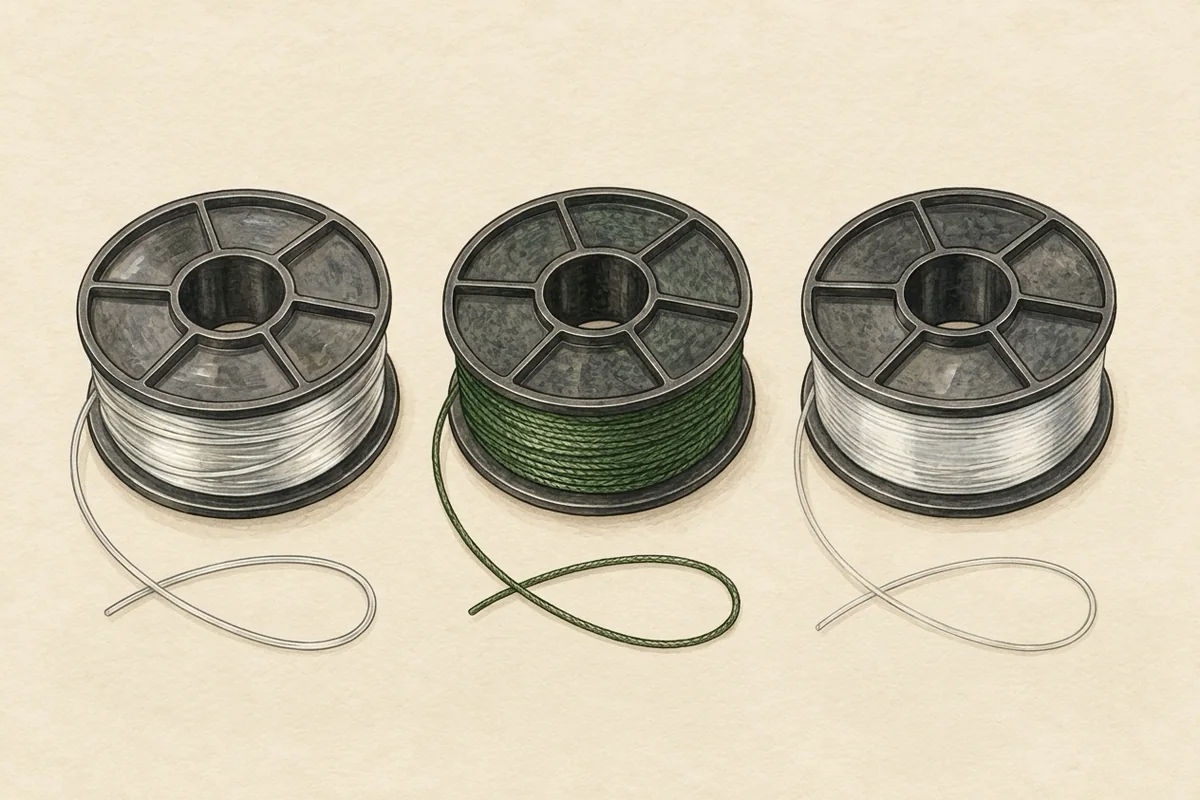
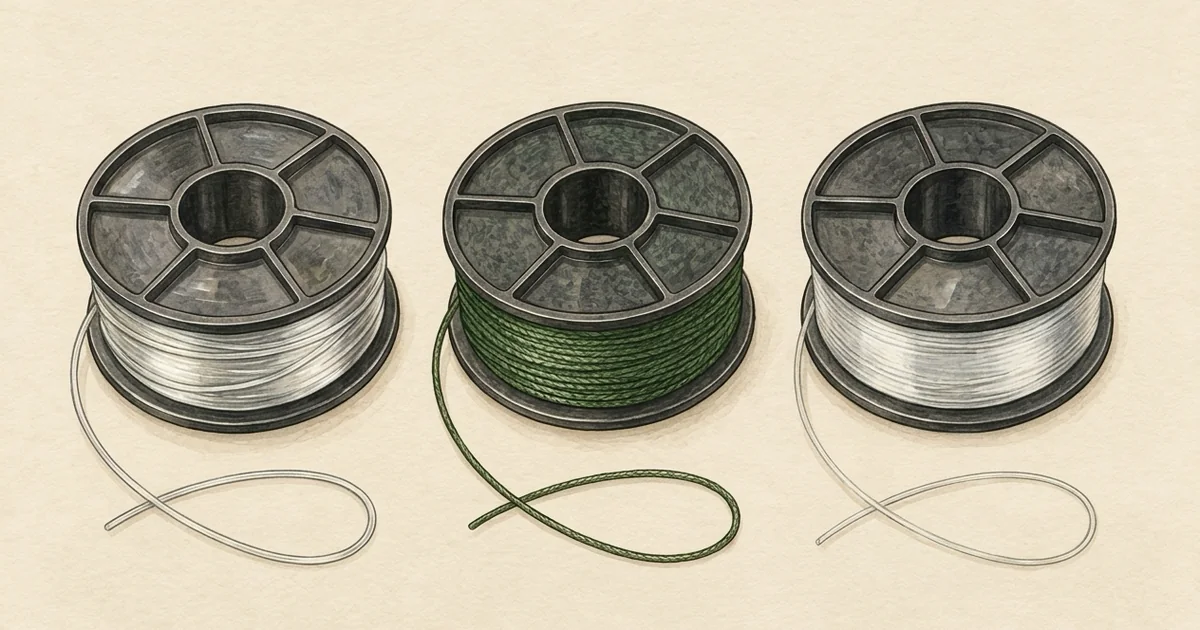
The three line types differ mainly in material. Monofilament line is a single strand of nylon (polyamide). Braided line consists of several very thin fibres of ultra-high-molecular-weight polyethylene (UHMWPE) braided together. Fluorocarbon is also a single strand, but made of a fluoroplastic (PVDF).
| Property | Monofilament (nylon) | Braid (PE) | Fluorocarbon |
|---|---|---|---|
| Density of the material (water = 1) | approx. 1,13, sinks slowly | Fibres around 0,93–0,94, the line tends to float | approx. 1,76–1,83, sinks |
| Refractive index (water 1,33) | 1,53–1,56 | – | approx. 1,42 |
| Stretch | high, around 15 % for many lines | very low | little, between mono and braid |
| Breaking strain at the same diameter | lower than braid | considerably higher | somewhat lower than mono |
| Typical use | All-round, entry level, float and bottom fishing | Spinning, long casts, bite detection at a distance | Leader, clear water, obstacles |
Monofilament line: the forgiving all-rounder
Nylon stretches noticeably under load. That cushions runs and head shakes and prevents the hook from tearing out of a soft mouth. The drawback of the same property: at long distance a bite arrives muted, and the strike becomes softer. Nylon also absorbs water and can weaken over time through heat, sunlight and salt water. More on this under Monofilament line.
Practical tip: Check your monofilament mainline regularly. If it is damaged over a longer stretch or has been on the spool for many years, it is time to change it.
Braided line: direct contact, little cushion
Braid hardly stretches. Every contact with the bottom or a fish arrives directly in the rod, and the strike sets even at a distance. At the same diameter braid is considerably stronger than mono, so you can fish thinner. What is missing is the cushion: rod action and drag have to absorb the runs, and you set the drag much more finely than with mono, see Setting the reel drag.
There are two points you should know. First, the material is smooth, so knots hold worse. In a series of measurements by Fisch & Fang, two braids tested, knotted, held on average only about 54 and 59 per cent of their breaking strain. Check every knot, for example the Palomar knot, with a pull test. Second, the stated diameter is often wrong: in a Blinker test five lines rated at 0,08 mm measured between 0,09 and 0,14 mm. That affects how much line fits on your spool (see Line calculator, diameter allowance).
Fluorocarbon: low refraction of light, sinks quickly
The refractive index of fluorocarbon is closer to that of water than that of nylon. That is why it is considered harder to see. A tank experiment with a physicist, however, showed that fluorocarbon was hardly less conspicuous than nylon, because every round line acts like a small lens in water. It does not absorb water and is less sensitive to UV light. That it is particularly abrasion-resistant is claimed and doubted at the same time, more on this under Fluorocarbon. At the same diameter it is often stiffer than nylon and slightly less strong. When knotting, fewer turns than with nylon and careful wetting before tightening help.
Fluorocarbon is mostly used as a leader in front of a braided mainline, joined for example with the FG knot. That way you combine the direct contact of braid with an inconspicuous end piece. It is not fully bite-proof against pike teeth, only in very thick diameters and even then not like metal. Where pike occur, steel or titanium belongs in front of the lure, see Pike hooklength.
Reading the details on spool and packaging
Three details are almost always on the packaging: the diameter in millimetres, the breaking strength in kilograms or in lb (pounds) and, with braid, often a PE number. For conversion, 1 lb equals around 0,454 kg, so 20 lb becomes about 9,1 kg. The unit converter works that out for you.
Of the three figures, the diameter is the weakest. With braid, according to Rute & Rolle, there is no uniform basis on which manufacturers measure it. Breaking strength is right more often, because it is measured on tensile testing machines. It is still not reliable: in the braid test there were also marked deviations from the values on the spool. And if a line of 0,10 mm carries a very high value such as 10 kg, then in the editors‘ view probably only one of the two figures is right.
Whether a breaking strength figure applies to straight line or to knotted line decides what arrives at the water. In the test with the home-built testing machine, lines from different manufacturers showed different values for both line and knot strength.
The PE number sorts braids into classes. According to Blinker, PE 0,2 corresponds to a braid of 0,08 mm, PE 1 to one of 0,165 mm and PE 6 to one of 0,40 mm. On lines from the German trade it is only rarely on the packaging. The construction of braid is covered under Braided line.
For choosing, breaking strength in kg is therefore the yardstick, with the diameter only as a rough guide.
Knot strength: what is left after the knot
Every knot weakens the line, and how much depends on the material. Fisch & Fang has published a series of measurements in which knotted samples were loaded to breaking with a home-built machine and compared with the breaking strength of the straight line. Five monofilaments from 0,20 to 0,50 mm and two braids were tested. The series is small; the percentages are guide values.
- Improved clinch knot: monofilament on average around 81 per cent, braid around 64 per cent of breaking strength.
- Uni or grinner knot: monofilament around 70 per cent, braid around 58 per cent.
- Surgeon’s loop: monofilament around 66 per cent, braid around 47 per cent.
- No-knot (wire connector around which the line is wound): around 89 per cent with the two braids.
With the thicker monofilaments the share was lower. The thinnest monofilament (0,20 mm) kept around 81 per cent on average across all knots tested; at 0,40 mm it was 59 and at 0,50 mm 67 per cent. In absolute terms the thicker line still carried more. On braid no knot slipped through; it broke at the clamping point. You will find the knots themselves under Improved clinch knot and Uni knot. Wet every knot before pulling it tight and test it with a pull test before use.
Abrasion, UV light, water and ageing
- Abrasion: monofilament is often markedly more abrasion-resistant than braid. Braid reacts sensitively to sharp-edged mussel shells and stones and is quickly cut. Among braids, the four-strand weave has somewhat better abrasion resistance than the eight-strand, which runs smoother and quieter in return. For fluorocarbon, abrasion resistance is disputed (see above).
- UV light: monofilament line can age with long exposure to sunlight and lose breaking strength. Fluorocarbon is considered less sensitive.
- Water: polyamide absorbs water. A study by the Leibniz Institute of Polymer Research Dresden and TU Dortmund describes how absorbed water markedly lowers the stiffness and strength of polyamide 6. It measures the material, not finished fishing line, and gives no percentage figure for line.
- Age: line loses breaking strength over time, even if it is hardly fished. After some years the losses can be considerable.
Storage
Store line cool and dry and protect it from constant UV exposure, otherwise it becomes brittle. After fishing, reels with monofilament are best put away in a dark bag. New monofilament from the bulk spool needs time: give it at least 24 hours to adapt to the smaller spool shape, otherwise it forms twist and bird’s nests.
Whether a line has weak points is shown by the cotton-wool test: run it through a ball of cotton wool. If fibres catch, it is damaged and should be replaced. Monofilament only lasts long if the rod guides and line roller are intact.
Main line by method: guide values
The ranges come from angling magazines and exam materials, which the line calculator also draws its guide values from. They are usual figures, not a standard. Figures in lb are converted with 1 lb equal to 0,454 kg.
| Method | Main line | Breaking strength | Example |
|---|---|---|---|
| Float fishing for coarse fish | Monofilament | 1,8 to 2,7 kg | Bream, tench, roach |
| Feeder and bottom fishing for coarse fish | Monofilament | 3,6 to 5 kg | Bream, tench |
| Carp on the bottom | Braid or monofilament | Braid 10 to 20 kg, monofilament in a river at least 6,8 to 9,1 kg | Hooklength separate |
| Spinning for perch and trout | Braid | 4 to 5,4 kg | light tackle |
| Spinning for zander, pike, asp | Braid | 6,8 to 15 kg | Pike: steel or titanium in front of the lure |
| Wels catfish fishing | Braid | 30 to 70 kg | Exam question, Bavaria: 0,50 mm |
| Spinning and pirking at sea | Braid | 8 to 15 kg, pirking around 20 kg | Coast and fjord |
| Beachcasting | Monofilament with thick shock leader | Main line 5,4 to 13,6 kg, shock leader around 27 kg | heavy weights |
Joining braid to monofilament or fluorocarbon
Between thin braid and the lure there is almost always a piece of other material. A piece of monofilament protects the first metres in front of the lure better against abrasion. Its stretch gives some buffer and lowers the number of fish coming off. With heavy weights there is another point: a thick mono shock leader does not cut into hands and fingers on the cast the way braid does.
The rule for the length of the shock leader is: as long as the rod plus five to six turns on the reel. In heavy feeder fishing it stays at no more than 0,35 mm thick, and in surf fishing it is up to 0,70 mm. As a buffer in the fight, Rute & Rolle recommends by contrast two to three rod lengths of monofilament in front of the braid for soft-mouthed fish such as trout, perch, asp and chub.
- FG knot: the braid is laid in crossing wraps around the monofilament, which itself is not knotted. Tied properly it reaches almost 100 per cent of the breaking strength, adds hardly any bulk and glides through the guides.
- Albright knot: joins lines of different thickness. It is not recommended for very high drag forces, because the braid can cut through the doubled monofilament.
- Swivel or knotless connector: this only works with short pieces of mono. If the monofilament becomes longer than about 1 m, the risk rises of the swivel being wound through the tip ring.
- Shock leader knot: the knot between shock leader and main line must be tied cleanly and be as small as possible so that it runs through the guides with little friction. Trim the ends, see Shock leader knot.
Anyone who snags often can tie the lure connection on the monofilament with a uni knot, which at 70 to 80 per cent of breaking strength serves as a deliberate weak link. In a snag, only the lure is then lost.
Line breaks on the cast: causes
If the line breaks on the cast, it is seldom down to breaking strength alone. Go through the possibilities in turn:
- Main line too thin for the weight. On power casts with heavy weights, forces arise that would tear thin main lines. That is what the shock leader is for, as a buffer.
- Shock leader too short or knot too big. If the shock leader is shorter than the rod plus turns, the thin braid runs through the guides under load. A thick knot also slows the cast.
- Rough guides or line roller. Check guide inserts and roller before you spool new line; the cotton-wool test shows a damaged spot.
- Spooled too loosely. If braid lies too loose, it can cut into the lower layers under load and no longer peel off. Wind loops and knots are then likely. The instructions are under Spooling a reel correctly.
- Too little line on the spool. A spool that is not properly filled prevents long casts, because the line rubs a lot on the spool edge.
- Old or damaged line. It has lost breaking strength and breaks first where it has already suffered.
Changing and disposing of old line
Reasons for a change are line that has become too short through break-offs, damage over a longer stretch and many years on the spool. With braid it is worth spooling a few turns of monofilament first, because the smooth line can otherwise slip on the spool core under load.
Do not cut old line off the spool with a knife; you can damage the spool. A cordless screwdriver helps to spool it off. Cut the old line into short pieces and dispose of it properly so that birds and other animals do not get caught in the remains.
Common mistakes
- Fishing braid like mono. With no stretch in the system the drag needs a finer setting, otherwise fish are lost in the fight.
- Trusting the diameter of braid. The spool is then full earlier than calculated, because the line is thicker than stated.
- Using fluorocarbon as pike protection. Sharp teeth can damage it, only metal is safe.
- Spooling braid without a monofilament backing. The smooth line then turns on the spool core under load.
- Fishing new monofilament straight away. Freshly spooled from the bulk spool, it is prone to twist; let it rest for 24 hours.
- Not testing the knot. A pull test shows a badly tightened knot before it breaks on a fish.
Frequently asked questions
Which fishing line is best for beginners?
Mono. It is easy to knot and, thanks to the stretch, forgives mistakes in the fight. If you later cast far or fish with lures, you switch to braid with a leader.
Does braid always need a leader?
Usually yes. Braid is easy to see in clear water and under tension can break at the slightest contact with mussels or stones. A leader of fluorocarbon or mono serves as protection against visibility and abrasion.
Does braided line sink?
Rather not. The fibres are lighter than water, and the braid traps air. Even braids sold as sinking tend to float up.
How long should a shock leader be?
As a rule of thumb, as long as the rod plus five to six turns on the reel. Then there is no strain on the thin braid on the cast. The knot stays on the spool until the line peels off.
When should I change the main line?
When it has become too short through break-offs, is damaged over a longer stretch or has been on the spool for many years. Even unused line loses breaking strength over time.
Related
- Monofilament line: stretch, breaking strain and ageing in detail
- Braided line: number of strands, diameter and knots
- Fluorocarbon: what is proven and what is only on the pack
- Pike hooklength: steel, titanium or hard mono in front of the lure
- Spooling a reel correctly: new line without twist
- FG knot: joining braid and leader
- Line calculator: breaking strain after the knot and spool capacity
- Unit converter: lb, oz, ft and yd to kg, g and cm
Sources
- Blinker: Monofile Angelschnur, ein Strang für viele Situationen (Handhabung, Dehnung, Tragkraft, UV-Alterung, Abrieb)
- Blinker: Karpfenschnur, die richtige Leine fürs Karpfenangeln (Dehnung etwa 15 %)
- Blinker: Fluorocarbon-Angelschnur, die unsichtbare Leine (Brechungsindex 1,42 und 1,53–1,56, Steifheit, Tragkraft, Knoten, UV)
- Blinker: Geflochtene Angelschnur im Test (gemessene Durchmesser und Tragkraft, Flechtung, Abrieb)
- Blinker: Wie viel Schnur passt auf eine Angelrolle? (PE-Nummer)
- Blinker: Angeln mit der Baitcaster-Rolle (feinere Bremse bei Geflecht)
- Blinker: Fluorocarbon-Vorfach für Hecht (nicht völlig bissfest)
- Blinker: Alles neu, mit frischer Schnur in die Saison (Anlässe für den Wechsel, Unterfüttern, Aufspulen, Entsorgung)
- Blinker: Was ist eigentlich eine Schlagschnur? (Länge, Dicke, Knoten, Muscheln)
- Blinker: Mono an Geflecht, mit diesen Knoten sind Sie immer gut verbunden (FG, Albright, Wirbel, Sollbruchstelle)
- Blinker: Richtiger Umgang mit monofiler Schnur (Lagerung, Spulenform, Knotentest)
- Blinker: Haltbarkeits-Datum (Sonnenlicht, Wattebausch-Probe, Ringe)
- Fisch & Fang: Die Wahrheit über Fluorocarbon (Wannenversuch, Linseneffekt)
- Fisch & Fang: Knoten im Vergleich (PDF) (Knotenfestigkeit je Material und Durchmesser, Herstellerabweichungen)
- Rute & Rolle: Schnur, Verbindung zum Fisch (Pufferwirkung, Tragkraft zu Durchmesser, Durchmesserangaben)
- Rute & Rolle: Die richtige Schnur, monofile oder geflochtene? (Geflecht reißt bei Berührung unter Spannung, Mono-Puffer)
- Angling Times: Is fluorocarbon, braid or mono better for carp fishing? (Schwimm- und Sinkverhalten, Dehnung im Vergleich)
- Polymers (2024): Molecular Dynamics Simulation of Hydrogen Barrier Performance of Modified Polyamide 6 (Dichte von Polyamid 6 um 1,13)
- University of Warwick, Polymers 13(9): On the Solubility and Stability of Polyvinylidene Fluoride (Dichte von PVDF 1,76–1,83)
- Leibniz-Institut für Polymerforschung Dresden und TU Dortmund, Polymers 13(9): Characterisation and FE Modelling of the Sorption and Swelling Behaviour of Polyamide 6 in Water (Wasseraufnahme senkt Festigkeit)
- Wikipedia: Ultra-high-molecular-weight polyethylene (ergänzend: Dichte der Fasern)
- Wikipedia: Monofilament fishing line (ergänzend: Schwächung durch Hitze, Sonnenlicht und Salzwasser)
- Blinker: Brassen mit der Feederrute leicht gemacht, Angling Times: How to catch your first tench und Angling Times: Catch more skimmers and bream on the waggler (Richtwerte Pose und Feeder)
- Blinker: Karpfen-Kickstart und Angling Times: How to catch your first river carp (Richtwerte Karpfen)
- Angling Times: Winter perch lure fishing tips und Rute & Rolle: Leicht auf Forellen mit UL-Baits am Bach (Richtwerte Barsch und Forelle)
- Blinker: Gummifischgröße für Zander, Blinker: Einsteiger-Guide Hecht und Blinker: Zielfisch Rapfen (Richtwerte Raubfisch)
- Blinker: Welsangeln, Tipps und Tricks und Bayerische Landesanstalt für Landwirtschaft: Prüfungsfragen zur Fischerprüfung 2023/2024 (PDF) (Richtwerte Wels)
- Blinker: Norwegen, Angeln im Fjord und Sea Angler: Beginner’s guide to cod fishing from the shore and beach (Richtwerte Meer und Brandung)
Text AI-assisted, drawings AI-generated. Sources opened and checked in November 2026, no graphics taken from the sources.
All figures are guide values without guarantee. The properties of individual lines depend on manufacturer, diameter and coating.