
Knowledge · Knots
How to tie a shock leader knot
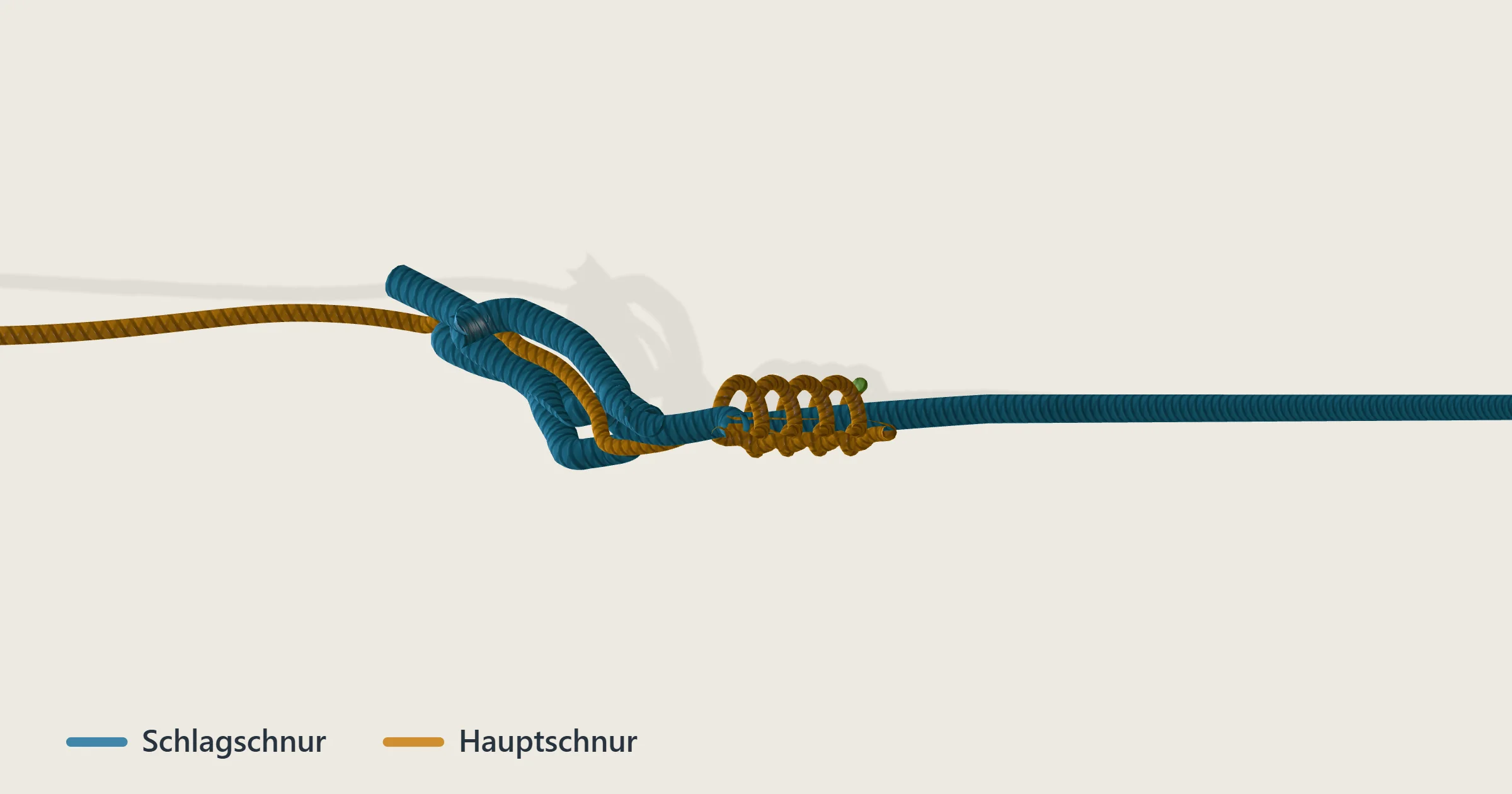
The shock leader knot joins a thin main line to a thick shock leader. The shock leader protects the main line from snapping when heavy rigs are cast. A common connection is an overhand knot in the shock leader combined with a wrapped knot of the main line in the manner of the grinner.
What is the shock leader knot good for?
You need a shock leader wherever heavy weights or feeders are cast a long way: in sea fishing from the shore as much as in carp and feeder fishing at distance. As a guide, Sea Angler gives at least 50 lb breaking strength for the shock leader with a 150 g weight and 60 lb with 170 g. Keep the knot in the thick line as small as possible, so a simple overhand knot is enough there.
There is no single standard shock leader knot. Other sources use the Albright knot or the FG knot for the same purpose.
Tying the shock leader knot step by step
- Overhand knot in the shock leader. Tie a simple overhand knot in the end of the shock leader and do not tighten it yet.
- Passing the main line through. Push the end of the main line through the open overhand knot. Sea Angler pulls about 20 cm through.
- Tightening the overhand knot. Moisten the overhand knot and pull it really tight.
- Tying the grinner. With the main line, lay a loop close to the overhand knot, wrap its end about six times around the shock leader and pass it through the loop. Sea Angler adds two more turns around the shock leader for safety.
- Drawing up. First pull gently until the turns settle neatly. Then moisten the whole knot, pull the turns tight and give the overhand knot another firm pull.
- Trimming. Cut the ends off close so that the knot stays compact and runs smoothly through the rings.
Common mistakes
- Pulled with full force straight away: Pull gently first so that the turns settle cleanly, and only then firmly.
- Turns with gaps: The turns of the main line must lie close together, otherwise the knot slips.
- Loose overhand knot: It must be pulled up tight before you tie the grinner.
- Ends too long: Long ends run badly through the rod rings.
Pull test and knot strength
First check that the turns lie neatly side by side and both lines are undamaged. Then pull steadily on the main line and the shock leader. Do not wrap thin line round bare fingers. If an end slips or the knot distorts, tie it again. A pull test does not measure breaking strength, it only shows gross tying faults.
Material, diameter and tying technique affect every connection. The line calculator gives you a rough guide using cautious knot factors of our own.
Related knots
The grinner corresponds to the Uni/grinner knot. The sources name the Albright knot and the FG knot as alternatives.
Used in the rig: surf rig. Also used in surf fishing.
Note: The sources name different knots and numbers of turns for the shock leader. The steps here follow the instructions from Sea Angler.
Sources
- Sea Angler – How to tie the shockleader knot
- Angling Times – How to tie a shockleader for fishing
- Blinker – Der FG-Knoten
Sources opened and checked on 2 October 2026. Texts in our own words, sketch drawn independently; no graphics taken from the sources. You will find all knots in the overview of fishing knots.
All figures are guide values without guarantee. Follow the line manufacturer’s instructions.