
Knowledge · Fishing methods
Beachcasting
In surf fishing you cast a ledger rig with natural bait far out to sea from the beach, set the rod steeply in a tripod and wait for the bite on the tip. On the Baltic coast, surf fishing has its season from autumn to spring.
What beachcasting is and where it is done
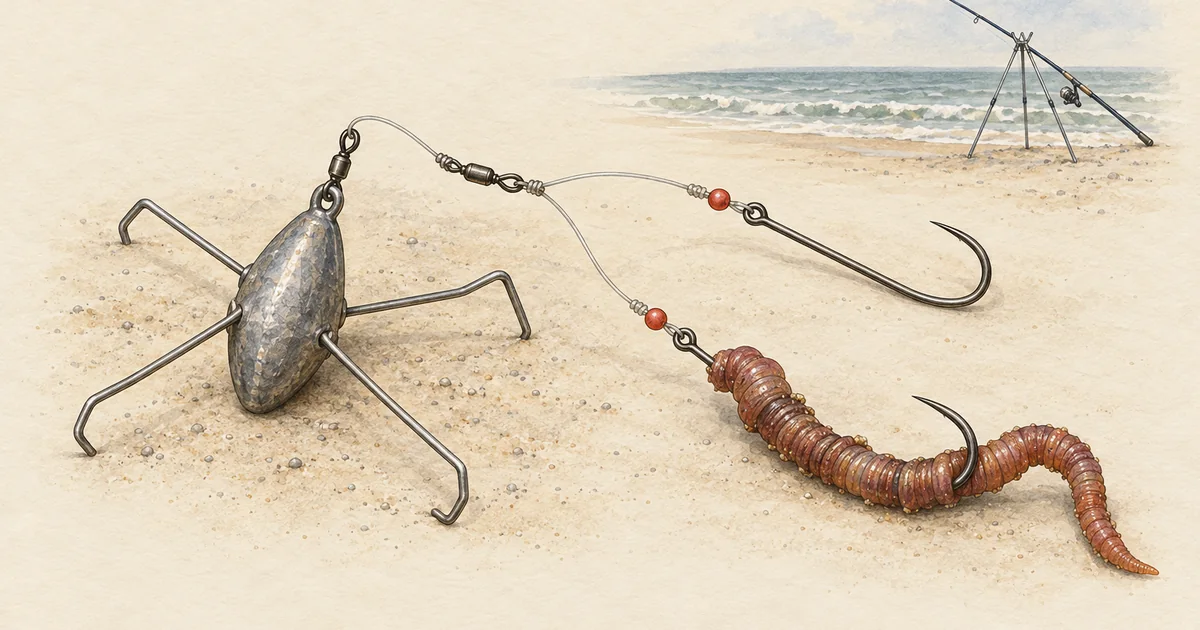
Beachcasting is bottom fishing at sea: a heavy lead holds the rig on the bottom, and the bite shows on the rod tip. Surf, meaning breaking waves, is often hard to find on a Baltic beach, writes the magazine Blinker.
On the Baltic, according to Blinker, many sea anglers stand on the beach with their tripods from autumn to spring. Fishing from the beach is also done on the North Sea, reports the Deutscher Angelfischerverband (DAFV). On the seaward coasts of the East and North Frisian islands and on the west coast of Denmark, according to Blinker the wind is often onshore, that is, blowing from the sea to the land. Heavy beachcasting tackle is a must there. In Denmark flatfish can be caught along almost the whole coastline (Blinker).
Reading the beach
Off a sandy beach, sandbars and gullies alternate. Geoscience calls the bars sand reefs: accumulations of sand or gravel that, in the surf zone of flat coasts, usually lie parallel to the beach (Lexikon der Geowissenschaften). The Generalplan Küstenschutz for Mecklenburg-Western Pomerania puts their height on the outer coast at a few decimetres to about 1,5 metres. Their number is given on the page Fishing the coast and surf.
How to tell a bar from a gully:
- Breaking waves: A wave breaks when it reaches shallow water and is slowed at the bottom (DLRG). If the waves break further out in a line parallel to the beach, there is a shallow spot there: the sandbar.
- Dark stripes: A dark stripe in the water shows a deeper gully (Fisch & Fang). Look for it while it is still light.
- Low water: On the North Sea, the sea-angling officer of the association (DAFV) inspects the beaches at ebb tide to find gullies and hollows. More under Tides: ebb and flow.
- Current: When waves hit the coast at an angle, a longshore current runs parallel to the beach between the shore and the sand reef (Lexikon der Geowissenschaften). A trial cast with just a lead shows where the line drifts (Fisch & Fang).
- Gap in the sandbar: Here the banked-up water pushes seaward. The DLRG calls this rip current particularly dangerous; you do not wade there.
Where the fish feed
According to the Thünen-Institut, the flounder eats thin-shelled mussels, bristle worms, crustaceans and small fish. That is why Blinker looks at eelgrass and mussel beds next to the sandy bottom.
The sources see differently where the flatfish lie. Blinker calls the sandbar their home, where they partly lie buried. The DAFV officer, by contrast, fished in the troughs between the beach and the first sandbar and warns against casting too far: the fish feed right in close.
The cod keeps to different ground: weedy, stony or gravelly, plus mussel beds (Blinker extra). In one example from the magazine the cod were hunting in the first weedy gully, not 30 metres from the shore.
Wind, waves and turbidity
Waves work on the bottom: the swell loosens material and stirs it up, says the Generalplan Küstenschutz. With an onshore wind of force 6 to 8, the plan expects mean wave heights of 0,5 to 1,5 metres near the shore.
On the time of day there is one expert statement: according to the Thünen-Institut, large flounders lie buried in the sand by day and move into shallower water at night to feed.
What follows from that for catching is found in the angling press. It has not been measured. Blinker puts it like this: if the sea is calm and the water clear, flatfish are usually caught from the beach only in the evening and at night. With waves and murky weather they can bite all day. An onshore wind brings turbidity and water movement and sends flatfish looking for food. For cod, the Blinker supplement names spots with an onshore wind, dusk and night.
More recent is an observation by a Blinker author: since the cod have been missing from the Baltic, flatfish also bite in broad daylight. Wind and gusts for your coastal spot are shown by Weather at the water.
Tackle in outline
Lengths, casting weights and line strengths are under Sea rod and Beachcasting rig. Here only their purpose:
- Rod and reel: long and strong, so that bait and heavy lead travel far out.
- Shock leader: a thick length of line in front of the thin main line. It absorbs the forces of the cast that would snap the main line (Blinker). The connection is shown by the shock leader knot.
- Grip lead: a lead with wire arms. Only such leads, according to Blinker, hold the rig in place in heavy surf. The arms do pick up weed, though.
- Tripod: the rod rest with three legs. A bag of sand hung from it stops wind or a fish knocking it over.
- Bait: lugworm and ragworm.
How a session goes on the beach
- Setting up: Put up the tripod and weigh it down.
- Baiting up: The lugworm goes on the hook with a baiting needle; only that way, according to Blinker, does it survive the cast.
- Casting: With the pendulum cast the lead lies behind you on the sand, the line taut. Then you pull the rod through over your shoulder to the front. The reel drag is fully tightened for this (Rod and reel).
- Tightening the line: Wind in the slack line until the tip is under slight tension. Then it also shows the drop-back bite, where the fish swims towards you (Blinker, there for the feeder rod).
- Rod steep: The higher the tip, the less line lies in the waves. Fisch & Fang leans the rods lower only when little weed is drifting.
- Waiting for the bite: According to Blinker, flatfish bite cautiously. The tip trembles briefly, then it goes quiet. Wait to strike until the fish has taken the bait.
- Searching: Blinker casts one rod as far as possible and puts the second out at about 60 metres, later at 40. Now and then inching is worthwhile: draw in a little line so the bait moves.
Target fish and season
| Species | Where it lives | Time | Note |
|---|---|---|---|
| Flounder | from close to the beach out into the deep, over sand and gravel | May to November | feeds at night in the shallows |
| Plaice | more in the west of the Baltic, mostly deeper | May to November | now more often from the beach |
| Dab | saltier west, mostly from 6 to 8 m depth | May to November | likes to feed near the beach at night |
| Whiting | more at breakwaters and sea piers | all year, best from late summer to autumn | occasional bycatch |
| Cod | weed, stones, gravel, mussel beds | April to June, October to December | Baltic banned in 2026, catch back at once |
Spots and months come from a Blinker supplement of 2007 for the Baltic Sea. They are guide values. As the best time for flatfish in the surf, Blinker names September to the end of November. Sea trout bite while beachcasting only by chance. Monthly values are shown by the Catch calendar.
Cod in the Baltic Sea: In the whole Baltic Sea fishing for cod is banned in 2026. If you catch one by accident off the German or Danish coast, you put it back at once (Verordnung (EU) 2025/2454, Artikel 10; DAFV). The catch limits are decided anew every year; this is the position as of October 2026. More under Releasing fish.
Safety, cold and paperwork
- Casting: Cast only when nobody is behind you or in the line of the cast, and keep your distance from your neighbour. Blinker warns about walkers on the beach: a 180-gram lead in flight can be lethal. The shock leader absorbs the forces of the cast, and a finger guard protects your index finger from the line.
- Do not wade into the surf: According to the DLRG, the backwash can knock adults off their feet even in shallow water. If you wade, read Bank and waders first.
- Cold: In cold weather wind chills the skin the more, the faster it blows. The Deutscher Wetterdienst calls this the wind-chill effect (DWD). On an autumn beach, windproof clothing counts.
- Darkness: A head torch leaves both hands free. More under Night fishing.
- Paperwork: Each coastal state sets its own rules on the fishing licence (Fischereischein), minimum sizes (Mindestmaß) and closed seasons (Schonzeit). Guides: Fishing the coast and surf, Fishing licence and angling exam, Fishing in Germany and Fishing holiday in Denmark.
Frequently asked questions
How far do you need to cast?
Often not as far as you think. For flatfish at most beaches, Blinker gives 40 to 100 metres. Put one rod out far and one short.
Can you take a cod from the Baltic Sea?
Not in 2026. Fishing for cod is banned there, and a fish caught by accident goes straight back. The rule is decided anew every year.
Do you always need a grip lead?
No. Blinker advises doing without one whenever conditions allow: a bait that slowly moves across the bottom catches more flatfish than an anchored one.
Related
- Beachcasting rig: how the hooklength is built, with two snoods
- Sea rod: length and casting weight of the surf rod
- Sea fishing: pier, boat and charter boat at a glance
- Weather, air pressure and wind: what is proven about weather and bites
Sources
- Blinker: Beachcasting, Plattfischangeln, 10 Tipps, Plattfische angeln mit Wurm vom Ufer, Angeln in Dänemark (Reviere, Platzwahl, Wurf, Biss, Zeiten)
- Blinker: Was ist eigentlich eine Schlagschnur?, Bissanzeiger richtig nutzen, Steckbrief Wittling, Blinker extra: Die Fische der Ostsee (Beilage 2007: Plätze, Monate)
- Fisch & Fang: Zitterübung in der Brandung (dunkler Streifen, Probewurf, Rutenstellung)
- Rute & Rolle: Brandungsangeln, 10 Tipps für mehr Meter (Rollenbremse)
- Deutscher Angelfischerverband: Steinbutt, Flundern und Sonnenbrand (Nordsee, Rinnen bei Ebbe, kurze Würfe), Fangregeln Ostsee 2026
- Thünen-Institut, Fischbestände online: Flunder (Nahrung, nachts im Flachen)
- Verordnung (EU) 2025/2454, Artikel 10 (Dorsch in der Ostsee 2026)
- Spektrum, Lexikon der Geowissenschaften: Sandriff, Brandungsstrom
- DLRG: Gefahren in Küstengewässern (Brandung, Sog, Rippströmung)
- Deutscher Wetterdienst: Wind-Chill-Effekt
- Generalplan Küsten- und Hochwasserschutz Mecklenburg-Vorpommern (Sandriffe, Seegang)
Text AI-assisted, drawing AI-generated. Sources opened and checked in October 2026; no graphics taken from the sources.
All figures are guide values without guarantee. The safety notes are no substitute for medical advice; the fishing licence (Fischereischein) and fishing bans are governed by the coastal states and the EU.