
Knowledge · Tackle
Sea rod: Surf rod, pilk rod and boat rod
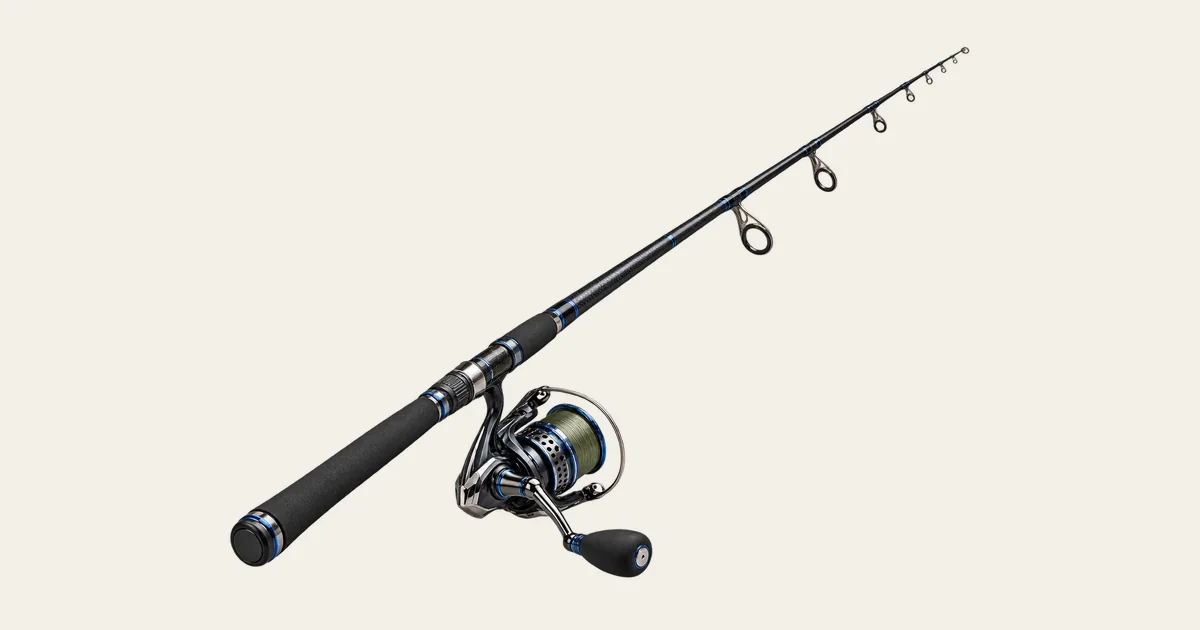
There is no such thing as one sea rod: on the beach, on a cutter and in a boat over deep water you need three different designs. This page shows what separates the surf rod, the pilk rod and the boat rod, which lengths and casting weights are usual, and what salt water demands of the gear.
Three designs at a glance
| Design | Length | Casting weight or class | Use |
|---|---|---|---|
| Surf rod | 3,50–4,20 m | around 200 g | Bottom rig with a weight far from the beach, rod laid in the tripod |
| Pilk rod | 2,10–3,00 m, on the cutter up to 3,50 m | 100–250 g | Pilkers and soft plastics from a cutter or boat, mainly for cod |
| Boat rod for natural baits | 1,65–2,40 m | 20–30 lb, heavy 30–50 lb | Natural bait fished vertically under the boat, even at great depth |
The ranges come from specialist magazines and from teaching material for the angling exam (Fischerprüfung) and are guide values. For spinning from the shore, the spinning rod from fresh water is often enough.
Surf rod: distance from the beach
According to the specialist press, lengths between 3,50 and 4,20 m are usual. One magazine gives 3,90–4,20 m for anglers of normal build, another advises anyone who is not very tall to use 3,50 m. Around 200 g counts as a good casting weight, and the leads usually weigh 125–200 g; the exam material gives up to 300 g for pilk and surf rods. Length and casting weight send the rig far out to flatfish and cod. After the cast the rod stands upright in the tripod, a three-legged rod rest.
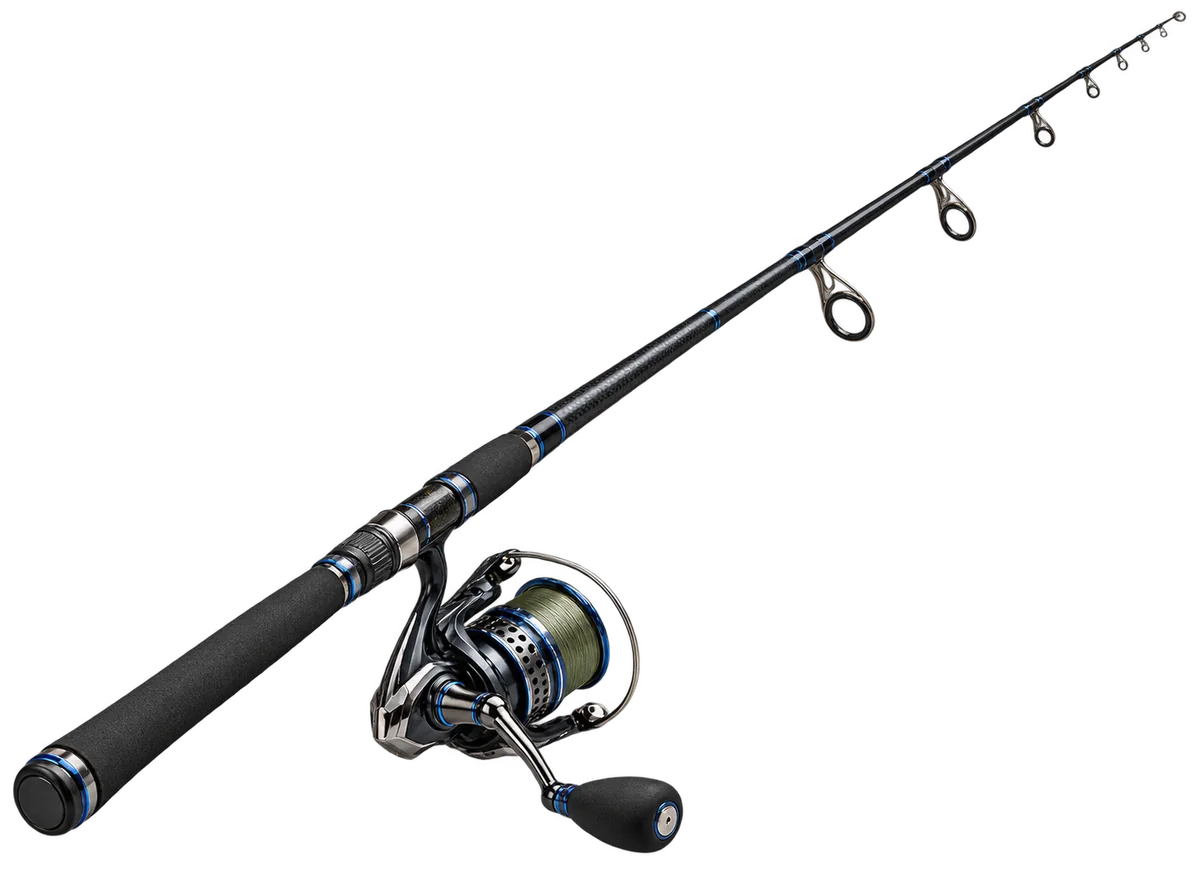
This calls for a large fixed-spool reel, that is, a reel with a fixed spool. Anyone casting with full power needs a shock leader (Schlagschnur): a thick length of line in front of the thin main line that absorbs the forces of the cast. It should be as long as the rod, plus five to six turns on the reel; diameters up to 0,70 mm are quoted for the sea. An alternative is the tapered leader, which tapers without a knot, for example from 0,58 to 0,33 mm. The page Surf rig shows the set-up.
Pilk rod: artificial lures from the cutter
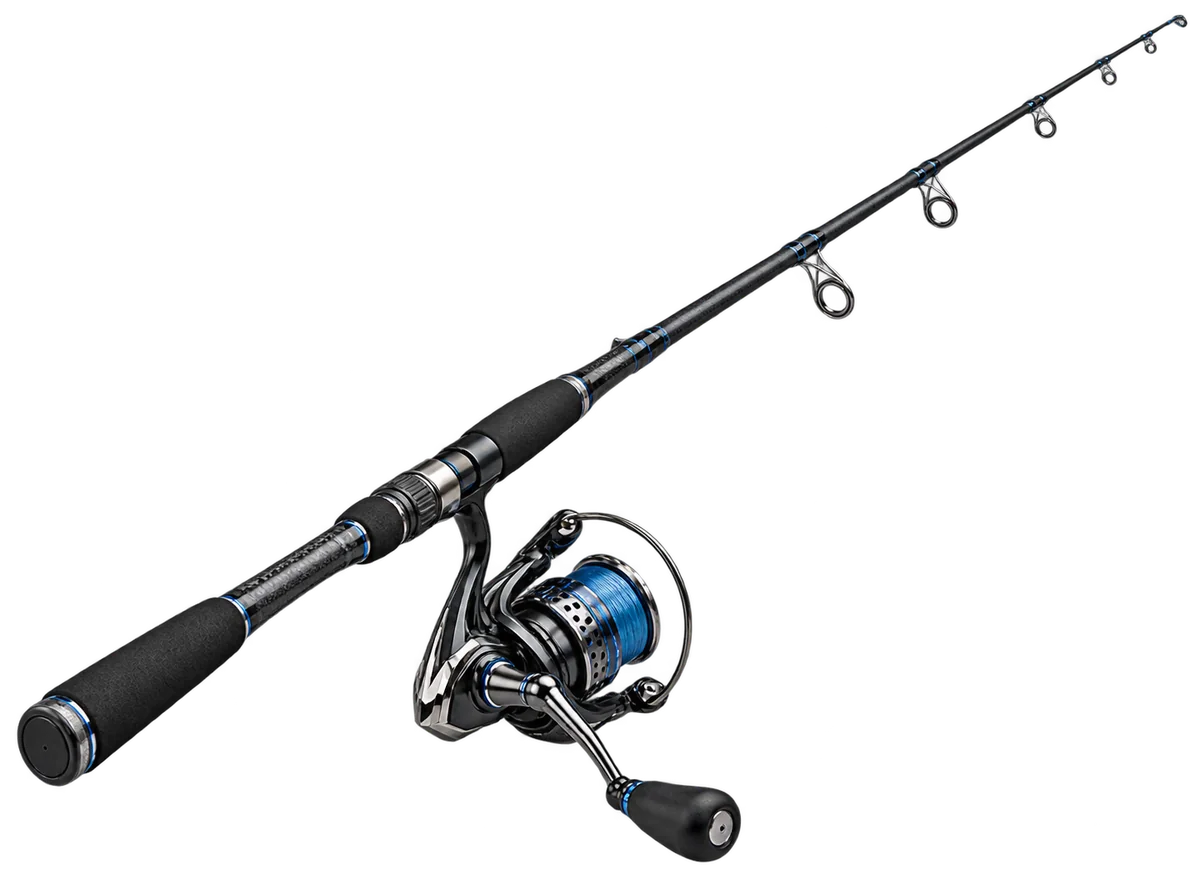
The pilk rod works pilkers (heavy metal lures) and soft plastics over the bottom from a cutter or small boat. For inshore pilking, a specialist magazine gives a length of 2,10–3,00 m and a casting weight of 150–250 g. Another advises at least 3 m with 100–200 g on a cutter and, with high superstructures behind you, models up to 3,50 m. In German waters the lures usually weigh 60–200 g, depending on the current. At reefs and wrecks, shorter, stronger rods of 2,10–2,70 m and 200–500 g are quoted. Fishing is done with a fixed-spool or multiplier reel and braided line.
Action and pirk weight
A pirk only catches when it moves. Rute & Rolle describes the technique like this: lower the rod towards the lure, wind in the slack line, then pull the rod back with one long or two or three short jerks and let the pirk tumble back to the bottom. According to the magazine, most bites come as it sinks. Fisch & Fang names a semi-parabolic action for the charter-boat rod. This means a rod that bends from the tip to about halfway under load, as the training material for the angling exam (Fischerprüfung) explains. According to Blinker this action suits pirking as well as natural baits.
The deeper the water and the faster the charter boat drifts, the heavier the pirk has to be to reach the bottom. The rod’s casting weight is chosen to match this heaviest pirk. It should not be heavier than necessary: heavy pirks sink faster, but they have less action on the drop, writes Rute & Rolle. For Norway, Blinker names a medium pirk rod with a casting weight of around 200–300 g, for pirks, soft plastics and lighter natural-bait fishing down to about 100 m. Rute & Rolle gives 100 to 200 or 300 g for the classic pirk rod, combined with a large fixed-spool reel.
On the charter boat: casting, securing the rod, teasers
You can drop the pirk straight down beside the boat or cast it. In shallow water a large boat scares the cod away; according to Rute & Rolle, the anglers who present the pirk some way from the boat therefore usually catch more. Even when the charter boat barely drifts in a calm, you search the area by casting. On Danish charter boats the rods are often kept in steel tubes on the rail between drifts. A report in Rute & Rolle secures them there with a bungee cord, hooked in at the bottom of the tube and looped once round the reel foot, so that they do not fall out in a swell.
Above the pirk there are often one or two teasers: small extra lures on a side dropper, usually a soft plastic, as the training material for the angling exam explains. When fishing over wrecks, Rute & Rolle advises no more than one teaser, as otherwise several big cod can be hooked on one rod at the same time. What else belongs on board besides the rod is listed in the Charter boat trip packing list.
Boat rod for natural baits: short and strong
Under the boat you mostly fish vertically, and casting distance does not matter. That is why these rods are short: for great depths and heavy fish, 1,65–2,10 m is quoted, and as a compromise for boat fishing 1,80–2,40 m. The short lever makes playing the fish easier.
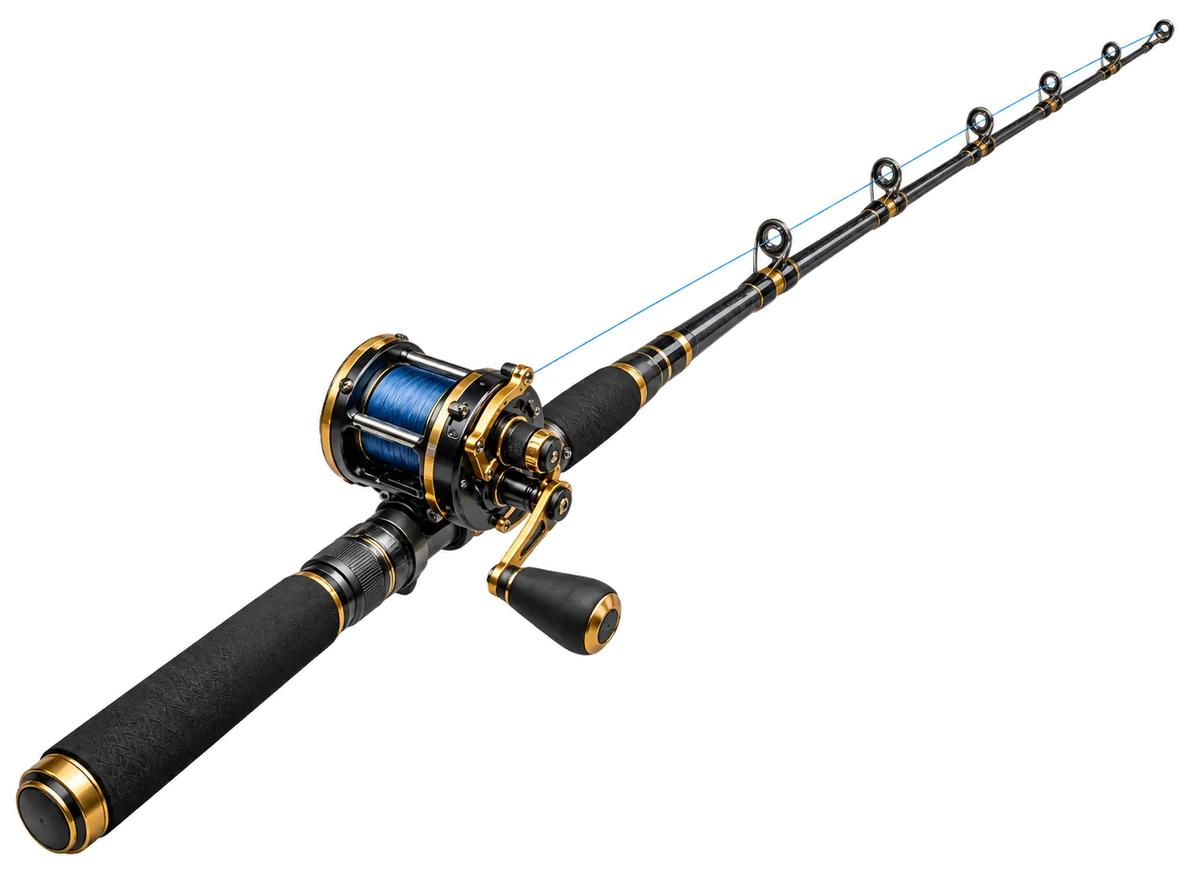
Instead of a casting weight, the blank (the rod shaft) often carries a rating in lb (English pounds); 1 lb is about 454 g. Depending on the rod, it stands for the line class, i.e. the breaking strength of the line the rod is matched to, or for the test curve: the weight that bends the rod to a right angle. For cod, pollack and similar species in Norway, a specialist magazine gives 20–30 lb (about 9–13,6 kg), and for very large fish or great depths 30–50 lb (up to about 22,7 kg). The unit converter translates the marking. Such rods usually take a multiplier reel, that is, a reel with a rotating spool that sits on top of the rod. You find the matching rig under Natural bait rig.
Rule of thumb: Long rods cast far, short rods give more control when playing a fish. That is why the surf rod measures up to 4,20 m and the heavy natural-bait rod for the boat is often only around 2 m.
Light natural-bait rod for the boat
Not every rod for natural bait in the boat is short and heavy. For plaice, flounder and dab lighter tackle is enough, as long as the bait stays on the bottom. For boat fishing for dab and flounder, Rute & Rolle names medium-weight ledger rods, and for dab a medium-sized fixed-spool reel and braided main line of 0,14 to 0,18 mm. Blinker considers light spinning rods right for flatfish in the Baltic Sea; only in deep water do heavier leads and stronger rods come in. On a charter boat off Denmark, Fisch & Fang describes simple pirk rods of 3 to 3,30 m with a casting weight of 100 to 200 g. Above all, the report says, enough length to handle the traces is important there.
The soft tip shows the bite
Flatfish bite cautiously. Blinker describes the bite as a slight trembling at first; Fisch & Fang calls the tip the bite indicator. A soft tip makes such plucks visible. That is why Rute & Rolle considers the feeder rod a proven choice when going after flounder from a boat, and Blinker mentions sea rods with a glass-fibre tip that shows bites better. On the strike the sources differ. Blinker advises not waiting long, because otherwise flatfish suck the bait in deeply; with an early strike, undersized fish can be unhooked gently. A report in Fisch & Fang, on the other hand, describes waiting and giving line until the fish hooks itself. If you have to return undersized fish, you will find what you need under Releasing a fish.
Paternoster with lugworm and fish strips
For a charter boat that barely drifts, Fisch & Fang describes a paternoster for casting: the lead sits at the end, with two or three side snoods above it, each with a hook. The lowest snood is tied long enough for the bait to drag over the bottom; the upper ones stay shorter so that nothing tangles. As baits, Rute & Rolle names lugworm and ragworm, fish strips and crab and mussel meat. According to Blinker, fishing is mostly done from a drifting boat; when there is very little drift, a short cast helps. The lead should be a little too heavy rather than too light, so that the bait keeps contact with the bottom. Fisch & Fang managed with around 100 g on a charter boat that was barely drifting. You choose the rod’s casting weight by this weight, not by casting distance.
How it differs from the surf rod
On the beach and in the boat, the same worm often goes after the same flatfish. The difference lies in the job. The surf rod has to get bait and a heavy lead from the beach out to a sandbank, as Rute & Rolle explains. For that it is 3,50 to 4,20 m long and carries a powerful fixed-spool reel with a large line capacity. For dab from the surf, the same magazine names monofilament main line of 0,40 to 0,45 mm, but thin braid in the boat. For flounder it lists ledger, boat and surf rods equally. In the boat, however, you mostly fish vertically, so the casting distance the surf rod is built for hardly matters there.
- From the beach at distance: surf rod, in a tripod after the cast.
- Small boat drifting, shallow water: light spinning or ledger rod with a soft tip.
- Charter boat for flatfish: simple pirk rod from 3 m, long enough for the trace.
- Deep water, strong drift, heavy leads: a stronger rod; at great depths the boat rod with a lb rating.
Salt water: rings, reel seats and care
Salt water quickly attacks poor-quality parts. Look for rings and reel seats that are marked as saltwater-proof or corrosion-resistant. The ring layout must suit the reel: rods for multiplier reels have more and lower rings so that the line does not touch the blank under load. Rods for fixed-spool reels have fewer rings that stand further off.
After the day’s fishing you rinse rod and reel with fresh water, without much pressure, and let both dry. Close the drag on the reel first and screw the handle tight; you should not submerge it.
Common mistakes
- Blindly trusting the marking: On surf rods, the stated casting weights are often too high, according to the specialist press.
- Buying too long and too heavy: Someone of normal build can hardly accelerate a very long, heavy rod; one magazine names 3,90 or 4,20 m and at most 200 g as the better choice.
- Pulling through at full power without a shock leader: The thin main line can snap during the cast.
- Always casting as far as possible: Cod sometimes hunt in the first gutter close to the shore. Put one rod out far and one shorter.
- Pilkers that are too light: The lure has to work on the bottom; if in doubt, choose it a little heavier.
- Mixing reel and ring layout: A multiplier reel belongs on a rod with rings made for it.
Angling for cod is banned in the whole Baltic Sea in 2026; the catch limits are decided anew every year. Check the rules for your area before every trip. The pages under Law give a starting point.
Frequently asked questions
Which pilk rod suits cod from a cutter?
For inshore pilking, a specialist magazine gives a length of 2,10 to 3,00 m and a casting weight of 150 to 250 g. Another advises at least 3 m with 100 to 200 g on a cutter.
What does lb mean on a boat rod?
The rating in English pounds stands, depending on the rod, for the line class or for the test curve. 1 lb is about 454 g. A specialist magazine gives 20 to 30 lb for cod and pollack in Norway.
How long should a surf rod be?
3,50 to 4,20 m is usual. One magazine advises anglers of normal build to use 3,90 to 4,20 m, another advises anyone who is not very tall to use 3,50 m.
Do I need to rinse rod and reel after salt water?
After the day’s fishing you rinse both with fresh water, without much pressure, and let them dry. Close the drag on the reel first and screw the handle tight.
Which rod should I use for flatfish from a boat?
Rute & Rolle names medium-weight ledger rods with a medium-sized fixed-spool reel; Blinker names light spinning rods for the Baltic Sea. What matters is a soft tip that shows the cautious bite. For the charter boat, Fisch & Fang names simple pirk rods from 3 m.
Related
- Sea fishing: methods and routine at the coast
- Surf rig: set-up with shock leader and weight
- Natural bait rig: rig for the boat rod
- Sea paternoster: side snoods above the lead
- Surf rod: the rod for long casts in detail
- Baitcaster and multiplier reel: reel with a rotating spool
- Fishing rods: overview of action and casting weight
- Line calculator: breaking strength and knots
Sources
- Blinker: Die richtige Meeresrute, darauf kommts an (Längen nach Einsatz, lb und Testkurve, Beringung, korrosionsbeständige Bauteile, semiparabolische Aktion, Glasfaserspitze, mittlere Pilkrute für Norwegen)
- Blinker: Brandungsangeln, alles, was man über diese Angelmethode wissen muss (3,50–4,20 m, 200 g, Dreibein, Keulenschnur, Rolle) und Rute & Rolle: Brandungsangeln, 10 Tipps für mehr Meter (3,90–4,20 m, höchstens 200 g)
- Blinker: Was ist eigentlich eine Schlagschnur? (Zweck, Länge, Durchmesser)
- Blinker: Hochseeangeln Nordsee und Ostsee (Pilkrute 2,10–3,00 m, Riffe und Wracks) und Fisch & Fang: Zielfisch Dorsch, ein Platz an der Reling (Pilkrute ab 3 m, 100–200 g, semiparabolische Aktion, Pilkergewicht)
- Rute & Rolle: Dorsch (Gadus morhua) (Pilkrute vom Kutter und Kleinboot, Ködergewichte) und Blinker: Angelausrüstung für Norwegen (Bootsrute 1,80–2,10 m, 20–30 lb und 30–50 lb)
- Fischereiverein Löningen: Zusammenfassung Gerätekunde (Multirolle) und Fischereiverein Löningen: Gerätekunde zur Fischerprüfung (Wurfgewicht bis 300 g, Pilker, Springer, semiparabolische Aktion)
- Blinker: Angeln am Mittelmeer (Abspülen mit Süßwasser), Blinker: Salzwasser-Spinnruten (salzwasserfeste Ringe und Rollenhalter) und Blinker: Profitipps zur Rollenpflege (Rolle nach Salzwasser abspülen)
- Rute & Rolle: Der Pilker, Heavy-Metal-Klassiker (Führung des Pilkers, Pilkergewicht nach Tiefe und Drift, Absinken schwerer Pilker, Werfen vom Kutter) und Rute & Rolle: Gerätetipps für Norwegen (klassische Pilkrute 100 bis 200/300 g, bis 100 m Tiefe)
- Rute & Rolle: Kutterfischen in Norddänemark (Rute in der Relinghalterung sichern, höchstens ein Beifänger am Wrack)
- Fisch & Fang: Plattfisch, Platte vor Lolland (Pilkruten 3–3,30 m auf dem Kutter, Spitze als Bissanzeiger, Wurf-Paternoster, Blei um 100 g, Anhieb)
- Rute & Rolle: Kliesche (Gerät für Boot und Brandung im Vergleich, Köder) und Rute & Rolle: Flunder (Feederrute mit weicher Spitze im Boot, Aufgabe der Brandungsrute)
- Blinker: Plattfisch in der Ostsee, Angeln mit leichtem Gerät (leichte Ruten, Drift, Bisserkennung, Anhieb, Bleigewicht)
- Verordnung (EU) 2025/2454 des Rates: Fangmöglichkeiten in der Ostsee 2026, Artikel 10 (Angelverbot für Dorsch)
All figures are guide values without guarantee. Which rod suits depends on the water, depth, current, lure weight and target fish.