
Knowledge · Rigs & setups
Natural-bait rig for the sea
The natural-bait rig takes strips of fish or whole bait fish to the bottom in the sea, usually from a drifting boat and often in 100 metres of water or more. Two designs are common: the paternoster with side arms above the end weight and the flowing trace, in which the bait runs behind the weight. Here you will find the set-up, guide values and typical mistakes.
What you need
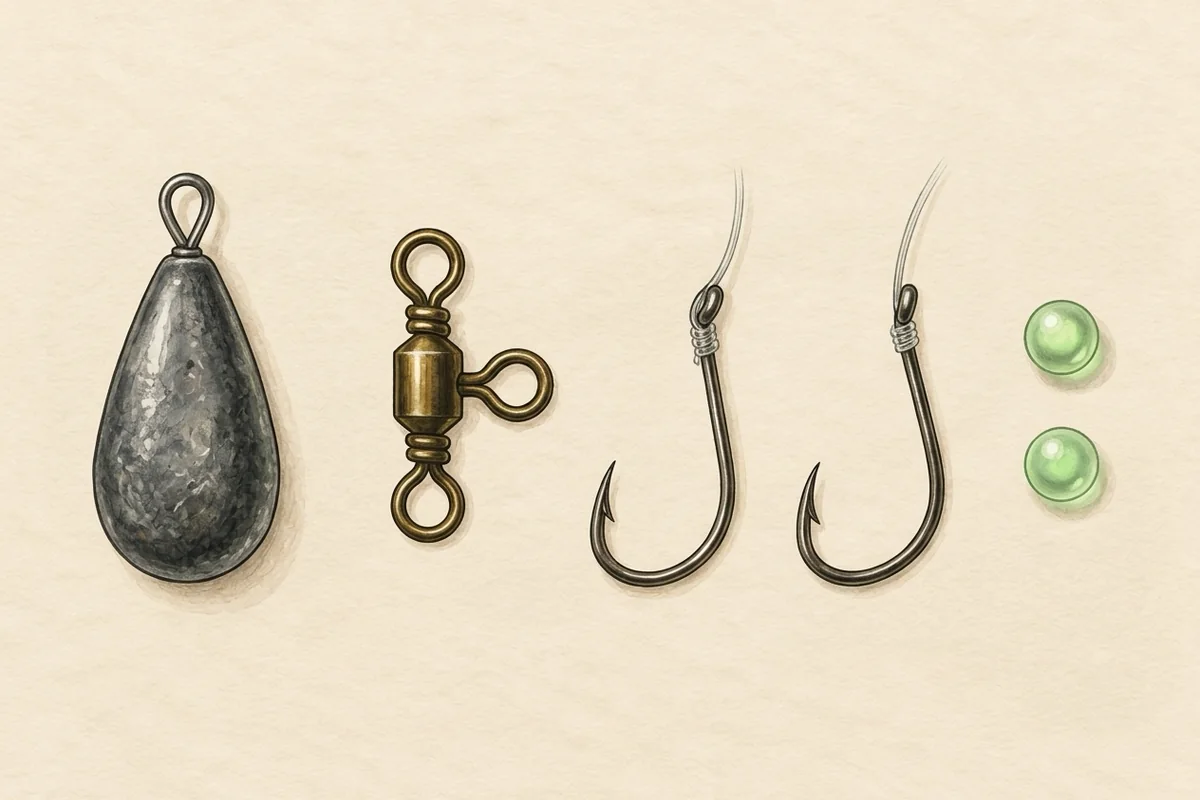
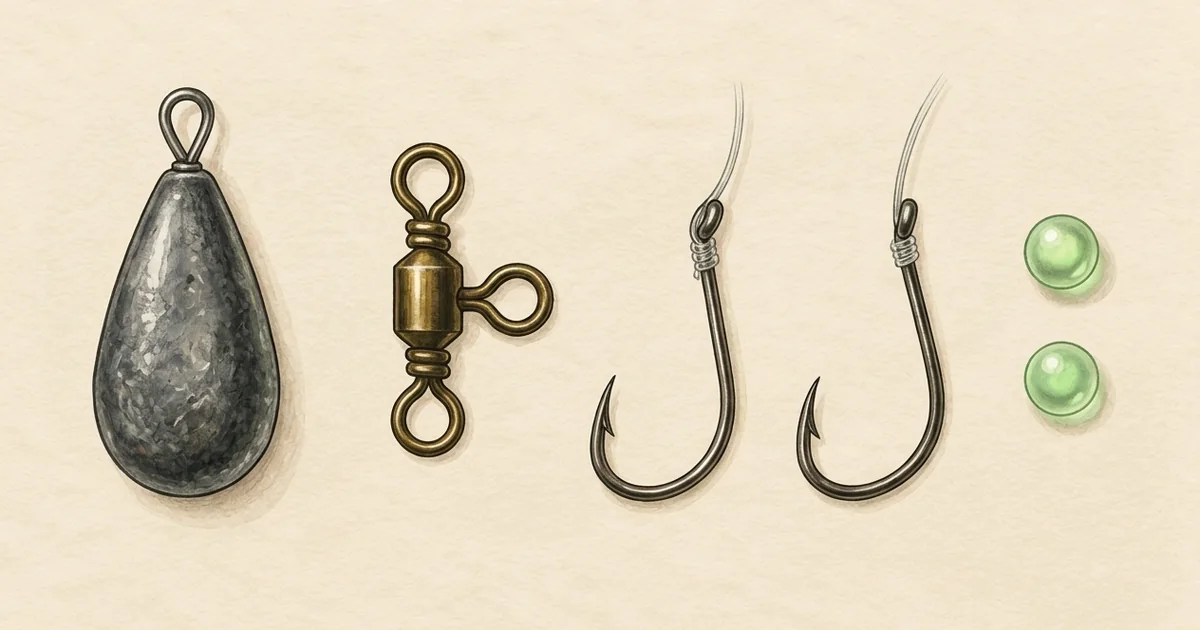
- thick monofilament hooklength line; depending on the fish and the design, the range according to Blinker runs from 0,60 to over 1 millimetre (table below)
- sharp, strong single hooks, from 3/0 to 9/0 depending on the species
- sturdy swivels, a snap swivel or clip for the weight
- luminous tube or small glow-in-the-dark octopus lures for the side arms
- Weights from 200 to 1000 grams, depending on depth, current and drift
Fillets and strips of mackerel and herring work as bait, and for hake also squid and strips of garfish. You will find more on the page Fish strips.
Two types of rig
Paternoster: The weight hangs at the end, with side arms fixed to the hooklength above it. For tusk, Blinker describes a hooklength of about one and a half metres of 0,60 to 0,70 monofilament. Two or three side arms are knotted in at intervals of 50 centimetres, each with a short hook snood; at the bottom the weight hangs from a snap swivel. According to Blinker it is robust but less sensitive than a rig with a boom, a guide tube for the weight.
Flowing trace: A plastic boom or a metal sliding tube runs on the main line. A snap swivel sits at the end of the main line, and the trace of 1 to 1,5 metres with the hook hangs from it. The weight clips on at the bottom of the tube and so lies in front of the bait. For ling, Blinker mentions the two-armed paternoster with an end weight, but recommends the trailing rig as the better choice. For hake both work: two short side arms above the weight or a single hook on a slightly longer trace.
Variant with a stick pilker as the weight
For big ling, Blinker builds a rig without side arms: a stick pilker weighing 500 to 700 grams serves as the weight, two sharp hooks from 6/0 to 9/0 hang 3 to 10 centimetres apart on a hooklength of 1 to 1,2 millimetre monofilament, with a glow octopus in front of them. The reason: every attachment gives the current something to push against and calls for more lead. According to Blinker this lets you fish in a fjord at more than 300 metres of depth. These are the values for this one rig; the ranges for each target fish are in the table further down.
Build a paternoster in five steps
- Knot a swivel to the top end of the hooklength. For thick monofilament, Blinker names the uni knot with three to four turns or the Palomar knot.
- Tie in the side arms. A dropper loop knot makes one to three doubled arms. Leave enough space between them so they do not tangle. The whole hooklength of the pilk paternoster is about 1,5 metres long, and about 3 metres for the redfish paternoster with three arms.
- Slide on the glow tubing and loop on the hook.
- Knot a lead clip or snap swivel for the weight to the bottom end.
- Put on the bait. You pierce the mackerel fillet on the hook several times.
Guide values for hook, hooklength and weight
The figures come from various Blinker articles and partly differ from one another. Take them as a range, not a rule.
| Target fish | Hooks | Leader | Weight |
|---|---|---|---|
| Ling and tusk (overview) | 6/0 to 9/0 | not under 0,90 mm | 500 to 1000 g |
| Tusk (profile) | 4/0 to 8/0 | 0,60 to 0,70 mm | from 500 g |
| Ling (profile) | 4/0 and larger | no figure given | 300 and 500 g |
| Hake | 4/0 to 8/0 | 0,80 to 1,2 mm | no figure given |
| Redfish | 3/0 to 5/0 | from 0,80 mm | no figure given |
For redfish the overview gives hooks from 3/0 to 5/0, the build guide 3/0 to 6/0, preferably circle hooks. With hake the teeth matter: Blinker names 0,80 to 1,2 millimetre mono or fluorocarbon as a must and also suggests a rubber tube over the line in front of the hook.
On weights: for ling, Blinker says to carry 300 and 500 grams, and in strong current and drift you may even need double. A report from southern Norway got by with 600 to 800 grams, but also names weights over a kilo depending on wind and current. For medium-depth natural-bait fishing in the fjord, Blinker lists weights of 80 to 300 grams instead.
Weak link and lead rules: Blinker describes a system with two weights of 300 grams each. The split ring of the lower weight is the weakest link: if you snag, only this weight is lost. The EU has adopted the restriction on lead in fishing tackle with Regulation (EU) 2026/2501, which applies from 3 December 2026 (as of November 2026). It governs sales, not recreational angling. Weights and lures containing lead up to 50 grams may no longer be sold from 3 December 2029, heavier ones up to 1 kilogram from 3 December 2031, and lead wire and drop-off leads from as early as 3 June 2027. What applies at the water is set by the water rules and the fishing permit (Erlaubnisschein).
Bait and retrieve
As the best bait for ling and tusk Blinker names mackerel fillets. If you let the strip hang out a little, it flutters in the water, but with cautious bites the number of missed bites goes up. For tusk Blinker also recommends a large, fat herring fillet or a big prawn; the prawn sits badly and can be secured on the hook with a rubber band.
From a boat you often fish on the drift. The southern Norway report advises drifting from deep into shallower water and names the rising tide as an especially promising time. For hake, Blinker describes offering the bait 1 to 10 metres above the bottom: lower it to the bottom, wind up a few turns of the handle, wait a few minutes and wind in again. When the rig is about 10 metres above the bottom, it goes back down. Strike only when there is steady pressure on the rod, not at the first tug.
Depths and spots
FishBase gives 100 to 1000 metres for ling, mostly 100 to 400 metres, and 18 to 1000 metres for tusk, mostly 18 to 549 metres. Blinker looks for ling at wrecks, reefs, rocky ground and steep drop-offs; at a wreck big fish also stand in only 40 metres. In fjord and central Norway, tusk come up to 30 to 50 metres to spawn from June to August. Rubble plateaus and rises at 50 to 200 metres count as top spots there, and according to Blinker the capital fish only stand from 200 to 300 metres. For hake, Blinker puts the best time from the end of June until autumn; the spawning groups then mostly stand over softer ground at 50 to 150 metres. It does not occur in northern Norway.
Playing, returning and the rules in Norway
Don’t pump a ling up quickly. Blinker explains that the swim bladder cannot adapt fast enough to the falling pressure, expands strongly and paralyses the fish; a careful fight is better. In general terms, the University of Florida describes barotrauma as a pressure injury: the gas in the swim bladder expands during the ascent, the stomach can come out of the mouth, and the fish may no longer be able to get back down to depth by itself. According to its publication, the risk increases with depth and with time at the surface. Only plan to take what you are allowed to use and can actually use.
Norway: The Fiskeridirektoratet lists the blue ling as protected all year, and halibut, redfish and some other species temporarily. Halibut over 2 metres must be returned. According to Blinker the blue ling differs from the common ling in its larger eyes and shorter chin barbel; it grows to 1,50 metres at most. The exact periods and minimum sizes are given by the Fiskeridirektoratet.
Common mistakes
- Hooklength too thin for toothy fish: For hake, Blinker names 0,80 to 1,2 millimetres as a must.
- Blunt hooks: In the leathery mouth of ling and tusk, blunt hooks do not penetrate reliably, according to Blinker.
- Too much tackle on the hooklength: It gives the current something to push against and calls for more lead.
- Too many baits for big fish: With the pilk paternoster for cod and coley, Blinker advises no more than two or three extra lures in front of the pilker.
- No weak link at the weight: If you snag, the whole rig is gone.
- Blue ling not recognised: If you cannot tell it from ling, you risk keeping a protected species in Norway.
Frequently asked questions
What is the glow tubing for?
It is meant to add an extra visual trigger in the darkness of the deep. On the redfish paternoster, Blinker slips a piece of glow tubing or a small glow octopus onto each side arm. The source gives no proof that it brings more bites.
How heavy does the weight have to be?
It depends on depth, current and drift. For deep-sea fishing for ling and tusk, Blinker gives 500 to 1000 grams, and for medium-depth natural-bait fishing in the fjord 80 to 300 grams.
Paternoster or trailing rig?
The paternoster is simple and robust, and the baits stand above the bottom. The trailing rig runs the bait behind the weight and, according to Blinker, is the better choice for ling.
At what depth do you catch ling and tusk?
Usually deep: FishBase gives several hundred metres for both species. According to Blinker, though, tusk can be caught in summer at 30 to 50 metres and big ling at wrecks at 40 metres.
Related
- Side-arm rig: weight at the bottom, bait on the short arm above it
- Sea rod: which boat rod suits natural baits in the deep
- Fish strips: fillets and strips as bait on the hook
- Pilking: the active counterpart to the natural-bait rig
- Ling and tusk: the two main target fish of the deep
- Dropper loop: how the arms of a paternoster are made
- Fishing holidays in Norway: waters for deep-sea fishing
Sources
- Blinker: Angelmontage für Norwegen selber bauen (Seitenarme, Rotbarsch-Paternoster, Stabpilker-Montage, Vorfach- und Hakenwerte, Strömungswiderstand)
- Blinker: Angeln in Norwegen (Haken, Vorfachstärke und Bleigewichte für Leng, Lumb und Rotbarsch)
- Blinker: Angeln in Südnorwegen (Makrelenfilet, zwei Bleie, Drift, Tiefen, auflaufendes Wasser)
- Blinker: Steckbrief Leng (Schleppmontage, Bleie, Haken, Drill, Blauleng, Plätze)
- Blinker: Steckbrief Lumb (Paternoster, Boom, Köder, Hakengrößen, Tiefen und Zeiten)
- Blinker: Meeresangeln auf Seehecht (Köder, Führung über Grund, Haken, Vorfachstärke, Laichzeit)
- Blinker: Norwegen, Angeln im Fjord (leichte und schwere Ausrüstung für Naturköder, Bleigewichte)
- Fiskeridirektoratet: Meeresangeln in Norwegen, Regeln für ausländische Besucher (geschützte Arten, Heilbutt über 2 Meter)
- FishBase: Molva molva (Leng) (Tiefenbereich)
- FishBase: Brosme brosme (Lumb) (Tiefenbereich)
- University of Florida, IFAS: Barotrauma and Successful Release of Fish Caught in Deep Water (Barotrauma: Ursache, Anzeichen, Zunahme mit der Tiefe)
- EUR-Lex: Verordnung (EU) 2026/2501 der Kommission vom 12. November 2026, Blei in bestimmtem Fischereigerät und Berichtigung vom 17. November 2026 (Stichtage, Verkauf statt Verwendung)
- Deutscher Angelfischerverband: EU-Bleibeschränkung für Angelgeräte, aktueller Stand (Zustimmung im Ausschuss, Verkauf statt Verwendung, Stand 4. Mai 2026)
Text AI-assisted, drawing AI-generated. Sources opened and checked in October 2026; no graphics taken from the sources.
All figures are guide values without guarantee. Follow the water rules (Gewässerordnung) and state law, and in Norway the rules of the Fiskeridirektoratet; the text does not replace official information.