
Knowledge · Fish welfare and practice
Fight, heat and depth
A long fight drains a fish’s energy reserves, warm water prolongs its recovery, and bringing it up quickly from great depth risks damage to the swim bladder. Much of this is in the angler’s own hands, with suitable tackle and a glance at the water temperature.
What the fight triggers in a fish’s body
On the hook, the fish fights back with short, intense sprints. A review in Fisheries Research (Brownscombe and colleagues, 2016) classifies this as anaerobic work: the muscle works without enough oxygen arriving. This produces lactic acid, whose salts are called lactate, according to the Lexikon der Biologie the end product of breaking down sugar without oxygen.
Afterwards the fish pays the price. During this oxygen debt, the body uses extra oxygen to break down the lactate and to replenish glycogen, energy-rich phosphates and oxygen stores. From the outside you see the rapid, deep breathing.
A team led by Robert Arlinghaus of the Leibniz-Institut für Gewässerökologie und Binnenfischerei (IGB) measured how long this takes in pike (Arlinghaus and colleagues, 2009). After a 60-second chase to exhaustion, at an average of 18,6 °C, lactate in the muscle was raised and the energy stores had dropped. The muscle was back in the normal range after one hour, and the blood, apart from sugar, after six hours. Pike have mostly white muscle fibres, built for sprints without oxygen.
The Swiss fishing magazine Petri-Heil warns: after a long fight the fish needs a lot of oxygen. If it then lies in the air for a long time, the deficit grows until it no longer recovers.
A short fight with suitable tackle
Brownscombe and colleagues advise tackle with enough in reserve so that the fight stays short. That also applies to by-catch: if the rod is too light for an unexpectedly large fish, the fight drags on. For the drag, see Setting the reel drag; the Line calculator checks the breaking strain. What studies found on fight duration is covered under Landing and unhooking fish.
Warm water prolongs recovery
Why warm water holds less oxygen is shown in Water temperature and oxygen. For the catch, according to Brownscombe and colleagues, this means: a long fight at high temperature means more work without oxygen, more stress and a longer recovery. The pike study sets five minutes in the air as the upper limit and suspects that it is lower in warmer water.
The Thünen-Institut kept rod-caught cod from the western Baltic in net cages for at least ten days. On average 11,2 per cent died, between 0 and 27,3 per cent depending on the trial. Bleeding wounds and higher water temperature increased mortality.
Heat rules from authorities and associations
Some bodies ask anglers to spare certain species when the water is warm:
| Where | Advice | Species |
|---|---|---|
| Northern Ireland’s Department of Agriculture (DAERA), June 2026 | from 18 °C take particular care, above 20 °C stop fishing | Salmon, trout |
| River Tweed Commission, following Scottish Government guidance | above 20 °C stop fishing | Salmon, trout |
| Fisheries offices of Aargau, St Gallen, Thurgau, Zurich | refrain in hot weather; stretches can be closed | mainly grayling, brown trout |
| Canton of Solothurn, June 2026 | no fishing in three small rivers, ban possible | all aquatic animals |
| IGB, Waidgerecht project | above 22 °C no catch and release | Pike |
Details from DAERA, the River Tweed Commission, in the drought leaflet (Merkblatt Trockenheit), from the Canton of Solothurn and in the Waidgerecht project. The Swiss leaflet holds the leaseholders responsible for halting fishing in hot weather. Solothurn measured 30,2 °C in the Dünnern near Olten. DAERA also asks coarse anglers to do without the keepnet in warm weather.
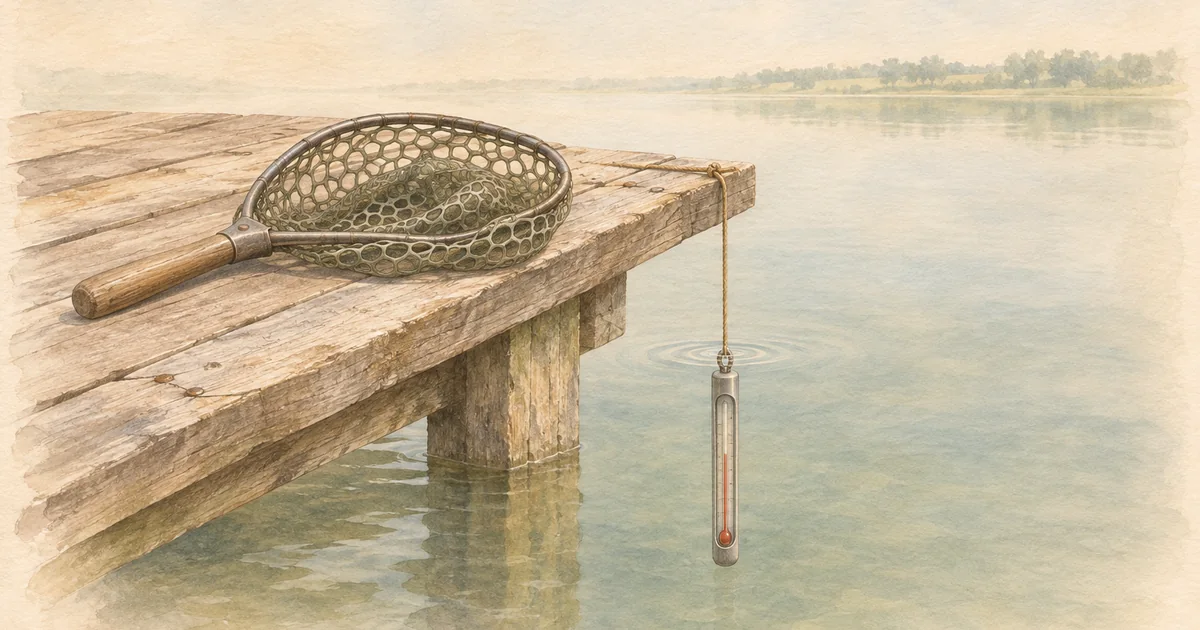
The sources checked here contain no uniform limit for Germany. Whether your club closes stretches in hot weather is stated in the water rules (Gewässerordnung). A thermometer in the water shows you where you stand.
Barotrauma: fish from the depths
The gas-filled swim bladder keeps a fish suspended. A cod adjusts it to the depth at which it is holding. Cod-like fishes have no connection between gut and swim bladder and only get rid of excess gas through their metabolism, writes Bernd Mieske of the Institut für Ostseefischerei in Forschungsreport 1/2001. If the fish comes up quickly, the gas expands, all the more the deeper it was. Cyprinids and catfish, by contrast, have a duct from the swim bladder to the gut, according to the Lexikon der Biologie.
This damage is called barotrauma. The bladder can tear, and gas gets into the body cavity and head. Signs according to Brownscombe and colleagues and the US information network RecFIN:
- bloated belly
- stomach bulging out of the mouth, or gut protruding from the vent
- bulging eyes, bleeding in the skin
- the fish floats at the top and can’t get back down
The critical depth depends on the species. The review names catches from more than 30 metres as the most common case, and as little as 5 metres for the sensitive North American black bass. For cod, Ferter and colleagues (2015) studied catches from 0 to 90 metres: the deeper, the more often swim bladders ruptured and gas escaped at the vent. Cod from more than 50 metres that had to stay at the surface in a net cage died at rates of 40 per cent and more, because of the persistent barotrauma and the warm surface water. When released immediately, 97,8 per cent dived down. So that the cod has the strength for this, the authors advise not playing it to exhaustion and handling it as little as possible. This mainly concerns pirking over deep ground.
For the walleye, a North American relative of the zander, the South Dakota fisheries agency found a threshold at about 9 metres: shallower than that, the predicted mortality after release was 1,5 per cent, deeper 15 per cent. The sources checked here contain no figures for zander and perch from deep lakes and reservoirs.
Release or take
A fish floating at the surface is exposed to predators, light and warm water; Mieske names seabirds. In North America there are two aids: piercing the swim bladder with a hollow needle, or taking the fish back down to capture depth with a weighted descending device. Piercing is controversial, and RecFIN advises against it because of injuries and infections. According to the review, descending devices usually work better. The sources checked here contain no German official recommendation on either, so this page recommends neither.
What happens to a damaged fish is regulated by the states. In Bavaria, undersized fish or fish caught in the closed season (Schonzeit) must go back if they are viable (§ 11 Abs. 6 AVBayFiG). The Bremische Binnenfischereiverordnung requires in § 5 that fish which are no longer viable and may not be taken are killed immediately in line with animal welfare rules and disposed of safely. South Dakota advises fishing shallower or taking fish from the depths home where the rules allow. More under Stunning and killing fish and Closed season and minimum size explained.
According to the Landesportal Schleswig-Holstein, recreational fishing for cod in the Baltic is banned all year round in 2026, and cod caught by chance go back immediately and gently. The EU Fisheries Council will discuss 2027 at the end of 2026.
Note: you often can’t tell by looking whether a fish will survive capture. Pike that had spent five minutes in the air had hardly changed blood values, but swam abnormally in the first hour. In the Thünen trial, around 85 per cent of the cod that died did so later, within 24 hours. According to the review, tears in the swim bladder and internal bleeding are common and lie inside the body. According to Ferter and colleagues, the long-term effects of barotrauma have not been studied.
Frequently asked questions
How long does a fish take to recover from the fight?
That depends on species and temperature. In exhausted pike the muscle was back to normal after one hour, the blood, apart from sugar, after six hours. In warm water it takes longer.
From what water temperature should I leave trout alone?
Northern Ireland and the Scottish guidance give 20 °C for salmon and trout, and Northern Ireland urges caution from 18 °C. What applies on your water is stated in the water rules (Gewässerordnung).
Does a bloated cod survive being released?
Often yes, if it dives down on its own straight away and is not otherwise badly injured. In the study by Ferter and colleagues, 97,8 per cent of the cod managed this. The rest floated up and would probably have died without help.
May I pierce the swim bladder?
The sources checked here contain no German recommendation on this, and piercing is controversial in research. Ask your state’s fisheries authority (Fischereibehörde) first.
Related
- Returning fish: legal position and survival rates by species
- Landing and unhooking fish: landing net, wet hands, time in the air
- Water temperature and oxygen: oxygen per degree, layering in the lake
- Fish-friendly tackle: hooks, barbs, break-offs
- Fishing from a charter boat and a boat: fishing over deep water
- Cod and Zander: way of life and habitat
Sources
- Brownscombe und Kollegen: Best practices for catch-and-release recreational fisheries, Fisheries Research 2016 (Drill, Gerät, Wärme, Barotrauma, Hilfen)
- Arlinghaus und Kollegen: Catch-and-release angling on northern pike, Fisheries Research 2009 (Laktat, Erholung, Luftzeit)
- Spektrum, Lexikon der Biologie: Milchsäure, Sauerstoffschuld, Physostomen (Begriffe)
- Petri-Heil: Vom Haken zurück ins Wasser (2019) (Sauerstoffdefizit)
- Thünen-Institut für Ostseefischerei: Sterblichkeit von geangelten und zurückgesetzten Dorschen (Sterblichkeit, Temperatur)
- Ferter und Kollegen: Dive to survive, ICES Journal of Marine Science 2015 (Barotrauma beim Dorsch)
- Mieske: Die Chance zu überleben, Forschungsreport 1/2001 (Schwimmblase der Dorschartigen)
- South Dakota Game, Fish and Parks: Walleye mortality; RecFIN: What is barotrauma (Fangtiefe, Anzeichen)
- Humboldt-Universität zu Berlin und IGB: Projekt Waidgerecht, Pike; DAERA: Angling in warm weather; River Tweed Commission: Water temperatures (Temperaturgrenzen)
- Fischereifachstellen AG, SG, TG, ZH: Merkblatt Trockenheit; Kanton Solothurn: Hitzewelle bedroht Wasserlebewesen (Verzicht, Sperrungen)
- AVBayFiG § 11; Bremische Binnenfischereiverordnung; Schleswig-Holstein: Dorsch 2026 (Recht)
Text AI-assisted, drawing AI-generated. Sources opened and checked in November 2026; no graphics taken from the sources.
All information is indicative and without guarantee. Temperature limits and depths come from individual studies and foreign guidelines; what counts is the law of your federal state and the fishing permit.