
Knowledge · Fish welfare and practice
Returning fish
If you want to release a fish, you should know beforehand whether you must, may or had better not. Minimum size (Mindestmaß), closed season (Schonzeit) and protection status make releasing compulsory. Whether a fish that may be kept can be put back voluntarily is regulated differently by state law. Added to that are figures from research on survival rates and the handling that helps the fish.
When the fish has to go back
Which fish you may keep is set by state law. The Saarland fisheries ordinance (Landesfischereiordnung) requires in § 7 that fish under the minimum size or under another fishing ban be put back into the water without delay and with the necessary care. The ministry in Mecklenburg-Western Pomerania says the same in a leaflet for undersized fish, fish caught in the closed season and generally protected fish. The angler cannot identify the target fish, that is, cannot determine what will bite, it states there.
The water owner may be stricter than the law. According to a leaflet from the state of Schleswig-Holstein, private holders of fishing rights issue, for example, higher minimum sizes or their own rules on taking fish from special stocked waters, usually printed on the fishing permit (Erlaubnisschein). The ministry in Mecklenburg-Western Pomerania also mentions longer closed seasons. What applies to your water is therefore written in two papers: in state law and in the permit. The basics are explained by closed season and minimum size and fishing permit and water map, and the closed seasons of the species are shown in the fishing calendar.
Voluntary release: wording of the law and state law
At federal level the Animal Welfare Act (Tierschutzgesetz) applies. Under § 1 nobody may cause an animal pain, suffering or harm without a reasonable cause. § 17 threatens imprisonment of up to three years or a fine if someone kills a vertebrate without a reasonable cause or, out of cruelty, causes it considerable or prolonged pain or suffering. What a reasonable cause is, the law does not define. Authorities and courts decide that case by case; you will therefore not find an interpretation on this page.
Individual states are more specific:
- Schleswig-Holstein: Fishing in which releasing the fish is planned from the outset is, according to a leaflet from the agriculture ministry (as of February 2026), prohibited and an administrative offence under § 39 of the state fisheries act (Landesfischereigesetz).
- Saarland: § 10 paragraph 1 number 6 of the fisheries ordinance (Landesfischereiordnung) prohibits fishing with the hand rod that is aimed from the outset at releasing and expressly calls it catch & release. Under paragraph 3 this also applies in closed waters. Fish in a keepnet, which is permitted only for eating and restocking, may not be released according to § 8.
- Mecklenburg-Western Pomerania: The ministry writes that catch & release is not always prohibited there but is disputed under animal welfare law. As a reasonable cause it names the sensible use of the catch, for example as food, animal feed or a dead bait fish. From the animal welfare point of view, deliberately fishing for trophy fish that are to be released after weighing, measuring and photographing is not permissible.
Note: For the other federal states (Bundesland) no statement has been checked here. Read the fisheries act and fisheries regulation of your state and the fishing permit, and if in doubt ask the fisheries authority (Fischereibehörde) or the club. This text is not a substitute for legal advice.
How anglers actually decide was studied by the Leibniz Institute of Freshwater Ecology and Inland Fisheries (IGB) using catch diaries: about 19,800 catch entries from Lower Saxony and Mecklenburg-Western Pomerania. Large pike and carp were particularly often released voluntarily, whereas sea fish, salmon and trout were more likely to be taken home. Protected species and sizes always had to go back anyway.
Harvest slot: small and large fish go back
A harvest slot allows fish to be taken only within a size range. According to the description by the working group on angling (Arbeitskreis Angeln) in the German Anglers‘ Association (DAFV) of April 2025, even fish that already reach the statutory minimum size but fall below the lower limit of the slot, and those above a set maximum size, must be released gently by all anglers. According to the DAFV, Hesse and Hamburg have ordered it at state level, while in other states authorities strictly reject it, as it presents things. Otherwise it is found in the water rules of the manager.
The idea behind it: one large female can make up for the egg count of many small fish, and fish of different ages spawn at different times. The IGB considers the slot superior above all where commercial and angling fishing share a stock, as with pike in the coastal waters around Rügen. If only the yield in kilograms is to be as high as possible, the minimum size is the better fit, according to the IGB. The DAFV adds two conditions: mortality on release must be low, and its effect in inland waters has so far not been sufficiently researched.
What studies say about survival rates
The figures below come from evaluated studies, not from your water. They show orders of magnitude and differences, nothing more.
| Species | Mortality | Evaluation |
|---|---|---|
| Carp | 3,3 % | Petri-Heil after Arlinghaus |
| Pike | 7,1 % | Petri-Heil after Arlinghaus |
| Trout | 7,4 % | Petri-Heil after Arlinghaus |
| perch | 11 % | Petri-Heil after Arlinghaus |
| Zander | 27,5 % | Petri-Heil after Arlinghaus |
| Pike | 25 ± 5 %, range 0 to 33 % | IGB, 23 studies |
For pike the two figures contradict each other. The IGB evaluates 23 studies for its Waidgerecht project and gives a mean of 25 ± 5 per cent, with values between 0 and 33 per cent. The Swiss magazine Petri-Heil reports on an evaluation by Arlinghaus and colleagues with 7.1 per cent. Which figure applies to your water cannot be said. Both show, however, that species and circumstances matter more than an average.
Petri-Heil also names these influences:
- Bait: Of fish caught on worm or bait fish, 25.9 per cent died, on spinner, crankbait or soft plastic 11.4 per cent. The reason: natural baits are more often swallowed deep.
- Hook: Treble and single hooks hardly differ, but barbed hooks do clearly more damage than barbless ones.
- Size: Undersized fish survive with the same probability as fish of legal size.
- Temperature: In some salmonids mortality rises from 0 per cent at 8 °C to over 80 per cent at 20 °C. The IGB advises not to catch and release pike at water temperatures above 22 °C. Why warm water is so critical is explained under water temperature and oxygen.
- Long-term effects: According to Petri-Heil, fish that have been caught are often more cautious afterwards, sometimes eat less and grow more slowly.
How to get the fish back unharmed
The IGB’s recommendations for pike: guide the bait actively rather than fishing passively from a stationary rod, because that reduces deep hooking, strike at once with natural baits, tend to choose larger baits, use an unhooking mat, also in the boat, and hold the fish level. From the practical sources comes the following:
- Choose tackle to suit the target fish so that the fight stays short (Petri-Heil).
- Wet your hands and the mat beforehand. The mucus layer protects against pathogens (Blinker).
- Unhook undersized and protected fish directly in the water (Blinker). If you have to touch them, do not squeeze them (Petri-Heil).
- Never lift by the bait: the skeleton is not designed for that tensile load (Petri-Heil). Carry large fish level with both hands, held upright the weight hangs on the neck vertebrae (Blinker).
- Have the disgorger, tape measure and camera ready beforehand so that the time in the air stays short (Blinker). Petri-Heil recommends skipping photos altogether for fish that are released. If you do take one, hold the fish briefly, low and just above the water.
- Support the fish in the water until it swims off by itself. In summer this is particularly important because warm water holds little oxygen (Blinker).
The handling is described in detail under landing and unhooking a fish, suitable gear under unhooking mat and disgorger.
Common mistakes
- Deliberately fishing for pike at water temperatures above 22 °C even though it is to be released.
- Leaving a natural bait lying for a long time until the fish has swallowed it deep.
- Lifting the fish by the bait or vertically.
- Landing with a jaw gripper: in studies on sea fish (bonefish, barramundi), injuries to the lower jaw occurred in 80 to 100 per cent of the animals, according to Blinker.
- Grabbing with a dry hand or rough glove, laying the fish on dry ground.
- Only searching at the water for where the tape measure and disgorger are.
Frequently asked questions
Is catch and release banned in Germany?
There is no uniform rule. Schleswig-Holstein and Saarland expressly prohibit fishing aimed from the outset at releasing, Mecklenburg-Western Pomerania calls it disputed under animal welfare law. For all other states the rule is: read state law and the fishing permit (Erlaubnisschein).
Do I have to release an undersized fish?
Yes. Saarland lays it down in § 7 of its fisheries ordinance (Landesfischereiordnung), Mecklenburg-Western Pomerania in its leaflet. Minimum sizes are set by state law, and the water owner may raise them.
At what water temperature does releasing become risky?
There is no general limit. The IGB gives 22 °C for pike. For salmonids, Petri-Heil reports sharply rising mortality between 8 and 20 °C and advises against fishing in warm running waters.
May I photograph the fish before releasing it?
No blanket ban appears in the sources checked here. In Mecklenburg-Western Pomerania, however, fishing that is aimed from the outset at weighing, measuring and photographing is inadmissible from the animal welfare point of view. Do not photograph fish that are being released, or only very briefly.
Related
- Closed season and minimum size explained: when fish must go back
- Fishing permit and water map: where the rules of your water are written
- Landing and unhooking a fish: handling from landing net to mat
- Unhooking mat: lay down softly, unhook gently
- Disgorger: unhook quickly and gently
- Tape measure and measuring mat: measure the minimum size reliably
- Water temperature and oxygen: why warm water stresses fish
- Fishing calendar: closed seasons of the species at a glance
Sources
- Bundesjustizministerium: Tierschutzgesetz § 1 (vernünftiger Grund)
- Bundesjustizministerium: Tierschutzgesetz § 17 (Strafvorschrift)
- Landwirtschaftsministerium Schleswig-Holstein: Merkblatt zum Urlauberfischereischein (Stand Februar 2026, PDF) (Verbot des geplanten Zurücksetzens, Regeln der Rechtsinhaber)
- Fischereiverband Saar: Saarländisches Fischereirecht, Fischereigesetz und Landesfischereiordnung (PDF) (§ 7 Zurücksetzen, § 8 Setzkescher, § 10 Catch & Release)
- Ministerium für Landwirtschaft und Umwelt Mecklenburg-Vorpommern: Angeln in MV, aber richtig. Hinweise zur Einhaltung des Tierschutzes (Faltblatt, 2017, PDF) (Zurücksetzen untermaßiger Fische, vernünftiger Grund, Catch & Release, Trophäenfische)
- Deutscher Angelfischerverband, Arbeitskreis Angeln: Veröffentlichung Nr. 1, Entnahmefenster (April 2025, PDF) (Begriff, Länderregelungen, Bedingungen)
- Humboldt-Universität zu Berlin und IGB: Projekt Waidgerecht, Pike (23 Studien, Sterblichkeit, Empfehlungen)
- Leibniz-Institut für Gewässerökologie und Binnenfischerei: Catch or release (Pressemitteilung, 18. Dezember 2025) (Fangtagebuchstudie zum freiwilligen Zurücksetzen)
- Leibniz-Institut für Gewässerökologie und Binnenfischerei: Gegen Überfischung, Schont die Alten! (Pressemitteilung, 16. März 2020) (Entnahmefenster und Mindestmaß)
- Petri-Heil: Vom Haken zurück ins Wasser (März 2019) (Sterblichkeit nach Art, Köder, Haken, Temperatur, Spätfolgen, Umgang)
- Blinker: Fische landen, Kescher, Lip-Grip und Co. (nasse Hände, Matte, Abhaken im Wasser, waagerechtes Tragen, Kiefergreifer-Studien)
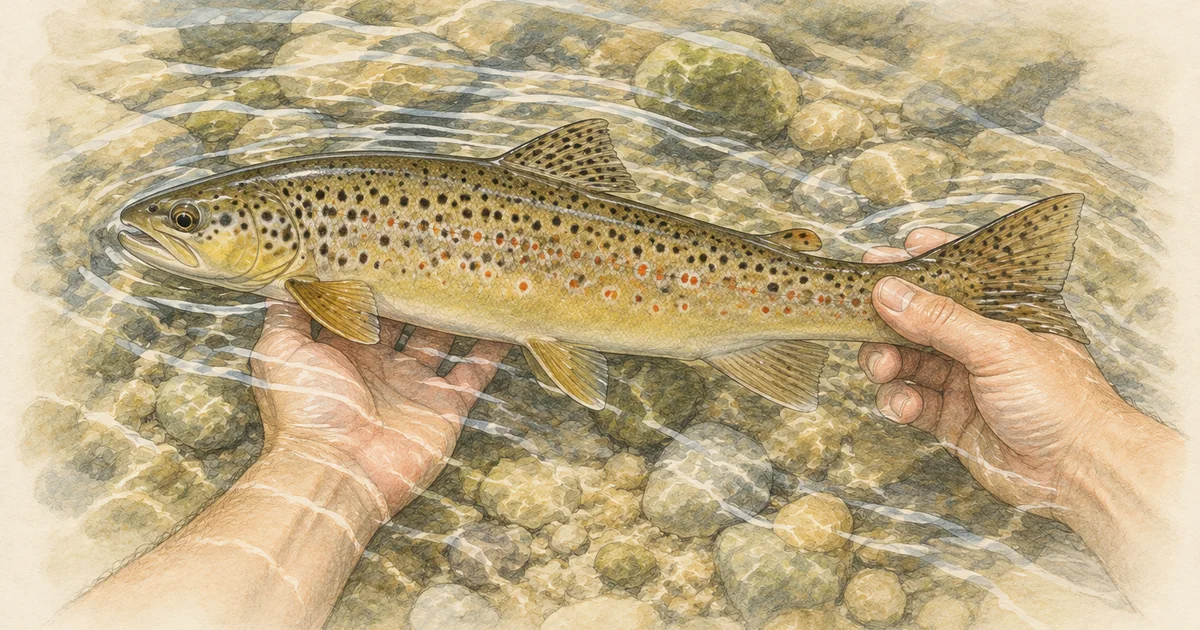
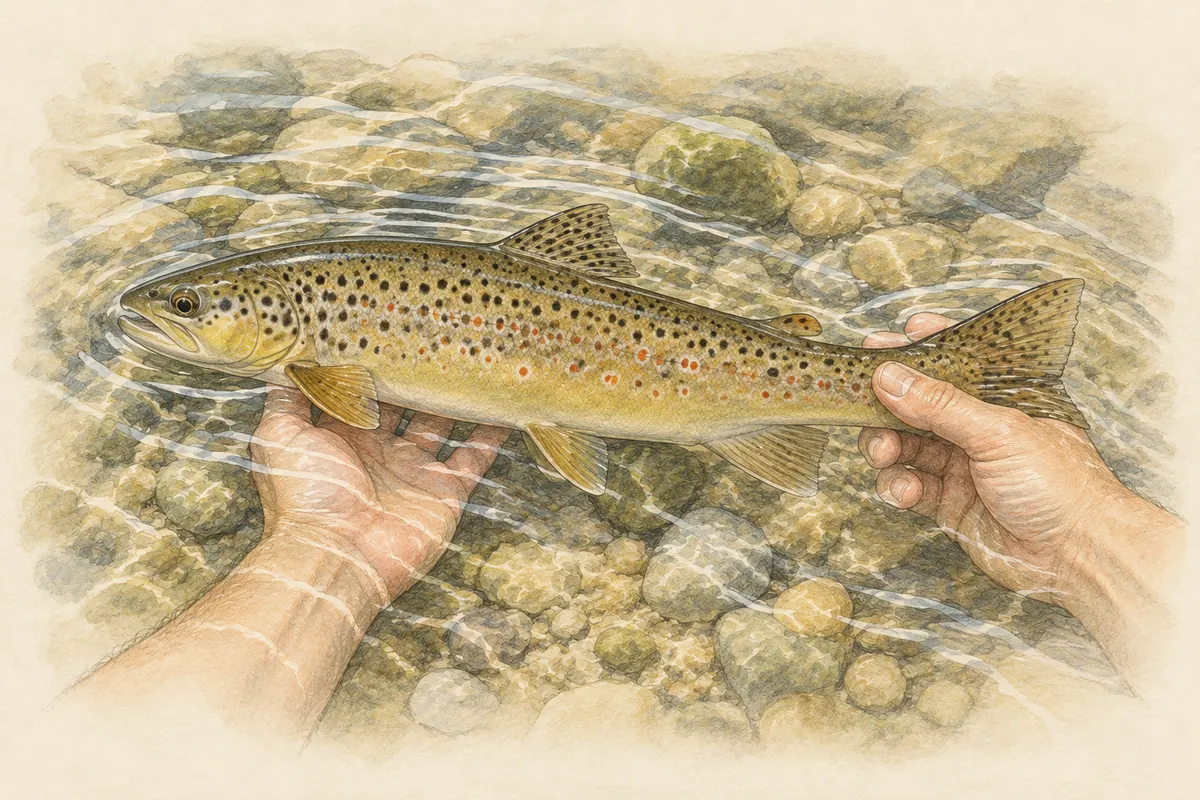
Text AI-assisted, drawing AI-generated. Sources opened and checked in October 2026; no graphics taken from the sources.
All information is indicative, without guarantee, and is not a substitute for legal advice. What counts is the law of your federal state (Bundesland), the water rules and the fishing permit (Erlaubnisschein).