
Knowledge · Tackle
Unhooking mat: Setting the fish down softly, unhooking gently
An unhooking mat is a padded surface on which you lay a caught fish on land to remove the hook, measure it or take a quick photo. It keeps sand, stones and hard ground away from its slime layer and catches a thrashing fish softly.
What the mat protects
A fish’s skin is covered in slime. Together with the scales, this layer fends off parasites and pathogens, writes the magazine Blinker. If the fish touches dry or rough ground, it is damaged. Germs and fungi get in at such a spot, and in the worst case the fish develops fungus over a large area and dies. The Swiss specialist magazine Petri-Heil sees the same chain: the longer a fish lies in the air, the more likely the mucous membrane is to be damaged, with bacterial infection or fungal attack as a possible result.
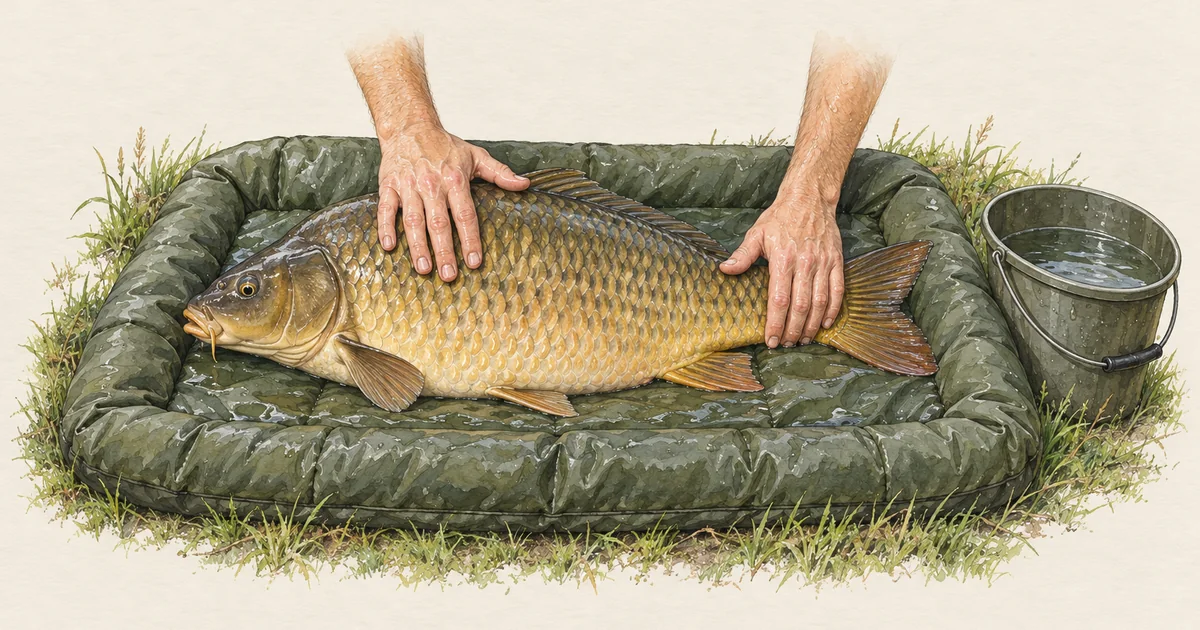
Sand and stones are not the only dangers. Ice, snow and rock-hard frozen ground are dangerous too: there a fish can not only graze itself, but its skin, eyes and fins are even at risk of frostbite. Damp grass would be a decent surface, but most swims have none. Then there is the fall. If a fish slips from your grasp as you lift it, soft padding cushions the impact.
Unhooking in the water comes first
The fish that is least stressed is one that never comes onto land at all. The Swiss fisheries advisory service FIBER advises freeing fish that are meant to swim on from the hook in the water wherever possible, and doing without unnecessary measuring and photographing. Undersized fish, or fish caught in the closed season (Schonzeit), should always be treated this way. How to hold a fish in the landing net and remove the hook for this is described under Landing and unhooking fish.
The mat is for the cases where that is not possible: a heavy carp, a fish that has to be measured, a hook that cannot be removed in the water. Time in the air begins during the fight itself. FIBER recommends choosing tackle so that the fight stays short. The line calculator shows what breaking strain your line still has after the knot.
Designs
Which shape suits you depends on how much you walk along the water and how big the fish can grow.
Flat mat
For lure anglers who change spot often, there are mats that fold or roll up, light and with a small packed size. Many carry a printed centimetre scale, which according to Blinker usually runs to 120 cm. That way you measure the fish while it lies softly. The drawback: without a high rim, a fish that thrashes its tail can slide off such a mat.
Tray with a rim
If you sit in one place, you are better off with the big mats from carp fishing. Their high rim keeps even a strong fish on the padding. There are also floating versions with a wide rim, from which a fish cannot escape unexpectedly. For stalking, that much luggage is a nuisance: when creeping up on carp, stalking anglers often do without a mat altogether.
Unhooking cradle
For big carp, an unhooking cradle, known in the trade as a cradle, is an option alongside the mat. Pike anglers use them too: the pike goes into the cradle together with the landing net, has a bucket of water poured over it and is unhooked there. It lies on a mat briefly only for measuring.
| Design | Suits | What to watch for |
|---|---|---|
| Flat mat | Lure fishing, frequent changes of spot | without a high rim a fish slips off more easily |
| Tray with a rim | Sitting out for carp and big predators | large and heavy to carry |
| Unhooking cradle | big carp, pike on a session | Put the fish in with the landing net, keep it wet |
| Tape measure as a stopgap | Stalking through dense bankside scrub | only for slim fish, dampen it first |
For anglers who have to push through undergrowth, there is a stopgap: a wide, roll-up tape measure, dampened, supports slim fish better than sandy ground. How to measure correctly in that case is described under Tape measure and measuring mat.
Using the mat correctly
- Lay it out before the bite. A level spot is enough, in the boat just as on the bank. Disgorger, tape measure, scales and camera lie to hand beside it so that you do not have to search your bag. For a night session, Fisch & Fang also names the wet weigh bag and a filled bucket of water next to the mat.
- Wet it thoroughly. First the mat, then your hands. The padding can hardly be too wet. In its tackle instruction, the Landesfischereiverband Baden-Württemberg teaches that fish should be held only with wet hands or a damp cloth.
- Lift level, lay it down flat. Take the fish in both hands so that its weight is spread. If a large fish hangs vertically from a gill grip, its weight falls on the neck vertebrae.
- Wet it again. If unhooking takes a while, you pour water from the bucket over the fish, as pike anglers do on a session.
- Stay low. For a photo you crouch or kneel, so that a fish that slips from your grasp only falls a short way. Petri-Heil advises lifting it only briefly and level, and holding it just above the water, not above a hard boat floor.
- Back into the water. Put the fish in carefully and support it until it swims away under its own power. Especially in warm summer water it recovers only slowly. More under Releasing fish.
Not a free pass: The mat spares the fish, but it does not make releasing legally safe. The Bavarian State Office for Health and Food Safety (LGL) writes that the courts have consistently classed deliberately catching capital fish to measure, weigh or photograph them and then release them as a criminal offence. What is allowed is regulated by your federal state (Bundesland).
Accessories next to the mat
Whether the slime layer stays intact does not depend on the padding alone. Just as important is what you handle the fish with and whether enough water is ready. That is why three things often lie next to the mat, and not all of them are good for the fish.
Water bucket for wetting
The bucket stands filled next to the mat before the first fish arrives. You use it to wet the padding and your hands, and you top up when unhooking takes longer. The Bavarian exam catalogue explains the need for wet hands by saying that otherwise the fish’s skin is damaged.
Fetching water gets tricky on high banks. By the sea, according to Blinker, you often stand on a high quay wall or on large rocks, and from there the water is hard to reach. One of the magazine’s tackle lists for herring fishing names a folding bucket on a rope for this, which you lower into the water (Fig. 3). A sponge on a string takes up even less space: throw it in, pull it back, wet your hands. With small fish, the delicate scales come off easily, so wet hands are especially important there, according to Blinker. Designs and safe scooping from jetties and piers are covered under Angling bucket.
The bucket is for wetting, not for keeping live fish. On transporting live fish, the Bavarian exam material says the container must provide enough water and enough oxygen. Whether and how fish may be kept alive is regulated by your federal state (Bundesland); the rules are in the state fisheries regulation (Landesfischereiverordnung) and on your fishing permit (Erlaubnisschein).
Unhooking glove for pike
With pike, the glove protects the angler, not the fish. According to Blinker, a pike’s mouth is full of teeth, and the magazine calls the gill arches razor-sharp. An unhooking or landing glove keeps out smaller teeth and the sharp gill arches. It is no help against a hook driven in with force, and the large teeth in the lower jaw bore right through the material.
For the gill grip, slide four fingers behind the gill cover and keep your hand against its inner side. Otherwise, according to Blinker, your fingers can end up between the gill arches. The magazine advises beginners to net smaller pike first and then lift them out of the net with the gill grip. Do not reach into the mouth, even with a glove; remove the hook with disgorger pliers. So that the fish does not hang vertically, your second hand supports the belly (Fig. 3).
The glove brings the fish no benefit. A review in Fisheries Research (2016) knows of no study showing that gloves strip off less slime than bare hands; in one trial the loss was similar. The authors consider clean, wet hands and gloves without a rough surface both likely to be well suited. In the correct answers of the exam catalogues from Bavaria and Saxony-Anhalt, wet hands are given for a fish that goes back, and in Bavaria also unhooking in the water. A glove does not appear there. Other designs are described in Fishing gloves.
Fish towel
A cloth gives grip where a bare hand slips. When dry, however, it can damage the mucous skin. For a fish that is going back into the water, the exam material is clear. In the Bavarian question catalogue, holding an undersized fish with a dry cloth is the wrong answer; in the catalogue from Saxony-Anhalt, the same applies to every fish that is released. In both cases the correct answer is wet hands. The equipment guide of the Landesfischereiverband Baden-Württemberg accepts a damp cloth as well as wet hands. If a cloth touches the fish, it must be wet.
For eel, an article in Blinker takes a different view: a wet cloth slips, which drags out unhooking, so a dry cloth is the more sensible choice even for undersized eels. In the catalogue from Saxony-Anhalt, by contrast, holding with wet hands applies to every fish that is to be released, and the answer makes no exception for eel. For fish that go back, this page follows the exam material.
A second, dry towel is for you. Use it to wipe slime and bait residue off your hands. According to Blinker, eel slime dries onto the skin within a few minutes, and at night or in the cold season wet hands quickly get cold. This towel never touches a fish that is going back.
Where a mat is compulsory
Fisheries law is state law. Hamburg expressly prescribes the mat: under § 4 paragraph 3 of the Verordnung zur Durchführung des Hamburgischen Fischerei- und Angelgesetzes (HmbFAnGDVO), you may only use a landing net with a rubberised mesh and an unhooking mat there. Fly anglers are exempt as long as they unhook their fish in the water (version with the amendment of 1 February 2022).
Elsewhere the club or the water’s manager decides which tackle you must have with you at the water. That is in the water rules (Gewässerordnung) and on the fishing permit (Erlaubnisschein), see Fishing permit and water map.
Common mistakes
- Laying the mat out dry. The padding should be wetted before the fish is put down, so that the slime layer stays intact.
- Searching only once the fish is in the net. Every minute that the mat, pliers or tape measure are still in the bag lengthens the time in the air.
- Posing standing up. From hip height a thrashing fish falls a long way. Kneel over the mat.
- Small mat for a big fish. On a flat lure mat without a rim, a heavy carp or pike can thrash off it and still injure itself.
- Gripping with rough gloves. According to Blinker, many landing gloves have a rough surface that damages the mucous membrane. Take them off if you can grip safely without them.
Frequently asked questions
Does wet grass do instead of a mat?
Damp grass is a decent surface, but rarely available. Anyone stalking carp at the surface wets tall grass, moss or reeds instead. In Hamburg that is not enough: the regulation names the unhooking mat there, and fly anglers are exempt as long as they unhook their fish in the water.
Do I need a mat as a lure angler?
It makes sense for predator anglers too, especially at waters with a slot limit (Entnahmefenster), where large pike and zander have to be released. Folding and roll-up mats exist for travelling. Where you cannot carry one, a dampened wide tape measure helps for slim fish.
Can I measure on the mat?
Yes, if it has a scale. Many mats have a printed centimetre scale, usually up to 120 cm. The fish lies wet and soft while you do so, and you save one movement.
Can I hold a fish with a towel?
For a fish that is going back, only with a wet cloth or wet hands. In the exam catalogues from Bavaria and Saxony-Anhalt, holding with a dry cloth is the wrong answer. A dry towel is there for your hands.
Related
- Landing and unhooking fish: landing net, handling and removing the hook
- Releasing fish: when it is a duty and where the grey area begins
- Landing net: the tool that gets the fish out of the water ahead of the mat
- Weigh sling: for weighing when the fish is lying on the mat anyway
- Disgorger: the tool that should be lying next to the mat before the bite
- Carp fishing: self-hooking rig, feed and handling big carp
- Line calculator: breaking strain after the knot for a short fight
- Wound disinfectant for fish: what is documented about wound treatments after unhooking
Sources
- Blinker: Abhakmatte: Richtig einsetzen und schonend releasen (Schleimhautschäden und Verpilzung, Eis und gefrorener Boden, kleine und große Matten, hoher und schwimmender Rand, Skala bis 120 cm, Matte nass halten, Maßband als Notbehelf, Entnahmefenster)
- Blinker: Fische landen: Wie nutze ich Kescher, Lip-Grip und Co.? (Schleimschicht und Schuppen als Schutz, feuchtes Gras, ebener Boden, Boot, Matte nass machen, Landehandschuhe, waagerecht heben, Werkzeug griffbereit, im Wasser abhaken, hinknien beim Foto, Erholung im Sommer)
- Blinker: Karpfen-Kickstart (Abhakmatte oder Cradle für große Karpfen) und Blinker: Winterliches Fischbuffet (Hecht samt Kescher in die Wiege, mit Wasser übergießen, Matte zum Messen)
- Fisch & Fang: 13 Karpfen-Mythen auf dem Prüfstand (beim Pirschen ohne Matte, hohes Gras, Moos oder Schilf befeuchten) und Fisch & Fang: Nachtangeln auf Karpfen (Wassereimer, Wiegesack, Waage und Maßband bei der Matte)
- Freie und Hansestadt Hamburg: HmbFAnGDVO (§ 4 Absatz 3: gummierter Kescher und Abhakmatte, Ausnahme Fliegenfischen)
- Landesfischereiverband Baden-Württemberg: Gerätekunde (PDF) (nasse Hände oder feuchtes Tuch gegen Schleimhautverletzungen)
- FIBER: Schonende Methoden (im Wasser abhaken, Messen und Fotos vermeiden, Gerät für kurzen Drill)
- Petri-Heil: Vom Haken zurück ins Wasser (Luftzeit und Schleimhaut, Infektionen, waagerecht und knapp über dem Wasser halten)
- LGL Bayern: Tierschutzaspekte bei der Angelfischerei (Trophäenfischen nach Auffassung der Gerichte strafbar)
- Blinker: Hecht landen, risikofrei zum Fisch (Zähne und scharfe Kiemenbögen, was der Landehandschuh abhält, Kiemengriff an der Innenseite des Kiemendeckels, erst keschern)
- Fisheries Research: Best practices for catch-and-release recreational fisheries, angling tools and tactics (PDF) (Übersichtsarbeit 2016: Handschuhe und Schleimverlust, nasse Hände oder Handschuhe ohne raue Oberfläche)
- Bayerische Landesanstalt für Landwirtschaft: Staatliche Fischerprüfung in Bayern, Prüfungsfragen 2023/2024 (PDF) (Fragen 3.127, 4.128, 4.129: Transportgefäß, trockenes Tuch falsch, nasse Hände schützen die Haut)
- Ministerium für Wirtschaft, Tourismus, Landwirtschaft und Forsten Sachsen-Anhalt: Fragenkatalog zur Fischerprüfung (PDF) (zurückzusetzender Fisch: nasse Hände richtig, trockenes Tuch falsch)
- Blinker: Aale mit dem Tuch halten (trockenes Tuch beim Aal, angetrockneter Aalschleim an den Händen)
- Blinker: Meeresangeln, 6 Tipps für die Artenjagd an der Küste (hoher Kai, Schwamm am Seil, nasse Hände bei kleinen Fischen) und Blinker: Silber satt, 18 Profitipps zum Angeln auf Hering (Falteimer mit Seil zum Wasserholen)
- Blinker: Immer in der Tacklebox, kleine Helfer (Handtuch für schleimige Hände) und Blinker: Angler-Werkzeug, was muss noch mit ans Wasser (nasse Hände werden nachts und in der Kälte schnell kalt)
Text AI-assisted, drawing AI-generated. Sources opened and checked in October and November 2026, no graphics taken from the sources.
All figures are guidelines only, without guarantee. Whether you have to carry a mat is regulated by state law, the water rules and the fishing permit; this page is no substitute for legal advice.