
Knowledge · Tackle
Fishing gloves: Warm, grippy and flexible
Fishing gloves keep your fingers working in winter and protect against spines, teeth and sharp line, but they cost you feel in the hand. This page covers which design suits what, where a glove does little and why it has no place on a fish that is going back into the water.
Cold: warm hands that can still tie knots
Tying a rig with numb fingers is, in the words of the Blinker magazine’s winter tips, agony. The magazine recommends fleece or wool gloves and, on very cold days, hand warmers. Because the warmers get hot, they belong in a thick sock and not loose in your trouser pocket. In return every glove dulls the feeling in your fingertips, and that is exactly what you need at an ice hole. That is why some designs leave part of the fingers free.
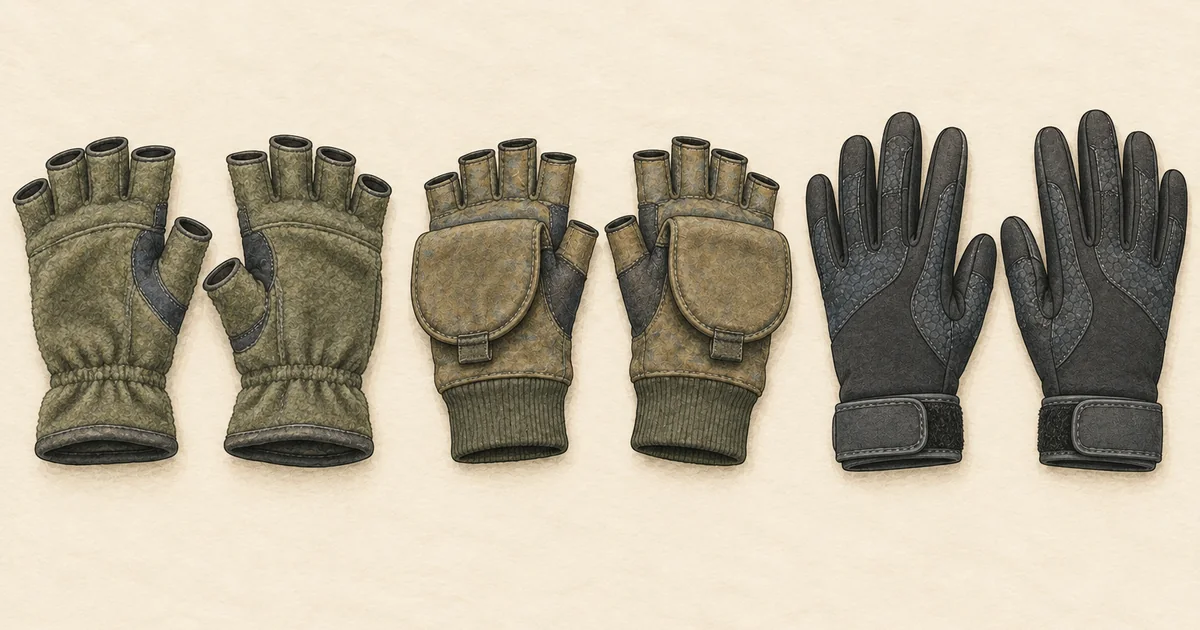
Fingerless gloves
They warm the back of the hand and the base of the fingers, while the tips stay bare. For winter feeder fishing they must be supple enough to fill the feeder and cast accurately, and leave the fingertips free so that unhooking is easy.
Flip-top mitten
The flip-top mitten is a fingered glove with a mitten cap attached. When you flip the cap back, the fingertips are bare. At the water you switch between two states: while waiting for a bite your hand sits under the cap, and for tying knots, baiting and unhooking the cap lies on the back of your hand as in fig. 1.
Neoprene
Neoprene is a synthetic rubber. In its foamed form it holds many tiny gas bubbles that conduct heat poorly. Cold-protection suits for divers and surfers are made from this foam, and surf gloves are usually neoprene. Anglers know the material from waders. The sources used here give no test figures of their own for neoprene fishing gloves.
A second pair is worth having as soon as water is involved, so you do not have to fish with wet fingers. For Norway, a Blinker equipment list names gloves that let no water through and a towel for the hands. Guide values for ice thickness and help if the ice gives way are under Walking on ice.
Frostbite: The German Red Cross (DRK) describes it as local tissue damage from prolonged cold, usually together with wet and wind, and names fingers as often affected. According to the DRK, warning signs are numbness and skin that first turns bluish red and later whitish. The DRK advises calling the emergency number 112 and not warming frozen areas by rubbing or with a hot-water bottle. The faster the wind blows, the more it cools the skin, explains the German Weather Service (Deutscher Wetterdienst). This note is no substitute for medical advice.
Finger protection when casting with braid
When casting with a fixed-spool reel, your index finger holds the line until you release it. On a full pull-through with a surf rod an enormous force presses on the index finger, which is why surf anglers usually carry a finger guard. There, between the main line and the hooklength, sits a shock leader, a stronger length that absorbs the force of the cast. Rute & Rolle warns that if this shock leader is braid, a casting glove or finger guard belongs on your hand. Otherwise the thin line cuts into the index finger.
A makeshift fix from fly fishing: if you hold the line too tightly, it cuts through the thin skin. A finger protector will do as a stopgap: you cut a finger off a kitchen glove and slip it on. The Line calculator shows how much breaking strain thin braid still has after the knot; the right rod for long casts is under Sea rod.
Spines, teeth and blood
In the Bavarian question catalogue for the angling exam (Fischerprüfung), for species with spiny rays, spines on the body or sharp teeth, an increased risk of injury counts as the correct answer, and for spiny rays in the dorsal fin the warning about poorly healing wounds is added. One example is the perch. At the coast, according to the exam questions from Saxony-Anhalt, you have to handle the weever with particular care because of the venomous spines in the dorsal fin and gill covers. For processing, angling magazines recommend sturdy work gloves. The filleting glove protects against the knife blade when cutting up a fish; that page also says what it does not stop.
There are landing gloves for the pike. They keep out smaller teeth and the sharp gill arches, but not a hook driving in hard. The large teeth in the lower jaw bore through the glove, so you do not reach into the mouth even with one on. You free the hook with forceps or a disgorger.
When you kill a fish, blood matters. In the exam questions from Saxony-Anhalt, the blood of eel and wels catfish irritates the mucous membranes, and eel blood must not get into open wounds. The Bavarian catalogue names the eyes as well as wounds. A tight rubber glove covers cracks in the skin of the hand; the procedure is shown in Stunning and killing a fish.
On a fish that is going back: gloves off
A layer of mucus covers the fish’s skin. According to the Bavarian exam catalogue it protects against outside influences and reduces friction when swimming. For an undersized fish the correct answer there is: unhook it in the water or with wet hands and let it glide straight back so its skin comes to no harm. In the Saxony-Anhalt catalogue, holding it with a dry cloth is explicitly a wrong answer.
Landing gloves have drawbacks. Many have a rough surface that gives grip but damages the mucous membrane. With a glove on you also lose feel, which is awkward with a gill grip because your hand is then close to the delicate gills. So you only wear one when a hook threatens to drive into your fingers, and you take off ordinary gloves before touching a fish that must go back unharmed. The whole procedure is described in Landing and unhooking a fish and Returning a fish.
Designs at a glance
| Design | What for | Limit |
|---|---|---|
| fingerless | Knots, feeder, unhooking | fingertips unprotected |
| Flip-top mitten | Alternating waiting and knot tying | fold the cap back to tie knots |
| Neoprene | Cold at the water | closed, less feel |
| Casting glove, finger guard | Long cast with braid | protects only the line finger |
| Landing glove | Pike teeth, gill arches | does not stop a hook, rough on the mucous membrane |
| Work or rubber glove | Spines, fish blood | not for a fish that is going back |
Heat sources for hands and feet
If gloves alone aren’t enough, warmth from outside comes in. For people working outdoors, the DGUV, in its guidance on cold, names facilities for warming hands and feet, such as heating plates, alongside suitable clothing and changing out of wet things. According to the DGUV, anyone who is constantly cold at work is less focused and more likely to have an accident.
Pocket warmer and heat pad
According to Blinker, the classic pocket warmer is heated either by a charcoal stick or by lighter fuel. Disposable heat pads need no fuel: their filling reacts with the oxygen in the air and then gives off heat for several hours, the magazine says. So they only get warm once air can reach them.
At the water, warmers do two jobs. For ice fishing with active methods such as the drop shot, Fisch & Fang recommends hand warmers, because delicate bites can hardly be felt through thick gloves. You then fish with thin or fingerless gloves and warm your fingers in your pocket in between. Warmers also protect the bait: according to Blinker, baits stay unfrozen even in sub-zero temperatures if they lie in an insulated bag with a hand warmer. The magazine calls pocket warmers helpful for numb fingers and against freezing baits when burbot fishing. How else to keep maggots and worms fresh is explained under Maggot box.
Heated insoles and battery-heated clothing
For your feet there are heated insoles. Blinker distinguishes two kinds: insoles with a battery and disposable insoles that, like the heat pads, react with oxygen and stay warm for several hours. For ice fishing for roach, the magazine recommends boots that are well insulated or upgraded with heat pads. Which boots are suitable and how a mat helps against the frozen ground is described in Fishing shoes.
According to the Angling Times, heated socks and tops are also available. For gloves with built-in heating, the specialist sources checked here give no practical experience. The same applies to all these items: according to the Umweltbundesamt, a permanently built-in battery is very likely a lithium-ion battery. In the cold its performance drops sharply, according to Blinker, and below minus 20 °C its service life can be noticeably shortened, according to the UBA. The agency advises not charging batteries outdoors, in damp rooms or while you sleep. It considers swollen or deformed batteries defective; they should neither be used any further nor opened. If a battery gets so hot that you can hardly touch it although it isn’t charging, the Bundesanstalt für Materialforschung calls it dangerous. More on this under Batteries and power banks.
Heat only on skin that can still feel: warmers and heated insoles are for prevention. In the case of frostbite, the DRK expressly advises against actively applying heat, for example with a hot-water bottle. The diabetes information portal diabinfo describes how, with diabetic nerve damage, some people find it harder over time to sense differences in temperature. If you notice this in yourself, clarify the use of warmers and heated insoles with a doctor beforehand. This note does not replace medical advice.
Against cold over the whole body during long hours in a boat or on the ice, a thermal suit helps.
Common mistakes
- Handling a fish in a glove when it is going to be returned. The exam catalogues require wet hands; dry fabric and a rough coating damage the mucus layer.
- Closed gloves where feel matters. With a glove on, fingertip feel is limited, and at the ice hole and when tying knots you miss it.
- Trusting the landing glove too much. It does not help against a hook and the big teeth in a pike’s mouth.
- Pulling through fully with braid and no finger protection. The thin line cuts into the index finger.
- Keeping wet gloves on. According to the DRK, wet and wind encourage frostbite, so keep a dry spare pair in your bag.
Frequently asked questions
Can I handle a fish with gloves on?
If it is going back into the water, no. The exam catalogues from Bavaria and Saxony-Anhalt require wet hands so the fish’s skin stays intact. You only put on a landing glove if a hook would otherwise threaten to drive into your fingers.
Which gloves suit ice fishing?
At the ice hole gloves and hand warmers count, but so does fingertip feel. Fingerless models or a flip-top mitten leave the tips free for the rod and line. The gear is described in Ice fishing.
Does a glove protect against hook injuries?
Only to a limited extent. Even a landing glove will not stop a hook driving in hard. What to do after a hook injury is under Hook injury and first aid.
May I thaw frostbitten fingers with a hand warmer?
No. In the case of frostbite, the DRK advises against active heat and names calling the emergency number 112 as the first step. Hand warmers and heated insoles help beforehand, as long as your fingers still have feeling.
Related
- Filleting glove: cut protection for the hand that holds the fish while you cut it up
- Landing and unhooking a fish: landing net, wet mat and a short time in the air
- Ice fishing: rod, bait and rules at the hole
- Braided line: thin, low-stretch and delicate
- Weever: the venomous sea fish in profile
- Line calculator: breaking strain after the knot and backing
- Hook injury and first aid: what to do until you see a doctor
- Thermal suit: protection from the cold for the whole body in a boat and on the ice
Sources
- Blinker: 10 Tipps zum Angeln im Winter (klamme Finger, Fleece oder Wolle, Taschenöfen mit Kohlestab oder Benzin, Heizsohlen und Wärmepads) und Blinker: Eisangeln: Heiße Tipps für mehr Erfolg (Handschuhe und Taschenwärmer, Fingerspitzengefühl am Eisloch)
- Blinker: Angeln auf Brassen: Die richtige Feeder-Taktik für den Winter (geschmeidige Handschuhe, freie Fingerspitzen)
- Blinker: Angelausrüstung für Norwegen (wasserdichte Handschuhe, Handtuch)
- Wikipedia: Handschuh (Surfhandschuhe aus Neopren, nur ergänzend) und Wikipedia: Chloropren-Kautschuk (geschäumtes Neopren mit Gasbläschen, nur ergänzend)
- Deutsches Rotes Kreuz: Erfrierungen und Unterkühlungen (Entstehung, Warnzeichen, Notruf, keine aktive Wärme) und Deutscher Wetterdienst: Wind-Chill-Effekt (Abkühlung der Haut durch Wind)
- Rute & Rolle: Brandungsangeln, 10 Tipps für mehr Meter (Wurfhandschuh bei geflochtener Schlagschnur), Blinker: Brandungsangeln (Druck auf den Zeigefinger, Fingerschutz) und Blinker: Blutzoll (Fingerschützer aus einem Küchenhandschuh)
- LfL Bayern: Staatliche Fischerprüfung, Prüfungsfragen 2023/2024 (PDF) (Schleimschicht, nasse Hände, Stachelstrahlen, Aalblut) und Sachsen-Anhalt: Fragenkatalog zur Fischerprüfung (PDF) (Petermännchen, Blut von Aal und Wels, nasse Hände statt trockenem Tuch)
- Blinker: Fische landen, Kescher, Lip-Grip und Co. (Landehandschuhe und Schleimhaut, Fingerspitzengefühl, Handschuhe ausziehen), Blinker: Hecht landen (was der Landehandschuh abhält) und Blinker: Das Petermännchen (Arbeitshandschuhe)
- Blinker: Kein Frust bei Frost (Isoliertasche und Handwärmer gegen gefrierende Köder), Blinker: Die besten Tipps zum Quappenangeln mit Leber (Taschenwärmer für Finger und Köder) und Blinker: Futter-Tipps zum Eisangeln auf Rotaugen (isolierte Schuhe oder Wärmekissen)
- Fisch & Fang: Eisfischen in der Schweiz (Handwärmer bei aktiven Methoden, Bisse durch dicke Handschuhe kaum spürbar)
- Angling Times: How to keep your bivvy safe and warm (beheizte Socken und Oberteile) und Blinker: Strom am Wasser für Angler (Lithium-Akkus in der Kälte)
- Umweltbundesamt: Sachgemäßer Umgang mit Lithium-Batterien und -Akkus (eingebaute Akkus, Kälte, Laden, defekte Akkus nicht weiter benutzen) und BAM: Sicherer Umgang mit Lithium-Batterien (zu heißer Akku ohne Ladevorgang)
- DGUV Arbeit & Gesundheit: Schutz vor Kälte am Arbeitsplatz (Konzentration und Unfallrisiko beim Frieren) und DGUV: Fachbereich AKTUELL FBVW-506, Hilfestellung zu den ASTA-Empfehlungen zu Hitze und Kälte (PDF) (Einrichtungen zum Aufwärmen von Händen und Füßen, nasse Kleidung wechseln)
- diabinfo, Diabetesinformationsportal: Diabetische Neuropathie und Polyneuropathie (schlechteres Temperaturempfinden bei diabetischer Nervenschädigung)
Text AI-assisted, drawing AI-generated. Sources opened and checked in October and November 2026, no graphics taken from the sources.
All figures are rough guides with no guarantee. Which glove suits depends on temperature, fishing method and target fish; for cold injuries and wounds the text is no substitute for medical advice.