
Knowledge · Tackle
Filleting glove: Cut protection in the fish kitchen
A filleting glove protects the hand that holds the fish while you break it down. If the blade slips on the slimy skin, the glove is meant to stop it. This page covers which hand it belongs on, what the markings under EN 388 mean, where knitted gloves reach their limits and how to get it clean after working with fish.
Why the holding hand needs protection
When filleting, one hand holds the fish while the other guides a thin, sharp blade right next to it. In its rule on stab protection, the Deutsche Gesetzliche Unfallversicherung (DGUV) counts slippery material being cut, heavy exertion and a knife guided towards the body among the circumstances of increased danger. For boning and deboning, the Berufsgenossenschaft Nahrungsmittel und Gastgewerbe (BGN) describes that the knife can slip off the material being cut, and requires stab-resistant gloves in kitchens for this.
Then there is the fish itself. In the Bavarian question catalogue for the angling exam (Fischerprüfung), the correct answer for species with spiny rays, body spines or sharp teeth is an increased risk of injury, with the added warning about poorly healing wounds for spiny rays in the dorsal fin. The perch has such spiny rays in its first dorsal fin. BLINKER writes that perch anglers often have punctured fingers because the dorsal fin and gill-cover spines stab when filleting.
At the sea the weever is the special case. According to the Giftzentrale Bonn, its venom glands sit on the spine of the gill cover and on the bony rays of the front dorsal fin, and any contact with them should be avoided. BLINKER advises wearing sturdy work gloves when processing it and cutting off the spiny rays and gill-cover spines first with scissors.
Which hand the glove belongs on
On the hand that holds the fish. The DGUV describes stab-resistant gloves made of metal ring mesh as protecting the hand that holds the material, up to the wrist. In the BGN’s kitchen information, the hand without the knife wears the glove. If you cut with your right hand, you wear it on the left. According to the DGUV there are left and right versions, or models that fit either hand by turning them over.
The knife hand is not left unprotected either. When working with hand knives, the DGUV strongly recommends protecting it too with a cut-resistant glove. The BGN gives the reason: if the hand slides off the handle, the special fabric lowers the risk of injury.
The glove does not replace cutting technique. Guide the blade away from the holding hand towards the tail, as in Fig. 1. The BGN generally advises turning the edge away from parts of the body. If the blade does have to go towards the thumb, DGUV and BGN describe a separate thumb cut guard made of ring mesh. The sequence of cuts itself is covered under Filleting fish.
Narrow blades: The DGUV classes knives by blade width, measured 20 mm behind the tip. Below 8 mm the blade counts as extremely pointed. Such blades can penetrate ring mesh, so stab protection is not given even with a glove. For stabs or cuts towards the hand they are taboo according to the DGUV. If in doubt, measure your filleting knife with a ruler.
Ring mesh or cut-resistant knit
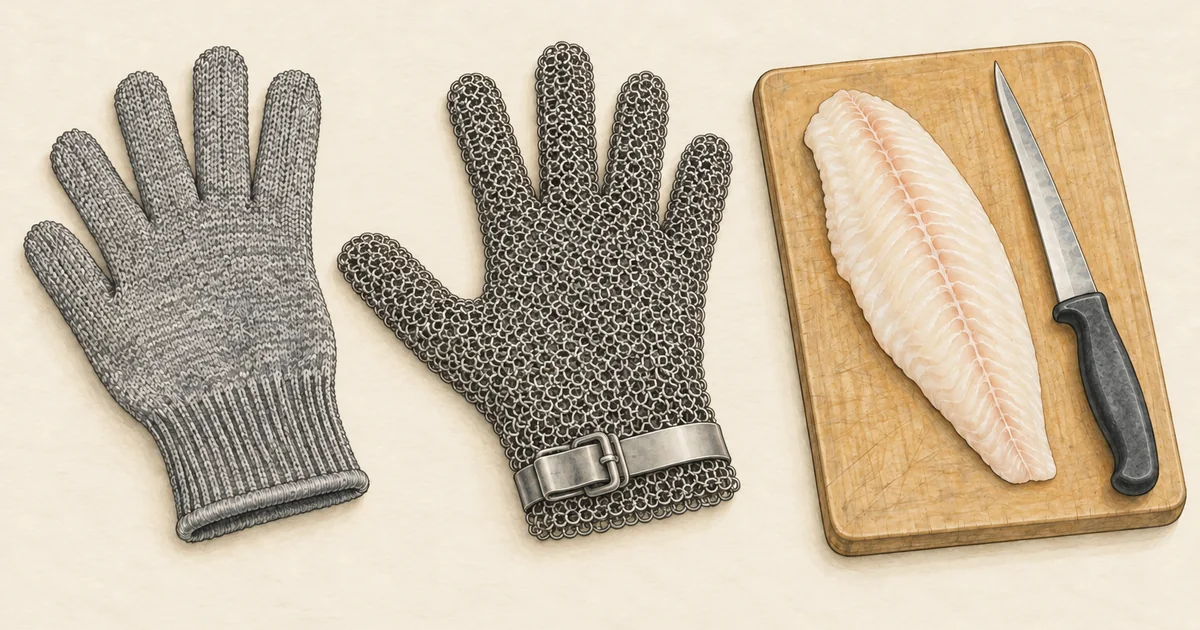
The glove made of metal ring mesh is colloquially called a chain-mail glove. For protection against stabs from hand knives, this was the only design available when the DGUV rule appeared in 2019, according to the DGUV. Besides steel, titanium is used, which according to the DGUV is more pleasant to wear: lighter, feels warmer and has a lower allergy potential.
According to the DGUV, cut-resistant knitted gloves are made, for example, from HPPE fibres, a high-strength polyethylene, with or without steel threads worked in. Their advantage, according to the DGUV: if the hand slips onto the blade, no serious injury should result. They do not protect against stabs, according to the DGUV. For perch spines or a knife tip, a knitted glove is therefore not reliable protection.
| Feature | Metal ring mesh | Cut-resistant knit |
|---|---|---|
| Cut | stops it | resists, level under EN 388 |
| Stab | stops it, not with an extremely pointed blade | no protection according to the DGUV |
| Hand according to the DGUV | Holding hand | Knife hand |
| Material | Steel or titanium rings | HPPE fibres, some with steel threads |
What the markings on the label mean
For cut-resistant gloves, the DGUV advises models with the CE mark and the pictogram under EN 388, the standard for protective gloves against mechanical risks. It lists ring-mesh gloves under their own standard, EN 1082-1.
Under the EN 388 pictogram is a code. The DGUV explains four test values in a fixed order: abrasion, cut, tear and puncture, for example 4.5.4.X. The second position is the cut protection under the older method. For knife work the DGUV recommends the highest level, 5, there. For high-performance fabrics there is, according to the DGUV, a letter from A to F under ISO 13997 in addition or instead, plus a P for the impact test where applicable. The digit and the letter are based on different test methods and cannot be compared with each other.
The X generally stands for an area that was not tested; in the example the DGUV reads it as missing stab protection. Either way, an X in fourth position promises no protection against stabs.
The EN code does not say whether a glove may come into contact with food. According to the Bayerisches Landesamt für Gesundheit und Lebensmittelsicherheit (LGL), such items carry the note “for food contact”, an intended use or the symbol with a glass and a fork. Look out for this when buying.
Fit and size
Ring mesh is flexible but does not stretch. According to the DGUV, such a glove fits properly only if you can make a fist in it and it nowhere presses, pulls or cramps the fingertips. Six sizes with a colour code are usual, from size 5 in brown through 6 green, 7 white, 8 red and 9 blue to 10 in orange. The DGUV nevertheless advises trying it on rather than buying by the label alone. Fixing elastics that run over the fingers to the wrist limit the play at the fingertips.
For cold, wet material such as fresh fish, the DGUV describes a three-layer set-up: a cotton glove directly on the skin, a waterproof glove over it, for example made of polyethylene, and the ring mesh on the outside. In this combination the outer glove should sag slightly at the fingertips and palm when the hand is open, so that the fist still closes.
Cleaning, drying, checking
The glove has touched raw fish and goes in the washing-up like the knife and the board. The Bundesamt für Verbraucherschutz und Lebensmittelsicherheit (BVL) advises cleaning hands, kitchen utensils and work surfaces thoroughly with hot water during and after preparing fish. The Bundesinstitut für Risikobewertung (BfR) considers simple cleaning products generally sufficient in the home. According to the BfR, disinfectants are needed only if a doctor or the health authority (Gesundheitsamt) advises them. More on this under Storage and hygiene.
- Ring mesh: clean according to the manufacturer’s instructions and hang it up to dry in an airy place. The DGUV warns against cleaning products with chlorine or acid in high concentration, because they can trigger stress corrosion and damage the rings.
- Knitted glove: For dishcloths and rags the BfR writes that bacteria multiply rapidly in damp fabric at room temperature, and advises drying and washing them at 60 °C or more. Do not leave a wet knitted glove lying damp either. Whether it can take 60 °C is in its care instructions.
Before every use it is worth checking the rings. According to the DGUV, typical damage is burst, kinked, stretched, notched, corroded or ground-down rings, especially at the fingertips. According to the BGN, such damage reduces the protective effect, and a damaged glove is not used any further. The manufacturer can usually repair it.
Common mistakes
- Putting the glove on the knife hand. The ring mesh belongs on the hand that holds the fish.
- Taking the knitted glove for stab protection. According to the DGUV it does not protect against stabs, and it cannot be relied on with perch spines either.
- Cutting towards the glove. Even with mesh the rule is blade away from the hand. According to the DGUV, an extremely pointed blade goes through anyway.
- Soaking the chain-mail glove in chlorine cleaner. That can attack the rings. Clean it according to the manufacturer’s instructions and let it dry hanging afterwards.
- Buying by the label instead of trying it on. If you cannot make a fist or the mesh presses on the fingertips, the size does not fit.
Frequently asked questions
Which hand needs the glove if I am left-handed?
The right, because it holds the fish. When buying, check whether the glove is made for the right hand or is reversible.
Does a cut-resistant glove protect against perch spines?
A knitted glove is not reliable, because according to the DGUV it does not stop stabs. Ring mesh is designed for stabs from hand knives. The rules used here do not mention a separate test for fish spines.
What should I do if I cut myself anyway?
What first-aid bodies recommend for injuries is covered under Hook injuries and first aid. After a sting from a weever, the Giftzentrale Bonn can be reached around the clock on 0228 19240. This page does not replace medical advice; in an emergency call 112.
Related
- Filleting knife: the knife that goes with the glove
- Filleting and boning fish: the three cuts and the pike with its Y-bones
- Fish bone pliers and tweezers: pulling bones from the finished fillet
- Hook injuries and first aid: what to do until you see a doctor, and tetanus protection
- Weever: portrait of the venomous sea fish
- Line calculator: breaking strain and knot strength of the fishing line
Sources
- DGUV: Regel 112-202, Benutzung von Stechschutzkleidung, Stechschutzhandschuhen und Armschützern (PDF) (Haltehand und Messerhand, Bauarten, EN 388, extrem spitze Klingen, Sitz, Reinigung, Schäden)
- BGN: ASI 7.10, Sicherer Umgang mit Messern in Küchen (PDF) (Abrutschen, Handschuh an der Hand ohne Messer)
- BGN Akzente: Stech- und Schnittverletzungen vermeiden (Messerhand, Schäden) und BGN Branchenwissen: Messerunfälle verhindern (Schneide abwenden)
- LfL Bayern: Staatliche Fischerprüfung, Prüfungsfragen 2023/2024 (PDF) (Stachelstrahlen, Verletzungsgefahr)
- Giftzentrale Bonn: Petermännchen (Giftdrüsen, Rufnummer)
- BLINKER: Steckbrief Barsch (zerstochene Finger beim Filetieren) und BLINKER: Das Petermännchen (Handschuhe, Stacheln abschneiden)
- LGL Bayern: Bedarfsgegenstände mit Lebensmittelkontakt (Kennzeichnung für Lebensmittelkontakt)
- BVL: Hygienischer Umgang mit Fisch (heißes Wasser) und BfR: Verbrauchertipps, Schutz vor Lebensmittelinfektionen im Privathaushalt (PDF) (Reiniger, feuchte Tücher)
- Wikipedia: EN 388 (A bis F, X, nur ergänzend)
Text AI-assisted, drawing AI-generated. Sources opened and checked in October 2026; no graphics taken from the sources.
All figures are guide values without guarantee. Which glove fits depends on the fish, the knife and the hand; the manufacturer’s specifications are what count.