
Knowledge · Kitchen and use
Filleting and deboning a fish
Filleting a fish means freeing the two flanks of flesh from the spine and ribs. The page walks you through the process on a trout and other round fish, describes flatfish and pike, and shows what helps against the fine bones in cyprinids. Common mistakes and hygiene follow.
Preparation and tools
Only fish that may lawfully be taken and has been killed humanely is filleted. The learning portal of the Landesfischereiverband Bayern recommends gutting it first (Gutting a fish). That reveals parasites in the body cavity and the stomach contents. According to the learning portal, you do not have to scale a fish if you are filleting it. Blinker leaves the scales on for curing or smoking and scales before gutting for frying or grilling. More under Scaling and skinning a fish.
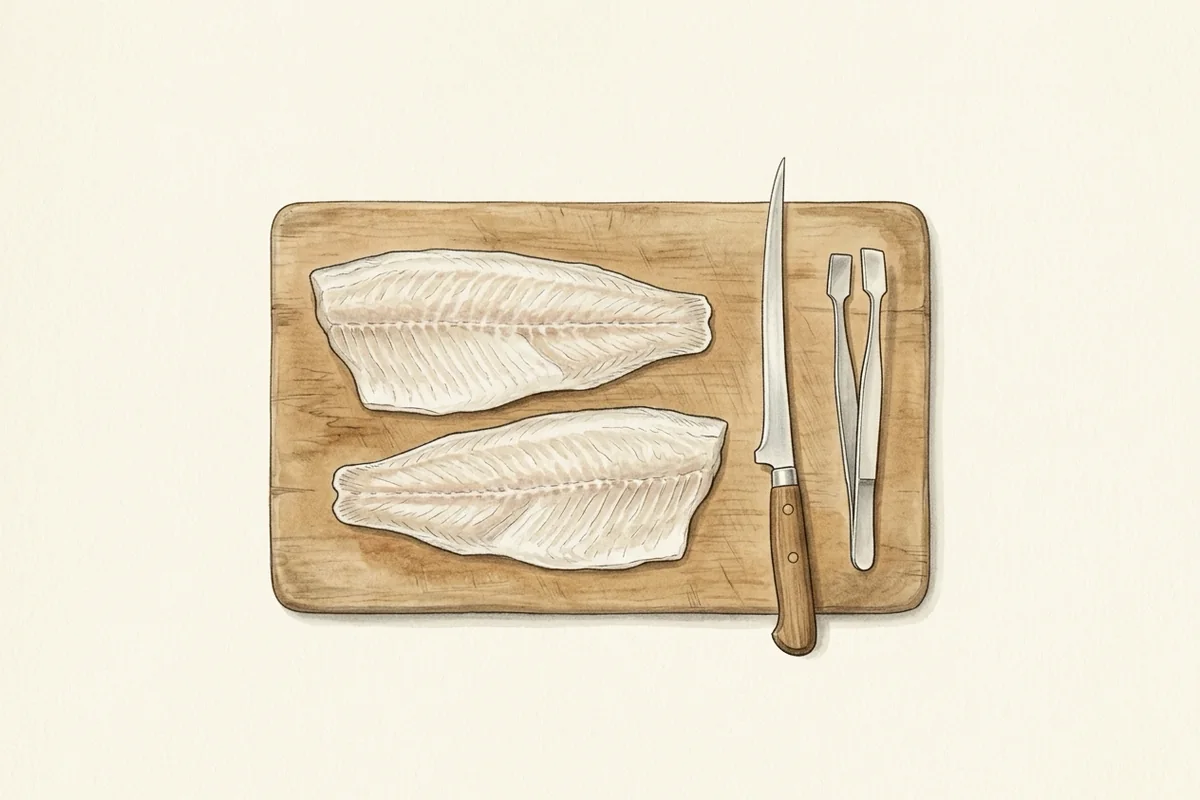
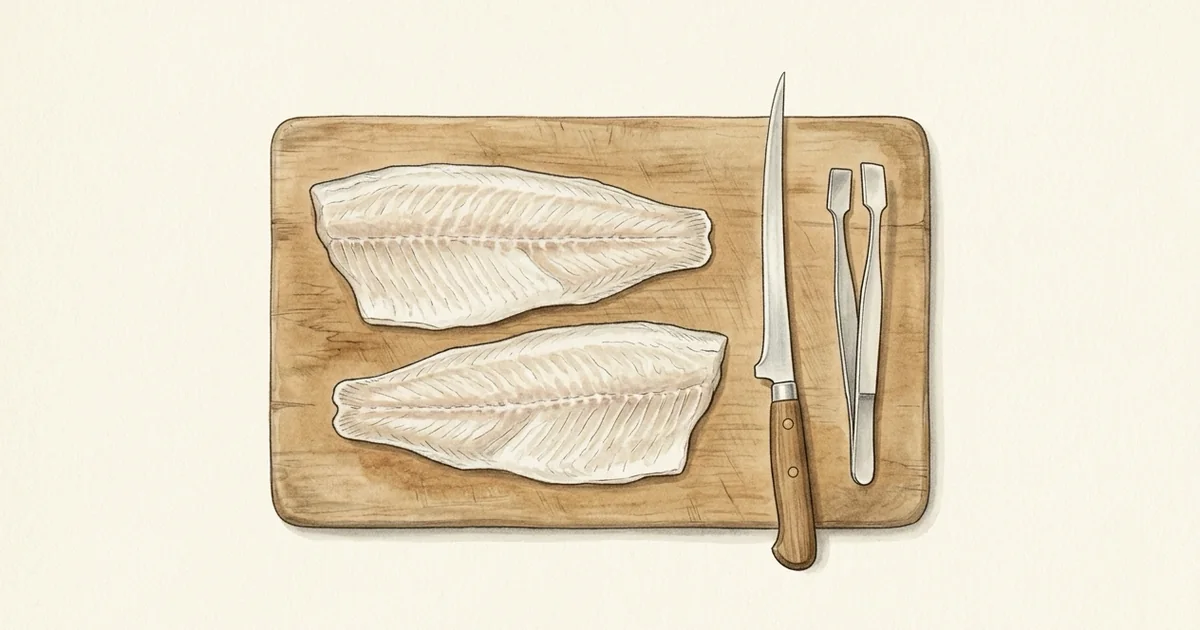
For freeing the rib cages of cyprinids, pike and salmonids, the Bavarian exam catalogue counts a long, flexible blade as correct. For a 72-centimetre sea trout, Blinker recommends a blade length of at least 20 centimetres; shapes and degrees of hardness are explained on the page Fillet knife. You also need a non-slip surface, according to the Fisch-Informationszentrum a board with a juice groove, kitchen paper for holding the fish in place, and bone tweezers for the fine work (Pin-bone pliers). For pike, the leaflet of the Bayerische Landesanstalt für Landwirtschaft (LfL) names a soft and a hard fillet knife and a beekeeper’s fork.
If possible, fillet fresh fish. After freezing, the flesh is softer and less stable according to the learning portal, which makes every cut harder. If you want to freeze fish with many bones, treat the bones beforehand (see below).
Round fish step by step
The sequence follows Blinker’s instructions for a large rainbow trout. The Fisch-Informationszentrum also makes the first cut at an angle behind the head.
- Cut behind the head. Set the knife at an angle behind the gills, so the blade lies behind the pectoral fin. Cut through the flesh down to the central bone.
- Along the central bone. Turn the blade sideways and run it along the central bone to the base of the tail. Blinker calls the cut over the central bone the hardest. If the tip of the knife loses contact with the backbone, you start again.
- Separating the belly bones. Run the knife downwards with pressure to the belly bones. This cut separates the belly bones and the lower fatty edge from the fillet.
- Pulling the transverse bones. Feel for the transverse bones in the back of the fillet with your index finger and pull them out with the pin-bone pliers.
- Turning over. Free the second side as a mirror image. The fish is now harder to hold than at the start, so the surface must not slip (Blinker).
A second school begins differently: Blinker cuts the head off as close as possible so that no neck flesh is lost, and first frees the boneless tail piece with one cut towards the tail fin. The cut over the central bone follows.
Note: Both sequences are basic frameworks. For flatfish and very small fish, the order changes considerably. If the skin is to stay on the fillet, for example for crisp-fried fish, you leave it on; otherwise you peel it off carefully (Fisch-Informationszentrum).
Bones: ribs, transverse bones, intermuscular bones
Not every bone stays attached to the skeleton. According to the learning portal, the backbone is not a bone in this sense. Bones in the narrower sense are small bones in the middle of the muscle flesh, with no connection to the spine. They are called intermuscular bones, pin bones or Y-bones. When you cut along the backbone, they stay in the fillet. Not all species have them:
| Fish | Intermuscular bones | What helps |
|---|---|---|
| Carp, bream, roach, chub | yes | Scoring, vinegar brine, mincer |
| Pike | yes | Wedge cut according to the LfL leaflet |
| Trout, char, zander, perch | no | Cut out the ribs, the rest with tweezers |
The fact that trout or zander carry no intermuscular bones does not make the fillet boneless. In Blinker’s account, a trout keeps transverse bones in the back, and above the belly bones there are small bones set crosswise that can be cracked with a short pressure from the wrist. In large trout, char and salmon, the exam catalogue says there is also a second row of ribs in the fillet, which you pull with tweezers.
The Fisch-Informationszentrum advises four moves when pulling bones: stroke your fingertips over the fillet, since bones are easier to feel than to see. Grip the bone close to the fillet. Pull it out slowly in the direction it grows so the fillet does not tear. Finally, make a second pass to find any bones you missed.
Cyprinids: scoring the bones
For carp, bream and other cyprinids, the way forward is scoring. The learning portal describes it like this: score the fish from the outside, or the fillet from the inside, at intervals of 2 to 3 millimetres, almost down to the spine. The bones break into pieces that hardly bother you. For fillets the exam catalogue gives the same spacing and cuts through to the skin. Only then do you portion it, into pieces of equal thickness, because equal thickness means equal cooking time.
There are alternatives. The learning portal mentions putting the fillet through a mincer, after which the fish looks like minced meat. The bones can also be dissolved with acid: they consist of calcium, and several days in vinegar or citric acid soften them. Simply sprinkling lemon juice over them is not enough. The exam catalogue also gives soaking fillet pieces in a vinegar brine as the answer. The treatment belongs before freezing.
Pike: the wedge cut against the Y-bones
In pike, the Y-bones sit loose between the muscle strands. The LfL leaflet describes its own way. You fillet both sides and cut out the ribs. Then you lay the fillet skin side down, and the short ends of the Y-bones show as white pegs. With the soft knife you run down behind the pegs until you feel resistance. Then you guide the blade along the bones towards the back, exposing the long part of the Y-bones. The second cut sits about a centimetre below the first, with the edge pointing upwards. Now the wedge-shaped strip of flesh with the bones can be removed.
The leaflet points out a peculiarity. In the tail and the middle part of the fillet there is also a second row of intermuscular bones that are not Y-bones. Here you run the knife at right angles to the skin from back to front along the visible pegs, make a second cut about a centimetre deeper and go along the bones towards the belly down to the skin. More on the species under Pike.
Flatfish
Flatfish such as plaice, flounder and dab are cut differently from round fish. Blinker first separates the tail with a sturdy fillet knife. Then he sets the knife at the tail end parallel to the central bone, tilts it onto the central bone and frees the fillet as far as the base of the fins. The other side follows in the same way. After that, two strips of fillet still hang on the central bone. The knife is pushed in above the central bone, the fillet is detached towards the rear and separated from the carcass with a round cut behind the gills.
Common mistakes
- The surface slips. The fish is harder to hold on the second side, which is why Blinker demands a very non-slip surface.
- The head is cut off too generously. Blinker cuts as close as possible so that neck flesh stays on the fillet.
- The knife loses contact with the spine and is pushed on. It is better to start again.
- The blade is blunt. Blinker advises sharpening it if necessary.
- Bones are pulled in a hurry. The Fisch-Informationszentrum advises a slow pull in the direction of growth, otherwise the fillet tears.
- With carp, it is portioned first and scored afterwards. According to the learning portal, treating the bones comes before portioning.
Checking fillets and keeping things clean
According to the Bundeszentrum für Ernährung (BZfE), fresh fillets look slightly glassy and clear, the flesh is elastic and firm, and the muscle segments hang closely together. The Bundesamt für Verbraucherschutz und Lebensmittelsicherheit (BVL) advises storing and preparing fish separately from food that will not be heated again, and cleaning hands, utensils and work surfaces with hot water. Frozen fillets thaw in the fridge on a sieve, and the thaw water is always thrown away according to the BZfE. Chilling times and freezing are covered on the page Storage and hygiene.
Frequently asked questions
Which knife is suitable for filleting?
A sharp knife with a long, flexible blade, is the answer in the Bavarian exam catalogue for cyprinids, pike and salmonids. For large fish such as a 72-centimetre sea trout, Blinker gives a blade length of at least 20 centimetres.
Do I have to scale and gut before filleting?
According to the learning portal, you do not have to scale if you are filleting. It recommends gutting beforehand because you see parasites and stomach contents while doing so. If the skin is to be eaten too, look at Scaling and skinning a fish.
How do I get rid of the bones in a carp?
Score the fish or fillet at intervals of 2 to 3 millimetres, almost down to the spine or through to the skin. Only then do you portion it. Alternatives are a mincer or several days in a vinegar brine.
How do I find the Y-bones in pike?
Lay the fillet skin side down. According to the LfL leaflet, the short ends of the Y-bones then show as white pegs in a row, and you cut along them.
Related
- Gutting a fish: belly cut, kidney and where the waste goes
- Scaling and skinning a fish: which species needs what
- Storage and hygiene: cooling, time limits and freezing
- Pike: the species with Y-bones
- Fillet knife: blade, soft and hard
- Pin-bone pliers and bone tweezers: feeling for and pulling bones
- Fillet glove: cut protection for the holding hand
- Kitchen and use: an overview of all the steps
- Knife sharpening: keep a fillet knife sharp by the water
Sources
- Bayerische Landesanstalt für Landwirtschaft: Anleitung zur Herstellung grätenfreier Hechtfilets (Ausrüstung, Y-Gräten als Stifte, Keilschnitt, zweite Grätenreihe)
- BLINKER: Fisch filetieren (Klingenlänge, Schwanzstück zuerst, Mittelgräte, Quergräten, Unterlage)
- BLINKER: Forelle filetieren (Kopfschnitt, Bauchgräten, Quergräten ziehen)
- BLINKER: Plattfisch filetieren (Schnittfolge bei Scholle, Flunder, Kliesche)
- Bayerische Landesanstalt für Landwirtschaft: Staatliche Fischerprüfung, Prüfungsfragen 2023/2024 (Klinge, zweite Rippenreihe, Einschneiden, Essigsud, Zwischenmuskelgräten)
- Landesfischereiverband Bayern, Lernportal: Betäuben und Schlachten (Gräten, Arten mit und ohne Zwischenmuskelgräten, Einschneiden, Säure, Fleischwolf)
- Landesfischereiverband Bayern, Lernportal: Fische aufbewahren, zerteilen und filetieren (Ausnehmen vorher, frisch statt aufgetaut, Grätenbehandlung vor dem Einfrieren)
- Landesfischereiverband Bayern, Lernportal: Fische versorgen (kein Schuppen beim Filetieren)
- Fisch-Informationszentrum: Vor- und Zubereitung (Werkzeug, erster Schnitt, Gräten ziehen, Haut am Filet; nur Technik)
- BVL: Hygienischer Umgang mit Fisch (Trennung von Speisen, Reinigen mit heißem Wasser)
- BZfE: Fisch, vom Einkauf in die Küche (Frischemerkmale am Filet, kurzes Abspülen, Tauwasser)
Text AI-assisted, drawings AI-generated. Sources opened and checked in October 2026; no graphics taken from the sources.
All figures are guide values without guarantee. The instructions of the food inspection authorities and the rules of your federal state (Bundesland) on taking and using fish are what count.