
Knowledge · Tackle
Fishing reels: Types and key figures
Fishing reels store the line, release it in the cast and brake a fleeing fish. Here you will find the designs compared, and what size, gear ratio, line capacity and braking force on the packaging mean.
Fixed or turning spool
The tackle knowledge for the angling exam (Fischerprüfung) recognises two basic types. On the fixed-spool reel the spool is fixed and its axis lies along the rod. On the multiplier reel and the fly reel, the spool itself turns and its axis stands across the rod. Fixed-spool reels hang under the casting hand, multiplier reels sit on top in front, and fly reels hang behind.
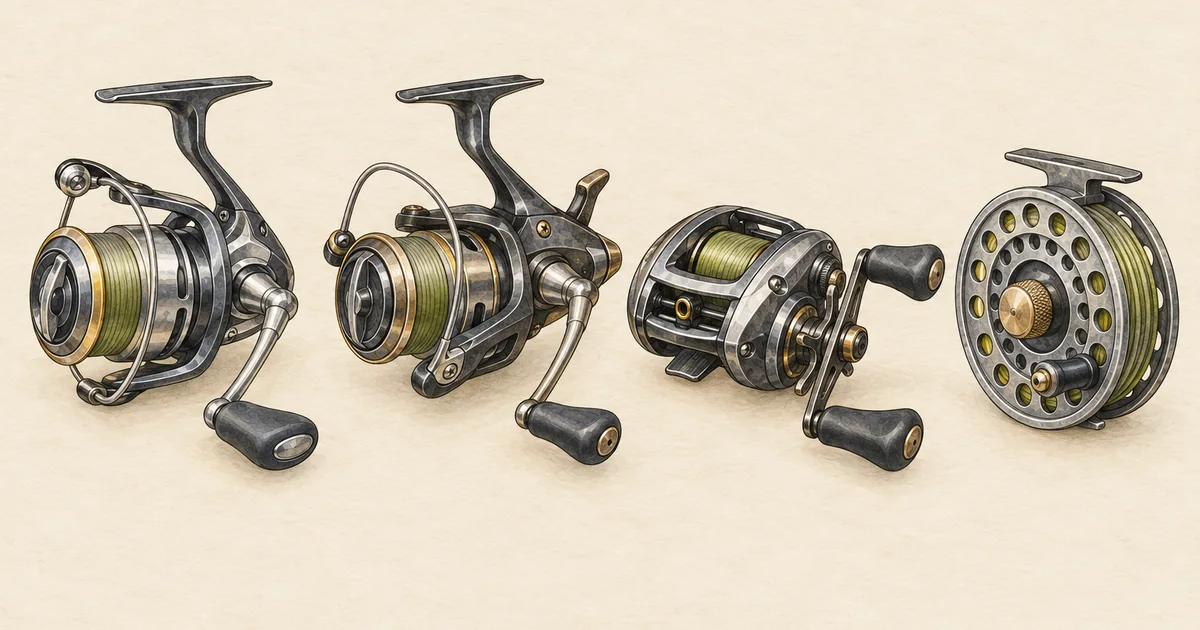
Fixed-spool reel
A rotor with bail arm and line roller turns around the fixed spool and winds the line on. It is the most widely used reel, easy to operate and strongest where you cast. Small models suit light spinning or float fishing, large ones carp fishing. Components, spool shapes and care are covered under Fixed-spool reel.
Freespool reel
A fixed-spool reel with a second, light drag. According to the tackle guide, the fish can pull line off even though the bail arm is closed and the drag is set. A switch, usually at the back of the housing, changes between the two. It is popular for carp fishing and for sitting with a deadbait on pike and zander. A variation is the quick-drag system. It has no true free spool, but a short turn on the front drag raises the braking force immediately. More under Baitrunner reel.
Baitcaster and multiplier reel
With the multiplier reel, the spool, supported on both sides, turns and takes up the line directly. This makes it sturdier than the fixed-spool reel and intended for sea, wels catfish and trolling fishing. The classic multiplier is poor for casting. The baitcaster is the form for casting: a casting brake, centrifugal or magnetic, slows the spool during the cast so that it does not overrun and form a bird’s nest, a tangle of line on the spool.
Most multiplier reels have a switchable click that makes a bite audible. Some have an automatic level wind. It is a weak point in extreme runs, so for heavy fishing you use multipliers without one and lay the line with your fingers. More under Baitcaster and multiplier reel.
Fly reel
In fly fishing the fly line is the casting weight. The reel holds it and the backing, a back-up line as a reserve in case a bigger fish runs. The fly reel is in principle a multiplier reel without a gear ratio. Its size depends on the line class of the rod, see Fly reel.
The centrepin as a special case
The centrepin reel is a specialist reel for float fishing on rivers. According to the British Angling Times it makes it easier to let the float trot downstream: the spool runs freely and your thumb brakes it. On the strike the thumb has to hold the spool, otherwise it keeps turning and the line tangles. Construction, drag and what to look for when buying are covered further down in the section “Centrepin on the river”.
| Design | Typical use | Position on the rod | Special feature |
|---|---|---|---|
| Fixed-spool reel | Spinning, float and bottom fishing | hangs under the grip | spool stands still, the bail arm winds on |
| Freespool reel | Sitting out for carp, bait fish for predators | hangs under the grip | second drag for line to run off with low resistance |
| Baitcaster | Spinning, often with heavy baits | on top of the grip | Cast control against backlashes |
| Multiplier reel | Boat, sea, wels catfish, trolling | on top of the grip | sturdy, star or slide drag |
| Fly reel | Fly fishing | hangs at the end of the grip | no gear ratio |
Size and line capacity
The number on a fixed-spool reel, such as 2500 or 4000, ranks it roughly by line quantity: the bigger the number, the bigger the reel and the more line, or the thicker line, fits on it. There is no common standard for this. The numbers range from about 500 to 30.000, manufacturers count differently in part, and with multiplier reels the grading is very inconsistent.
As a rough guide, Blinker gives 500 to 1500 for ultralight spinning and light coarse fishing, 2000 to 4000 as universal sizes in German fresh water, and 6000 to 10000 for a lot of line in carp fishing or thick line in wels catfish fishing. Reels from 10000 up belong almost only in salt water.
How little the number says on its own is shown by an example from the trout lake: large, shallow match spools often carry only about 150 m of 0,18 mm monofilament despite their size. That is intended there, because shallow spools release the line more easily on the cast.
Three figures instead of the size number
- Line capacity: it is printed on the spool or packaging as a length at a given diameter.
- Retrieve per turn of the handle: many manufacturers give it per turn of the handle. It says more about the speed of the reel than the gear ratio alone.
- Spool diameter: it is built into the retrieve: a larger spool takes in more line at the same gear ratio.
The line capacity always applies to the stated diameter. As a rough calculation, the length that fits on the same spool falls roughly with the square of the diameter. An assumed 150 m at 0,25 mm becomes about 77 m at 0,35 mm (150 × (0,25 ÷ 0,35)²). You can work it out more precisely in the line calculator, including backing. If you spool expensive braid, monofilament as backing can save braid and stops the fill slipping on the smooth spool, see Spooling a reel correctly.
How much line you need depends on the fishing: for ultralight spinning 100 m can be enough, while for deep-sea fishing in Norway at least 300 to 400 m is given. You convert units such as lb in the unit converter.
Gear ratio and line retrieved
The gear ratio, for example 5,2:1, says how often the rotor of the fixed-spool reel or the spool of the multiplier reel turns in one turn of the handle. Most reels lie between about 4:1 and 6:1, and the tackle guide gives 1:3 to 1:6 for fixed-spool reels, written the other way round. High-ratio reels retrieve faster but are harder to wind. Fixed-spool reels fundamentally have less retrieving power than multiplier reels, because the line is deflected through 90 degrees at the line roller.
The line retrieve per turn of the handle says more. A larger spool takes in more line at the same gear ratio, which is why many manufacturers give the retrieve as well. A high gear ratio does not automatically mean a high retrieve, as Fig. 2 shows. Rute & Rolle assigns low gear ratios of 3,8:1 to 4,8:1 to large, heavy lures, deep-diving crankbaits and slow retrieves in winter. Medium ones of 5,0:1 to 5,8:1 count as all-rounders, and high ones from 6,0:1 suit jigging and surface lures.
Worked example: the retrieve is roughly the diameter of the line layer times 3,14 times the gear ratio. With an assumed 5 cm and 5,2:1 that is 5 × 3,14 × 5,2, so around 82 cm per turn of the handle. At 3,6 cm and 6,0:1 it is only around 68 cm. As the spool empties during a fight, the diameter gets smaller and the retrieve falls.
Retrieve matters in coarse and carp fishing too: if the rig comes off the bottom faster, the risk of a snag falls. Anyone switching to a bigger reel often works the bait faster without noticing, and should first get used to the new speed.
Baitcaster or fixed-spool reel for getting started
The choice depends mainly on lure weight. Very light lures fly better from a fixed-spool reel; on a baitcaster they pull off too little line and bird’s nests form. Anyone who needs the greatest casting distance or retrieves fast in strong current has the advantage with the fixed-spool reel.
| Baits and lures | Obvious design | Bottom |
|---|---|---|
| very light (ultralight, small soft plastics) | Fixed-spool reel | baitcaster pulls off too little line, risk of bird’s nests |
| about 10 to 50 g | fixed-spool reel or baitcaster of the all-rounder class | the all-rounder class casts almost everything in this range |
| heavy (big baits, jerkbaits, trolling) | baitcaster or multiplier reel | more retrieving power, withstands load for longer |
Not every baitcaster casts every lure weight. According to Blinker, the smallest size classes are meant for lures up to about 10 to 15 g, the all-rounders cast almost everything between 10 and 50 g, and beginners are recommended a reel of this class. In return the baitcaster offers steadier lure flight because the line is always under tension, and it can be cast with one hand.
The baitcaster does not forgive a jerk. The rod has to load evenly, otherwise the spool accelerates faster than the lure pulls off line, and a bird’s nest forms. Beginners therefore tend to set the casting brakes firmly at first and practise with a lure that flies well and is neither very light nor sensitive to wind.
Drag, ball bearings and weight
The drag force is printed on the packaging in kg. You fish with considerably less, see Setting the reel drag.
Fixed-spool reels come with a front drag on the spool and with a rear drag at the back of the housing. The rear drag needs a mechanism that transmits the force forwards and is therefore usually somewhat more prone to trouble. Multiplier reels brake via a star wheel at the handle or a sliding lever. Simpler reels brake with felt and metal washers; higher-quality ones have carbon washers between the metal washers, which last longer and often brake more precisely.
The number of ball bearings is often advertised. Rute & Rolle counts the question about it among the wrong questions when buying. Four to five high-quality bearings in the right places can run better than more than ten poor ones. The bearings on the rotating axles matter most, and one in the line roller also makes sense. The tackle guide names gearing axles and line roller as bearing points of high-quality reels. Read the number as an advertising claim, not a measure of quality.
The weight depends on the material, from fibre-reinforced plastic to magnesium. Reels made of solid metal are the most robust. Aluminium spools are more durable than plastic spools.
Matching reel and rod
First the type has to match. Fixed-spool and baitrunner reels hang under the rod. Multiplier reels and baitcasters sit on top, and the rod needs a special, tighter arrangement of guides close to the blank for this, so that the line does not touch the blank under load. On a fly rod the reel seat sits at the butt end. More on rod types under Fishing rods.
Then the weight. Screw the reel onto the rod to test it: the centre of gravity should lie at the reel foot and the front grip, and a heavier reel balances a tip-heavy rod. This matters particularly on the spinning rod. According to tackle guides, the spool can be changed with a push button or a screw, and a spare spool carries a second line.
Salt water and care
For salt water use, reels need especially high-quality, preferably sealed ball bearings that keep out salt water and sand. Not every baitcaster is suitable for salt water. After every use in salt water the reel is rinsed: close the drag, screw the handle in firmly, hold the reel upright and briefly spray it cold with low pressure. Do not submerge it; no reel is completely sealed. Wiping with a damp cloth is not enough, because salt stays behind covers and the housing corrodes.
For lubricating there is a simple rule: gearing parts get no oil, only a grease that suits the reel and its use. Ball bearings are greased at the factory; oil thins the grease, and then they scratch and grind under load. That is what a care article in Blinker says, in which a reel servicing specialist speaks. He also points out that frequent rinsing washes lubricant out of bearings and gearing over time. His servicing workshop advises a service every one to one and a half years depending on use, with dismantling, cleaning and fresh lubrication. For storage after the fishing day he recommends loosening the drag to take the pressure off the washers.
Two habits that damage reels: closing the bail arm with the handle after the cast instead of by hand, and freeing a snag over the reel with the drag screwed tight. Both strain the rotor, the line roller and the gearing.
Centrepin on the river
The centrepin is the simplest design. Its spool runs freely on an axle which, according to Fisch & Fang, is fixed in the housing on one side only; the English name centrepin refers to this central axle. According to the same source, the principle was invented around 1850 in the English county of Nottinghamshire; it is also called a Nottingham reel. According to Rute & Rolle it has no gearing: one turn of the handle turns the spool exactly once.
Its speciality is trotting, fishing with a float that drifts downstream with the current (more under Float fishing and Fishing on the river). The spool runs so freely that the pull of the water on the float is enough to turn it. Fisch & Fang describes the difference: the float drifts away evenly, whereas line from an open fixed-spool reel jumps off jerkily in single coils. The slight running resistance holds the float back a little. This is intentional, because friction against the gravel slows the water near the bottom, where the bait drifts. According to Rute & Rolle the centrepin is no good for very sluggish water, where there is not enough pressure to turn the spool.
You brake with your thumb on the edge of the spool. On built-in drags the sources disagree. Rute & Rolle and Fisch & Fang describe the centrepin as having no drag; many models only have a switchable ratchet that stops the spool turning while you carry the rod. According to Angling Times, on the other hand, most models have an adjustable drag that is not meant for playing fish but controls how freely the spool runs. If you put the rod down for legering, Fisch & Fang says you need a ratchet that can be set tight enough, otherwise the current keeps pulling line off.
Worked example without gearing: One turn of the handle only retrieves the circumference of the line on the spool. With an assumed diameter of 11 cm that is 11 × 3,14, so roughly 35 cm, less than half the 82 cm from Fig. 2. Anglers therefore bring the empty rig back faster by knocking the spool rim with the flat of the hand and letting the spool spin quickly, known in English as batting. According to Angling Times this does not work with a fish on; then you wind on the handles.
According to Fisch & Fang, look out for four points when buying:
- Diameter: The drifting float pulls line more easily off a large spool. Models under 4,5 inches, roughly 11,4 cm, are better suited to heavier legering for barbel and chub.
- Spool width: Beginners are better off avoiding very narrow spools, as the line easily jumps off them.
- Free running: Given a good spin, the spool should keep turning for at least 40 seconds.
- Amount of line: Around 60 m is enough according to Fisch & Fang, as hardly anyone lets the float drift more than 30 m. Angling Times suggests about 100 m.
You cannot cast far with a centrepin. According to Rute & Rolle the rig is usually swung out and then drifts off level with the rod tip. According to Angling Times the loop cast gives a little more distance: pull line out between the reel and the first ring and let go during the sideways swing. A long match rod suits this; Blinker names 4,20 to 4,80 m for trotting. Without a centrepin, according to Blinker, it also works with a fixed-spool reel: the bail arm stays open and your index finger on the spool lip releases line in a controlled way. On the bite it holds the line briefly, then comes the strike, and only after that does the bail arm close.
Common mistakes
- Buying by size number. The same number does not mean the same line capacity.
- Counting bearings. The number says little about their quality.
- Looking at the gear ratio alone. Without the spool diameter it does not tell you how much line one turn of the handle takes in.
- Light lures on a baitcaster. They pull off too little line, the spool overruns, bird’s nests follow.
- Baitcaster on the wrong rod. Without the tight guides on top close to the blank, the line can touch the blank under load.
- Only wiping a saltwater reel. Salt behind the covers stays in, and the housing corrodes.
Frequently asked questions
Which reel size suits a beginner?
In fresh water, sizes 2000 to 4000 are the all-rounders for most target fish in spinning and bank fishing. Check the line capacity all the same.
Baitcaster or fixed-spool reel for beginners?
That depends on the lure. For very light lures the fixed-spool reel remains the better choice. Anyone who casts lures between 10 and 50 g can practise with an all-rounder-class baitcaster, but needs patience for an even cast.
Why does a reel with the same gear ratio take in more line?
The retrieve also depends on the diameter of the spool. A larger spool lays a longer coil per turn of the rotor, and a full spool takes in more than an almost empty one.
Are there reels for left-handers?
On fixed-spool reels the handle can be fitted on the left or right according to the tackle guide; for a right-hander it sits on the left. Multiplier reels come as right-hand and left-hand versions, and the handle side cannot be changed there. With the left-hand version a right-hander winds as on a fixed-spool reel.
Do I need a separate reel for the sea?
For salt water, particularly high-quality, sealed ball bearings are recommended, as they keep out salt water and sand. For boat fishing during sea fishing in Norway, robust multiplier reels are considered suitable. You have to rinse any reel after salt water.
Related
- Fixed-spool reel: build, spool shape and winding
- Baitrunner reel: the second drag when waiting for a bite
- Baitcaster and multiplier reel: casting with a rotating spool
- Fly reel: size to match line class and backing
- Spooling a reel correctly: fill level and line twist
- Setting the reel drag: guide value and spring scale
- Fishing line compared: monofilament, braid or fluorocarbon
- Line calculator: line quantity and backing
Sources
- Blinker: Angelrolle: Mehr als nur ein Schnurspeicher (Bauarten, Größen, Übersetzung, Bremse, Kugellager, Material, Beringung, Multirolle, Salzwasser) und Blinker: Die Freilaufrolle (Umschalthebel, Quick-Drag) sowie Rute & Rolle: Hecht: Erfolgreich mit Köderfisch (Freilauf beim Hechtansitz)
- Rute & Rolle: Das Einmaleins der Rollenübersetzung (Schnureinzug, Übersetzung nach Köder, Kugellager)
- Fischereiverein Löningen, H. Neef: Gerätekunde zur Fischerprüfung (PDF) (Grundtypen, Sitz, Freilauf, Spule, Kurbel, Kugellager) und Fischereiverein Löningen: Zusammenfassung Gerätekunde (PDF) (Übersetzung, Fliegenrute)
- Blinker: 9 Profitipps zur Rollenpflege (Salzwasser, Schmierung, Lagerung, Wartung, Bügel, Hänger)
- Blinker: Angeln mit der Baitcaster-Rolle (Ködergewichte, Einsteiger, Stationärrolle im Vergleich, Wurftechnik)
- Blinker: Die richtigen Rollen für den Forellensee (Matchspule, Schnurfassung, Einzug)
- Blinker: Spinnrute: Welche Rute passt zu meinem Zweck? (Balance) und Blinker: Fliegenfischen: Die besten Geräte-Tipps für Anfänger (Backing)
- Angling Times: How to use a centrepin reel for float fishing (Achsrolle, Bremse, Schlaufenwurf, Batting, Schnurmenge) und Rute & Rolle: Centrepin: Perfekt für die Pose (Begriff Achsrolle, Werfen) sowie Rute & Rolle: Centrepin: Völlig von der Rolle (Übersetzung, Knarre, Mindestströmung)
- Fisch & Fang: Keine Angst vor Centrepins (Aufbau, Herkunft, gleichmäßige Drift, Bremse, Knarre, Spulengröße, Freilauf, Schnurmenge) und Blinker: Einfach treiben lassen: Trotting am Fluss (Rutenlänge, Trotting mit der Stationärrolle)
Text AI-assisted, drawings AI-generated. Sources opened and checked in November 2026, no graphics taken from the sources.
All figures are guide values without guarantee. What counts are the details on your reel and the manufacturer’s care instructions.