
Knowledge · Fishing methods
Float fishing
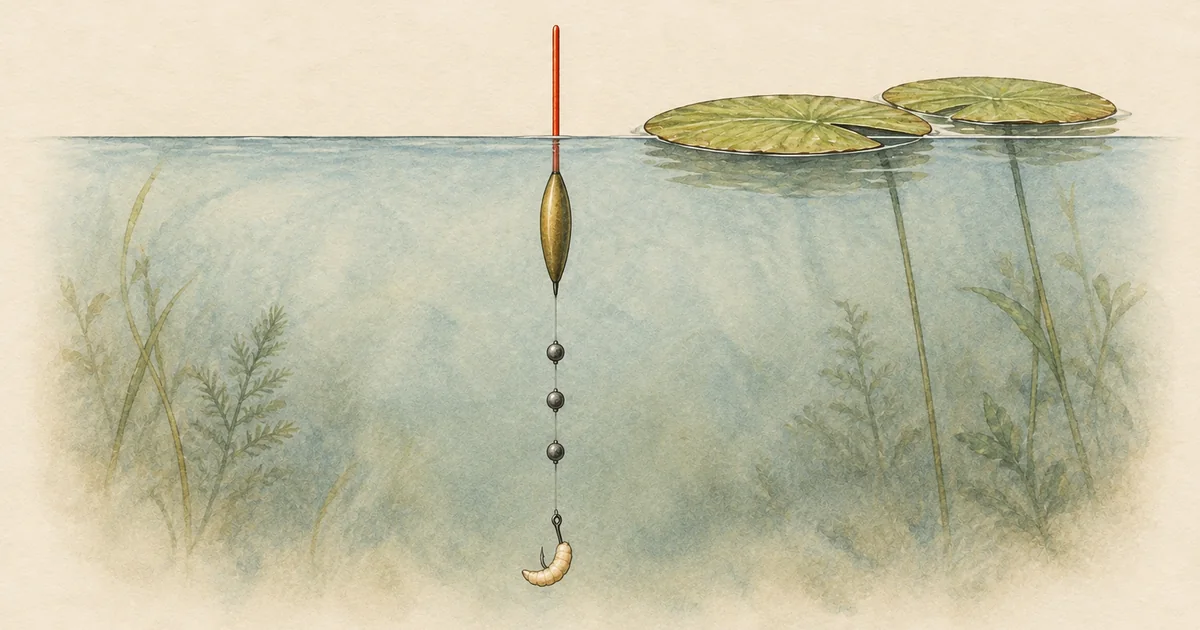
With float fishing the bait hangs at a fixed depth below a float that sits on the surface. It keeps the rig in the layer of water you want and shows you the bite visibly.
What the float does
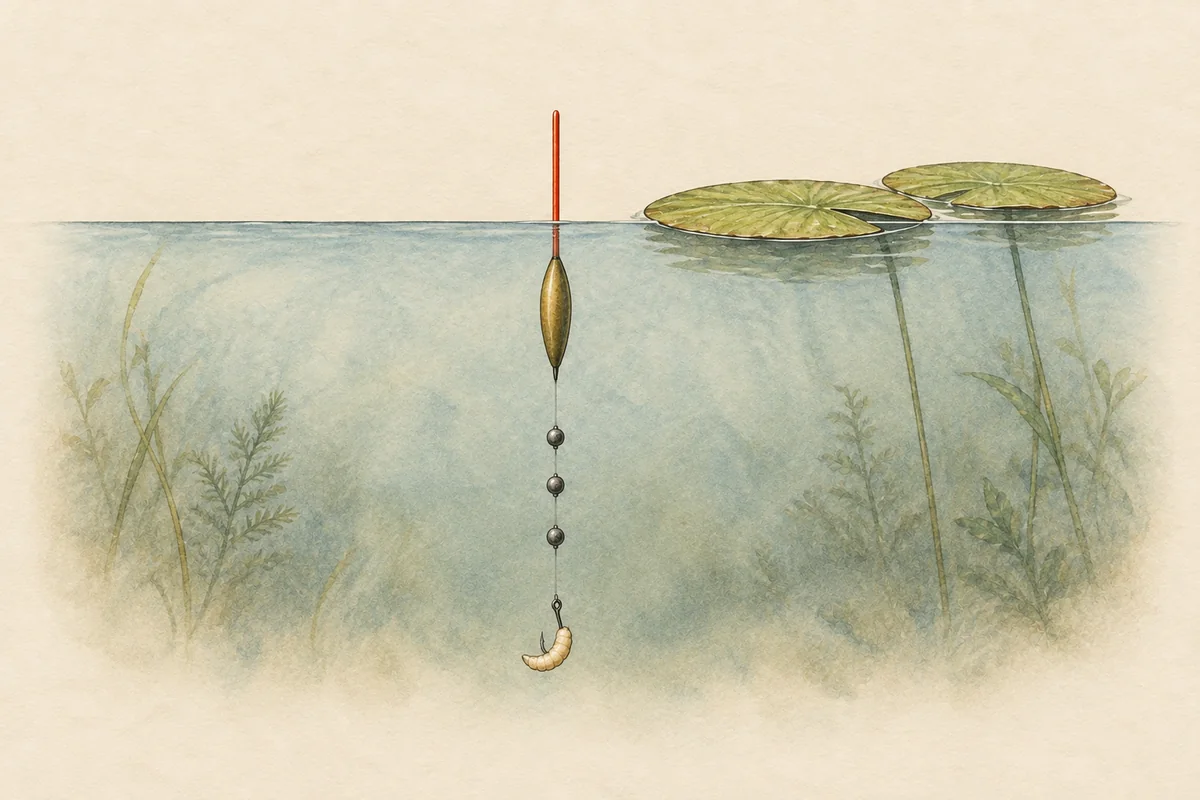
The Landesfischereiverband Baden-Württemberg describes the float in its tackle guide as a bite indicator: it floats on the water surface and is pulled under at a bite. The bait can thus be offered at any depth between the bottom and the surface. If the float is shotted correctly, the fish feels hardly any resistance at the bite.
Blinker names further advantages. The float is a small buoy that marks the fishing spot, so that the groundbait always falls in the same place. During the fight it acts as a buoyancy body and keeps the line off the bottom. Among water lilies it finds gaps in which a bottom weight would only bring snags.
Fixed float or sliding float
A fixed float sits at one point on the line; you set the depth by moving the float. The Landesfischereiverband Baden-Württemberg gives the rod length as the limit. Rute & Rolle works it out: with a three-metre rod a distance of two metres still works well. If the bait is to sit just above the bottom in a canal four metres deep, that is around 3.80 metres between float and hook, and you can hardly cast that any more.
That is what the sliding float is for. It glides on the line, a stopper holds it at the chosen depth. When assembling, according to Rute & Rolle the stopper always goes on the main line first, then the float, then the rest of the rig. Rubber and thread stoppers can be wound through the tip ring. Fisch & Fang ties the stopper as a knot of 0.22-millimetre monofilament and uses two of them to be safe.
A sliding float needs enough lead to pull the line through the eye. Fisch & Fang uses at least one gram of lead per metre of water depth. Set-up: float rig; variant with the float attached at the bottom end only: waggler rig.
Changing depth quickly. With a sliding float you move the stopper, with a fixed float the float itself. According to Blinker that takes only seconds, so try other depths before you change bait or spot.
The shape of the float suits the water
On still water, according to the Landesfischereiverband Baden-Württemberg, you take very slim, long floats, and on running waters short floats in a drop or ball shape. Blinker and Rute & Rolle distinguish the types further:
| Shape | Water | Feature |
|---|---|---|
| Waggler | still water | only an eye at the bottom, the line runs underwater |
| Zoomer | deep canal, light current | always a sliding float with a single shot |
| Stick | slow-flowing river | string of shot, heavier towards the float |
| Egg | Current | only the antenna sticks out |
| Lollipop | held-back fishing in the current | large drop lead, long hooklength |
For held-back fishing in current, according to Blinker, flat, streamlined lollipop floats are suitable, as they are not pushed straight to the bank. A waggler with little lead on the line drifts many metres in a deep canal before the bait reaches the bottom, hence the zoomer.
Buoyancy and shotting
The number on the float gives the lead weight in grams, as stated in the tackle guide of the Landesfischereiverband. The float is balanced when it stands upright in the water. Blinker advises choosing the float as light as possible: a model with 2 grams of buoyancy shows bites much better than one with 6 grams. If the maggots are sucked out when you reel in, the float was usually too heavy according to Blinker.
Guide values from practice, in each case the figures of individual authors:
- Pole fishing: a 2-gram float, about 80 per cent of the weight as an olivette (a drilled lead on the line) 50 centimetres above the end of the main line, below it small shot and a size 8 shot as bite indicator (Fisch & Fang).
- Waggler on a canal: usually 3 to 4 grams of buoyancy (Blinker).
- Winter on a lake: a 2.5-gram waggler, main line 0.16 millimetre, hooklength 0.11 millimetre, size 20 hook, the 15-centimetre hooklength lying entirely on the bottom (Rute & Rolle).
Which shot together make up the buoyancy is shown under Shotting a float. You can balance it at home: Blinker mentions a filled rain barrel; a bucket is only deep enough for very short floats. Designs: Floats.
Plumb the depth
According to the Landesfischereiverband Baden-Württemberg, the plummet is a hollow ball that you open and clamp onto the hook. If the float dives under, it is set too shallow; that is how you read off the water depth. According to Blinker, the plummet should clearly exceed the float’s buoyancy so that it lies firmly on the bottom. More under Plummet.
Blinker also describes a plumbing method in steps: the lead sinks to the bottom, the float is pulled down to the lead, then you pay out line in steps of 50 centimetres until it surfaces. 5.5 steps is about 2.75 metres. If a further plumbing shows only 3 steps, that is 1.5 metres, there is an edge there, and in the slack water behind it, according to Blinker, food and fish gather.
The plummet also reveals the bottom: according to Blinker, black, stinking mud is low in oxygen, while grey or brown mud is rich in oxygen and full of life.
Which depth for which fish
The answer depends on the species and the season. The Landesfischereiverband Bayern and the specialist press give some guidance:
- Rudd: likes to stay near the bank and near the surface (Fischlexikon).
- Roach: Fisch & Fang calls it a mid-water fish; anyone who fishes only on the bottom goes home empty-handed on some days. One angler there reports catches on a sinking flake of white bread in six metres of water.
- Bream: bottom-oriented, at night it searches the soft bottom (Fischlexikon).
- Tench: hides among plants by day and only roots through the bottom at dusk. It spends the winter buried in mud (Fischlexikon).
- Carp: in summer, according to Blinker, it often appears just below the surface. Then a float set shallow with a flake of bread can pay off.
In winter, according to Rute & Rolle, fish are more sluggish, their metabolism is slowed down, and they take food less often and in smaller amounts.
Bait on the bottom with a float
If the bait is to lie on the bottom and the float is still to show the bite, Blinker goes about it like this:
- Weight a fine float, usually a 3 to 4 gram waggler, so that only the antenna shows.
- Clamp another medium-sized shot on the line ten centimetres in front of the hook. The float now sinks.
- Slide the float higher up the line until the antenna is just visible again. Bait and shot now lie on the bottom.
The Blinker author does not keep the line tight here. With the lift method and a tight line, according to Blinker, you need a lightning-fast strike, and tench grubbing about on the bottom set off false alarms on the taut line. Into the wind he dips the rod tip after the cast and winds the line in tight for a moment, so that it lies under the surface current.
Reading bites and striking
Blinker describes three bite patterns: the float dives under, it pulls away sideways, or the fish lifts the last shot and the antenna grows “like an asparagus spear”. The lift occurs when a shot lies on the bottom. Whether you strike at once depends on the bait. The Blinker author waits for a steady movement, strikes earlier with small baits such as corn and later with large ones such as a lobworm for eel or a small fish for zander. On landing: Landing and unhooking fish.
At night Blinker reports good catches of eel and zander on a light float with a glow stick.
Baiting at the swim
With groundbait the angler brings silver fish to his spot and keeps them there, says the Anglerverband Niedersachsen. The float shows you where you have to throw it. The association advises topping up only once fish have shown up at the swim, and gives an average of 120 to 150 grams per hour of fishing for baiting anglers. Whether and how much you may bait is set by the water regulations.
Common mistakes
- Float too heavy: Cautious bites stay invisible.
- Depth guessed: The bait sits above the fish or beside an edge. Plumb the depth before the first cast.
- Line lying on the water: The wind puts a bow in the line and pulls the bait off the swim, which fish do not take according to Fisch & Fang.
- Fixed float set too deep: From a distance of about one rod length casting becomes difficult; then a sliding float belongs on the line.
- Sliding float too light: Less than a gram of lead per metre of depth pulls the line through the eye only hesitantly.
Frequently asked questions
How deep should I set the float?
That depends on the species and the season. Plumb the water depth first, then put the bait on the bottom, in mid-water or under the surface. Change the depth in small steps until bites come.
When do I use a sliding float instead of a fixed one?
When the water is about as deep as the rod is long. Up to that point a fixed float works; beyond it, casting becomes difficult. The sliding float works at any depth.
How heavy can the float be?
As light as possible, because a 2-gram float shows bites much better than a 6-gram one according to Blinker. With a sliding float the reverse applies: a minimum of about a gram of lead per metre of water depth.
When do I strike on the float?
Wait for a steady movement, not for every twitch. With corn the strike comes earlier, with a lobworm or deadbait later. A rising antenna can also be a bite.
Related
- Float rig: how to build it step by step
- Waggler rig: the float for wind and long casts
- Floats: shapes, buoyancy and use
- Float shotting: shot matched to the carrying capacity
- Plummet: measuring the water depth before float fishing
- Float rod: match, Bolognese and pole
- Whip fishing: float fishing with a rod without a reel
- Stopper knot: setting the depth of the sliding float
- Baits under the float: worms, maggots and larvae, sweetcorn and particles and baitfish
Sources
- Blinker: Posenangeln leicht gemacht (Vorteile, Formen, Tragkraft, Köder am Grund, Bisse)
- Blinker: Loten beim Angeln (Lotverfahren, Kanten, Schlamm)
- Blinker: Posen lassen sich schon zu Hause austarieren (Regentonne, Eimer)
- Blinker: Posenangeln im Kanal, Zoomer statt Waggler (Waggler und Zoomer)
- Landesfischereiverband Baden-Württemberg: Gerätekunde (PDF) (Pose, Formen, feste und Laufpose, Lotblei)
- Fisch & Fang: Pfiffiges zum Posenfischen (Stippbebleiung, Stopperknoten, Mindestblei)
- Fisch & Fang: Zielfisch Rotauge (Angeltiefe, Mittelwasser)
- Rute & Rolle: Die Laufpose, echt vielseitig (feste Pose und Laufpose, Stopper)
- Rute & Rolle: Friedfische, erfolgreich im Winter (Winter)
- Anglerverband Niedersachsen: Faktencheck Anfüttern (PDF) (Futtermengen, Nachfüttern)
- Landesfischereiverband Bayern: Fischlexikon (Lebensweise von Rotfeder, Brachse und Schleie)
Text AI-assisted, drawings AI-generated. Sources opened and checked in October 2026; no graphics taken from the sources.
All details are guide values without guarantee. Which baits and groundbait are permitted and whether several rods may be used is governed by state law and the water regulations.