
Knowledge · Tackle
Fishing rods: Types, construction and specifications
Length, casting weight and action decide what a rod is good for. This overview shows how fishing rods are built, what the markings on the blank mean and which type of rod goes with which method.
Construction: the parts of a rod
Almost every rod is made up of the same components.
- Blank: the load-bearing tube, today mostly made of carbon fibre. Its material determines how the finished rod behaves.
- Handle: the part where you hold the rod, usually covered with cork or EVA foam.
- Reel seat: clamps the reel foot with a screw or flip-over fitting. The reel must not wobble in it.
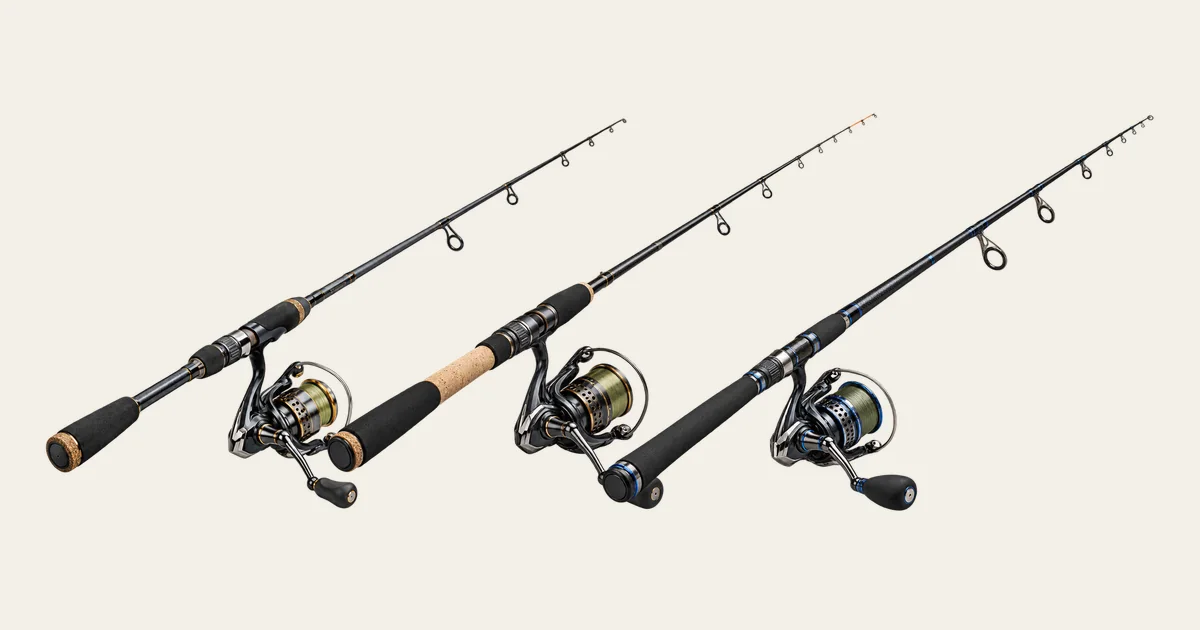
- Rings: guide the line along the rod and pass the load from the cast and from playing the fish, the fight with the hooked fish, evenly into the blank. The butt ring is the first ring above the reel, the tip ring sits right at the front.
- Tip: the thin upper end. It bends first and serves as the bite indicator on feeder rods.
- Joint: holds the rod sections together. On two-piece rods it usually sits in the middle.
Safety: carbon fibre conducts electricity, as it says in the training material for the angling exam (Fischerprüfung). In a thunderstorm you should therefore stop fishing, and near power pylons care is needed. How close a rod tip can come to a power line is explained in Power lines and fishing rods, and more about the weather is under Thunderstorms and weather.
Jointed rod and telescopic rod
With a jointed rod you put the sections together at the water. Most models are in two pieces, which preserves action and stability. It costs space, though: according to the angling press, a two-piece carp rod can still measure more than 1,80 m when taken apart. Travel rods in three to six pieces are shorter, and about 75 cm is the guide value for a suitcase.
With a telescopic rod you slide the sections into one another, usually at least five of them. It can be transported fully assembled. In return, at the same casting weight it is usually softer, slower and less robust than a jointed rod, and it casts worse. For float fishing or sitting out for eel that is enough. For spin fishing and for hard-fighting fish the jointed rod is the better choice.
A one-piece rod has an uninterrupted blank and therefore the greatest strength. Because it cannot be shortened, it usually stays under about 2 m. You find it mainly on sea, wels catfish and vertical rods. Telescopic rods often have a screw-off end cap at the end through which a defective rod section can be replaced. More on the designs is under Telescopic rod and Travel rod.
The figures in the print
Length
Short rods up to about 2 m are meant for boats and small waters. Most spinning and fly rods fall between 2 and 3 m. Rods over 3 m are almost always static rods for long casts, such as carp, feeder and beachcasting rods. If the length on the blank is given in feet (ft), 9 ft is just over 2,70 m and 12 ft just over 3,60 m.
Casting weight
The casting weight is printed on the blank in grams, as a range or as a maximum. What you have to count is the whole weight you cast, so with a soft plastic the jig head and the bait together. A rod usually casts furthest with weights from the middle of the range. Only when the weight suits does the blank load properly in the cast, that is, flex like a spring. If the rig is too light, that does not work and the lure flies short. If it is too heavy, the cast suffers just the same and the blank can break. Manufacturers rate the figure with different degrees of caution.
Worked example: The rod says 10–30 g, the middle is at 20 g. A 10 g jig head with a soft plastic of an assumed 8 g weighs 18 g and suits well. A 3 g spinner barely loads the same rod.
Action
Action describes how the rod bends under load.
- Tip action: The blank stays stiff over long stretches, and almost only the front part bends. You find it on spinning and jig rods, for example. You have close contact with the lure, and the strike, the jerk that sets the hook, comes through strongly.
- Semi-parabolic: The rod bends about as far as the middle. It is considered versatile, and many carp rods are built this way.
- Parabolic: The bend spreads evenly right down to the handle, as on fly rods and many telescopic rods. When playing a fish the rod gives more, and the load rests on a longer stretch of the blank.
For pike and zander, with their hard mouths, hard, fast rods are considered suitable. With carp, with their soft mouths, a softer or semi-parabolic rod is better, so that the hook does not tear out.
Test curve
Carp rods usually carry a test curve in lb (English pounds, 1 lb is about 454 g) instead of grams. It gives the weight that has to hang on the tip to make the blank bend at a right angle. Most carp rods fall between 2 and 4 lb. The higher the figure, the stronger the rod and the heavier the rig may be; more under carp rod. The unit converter translates prints into lb, oz and ft.
Adding up the real casting weight
The casting weight includes everything that flies at the end of the line. With a soft plastic that is head and lure; when feeder fishing it is the filled feeder with its feed. When feeder fishing in current, according to Fisch & Fang, just over 200 g comes together with feed, although a heavy feeder alone is described there as 80 to 120 g. If you cast heavy weights when carp fishing, for example in current or with a PVA bag, a 3 lb rod can reach its limit according to Blinker. The figure on the blank therefore applies to the whole rig, not to the empty lure.
If the rig gets too heavy, there is a risk of overloading up to breakage. According to the specialist press, brute-force casts into the wind with a wet rod often end with a crack in the blank. For feeder fishing, the page Feeder rod gives guide values by water.
Blank, tip and handle in detail
The materials are easy to survey. The exam questions of the Bavarian angling exam name glass fibre and carbon fibre for spinning and bottom rods, and carbon fibre is considered especially light there. Mixed constructions come on top. The table summarises what specialist articles attribute to the materials.
| Material | Property | Note |
|---|---|---|
| Carbon fibre (carbon) | light, sensitive, fast action | most common; somewhat more sensitive to knocks; conducts electricity |
| Glass fibre | forgives hard use | as a tip it shows bites more calmly |
| Mixed construction (composite) | combines sensitivity and stability | construction and behaviour differ from rod to rod |
The difference shows in long casting: according to the specialist press, carbon fibre is faster and casts further than glass fibre or mixed constructions.
Tip types
With the solid tip, the tip is not hollow but made of continuous carbon. It is much softer than usual and very sensitive. According to Blinker, this pays off when you fish slowly and keep the line tight: the fish feels hardly any resistance at the bite. If you want to give the lure speed via the rod, though, the soft tip cushions it. For twitchbaits and jig spinners the solid tip is therefore considered unsuitable. Some sea rods have a glass fibre tip so that bites are easier to see. On the feeder rod the tip is a replaceable component, more on the page Feeder rod.
Handle and reel seat
On the handle you find cork, EVA and especially slim handles of non-slip rubber. Which shape suits depends on the hand. On a rod for jigs, the hand section above the reel should not be too long, so that your fingers touch the blank and feel contact with the lure. According to teaching material, one-handed rods are generally light spinning and fly rods. Sea rods for multiplier reels usually have a special ridge on the reel seat, the trigger grip, for a better hold.
Guides: size, material and spacing
The guides help decide casting distance and how long the line lasts. The teaching material names wear-resistant ceramic or hard-chrome-plated metal as the material. Whipped guides are fitted on spigot rods, tube guides on telescopic rods and snake guides on fly rods. For salt water and braid, the specialist press recommends high-quality inserts of SiC or aluminium oxide, because braided line carries some salt with it and saws at the insert.
How many guides there are and how high they stand depends on the reel. A rod for multiplier reels has more guides, which stand lower and sit closer to the blank, because the reel sits on top of the rod and the line should not touch the blank under load. Rods for fixed-spool reels have fewer, more widely spaced and taller guides. Baitcaster rods also need their own guide arrangement.
- Size: carp and surf rods usually have especially large guides. Large guides let the knot of a shock leader pass. With small guides it catches, or the line breaks on the cast. Guides should also not be too small, so that they do not freeze up in frost.
- Weight: light guides at the front part make the rod oscillate less after the cast. That makes casts more accurate.
- Without guides: poles for pole fishing and interline rods for the sea have no guides; the line sits at the tip or runs through the blank.
- Wear: damaged guides damage the line, which then breaks more easily in the fight. The exam questions name the tip ring as the one under the greatest strain from friction. Replace defective guides immediately.
In winter you do not lay the rod in the snow: guides, reel and line freeze there quickly. A small rod rest or a tripod solves that.
Types of rod at a glance
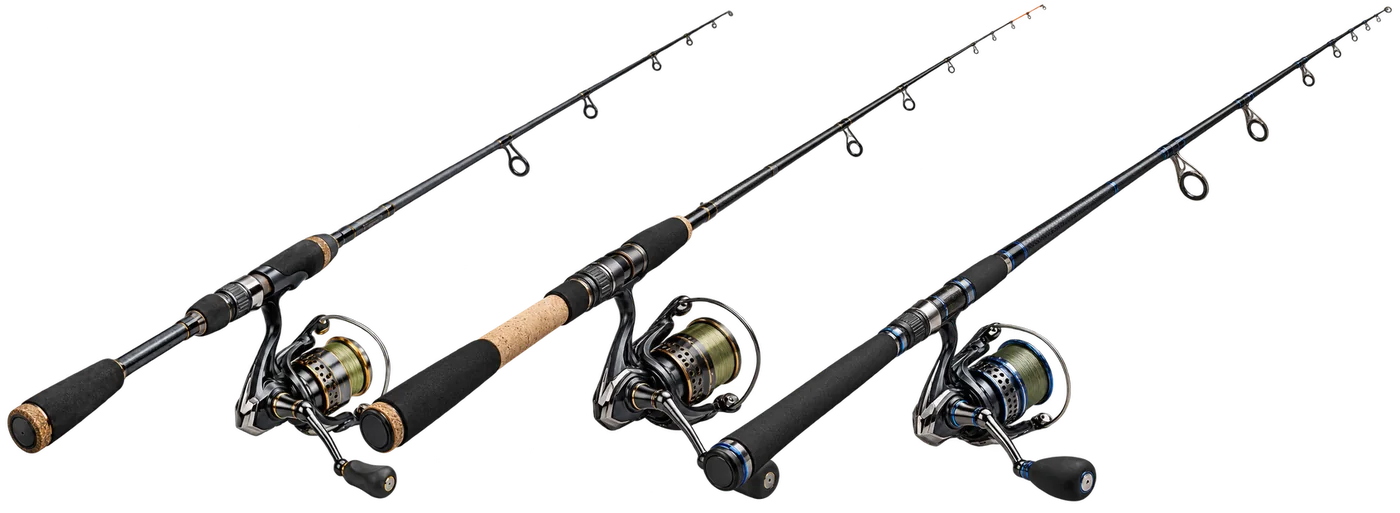
The lengths are guide values from the angling press and from training material for the angling exam (Fischerprüfung).
| Type of rod | What for | Typical length (guide value) |
|---|---|---|
| Spinning rod | Casting and working artificial lures | 1,50–3,00 m, occasionally up to 3,50 m |
| Ledger rod | Presenting natural baits with a weight on the bottom | 2,50–4,00 m |
| Feeder rod | Feeder, bite indication through the quiver tip | 3,00–4,50 m |
| Float rod | Fine presentation of float rigs, as a match, Bolognese or whip rod | Match rod 3,60–4,20 m, Bolognese rods and whips clearly longer |
| Carp rod | Casting heavy rigs far, cushioning powerful fish | 2,70–3,90 m, often 12 ft (just over 3,60 m) |
| Fly rod | Casts the fly line, not the bait | usually 2,00–3,00 m, 9 ft (just over 2,70 m) to start with |
| Sea rod | Short boat rods, long beachcasting rods for casts from the beach | Boat 1,65–2,40 m, beachcasting usually 3,50–4,20 m |
What makes sense for beginners
First comes the question of which fish you mainly want to catch and by what method.
- Sitting out with a bottom weight: a simple all-round rod for ledgering, as a guide value 3,00–3,60 m long with a casting weight of 60–80 g.
- Artificial lures: a spinning rod of about 2,70 m with a casting weight of 14–35 g. That is enough for most common lures in spin fishing.
- Coarse fish with a feeder: a medium feeder rod of 3,60 m and up to 80 g suits most waters. Feeder fishing is also considered a good choice for beginners.
Before buying, take the rod in your hand with the reel screwed on. On a spinning rod the centre of gravity should lie about at the reel foot, otherwise it is top-heavy. Children have their own standards, see Children’s rod.
Transport, care and repair
Many rods break not in the fight but in transport and when being put down. Car doors and boot lids are especially dangerous, as loose rod sections slip into them unnoticed. Rod sleeves can also become a trap: if rod sections stick out of the top, the thin tip easily snags on something. Use only a sleeve into which the rod fits completely, see Rod bag. Do not lay rods on the ground, where people easily tread on them, but lean them with the tip angled upwards or use a rest.
- Cleaning: blank and handle come clean with lukewarm water, mild soapy water and a not-too-hard brush. Pay attention to the joint, reel seat and guides. Leave cork unsealed; no oil belongs on the varnished blank.
- Tip ring off: if only the tip ring breaks, the rod can usually be saved. The ring is removed and glued back on. Beforehand you check whether the ferrule fits the remaining section. The rod becomes a few centimetres shorter, and according to the specialist press the action changes only slightly. If the rod breaks in the middle of the blank, though, it is usually a case for the bin.
- Storage: cool and dry, completely dried after cleaning.
Common mistakes
- The casting weight does not match the rig. If it is too light or too heavy, the blank does not load properly, the cast is short and in the worst case the rod breaks. Anyone who weighs only the lure and forgets feed, bag or lead quickly ends up too high.
- Choosing a telescopic rod for spin fishing. It is softer, slower and casts worse than a jointed rod.
- Buying the rod without a reel. Screw the reel on beforehand: it must sit firmly in the reel seat, and the rod should lie balanced.
- Freeing a snag with the rod. Especially with braided line this can destroy the rod. Put it in the rest and free the snag by hand on the line.
- Spooling line that is too strong. According to the specialist press, a 0,14 braid can carry around 12 kg. With the drag tightened hard, the rod then breaks before the line. The line calculator supplies suitable values.
- Letting the line wrap round the tip. This happens with line that is too thick, stiff or twisted. On a powerful cast it is then often not the line that breaks but the tip.
Frequently asked questions
What does the casting weight on the rod mean?
The casting weight is printed on the blank in grams, as a range or as a maximum. Everything you cast counts, so with a soft plastic the jig head and the bait together. The rig usually flies furthest with weights from the middle of the range.
Jointed rod or telescopic rod: which is better?
At the same casting weight, the jointed rod is usually harder, faster and more robust and casts better. It is the better choice for spin fishing and for hard-fighting fish. The telescopic rod can be transported fully assembled and is enough for float fishing and sitting out for eel.
What length and casting weight suit a beginner?
That depends on the method. For ledgering the guide value is 3,00–3,60 m and 60–80 g, for spin fishing a rod of about 2,70 m with 14–35 g, for feeder fishing a medium feeder rod of 3,60 m and up to 80 g.
What does lb mean on carp rods?
The test curve in lb, English pounds, gives the weight on the tip at which the blank bends at a right angle. 1 lb is about 454 g, and 2 to 4 lb is usual. A higher figure stands for a stronger rod.
How do I look after a fishing rod?
Wash blank and handle with lukewarm water, mild soapy water and a soft brush, rinse and let everything dry. No oil belongs on the blank, and cork stays untreated. Check the guides as you do so and replace damaged ones immediately. The rod is stored cool and dry.
Related
- Spinning rod: casting and working artificial lures
- Ledger rod: sitting out with a weight on the bottom
- Feeder rod: the feeder and interchangeable tips
- Carp rod: test curve and length
- Travel rod: multi-piece for luggage
- Children’s rod: short, robust and safe for getting started
- Line calculator: what the line holds after the knot
- Unit converter: converting lb, oz and ft
- Rod repair: fix a guide, tip ring or break
Sources
- Blinker: Die richtige Angelrute: Darauf kommt es an (Bauteile, Bauformen, Längenbereiche, Wurfgewicht, Aktion, Testkurve, Boots- und Brandungsruten, Baitcasterruten), Blinker: Spinnrute: Welche Rute passt zu meinem Zweck? (Längen der Spinnrute, straffe Rute für Hecht und Zander) und Blinker: Raubfischrute: Wichtige Kriterien für die Auswahl (Leitring, Ringgröße bei Frost, Einsteg und Zweisteg, Handteil)
- Blinker: Ruten-Kompaktklasse: Reise- oder Telerute? (Transportlängen, Teilung, Eigenschaften der Teleskoprute)
- Fischereiverein Löningen: Gerätekunde zur Fischerprüfung (PDF) (Rollenbefestigung, Ringarten und -werkstoffe, Aktion, Wurfgewicht, Einhandruten, Endkappe der Teleskoprute) und Fischereiverein Löningen: Zusammenfassung Gerätekunde (PDF) (Längen von Spinn-, Grund- und Feederrute, Kopfrute ohne Ringe, Wurfgewicht der Fliegenrute)
- Bayerische Landesanstalt für Landwirtschaft: Prüfungsfragen zur Fischerprüfung 2023/2024 (PDF) (Werkstoffe, Kohlefaser, schadhafte Ringe, Endring)
- Blinker: Karpfen: Welche Rute für welchen Zweck? (Testkurve, Längen der Karpfenrute, Fußmaße, Griffe, Ringe, schwere Montagen), Blinker: Teil 3: Informationen rund um das Thema: Matchruten, Tipps, Anfutterhilfen, Recommendations (Längen der Matchrute) und Blinker: Fliegenfischen für Anfänger: Die besten Geräte-Tipps (Fliegenrute mit 9 ft)
- Blinker: Grundangeln: Dein Weg zum Fangerfolg (Allround-Grundrute), Fisch & Fang: Das braucht der Allrounder! (Spinnrute 2,70 m, 14–35 g), Fisch & Fang: Das brauchen Sie zum Feedern (mittlere Feederrute), Fisch & Fang: 10 Tipps zum Heavy-Feedern im Strom (Gewicht von Korb und Futter) und Rute & Rolle: Feedern für Einsteiger (Feedern für Anfänger)
- Blinker: Brandungsangeln, alles, was man über diese Angelmethode wissen muss (Länge der Brandungsrute) und Blinker: Die richtige Meeresrute: Darauf kommt’s an (Werkstoffe, Glasfaserspitze, Ringeinlagen, Beringung für Multirollen, Triggergriff, Inlinerute)
- Blinker: Hohe Wurfweite: So fliegt die Montage bis zum Horizont (Wurfgewicht und Köder, Carbon gegenüber Glasfaser, Ringgewicht)
- Blinker: Barsch-Alarm: Solid-Tip-Rute im Einsatz (Vollcarbon-Spitze, geeignete und ungeeignete Köder)
- Blinker: Die 7 häufigsten Fehler, die Ihre Angelrute zerstören (Hänger, Schnurwahl, Bremse, Schnur um die Spitze), Blinker: Gerade empfindliche Ruten können leicht mal brechen (Autotür, Futteral, Ablegen auf dem Boden) und Blinker: Spitzenring reparieren: Erste Hilfe bei Rutenbruch (Reparatur des Spitzenrings)
- Rute & Rolle: Angelruten pflegen: So geht’s richtig! (Reinigung und Pflege von Blank und Griff) und Blinker: Eisangeln: Heiße Tipps für mehr Erfolg (Rute nicht in den Schnee legen)
- Angling Times: How to choose the right quivertip (Ringgröße bei Geflecht und Schlagschnur)
Text AI-assisted, drawings AI-generated. Sources opened and checked in November 2026, no graphics taken from the sources.
All figures are guide values without guarantee. What counts is the print on your rod and the manufacturer’s instructions.