
Knowledge · Tackle
Children’s rod: Short, sturdy and safe for starting out
A children’s rod is a short, light rod with which a child catches fish on its own, without an adult having to take over every move. This page covers which type is suitable, what the first rig looks like, what adults should watch for on the bank and where the rules for young anglers are found.
Pole or short rod with a reel
There are two types to consider for a start. The pole has neither guides nor a reel, the line is fixed to the tip. Rute & Rolle recommends 6 to at most 8 m for beginners and considers shorter models well suited to children, at the cost of less reach. The bait cannot go further than the rod is long. In return the child only has to learn two things: watching the float and striking when it dips. More on the type under Pole, on the method under Pole fishing.
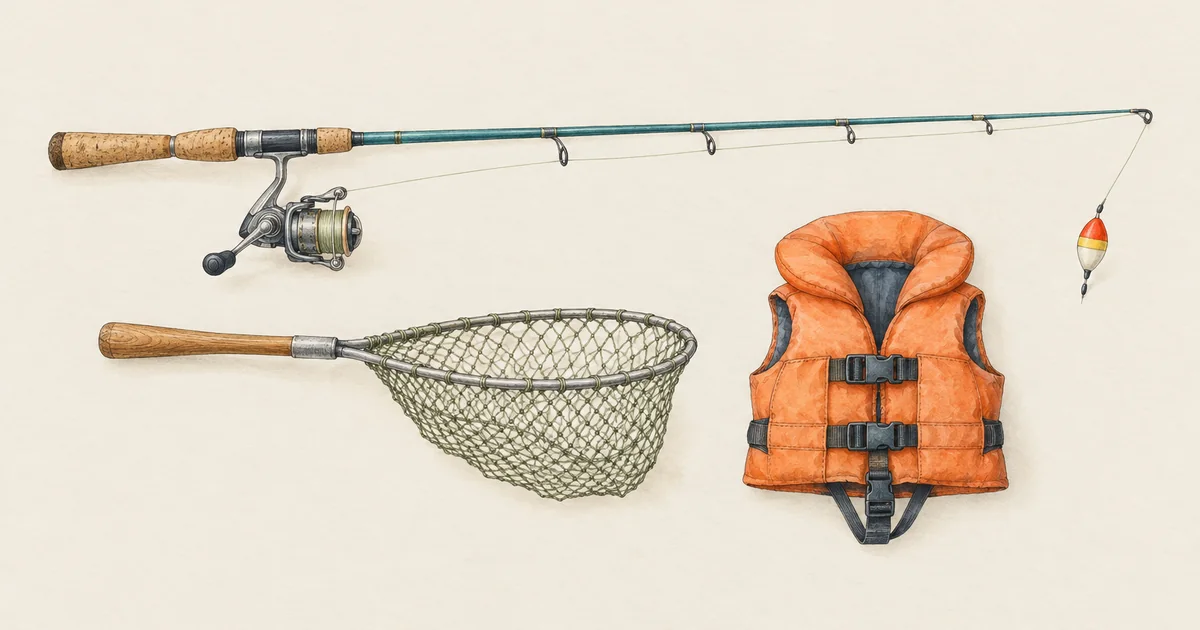
The second option is a short rod with a small fixed-spool reel. In an article about children at the fishing pond, Blinker recommends a light spinning rod, because children cast and wind themselves with it. If the rod is simply put down, they get bored much sooner. Small ponds where casts of 5 to 10 m are enough are a good choice. In the case described it took about half an hour until the children managed usable casts without help. The hardest part for them was holding the line with the finger during the cast and letting go at the right moment.
| Feature | Pole | Short rod with a reel |
|---|---|---|
| Reach | at most the length of the rod | cast, on a small pond 5–10 m |
| The child learns | watching the float, striking | casting, winding, releasing the line |
| Hurdle | holding the rod without effort | releasing the line in the cast |
| Suits | Coarse fishing close to the bank | active fishing, for example with a small lure |
Length, weight and material
The sources give no fixed length for children. A selection guide assigns rods up to about 2 m to bank fishing on small waters, where nobody has to cast far. Ultra-light spinning rods are, according to it, seldom much longer than 2 m and are balanced even with very small reels. Longer rods do cast further, but they also weigh more. The lengths of the spinning rod classes are given under Spinning rod.
On materials the statements differ. Blinker calls glass fibre indestructible and cheap, but fairly heavy and with a slow action. Carbon fibre is considered very light and strong there. The training material of the Löningen angling club for the angling exam considers carbon fibre rods lighter, stiffer and less likely to break than glass fibre. Important for parents: according to the same training material, carbon fibre conducts electric current. What that means under power lines is explained in Power lines and fishing rods. Whether a multi-piece or telescopic rod, the page Telescopic rod explains.
The first rig: fixed float
A fixed float is enough to start with. It is the simple solution because no stopper is needed, but it only suits shallow water: the depth set must not be greater than the length of the rod. For roach in still water the Löninger training material gives a float of about 1 g. How to shot it with split shot is shown in Float rig, and the Float loading calculator works out the right shot. What the thin line still carries after the knot is shown by the Line calculator.
White fish suit well as first target fish. Roach, rudd, silver bream and bream are, according to Rute & Rolle, plentiful in almost every water and bite quickly. This matters especially for children, so that their enthusiasm is not lost. The magazine advises small hooks in size 14 to 16 and names small dough balls made from white bread or small pieces of worm as bait. Things are more active when spinning for perch, which is also recommended for families with children, as is float fishing for bleak.
Safety on the bank
The DLRG in Hamburg writes that children playing by the water must always be supervised continuously. According to its guidance, non-swimmers belong within arm’s reach, even if they wear a life jacket. A safe swimmer there is only someone who holds the Jugendschwimmabzeichen in bronze (youth swimming badge), the Seepferdchen is only an intermediate step. Which life jacket fits and how it must sit is covered in Life jacket, notes on slopes and current in Banks and waders.
- Hook: Spots where many anglers stand close together carry a risk of injury with inexperienced anglers. So look for a place away from other anglers and stay next to the child when casting. The adult removes the hook from the fish.
- Sun: Water reflects UV radiation and intensifies it, writes the Bundesamt für Strahlenschutz. Near water it recommends sun protection factor 50+, explicitly very high protection for children, and considers all sun protection rules a must for them. More under Sun, heat and ticks.
- Power lines: If overhead lines are nearby, read Power lines and fishing rods beforehand. The danger also applies to short carbon fibre rods.
When the hook is in the skin: According to the German Red Cross, foreign bodies may only be removed by a doctor. Do not pull, pad around it and get medical help, in an emergency call 112. What to do until then is covered in Hook injuries and first aid. This page does not replace medical advice.
What the law says
From what age children may fish and who has to accompany them is regulated by each federal state (Bundesland) itself. Two examples with the wording of the law, as of October 2026:
- Bavaria, Art. 47 para. 2 Bayerisches Fischereigesetz, valid from 1 January 2025: “Persons who have completed their seventh but not their 18th year of age are entitled to fish only in the responsible company of an adult holder of a fishing licence (Fischereischein).”
- North Rhine-Westphalia, § 31 para. 3 no. 3 Landesfischereigesetz in the version from 1 July 2026: Children and young people between their tenth and 16th birthday do not need a fishing licence (Fischereischein) under it. “In these cases fishing may only be carried out in the company of a holder of a valid fishing licence.” The accompanying person must prove their age on request with a school pupil’s card or an official photo ID.
All 16 states with accompaniment, youth licence and exam are listed in a table under Fishing with children, and the laws themselves under Fishing licence and angling exam. Anything else that applies to a particular water is stated in the fishing permit. If in doubt, ask the fisheries authority or the club.
For the caught fish, § 4 para. 1 of the Animal Welfare Act (Tierschutzgesetz) applies: “A vertebrate may only be killed by someone who has the necessary knowledge and skills.” Unhooking, stunning and killing therefore remain with the adult, the children may watch. How to do it properly is covered in Stunning and killing fish.
Common mistakes
- Handing over an adult’s rod. Long rods weigh more, and nobody needs long casts on a small pond.
- Only a rod put down. A child that only watches gets bored much sooner than with a rod it handles itself. A second rod put down, under the adult’s supervision, brings surprising bites in return.
- Planning too long a day. Blinker advises planning no more than 3 to 4 hours for children and considers even a few hours at the water worthwhile.
- Aiming for big fish. If there is not a single bite for an hour, children’s mood quickly turns. White fish on the float bring bites more often.
- Supervising from a distance. Anyone who fishes themselves and only sees the child out of the corner of their eye is not within arm’s reach.
Frequently asked questions
From what age may my child fish?
That depends on the federal state. In Bavaria children from seven years may fish in the responsible company of an adult holder of a fishing licence (Fischereischein), in North Rhine-Westphalia children from ten to 15 years without their own licence accompanied by a licence holder. For other states the respective state law applies.
Pole or spinning rod to start with?
The pole is simpler, because there is nothing to cast and wind. The short spinning rod keeps children engaged for longer, but needs help with casting.
Does my child have to be able to swim?
The sources give no rule on this. According to the DLRG, however, non-swimmers should always be within an adult’s arm’s reach, even with a life jacket. Only someone who has the bronze youth swimming badge counts as a safe swimmer.
Related
- Fishing with children: what children may do in each federal state
- Find fishing ponds: trout lakes near you, good for a first catch
- Fishing rods: construction, casting weight and action
- Float rod: match, Bolognese and pole compared
- Pole: the rod without guides and reel
- Float rig: float, weight and hook step by step
- Life jacket: buoyancy, fit and children’s life jackets
- Hook injuries and first aid: what to do until the doctor arrives
- Fishing licence and angling exam: rules and authorities of the federal states
- Line calculator: line strength after the knot
Sources
- Blinker: Kinder am Angelsee: Freude vermitteln! (leichte Spinnrute, Würfe von 5 bis 10 m, Betreuung, Abhaken durch Erwachsene, Dauer)
- Blinker: Angeln als Familie (Spinnfischen auf Barsche, Posenangeln auf Ukelei, wenige Stunden am Wasser)
- Blinker: Die richtige Angelrute: Darauf kommt es an (kurze Ruten, Glasfaser und Kohlefaser) und Blinker: Angeln: Alles Wichtige für Deinen Einstieg (Reichweite der Stipprute, Gewicht, feste Pose)
- Blinker: Achtung: scharfe Haken (Abstand zu Mitanglern, Unerfahrenheit als Risiko)
- Rute & Rolle: Grundkurs Stippfischen (kürzere Stippruten für Kinder, Weißfische, Hakengröße, Köder)
- Fischereiverein Löningen: Zusammenfassung Gerätekunde (PDF) (Kohlefaser gegenüber Glasfaser, Kohlefaser leitet Strom, Pose für Rotaugen)
- DLRG Landesverband Hamburg: Allgemeine Sicherheitstipps (durchgehende Aufsicht, Armreichweite, sicherer Schwimmer)
- Bundesamt für Strahlenschutz: Tipps zum UV-Schutz (Spiegelung am Wasser, Schutz für Kinder) und DRK: Wundversorgung (Fremdkörper nur vom Arzt entfernen)
- Bayern.Recht: Art. 47 BayFiG (Fischfang durch Minderjährige, gültig ab 1. Januar 2025), GV. NRW. 2026 S. 383: Zweites Gesetz zur Änderung des Landesfischereigesetzes (PDF) (§ 31 Abs. 3 Nr. 3, in Kraft ab 1. Juli 2026) und Bundesministerium der Justiz: § 4 Tierschutzgesetz (Töten nur mit Kenntnissen und Fähigkeiten)
Text AI-assisted, drawing AI-generated. Sources opened and checked in October 2026; no graphics taken from the sources.
All figures are guide values without guarantee and replace neither medical nor legal advice. What counts are the law of your federal state, the water’s rules and an adult’s supervision at the water.