
Knowledge – safety by the water
Sun, heat and ticks
By the water the sun comes from above and as a reflection from below, shade is often missing, and ticks wait in the bankside grass. How to protect yourself from UV radiation, heat and tick bites on long fishing days is set out here following the recommendations of the responsible federal agencies. The page does not replace medical advice.
In an emergency: 112 If you suspect heat stroke, first call 112 and then cool the person; someone who is unconscious gets nothing to drink.
UV index: the number to check before a day’s fishing
The UV index describes, on an internationally uniform scale, how strongly UV radiation can cause sunburn. The higher it is, the faster unprotected skin can burn, writes the Bundesamt für Strahlenschutz (BfS). In summer it reaches 8 to 9 in Germany, and up to 11 in the high parts of the southern German mountains.
The BfS scale has five levels: 1 to 2 low, 3 to 5 moderate, 6 to 7 high, 8 to 10 very high, from 11 extreme. From 3 protection is required, from 8 it is absolutely necessary. At midday you should then avoid being outdoors if possible.
On the bank an addition from the BfS counts: water, snow and bright surfaces such as sand reflect UV radiation and intensify it. The exposure can then be higher than the UV index shows. From April to September the BfS issues a UV forecast for three days on Mondays, Wednesdays and Fridays.
Sun protection in the order recommended by the BfS
The BfS rules do not start with the cream: first avoid strong sun, then clothing, then eye protection, and only last apply sun cream. Sun creams do not block UV radiation completely and do not replace the other measures.
- Shade: From UV index 3, the midday hours belong in the shade. It only holds back part, though: under a parasol UV radiation falls by about 10 to 30 per cent, according to the BfS. According to the Bundesinstitut für Öffentliche Gesundheit (BIÖG), about half still reaches the skin in the shade.
- Clothing: The BfS calls clothing and headwear the best and simplest protection. Headwear should also cover the ears and neck and shade the eyes, and shoes should cover the top of the foot.
- Sun cream: The BfS recommends at least SPF 30, and 50+ at and in the water. It is applied 20 to 30 minutes beforehand and reapplied at least every two hours. That maintains the protection but does not extend it. For an adult’s whole body you need four heaped tablespoons.
Polarised glasses: glare protection is not yet UV protection
When light hits water at an angle of incidence of about 53 degrees, the reflected ray is completely linearly polarised (Lexikon der Physik). It then oscillates in one plane only. A polarising filter absorbs one of the two oscillation directions of the light and so suppresses disturbing reflections (Lexikon der Optik).
The magazine Blinker describes the effect by the water: polarised glasses filter the sun’s reflections off the surface and you can see into the water, to different depths depending on turbidity. When spinning you can spot fish following the lure. Because the effect depends on the angle of the sunlight, tilting your head to the side sometimes helps.
The polarising filter is glare protection. Whether glasses filter UV radiation cannot be seen by looking at them, according to the BfS. Look for the “UV 400” marking, good side protection and tint category 2 or 3. Incidentally, according to Blinker the glasses also protect your eyes from lures and hooks, more under Hook injuries and first aid.
Heat: drink before thirst sets in
The Deutscher Wetterdienst (DWD) issues heat warnings for individual districts. The threshold for strong heat stress is about 32 degrees felt temperature in the early afternoon, and for extreme heat stress 38 degrees. The DWD then advises avoiding direct sun, shifting exertion to the early morning hours and wearing airy, light-coloured clothing.
UV radiation and heat do not peak at the same time: the sun is strongest at midday, while on hot days the highest temperature is reached only between 5 and 6 pm, according to the BIÖG. Starting early and seeking shade from midday covers both.
The BIÖG recommends about two to three litres over the day in the heat, preferably water or unsweetened tea, a glass every hour. Thirst only sets in once too much fluid is already missing. If you have a heart or kidney condition, discuss the amount with your doctor. The catch goes straight into the cool bag, see Storage and hygiene.
Warning signs according to the BIÖG
| Condition | Signs | What to do |
|---|---|---|
| Sunstroke | headache, nausea, a red, hot head, often only two to twelve hours later | shade, lay down with the upper body raised, cool, drink |
| Heat exhaustion | strong thirst, weakness, dizziness, cold, clammy skin | lie down, cool, drink slowly; if no better after an hour, see a doctor |
| Heat stroke | hot, dry, red skin, altered consciousness, body temperature above 40 degrees | first 112, then cool; give nothing to drink to someone unconscious |
Emergency: Heat stroke is life-threatening, according to the BIÖG. If there is altered consciousness or a seizure, call 112 at once.
Ticks on the bank
According to the Robert Koch-Institut (RKI), ticks occur practically everywhere there are plants. They climb onto a blade of grass, a bush or dead wood and are brushed off when an animal or person passes. They do not fall from trees and do not jump. Most wait less than a metre high, often only 10 to 50 centimetres above the ground. They are usually most active in spring and autumn.
In tall grass, bushes and undergrowth, covering clothing offers a certain protection, according to the RKI: sturdy shoes, long trousers, long sleeves. If the trouser legs are tucked into your socks, the tick has to climb up on the outside and is more likely to be noticed, even more easily on light-coloured fabric. Repellents on the skin protect only for a limited time. Long, light-coloured, airy clothing therefore meets three recommendations at once: against UV radiation, against heat and against ticks.
After fishing you check your body. Ticks do not bite straight away; they wander around for up to an hour or longer. According to the RKI they prefer the hairline, ears, neck, armpits, the crook of the elbow, navel, genital area and the back of the knee, and also the waistband.
Removing a tick according to the RKI
- Pull it out as soon as possible, with a fingernail if necessary.
- Place tweezers or a tick remover close to the skin, at the mouthparts, never on the engorged body.
- Pull slowly, if possible with all parts.
- No oil, no glue: that irritates the animal, and it may release saliva containing pathogens.
- Disinfect the bite site and watch it; a photo helps with comparison.
You see a doctor if, after a few days to weeks, a ring-shaped redness appears and spreads, usually paler in the middle than at the edge. This is the migrating erythema, an early sign of Lyme disease. The same applies to fever, headache or aching limbs 7 to 14 days after a bite in a TBE risk area (FSME). The RKI does not recommend preventive antibiotics after every bite.
Lyme disease and TBE
Lyme disease is caused by bacteria and occurs nationwide; there is no protective vaccination so far. The bacteria are transmitted only after longer feeding. The RKI names a rising risk after more than 12 hours, elsewhere up to one to two days. Early removal therefore lowers above all the risk of Lyme disease. In 0.3 to 1.4 per cent of bites, symptoms of illness are to be expected, according to the RKI, usually a migrating erythema, which responds well to antibiotics.
TBE (FSME), tick-borne encephalitis, is caused by viruses. They are transmitted shortly after the bite, and there is no targeted treatment, according to the RKI. Vaccination offers protection: the Ständige Impfkommission recommends it for everyone exposed to ticks in a risk area. A vaccination straight after a bite most probably does not prevent infection.
Risk areas lie (as of January 2026) mainly in Bavaria, Baden-Württemberg and Saxony, plus southern Hesse, the south-east of Thuringia and Brandenburg and the east of Saxony-Anhalt. Individual districts in central Hesse, in Saarland, in Rhineland-Palatinate, Lower Saxony and North Rhine-Westphalia come on top. In total 185 districts are designated. The RKI renews the map of TBE risk areas every year.
Packing list for a summer day by the water
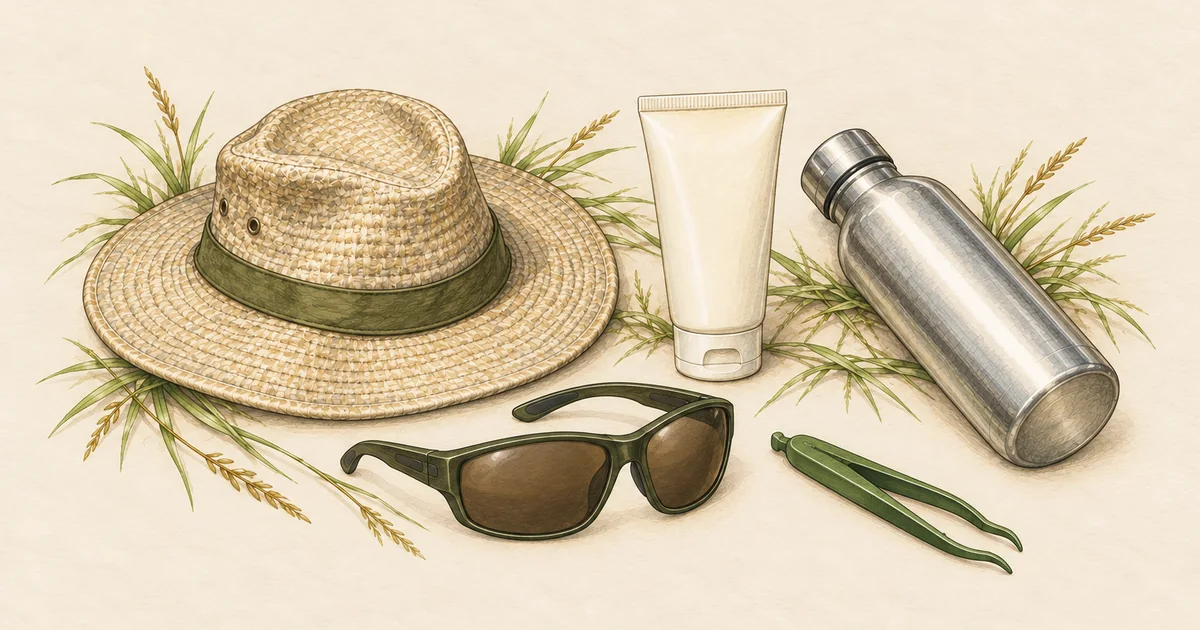
- wide-brimmed hat or cap with a neck flap
- long, light-coloured, airy shirt, long trousers, socks, closed shoes
- sunglasses marked “UV 400”, with a polarising filter for fishing
- sun cream SPF 50+
- two to three litres of water or unsweetened tea
- parasol for the midday hours
- tweezers, disinfectant, tick repellent
- cool bag for the catch
- phone for the UV forecast, heat warning and emergency call
Common mistakes
- Only sun cream: According to the BfS, sun cream still lets UV radiation through. Shade, a shirt and a hat come first; the cream covers only the rest.
- Blind faith in the UV index: Water surfaces and bright sand reflect radiation. On the bank the exposure can therefore be above the reported value.
- Polarised glasses mistaken for UV protection: The polarising filter removes the reflection. Whether the lenses block UV radiation is shown only by the “UV 400” marking.
- Waiting for thirst: According to the BIÖG, it only makes itself felt once the body has already lost too much water. So drink by the clock.
- Tick dabbed with oil: According to the RKI, that irritates it and it may release saliva containing pathogens. Pull it out straight away, with a fingernail if need be.
Frequently asked questions
Do you need sun protection under an overcast sky?
Often yes. A closed, thick cloud cover holds back up to 90 per cent of UV radiation, according to the BfS. Light cloud through which the sun is still visible, and fog, on the other hand can intensify it.
Should the removed tick go to a laboratory?
The RKI does not consider that sensible. Pathogens in the tick do not mean you have been infected, and a result without pathogens does not rule out infection.
How early before a fishing trip must TBE vaccination begin?
According to the RKI, reliable protection comes only after two doses, full protection as a rule after three. In the standard schedule the second follows two to twelve weeks after the first. For short-notice trips to a risk area there are accelerated schedules; your doctor will advise.
Do I have to reckon with ticks when fishing in winter too?
Less often, but yes. Depending on the species and developmental stage, ticks are found in every season, according to the RKI. In a mild winter even isolated TBE infections occur. So checking yourself after fishing is worthwhile in December too.
Related
- Thunderstorms and weather: the lightning-thunder rule and DWD warning levels
- Bank and waders: secure footing, current and wading
- Boat and life jacket: what you check before casting off
- Night fishing: avoiding the heat of the day
- Weather by the water: wind, rain and temperature for 22 places
- Hook injuries and first aid: a hook in the skin, first-aid kit and tetanus protection
- Safety by the water: all pages in this section
Sources
- BfS: Was ist der UV-Index? (Stufen, Reflexion an Wasser)
- BfS: UV-Prognose (Vorhersage)
- BfS: Tipps zum UV-Schutz (Regeln, Kleidung)
- BfS: Was ist UV-Strahlung? (Schatten, Wolken)
- BfS: UV-Schutz durch Sonnencreme (Faktor, Menge, Nachcremen)
- BfS: UV-Schutz für die Augen (Kennzeichnung, Tönung)
- BIÖG: Tipps bei Hitze (Trinken, Schatten, Tageszeit)
- BIÖG: Gesundheitsrisiken von Hitze (Warnzeichen)
- DWD: Hitzewarnung (Schwellen, Regeln)
- RKI: Fragen zu Zecken, Zeckenstich, Infektion (Vorkommen, Schutz, Entfernen)
- RKI: Fragen zu Borreliose (Übertragung, Wanderröte)
- RKI: Fragen zur FSME-Impfung (Empfehlung, Impfschema)
- RKI: Epidemiologisches Bulletin 9/2026, FSME-Risikogebiete (Länder, Kreise)
- Spektrum, Lexikon der Physik: Polarisationswinkel (Spiegelung)
- Spektrum, Lexikon der Optik: Polarisationsfilter (Filterwirkung)
- Blinker: Polarisationsbrille, voller Durchblick (Praxis)
Text AI-assisted, drawing AI-generated. Sources opened and checked in October 2026; no graphics taken from the sources.
All figures are guide values without guarantee. The text does not replace medical advice. In an emergency, call 112.