
Knowledge – safety by the water
Boat and life jacket
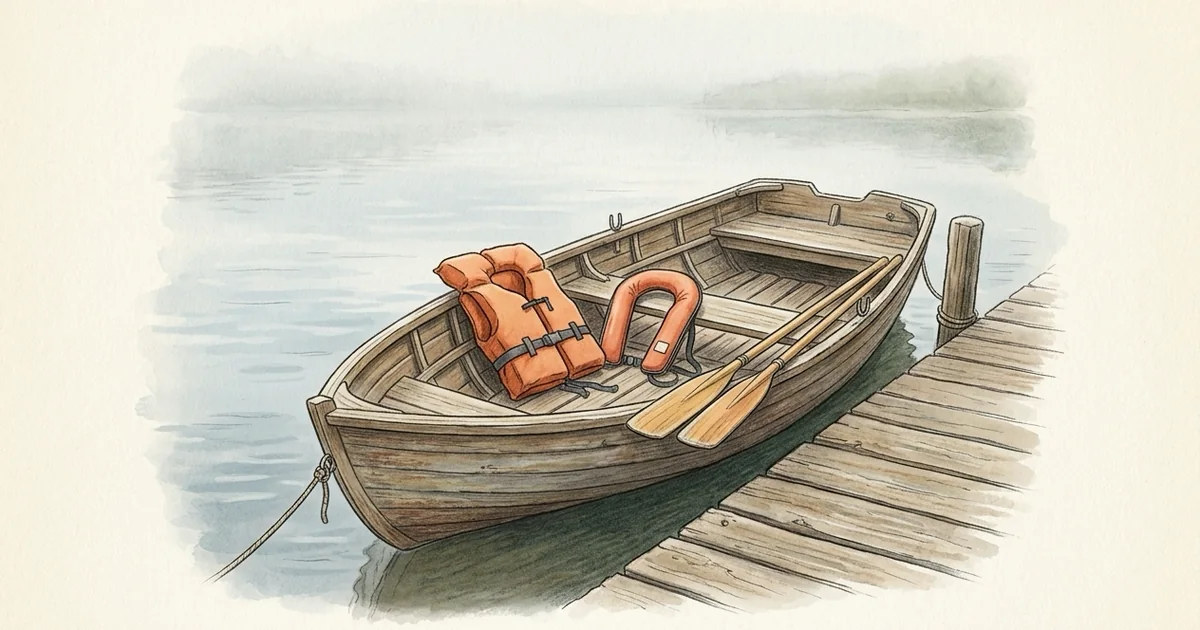
When fishing from a boat, the life jacket only helps if you wear it and have chosen the right type. This page explains the buoyancy classes from 50 to 275 newtons, the difference between a solid-foam jacket and an automatic one, and what to check before casting off.
In an emergency: 112 After capsizing you stay with the boat and attract attention; without a protective suit you keep your clothes on.
Wear the jacket, do not just bring it along
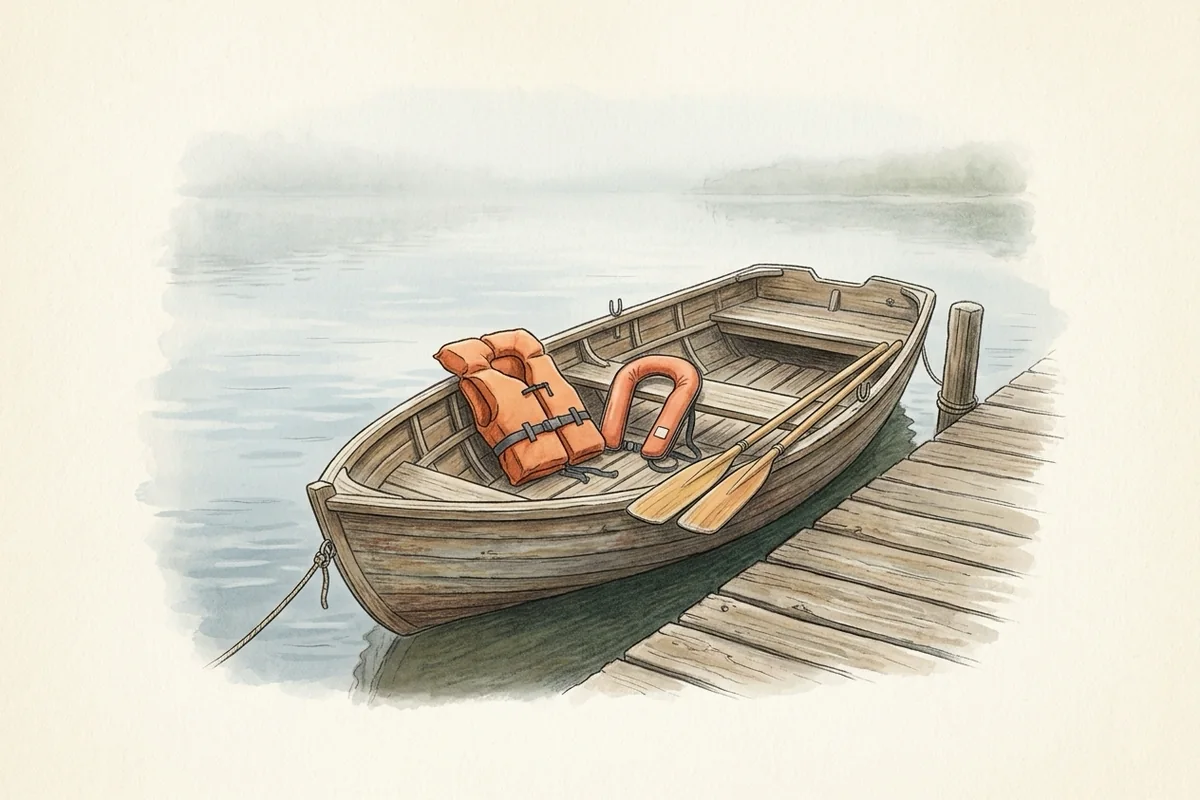
The Federal Ministry of Transport writes in its brochure “Sicherheit auf dem Wasser”: non-swimmers and children put on the life jacket before they board the boat and wear it until the end of the trip, in any weather. According to the brochure, even practised swimmers should put one on when on the water. The DLRG likewise advises water sports enthusiasts to wear a jacket, because even good swimmers can get circulation problems after falling into cold water. For 2025, the DLRG counts in its annual summary at least 393 drownings in Germany, across all waters and types of accident; it gives no separate figure for boating accidents there. The DLRG president there explicitly names anglers on boats among those who still too often treat their own safety carelessly.
The Austrian shipping authority lists four situations in which you should use a buoyancy aid in every case: on flowing waters, at water temperatures below 15 °C, with a large difference between air and water temperature, and when going out alone. According to the DGUV, a fall into the water is often preceded by a trip, slip or fall.
The recommendations are aimed at recreational boaters and apply by analogy to anglers in rowing boats, inflatables or motor boats.
Buoyancy classes: what the numbers mean
The buoyancy is printed in newtons (N) on the jacket. Roughly, 10 N corresponds to one kilogram, writes the DGUV. The DIN EN ISO 12402 series of standards knows four levels. The areas of use in the table come from the ministry’s brochure, the details on unconscious-safe turning from the DGUV information:
| Class | Assessment | Unconscious-safe according to DGUV | Use according to brochure |
|---|---|---|---|
| 50 N | Buoyancy aid | no | swimmers in sheltered waters, help close by |
| 100 N | Rescue jacket | only conditionally, clearly worse in clothing | sheltered waters and inland waters |
| 150 N | Rescue jacket | solid foam as a rule, inflatable only conditionally | open sea with foul-weather gear |
| 275 N | Rescue jacket | yes, when inflated | open sea in extreme conditions |
Unconscious-safe means: the jacket turns even an unconscious person onto their back and keeps mouth and nose above water. At level 150, according to the DGUV it depends on the design: solid-foam jackets reach the safe position when used correctly as a rule, automatic ones only conditionally. At 100 N the standard tests in swimwear; fully clothed, the jacket turns less well, and in a face-down position mouth and nose stay under water, according to the DGUV.
The minimum values apply to users from 70 kilograms. So check the maximum approved body weight of the jacket: if it is exceeded, the safe position is not guaranteed even with tested jackets, according to the ministry. Only buy jackets with a CE mark or the steering-wheel symbol.
A level 50 buoyancy aid is not a life jacket. With it you have to keep your head above water yourself by muscle power. If the person loses consciousness, the muscles go slack, the head tips forward and mouth and nose lie under water. The DGUV makes clear that buoyancy aids are not rescue equipment.
Clothing and equipment on the body
According to the DGUV, wet clothing generally does not pull you under. What is tricky is air pockets under closed weather-protection clothing, because they work against turning onto the back; for this the DGUV names jackets with 275 N. Objects on the body also need extra buoyancy, such as a belt with tools or a bag slung over the shoulder. More on waders on the page Bank and waders.
Fit matters: the Austrian shipping authority requires the jacket to fit so well that you cannot slip out of it, and names crotch straps as a common solution. The DGUV mentions adjustable straps that adapt to the shape of the body, and points out that crotch straps increase hold in the water but can make snagging easier.
Solid-foam, automatic and manual jackets
- Solid-foam jacket: The buoyancy body is made of foam, the buoyancy is there at once and less prone to damage than with inflated bodies. In return it needs volume, which restricts freedom of movement. Used as a seat cushion, the buoyancy body can be damaged (DGUV).
- Automatic jacket: It inflates itself on contact with water, and according to the DGUV the person resurfaces within a few seconds. Rain and high humidity do not trigger it. The thin cover of the buoyancy body can quickly be damaged on stones, rocks or branches, and then loss of buoyancy threatens.
- Manual jacket: You have to pull the cord yourself. According to the DGUV, a fall with a head injury, cold shock or disorientation can prevent triggering; if you lose consciousness, the unconscious-safe position is not guaranteed.
Note: Which jacket suits you depends on the water, your clothing and your body weight. Look at the marking and fit, and get advice from a specialist shop.
Checking and servicing
An automatic jacket needs a quick check before every trip. As examples, the DGUV names the questions of whether the manual release lever is secured, the automatic tablet is present and the cartridge is screwed in correctly. Whether the compressed-gas cylinder is still full is not always shown by the indicators; for that it is usually unscrewed. For inland vessels with an operating licence, the DGUV names at least an annual documented inspection and, as a rule, servicing by the manufacturer every two years; for you, the manufacturer’s instructions count.
For a solid-foam jacket, a visual check before the trip is enough; according to the DGUV it is inspected more thoroughly at regular intervals, for example annually at the start of the season. If you fish at night, according to the DGUV you can choose an emergency signal light that makes a person in the water easier to find.
Before casting off
- Check the weather: The ministry advises never setting out in coastal and sea areas without a weather report. The German Weather Service warns in four levels from yellow to violet; from red it advises avoiding time outdoors. On thunderstorms see Thunderstorms and weather.
- Mind the payload: The Bern cantonal police require, for inflatables, keeping to the stated maximum payload, always wearing a jacket and scouting unfamiliar stretches of river beforehand.
- Let someone know: The ministry recommends telling family, friends or the harbour master where you are going and giving your return time, also for canoes and rowing boats.
- Alcohol: On inland and maritime waterways, according to the brochure, no vessel may be operated from 0.5 per mille or 0.25 mg/l in the breath; violations are administrative offences. The brochure advises giving it up entirely. What applies on your water is governed by local rules.
- Phone: At sea the mobile network is patchy, so a phone is at most a supplement, according to the ministry. On the coast you should have the number of the DGzRS sea rescue control centre saved: +49 421 536870.
- Night trips: On federal waterways, rowing, sailing and motor boats are banned from going out at night and in poor visibility if they cannot show the required lights, except in an emergency.
- Children: According to the ministry, they always wear children’s life jackets, on board and on the bank, and are secured so that they cannot fall overboard. In inflatables or rowing boats there are never more children than adults sitting.
Capsizing and cold
After capsizing, according to the brochure, you should stay with the boat and try to attract attention. Cold water quickly saps your strength: a capsized person without protective clothing can at best still take an active part in rescue manoeuvres for about 10 minutes at 10 °C. As a rule of thumb for water below 15 °C, the Austrian shipping authority says the minutes of room for action roughly equal the water temperature in degrees. On sudden immersion, cold shock can trigger a reflex deep intake of breath, even in good swimmers.
Without protective clothing, you do not take your clothes off in the water, because they insulate (ministry). Even at air temperatures below 15 °C, wind alone can chill you; keep a windproof jacket, head cover and gloves within reach.
Common mistakes
- The jacket lies in the boat instead of being worn, or is only put on once on the water.
- The jacket fits loosely and can ride up in the water.
- A buoyancy aid or manual jacket is assumed to be unconscious-safe.
- The tablet and cartridge of the automatic have never been checked.
Frequently asked questions
As a good swimmer, do I need a life jacket?
The ministry and the DLRG advise it for good swimmers too. After a fall into cold water, circulation problems can occur, and cold shock can trigger a reflex deep intake of breath. Swimming ability alone does not protect against that.
Which buoyancy class do I need for fishing from a boat?
The sources name no fixed class for anglers. The ministry assigns 100 N to sheltered waters and inland areas, but according to the DGUV this level is only conditionally unconscious-safe. At 150 N it depends on the design; an inflated jacket with 275 N is regarded as unconscious-safe. Whether a jacket is compulsory is governed by the water authority.
Is the automatic jacket better than the solid-foam one?
That cannot be said across the board. The solid-foam jacket works at once and is more robust, but needs space. The automatic one is compact, but must be checked and serviced and can be damaged on branches or stones.
How often do I have to check an automatic jacket?
A quick check belongs before every trip, in which you look at the lever, tablet and cartridge. Servicing follows the manufacturer. For inland vessels the DGUV names annual inspections and, as a rule, servicing every two years.
Related
- Fishing from a cutter and boat: what happens on board and the rules for coast and small boats
- Belly boat: fishing from a floating seat on a lake
- Thunderstorms and weather: lightning distance and DWD warning levels
- Bank and waders: current, wading belt and safe footing
- Walking on ice: ice thickness and what to do if it breaks
- Sun, heat and ticks: protection on long days at the water
- Weather at the water: checking wind and weather for your fishing day
- Fishing permit and water map: what applies on your water
- Safety by the water: all pages in this section
Sources
- Bundesverkehrsministerium: Sicherheit auf dem Wasser, Stand Dezember 2023 (Weste vor dem Betreten, Einsatzbereiche der Westenklassen, Kentern, Abmelden, Alkohol, Kinder)
- DGUV Information 212-004: Rettungswesten und Schwimmhilfen (Auftrieb, Ohnmachtssicherheit, Kleidung, Kurzcheck, Wartung)
- Österreichisches Verkehrsministerium, Schifffahrtsaufsicht: Infofolder Rettungswesten (wann Auftriebsmittel tragen, Passform, 15-°C-Faustregel, Eintauchschock)
- DLRG: Beitragsvorschlag Badeunfälle vermeiden (Weste für Wassersportler)
- DLRG: Statistik Ertrinken 2025, Presseinfo (393 Ertrunkene 2025, Angler auf Booten)
- Kantonspolizei Bern: Schlauchboote auf der Aare (Weste, Nutzlast, unbekannte Abschnitte erkunden)
- Deutscher Wetterdienst: Warnstufen und Farbskala (Bedeutung der Warnfarben)
Text AI-assisted, drawings AI-generated. Sources opened and checked in October 2026; no graphics taken from the sources.
All figures are guide values without guarantee and are no substitute for expert or medical advice. Whether a life jacket is compulsory on your water is governed by the water authority and the water rules. In an emergency, call 112.