
Knowledge – safety by the water
Stepping onto ice
According to the ice rules of the DLRG and DRK-Wasserwacht, you only step onto a lake once the ice is 15 cm thick, and onto a river or stream only from 20 cm. But an ice sheet does not bear equally everywhere, and you can hardly tell from above. This page compares the guide values, the typical weak spots and the advice of the rescue organisations in case someone falls through.
In an emergency: 112 If someone falls through, first call 112 and help from the bank if you can, using a board, a rope or a branch, never a bare hand.
Guide values for ice thickness
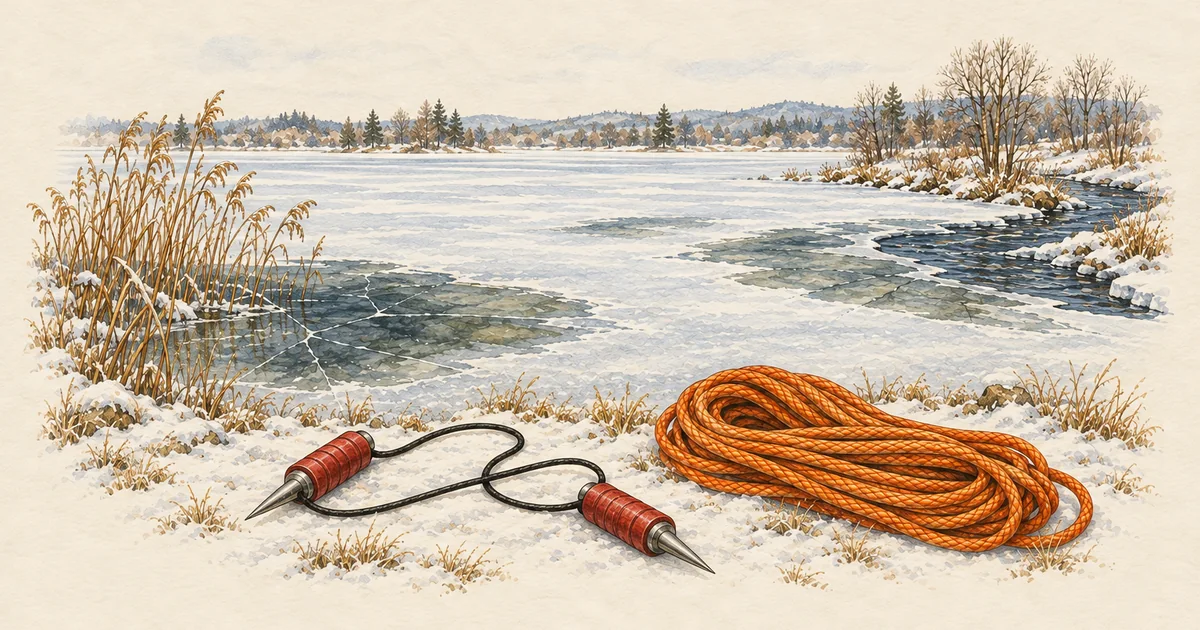
The DLRG ice rules give two figures: you step onto a lake only at an ice thickness of 15 centimetres, onto flowing water only at 20 centimetres. The DRK-Wasserwacht gives the same values.
| Where | Minimum thickness | Source |
|---|---|---|
| DLRG, DRK-Wasserwacht | 15 cm | still water |
| DLRG, DRK-Wasserwacht | 20 cm | flowing water |
| Wasserwacht Bayern | 10 cm | older leaflet (2008) |
| City of Hannover | 13 cm, throughout | opening of the Maschsee |
| Deutscher Wetterdienst | 20 cm | white ice, snow, many people |
None of these figures is a guarantee. According to the DLRG, ice can bear too little despite seemingly sufficient thickness.
The local authorities are responsible for opening an ice surface, writes the Deutscher Feuerwehrverband. The Wasserwacht Bayern stresses that it is not an authority and cannot open ice surfaces. The DLRG advises asking the competent office.
Why an ice sheet bears unevenly
According to the Deutscher Wetterdienst (DWD), load-bearing capacity depends not only on thickness but decisively on the quality of the ice.
- Black and white ice: Black ice forms in calm high-pressure weather without precipitation, is smooth, almost free of trapped air and particularly strong. White ice forms when snow on the ice turns to slush during a thaw or in rain and freezes again. According to the DWD, at the same thickness it can bear ten times less.
- Snow: If it falls shortly after the ice has formed, it insulates and slows the growth of the ice sheet (DWD).
- Inflows and current: At inlets and outlets the ice is sometimes suddenly thinner (Feuerwehrverband), and so it is over currents and springs (Wasserwacht Bayern). Where a lot of groundwater enters, the ice stays thinner, which is why gravel pits often freeze late or not at all (DWD). More under Reading the current.
- Reeds, bridges, dark patches: Near reeds, under bridges and over rising gases the ice is often much thinner (DWD). It can be too thin in dark patches, warns the Feuerwehrverband.
- Water level: The Wasserwacht Bayern also mentions changes in water level, as happen at a reservoir.
- Thaw: When temperatures rise, the ice becomes thinner and changes its structure. In spring the sun makes it rotten and brittle (DWD).
According to the DWD, a lake freezes only once it has cooled to about 4 degrees all the way down, more under Water temperature and oxygen. The DLRG advises not to step onto the ice on the first cold days.
Warning signs underfoot
If the ice creaks and cracks, you leave it immediately (DLRG). The Deutscher Feuerwehrverband names two further signs: cracks and water welling onto the surface in surges. If the ice sags strongly under load, it cracks first on the underside, then on the surface, according to the DWD, and the break-through is imminent.
The magazine Blinker advises anglers to avoid wet, slushy snow on the ice: the ice there is so thin that water seeps through. The same is said to apply to places where waterfowl gather.
If you are about to break through, you lie flat on the ice and carefully return to the bank the same way (DLRG). The Wasserwacht Bayern writes that after a few metres the ice there may bear again.
Preparation and behaviour
- Never alone: That is what the DLRG requires. If you are alone and nobody is nearby, you leave the ice (Wasserwacht Bayern).
- Keep your distance: According to the Wasserwacht Bayern, load-bearing capacity also depends on body weight, the number of people and the distance between them. A stationary load is more dangerous than a moving one, according to the DWD, so do not sit close together around a hole in the ice.
- Ice picks to hand: These are handles with spikes that give you a grip on the ice. The Wasserwacht Bayern lists them as personal equipment. Blinker recommends that anglers wear their ice picks round the neck while fishing and, in an emergency, drive them into the ice one after the other.
- Rope and rescue equipment: For the DLRG and Wasserwacht, ropes and lines count among the aids for rescue, and on the bank there is often an ice rescue ladder, a lifebuoy or a throw bag. Make a note of where.
- No stone throw as a test: A stone that stays on the ice is no guarantee of load-bearing capacity, according to the Wasserwacht Bayern.
The further out you are, the harder it is to get help: according to the DLRG, rescue is made from land where possible. The strip along the bank is still not safe if reeds grow there or a stream flows in.
At the ice hole: tips for anglers
At the drill hole you measure the thickness. Blinker advises drilling a test hole every few metres on fresh ice: at the bank it may already be 20 centimetres thick and in the middle only 3. The result applies only to the spot of the hole; the guide values of the rescue organisations are given above.
On the waters of the Landesanglerverband Brandenburg an ice hole may be at most 20 centimetres in diameter or edge length on the underside and must be clearly marked after fishing (water rules). The Fischereiamt Berlin requires twigs or sticks as markers and refers to the Berlin ice surface regulation. The reason: according to the Wasserwacht Bayern, a hole remains a possible break-through point even days later. Give other people’s markers a wide berth.
If someone falls through
Yourself
According to the DLRG, just a few minutes in ice-cold water stiffen your limbs so much that self-rescue fails. The procedure according to the DLRG, DRK and Wasserwacht:
- Spread your arms at once so you do not go under the ice, and call loudly for help. Keep your clothes on.
- Break the thin ice in the direction you came from until it bears again.
- Push or roll yourself flat onto the ice, on your front or your back, and crawl to the bank. Ice picks give you a grip.
As a helper
Your own safety comes first, writes the DLRG. According to the DWD, rescue attempts on the ice are extremely dangerous and best left to the emergency services. First you call 112 or ask someone to call.
- Help from the bank where you can: hold out, push or throw a board, pole, ladder, branch or rope (DLRG).
- If you have to go onto the ice, never on your feet: you advance lying down, best on a wide board, and a second helper secures you with a rope.
- Never offer your hand, only an object. People who have fallen through are in mortal fear and have enormous strength, writes the Wasserwacht Bayern.
- In flowing water, anyone who ends up under the ice is carried away. Without equipment, according to the DLRG, all that remains is a quick emergency call.
After the rescue
Hypothermia can be life-threatening, so after every rescue you call the emergency doctor (DLRG). Until they arrive, take the person to a warm place, remove the wet clothing there and wrap them in blankets. Do not rub them and do not use a hot-water bottle. Someone who is conscious gets warm, sugared drinks, no alcohol.
If the person becomes tired, rigid or unconscious, you make no further attempts to warm them according to the DRK, cover them up and repeatedly check consciousness and breathing. An unconscious person who is breathing normally is put in the recovery position; if there is no normal breathing, cardiopulmonary resuscitation follows.
Note: This section reproduces what the DLRG, DRK and Wasserwacht publish. It does not replace a rescue or first-aid course or medical advice.
Bans and clearances on site
Whether you may step onto a frozen water is decided on site. In Bavaria, municipalities can ban people from entering ice surfaces by regulation, and offences can be fined (Art. 27 LStVG). Munich states that entering the ice on municipal waters is generally forbidden. Hannover opens only the Maschsee, and only from 13 centimetres.
For anglers the water rules come on top. The Landesanglerverband Brandenburg allows ice fishing on its waters, provided no authority and no board decision stands in the way, and at your own risk. These are examples, as of October 2026. What applies at your water is stated in the fishing permit and the water rules (Fishing permit and water map). Also pay attention to signs and barriers on the bank.
Common mistakes
- Onto the ice on the first frosty day: The DLRG advises letting the first cold days pass before you go out.
- One hole for the whole lake: The measurement applies only to that spot. According to Blinker, the ice can be 20 centimetres near the bank and only 3 further out.
- A stone as a test: If a thrown stone stays on the ice, that proves nothing about load-bearing capacity, according to the Wasserwacht Bayern.
- Several people close together at the hole: A stationary load stresses the ice more than a moving one, according to the DWD. Spread out.
- Offering a hand: People who have fallen through develop enormous strength out of mortal fear, according to the Wasserwacht Bayern. So offer a board, a branch or a rope.
Frequently asked questions
From how many centimetres does ice bear weight?
The DLRG gives 15 centimetres for a lake and 20 for flowing water. Thickness alone says little, because white ice bears far less than black ice, according to the DWD.
What should you do if the ice cracks?
Stay calm, lie down flat and crawl back to the bank the same way. That spreads your weight.
Does the ice on a river bear weight?
The DLRG requires 20 centimetres there instead of 15. Anyone who ends up under the ice in the current is carried away, and for helpers all that remains, according to the DLRG, is the emergency call.
Is ice under a blanket of snow safe?
You cannot rely on it. According to the DWD, fresh snow on young ice holds back the cold, and the sheet then grows more slowly. If it turns to slush and freezes again, white ice forms, which bears less. Avoid wet, slushy patches completely.
Related
- Ice fishing: tackle, bait and presentation at the ice hole
- The year by the water: what happens in the water in winter
- Boat and life jacket: capsizing and hypothermia in cold water
- Bank and waders: a secure footing on the bank
- Fishing on a lake: reeds, inflows and other spots in the lake
- Hook injuries and first aid: emergency call and first aid by the water
- Safety by the water: all pages in this section
Sources
- DLRG: Eisregeln (Plakat) (15 und 20 Zentimeter, Verhalten, Notarzt)
- DLRG: Selbstrettung bei Eisunfällen, Fremdrettung aus dem Eis, Notruf richtig absetzen (Ablauf der Rettung, Notruf 112)
- Deutsches Rotes Kreuz: Betreten von Eisflächen, Erfrierungen und Unterkühlungen (Richtwerte, Einbruch, Erste Hilfe)
- Wasserwacht Bayern, Faltblätter: Eisregeln, Winterliche Gewässer (10 Zentimeter, Tragfähigkeit, Eispicker, Markierungen)
- Deutscher Wetterdienst: Thema des Tages, Sicher auf dem Eis (Eisqualität, Schwachstellen, Risse)
- Deutscher Feuerwehrverband: Dünnes Eis birgt große Gefahr (Freigabe, dunkle Stellen, Ein- und Ausflüsse)
- Landeshauptstadt Hannover: Betreten zugefrorener Gewässer verboten; muenchen.de: Warnung vor Betreten von Eisflächen (Verbot und Freigabe)
- Freistaat Bayern: Landesstraf- und Verordnungsgesetz, Art. 27 (Verbote der Gemeinden)
- Landesanglerverband Brandenburg: Gewässerordnung; Fischereiamt Berlin: Die Angelkarte und ihre Auflagen (Eislöcher)
- Blinker: Sicherheit beim Eisangeln, Ungleichmäßige Eisdicke (Praxisrat einer Angelzeitschrift)
Text AI-assisted, drawing AI-generated. Sources opened and checked in October 2026; no graphics taken from the sources.
All figures are guide values without guarantee. Whether an ice surface bears can only be judged on site. This text does not replace official clearance, a rescue course or medical advice. In an emergency, call 112.