
Knowledge · Fishing methods
Ice fishing
In ice fishing you drill a hole in the ice of a lake and present the bait vertically below it. In Germany it is only allowed on a few days and by no means everywhere; what applies is set out in the fishing permit (Erlaubnisschein) and the water rules (Gewässerordnung).
Fishing through a hole in the ice
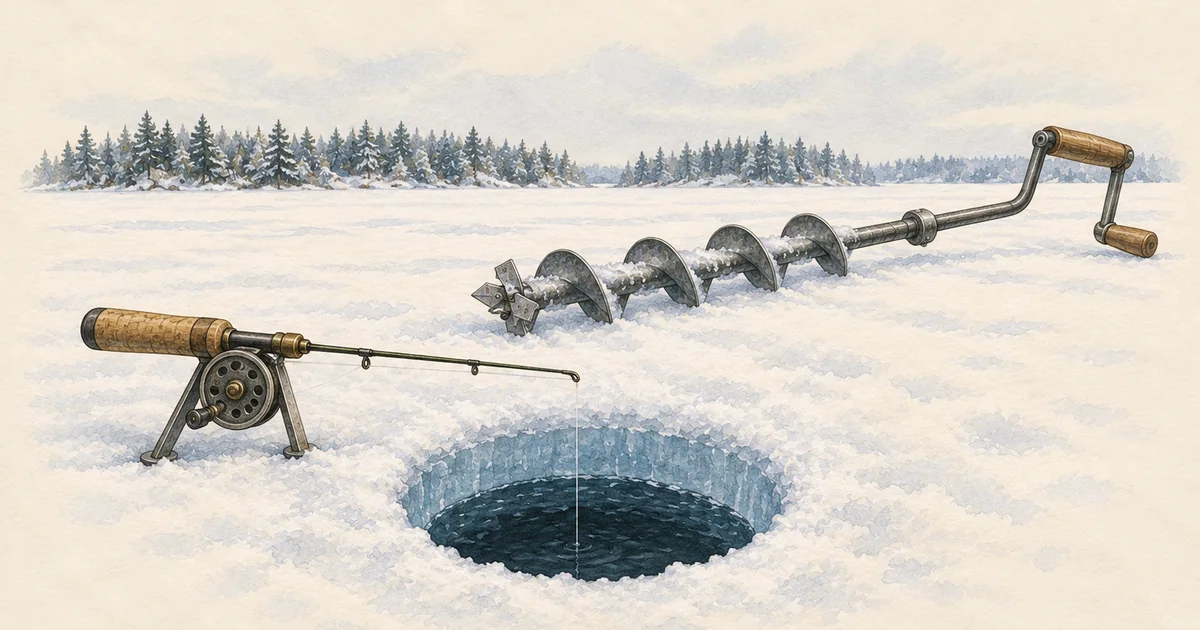
You do not cast at an ice hole. The bait sinks through the hole and stays vertically beneath the rod tip. Either you work a small artificial lure with short twitches, or a natural bait hangs quietly under a fine float (Rute & Rolle). Because cold fish hardly swim after a bait, it is better to drill several holes and look for the spot where they are holding (Blinker).
Tackle for the ice hole
- Ice auger: A hatchet or axe will also do, but chopping is loud, can scare fish off in shallow water and put cracks in the ice (Rute & Rolle). Fish hear noise and sense vibrations, writes the Anglerverband Niedersachsen. According to Blinker, augers with a diameter of 150 millimetres have proved their worth; even an unexpected pike fits through.
- Ice rod: Ice rods, also called pimpel among anglers, are short. Blinker gives 50 to 90, Rute & Rolle 60 to 100 centimetres. For the mormyshka, a tiny lead lure, there are little rods of about 20 centimetres with a spring tip; you then land the fish by hand on the line. Without special tackle a short spinning rod of 1.60 to 2.10 metres is enough (Blinker).
- Reel and line: a small fixed-spool reel with monofilament line, because braid soaks up water and freezes to the rings and reel in frost (Blinker). For roach Blinker gives 0.16 to 0.18 millimetres, for the mormyshka 0.10 to 0.14. More on choosing under Fishing line.
- Skimmer: In frost new ice forms quickly in the hole, and the sharp edges can cut the line. With a perforated scoop or a small sieve you lift out the ice slush and snow (Blinker, Fisch & Fang).
- Rod rest: A small stand keeps the rod out of the snow. If it lies in the snow, the rings, reel and line freeze up easily (Blinker).
Baits and presentation in cold water
Fish take on the temperature of the water around them, and their metabolism follows it. When the temperature falls below the range in which a species feeds well, circulation, energy demand and appetite slow down, explains an article on angling research at the Landesanglerverband Brandenburg. In practice, Blinker advises hardly moving baits in winter and putting them right in front of the fish’s mouth. How the water layers beneath the ice is covered in Water temperature and oxygen.
- Mormyshka: a very small hook with a lead bead on the shank, often baited with maggots. You hold the rod still; even the trembling of your hand makes the lure twitch. According to Blinker it catches mainly perch and whitefish in shallow water down to about five metres.
- Zocker: small metal lures that you move up and down vertically beneath the rod tip (more at Pilker). Rute & Rolle advises twitching them only from the wrist rather than yanking them half a metre upwards.
- Balance jig: a fish-shaped lure with the eyelet on the back and a fin on the tail. It sits horizontally in the water and veers aside at the slightest twitch; according to Blinker it can also simply hang quietly in between. It is considered there to be very productive for perch, and zander bite too.
- Natural baits: maggots, the smaller pinkies, a redworm or half a lobworm under a float. For pike and zander, Rute & Rolle offers a dead baitfish on or just above the bottom.
A search pattern from Rute & Rolle: lower the lure to the bottom, lift it ten centimetres and work it there for a few minutes with small hops. If it stays quiet, you wind in half a metre and try one level higher, up to just beneath the ice. When pike fishing, one Blinker author changes the hole after half an hour without a bite; freshly drilled holes often worked better for him. Feed sparingly; for roach Blinker gives two to three golf-ball-sized balls of groundbait to begin with.
- Lowering: Let the lure sink straight down through the hole until it touches the bottom.
- Just off the bottom: Lift it about ten centimetres and let it dance there in small hops for a few minutes.
- One level higher: If nothing happens, wind in roughly half a metre of line and try the same again at this height.
- Up to the ice: Work your way up like this, step by step, until the lure is just below the ice sheet.
Which fish bite under the ice
On natural waters, roach and perch are the easiest to coax through the hole, according to Rute & Rolle; pike and zander bite as well. Where the fish hold is described differently: one Blinker article looks for them in the deepest layers of water in winter, another stresses that under the ice sheet they are often not that deep at all. The background is shown in The year by the water.
| Species | Baits and lures | How to present |
|---|---|---|
| Perch | mormyshka, zocker, balance jig, worm | on the bottom or well above it |
| Roach | maggot, pinkie | fine float, 1 to 2 cm above the bottom |
| Pike | dead bait | on the bottom, just above it or in mid-water |
| Zander | dead baitfish, balance jig | on or just above the bottom |
| Burbot | only where allowed | critically threatened, protected in many places |
According to the fish lexicon of the Landesfischereiverband Bayern, the burbot looks for food at dusk and at night, above all in the cold season. The nationwide Red List classes it as critically threatened, and in the inland waters of Mecklenburg-Western Pomerania it is protected from 1 January to 15 February. Other closed seasons also fall in winter: Saxony protects pike from 1 February to 30 April. What lies behind this is explained in Closed season and minimum size.
When and where ice fishing is allowed
Load-bearing ice is rare in Germany. A lake only freezes once it has cooled to about 4 degrees all the way down, larger lakes often not until January, gravel pits sometimes not at all. Weeks of continuous frost that freezes almost every water is described by the Deutscher Wetterdienst as rare for Central Europe. Whether you may then go onto the ice and fish there is regulated by several bodies:
- Municipalities: In Bavaria they can ban entering ice surfaces by regulation (Art. 27 LStVG).
- State law: In the coastal waters of Mecklenburg-Western Pomerania, ice holes must be clearly visibly marked (§ 20 KüFVO M-V). The Fischereiamt Berlin requires the ice hole to be marked with twigs or sticks as you leave and refers to the Berlin ice surface regulation.
- Water rules: The Landesanglerverband Brandenburg allows ice fishing as long as no authority and no board decision opposes it; holes may measure at most 20 centimetres on the underside. The Landesanglerverband Sachsen-Anhalt draws the same line and prohibits ice fishing on flowing waters as a matter of principle. The Landesverband Sächsischer Angler forbids it at drinking-water reservoirs.
Note, as of October 2026: the examples come from six states and apply only there. What applies at your water is stated in the fishing permit and the water rules (see Fishing permit and water map). If in doubt, ask the club or the water’s manager before you drill the first hole.
Looking after the catch, staying safe
A caught fish does not stay lying on the ice. The Fischereiamt Berlin makes clear that fish must be properly killed when ice fishing too; letting them suffocate on the ice breaches animal welfare law. A fish you return is released at once and without holding it. The procedure is described in Stunning and killing a fish and Releasing a fish.
Just the essentials for safety: the DLRG advises never going onto the ice alone, asking the competent office whether it bears, and leaving it at once if it creaks and cracks. Guide values for ice thickness and what to do if someone falls through are given under Stepping onto ice.
Frequently asked questions
Is ice fishing allowed in Germany?
There is no uniform rule. Whether you may go onto the ice is regulated by the state and the municipality; whether and how you fish there is regulated by state law and the water rules. On some waters it is forbidden, for example at the drinking-water reservoirs managed by the Landesverband Sächsischer Angler.
How long is an ice rod?
Usually between 50 and 100 centimetres; the little rods for the mormyshka are only about 20 centimetres long. A short spinning rod of up to a good two metres will do as well.
How big may the ice hole be?
The water rules set this. The Landesanglerverband Brandenburg and Sachsen-Anhalt allow at most 20 centimetres on the underside of the ice on their waters. Mark the hole before you leave.
Related
- Stepping onto ice: guide values for ice thickness and help if someone falls through
- The year by the water: what happens in the lake between autumn and spring
- Float rig and Float shotting: balancing the fine float for roach at the hole
- Metal lures: pilkers, spoons and other metal lures at a glance
- Catch calendar: chances of a catch by species and month
Sources
- Blinker: Eisangeln: Heiße Tipps, Angeln mit der Mormyschka, Eisangeln auf Hecht, Eisangeln auf Rotaugen, Balance Jigs, 10 Tipps zum Angeln im Winter (Gerät, Köder, Führung, Erfahrungen am Eisloch)
- Rute & Rolle: Einstieg ins Eisangeln (Bohren statt Hacken, Eisruten, Zielfische, Köder, Suchmuster)
- Fisch & Fang: Auf zum Eisangeln (Pimpel, Schaumkelle, Maden an Mormyschka und Jig)
- Landesanglerverband Brandenburg: Beeinflusst das Wetter den Fangerfolg?, Gewässerordnung (Stoffwechsel und Wassertemperatur; Eisangeln, Lochgröße, Kennzeichnung)
- Anglerverband Niedersachsen: Faktencheck Eiszeit (Lärm und Erschütterungen auf dem Eis)
- Gewässerordnungen: Landesanglerverband Sachsen-Anhalt, Landesverband Sächsischer Angler, Ausgabe 2024 (Eisangeln auf Fließgewässern und an Trinkwassertalsperren, Lochgröße)
- Fischereiamt Berlin: Die Angelkarte und ihre Auflagen (Eisangeln, Tierschutz, Markieren des Eislochs, Zurücksetzen)
- LALLF Mecklenburg-Vorpommern: Küstenfischereiverordnung, Arbeitskopie, Mindestmaße und Schonzeiten (Kennzeichnung von Eislöchern, Schonzeit der Quappe)
- Landesrecht: Sächsische Fischereiverordnung, Bayerisches LStVG, Art. 27 (Schonzeit des Hechts in Sachsen; Betretungsverbote der Gemeinden in Bayern)
- Deutscher Wetterdienst: Sicher auf dem Eis?! (wann Seen zufrieren, Seltenheit von Dauerfrost)
- DLRG: Eisregeln (Verhalten auf dem Eis)
- Landesfischereiverband Bayern: Fischlexikon und Rote-Liste-Zentrum: Quappe (Fresszeiten und Gefährdung der Quappe)
Text AI-assisted, drawing AI-generated. Sources opened and checked in October 2026; no graphics taken from the sources.
All figures are guide values without guarantee. Whether the ice bears and whether you may fish there is decided by the authorities, state law and the water rules; the text does not replace legal or medical advice.