
Knowledge – Fish
Zander: Identification, fishing spots, bait and cooking
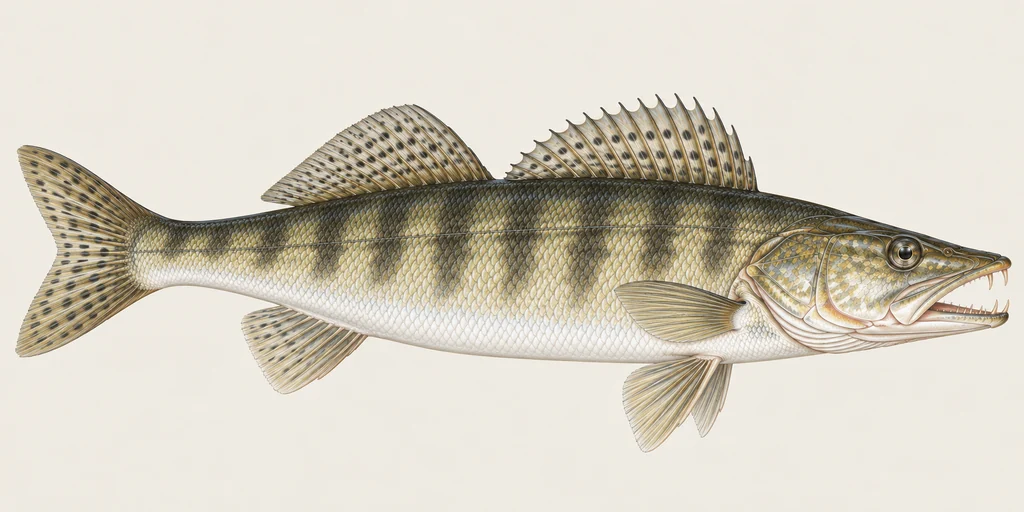
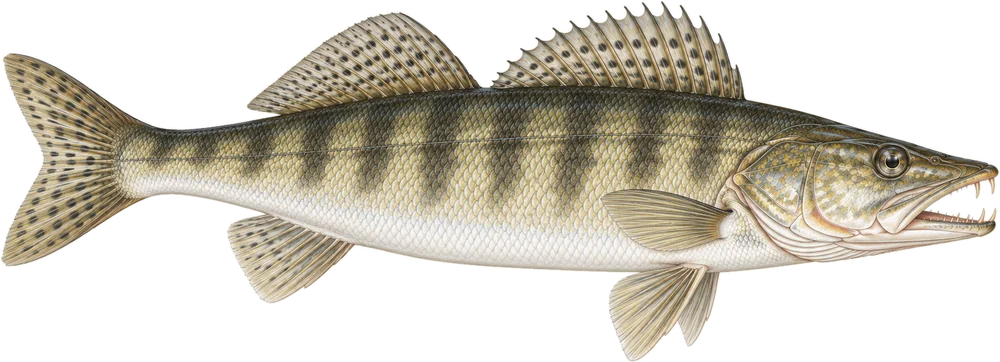
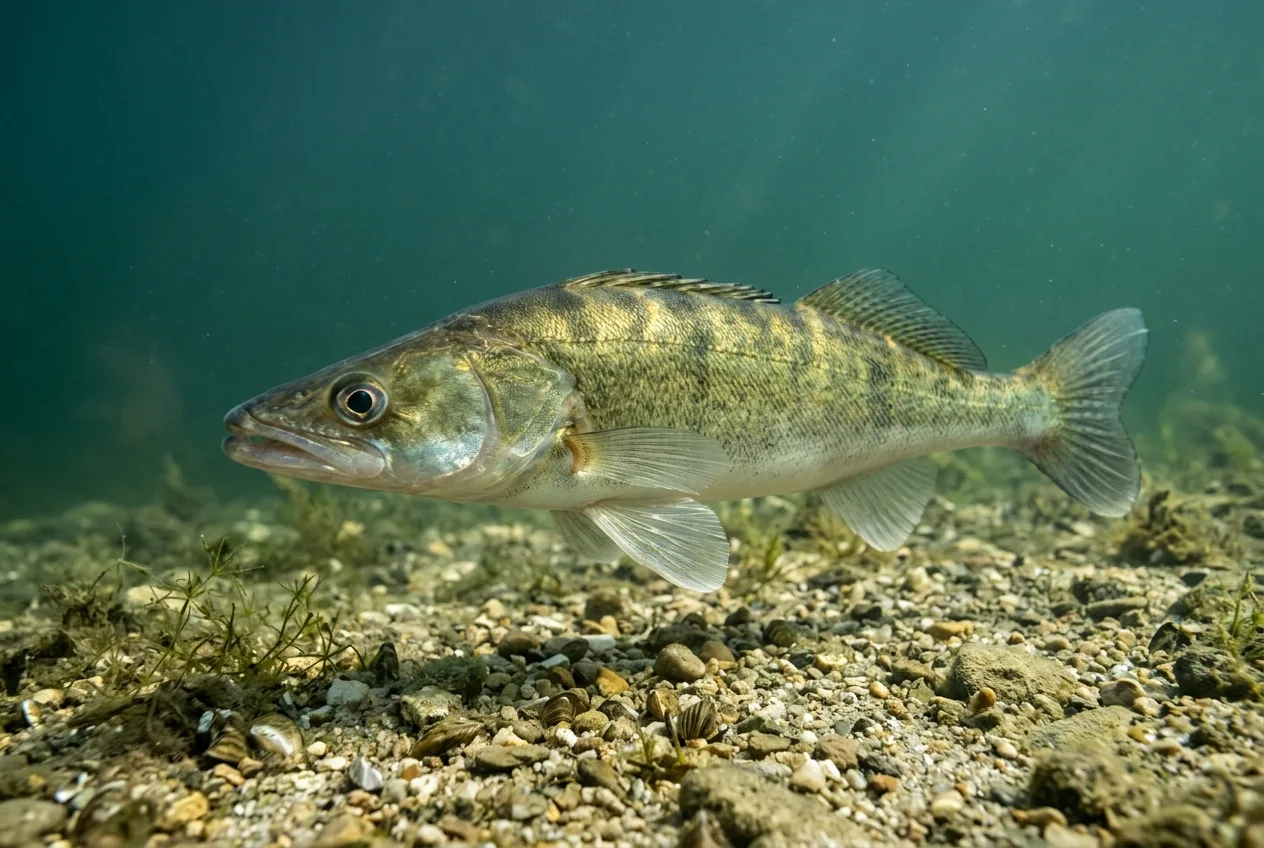
The zander (Sander lucioperca) is the largest perch-like fish in the fresh waters of Central Europe and a predator of turbid, deep waters. Its large eyes glow silvery in the light, hence the name Glasauge (glass eye). It is hunted mainly at dusk and at night.
In short: You are most likely to catch zander from September to December, in the evening, at night and in the morning. Good spots in a river: groyne pools, rock-armoured banks and current edges; in a lake: underwater humps, drop-offs and sunken trees. Proven baits: a dead baitfish or fish strips on the bottom; soft plastic shad, twister, spoon or plug. Step by step: Zander fishing.
- Two dorsal fins: the front one with spiny rays, the rear one with soft rays
- Deeply cleft mouth with long fangs
- Flanks dark-banded or clouded
Catch chances through the year
- Hardly any chance
- Possible
- Good
- Peak season
- Spawning (observe the closed season)
Editorial assessment for waters in Germany, not a measured value and no guarantee. Spawning time is not the same as the legal closed season.
Species profile and sources in the catch calendarAll species compared month by monthThe rules of your federal state
How to recognise a zander
The body is long and spindle-shaped, and the head tapers to a point. The gape reaches to the rear edge of the eye or beyond. Between small brush-like teeth, both jaws carry large fangs, the canine teeth. The gill cover ends in a short spine, and the body carries small ctenoid scales.
Two dorsal fins, separated by a short gap: the front one has sharp spiny rays, the rear one soft rays. The colouring varies from water to water; the zander is usually greenish-grey with a silvery or brassy sheen. Washed-out dark vertical bars show along the flanks, and the dorsal and tail fins are striped black.
According to the Landesfischereiverband Bayern, zander measure 50 to 80 centimetres on average and about 100 at most. FishBase gives 20 kilograms as the maximum weight and 17 years as the greatest reported age. According to Blinker, females reach up to 130 centimetres.
Zander, perch or pike?
| Feature | Zander | Perch | Pike |
|---|---|---|---|
| Dorsal fins | two, separated by a short gap, the front one with spiny rays | two, separated, with a dark spot at the end of the first | one, far back |
| Teeth | large fangs beside brush-like teeth | only small brush-like teeth | strong fangs in the lower jaw, fold-down ones in the upper jaw |
| Markings | washed-out dark vertical bars, fins marked with black | five to nine dark vertical bars, reddish fins | pale spots or crossbars on a yellow-green to brownish background |
The perch is stockier and deeper in the back. Reddish fins and a dark spot at the end of the first dorsal fin give it away, and it has no fangs. Ruffe usually only reach 10 to 20 centimetres. Their two dorsal fins are joined together, and the body is speckled dark.
The Volga zander, an immigrant from eastern Europe, has stripes running right down to the belly and lacks the typical canine teeth in its mouth. What sets the zander apart from the pike are the two dorsal fins and the pointed head.
Side by side
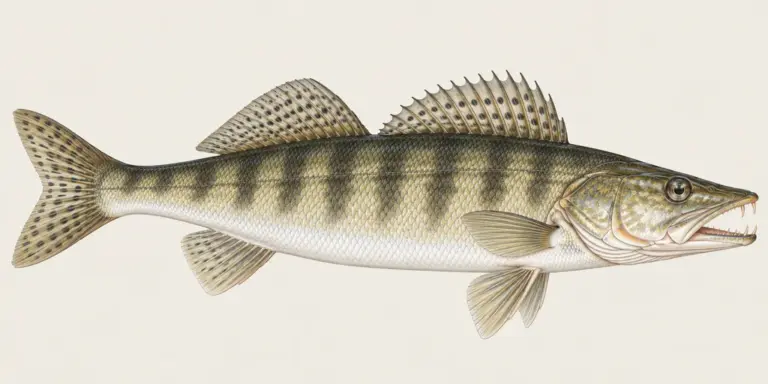
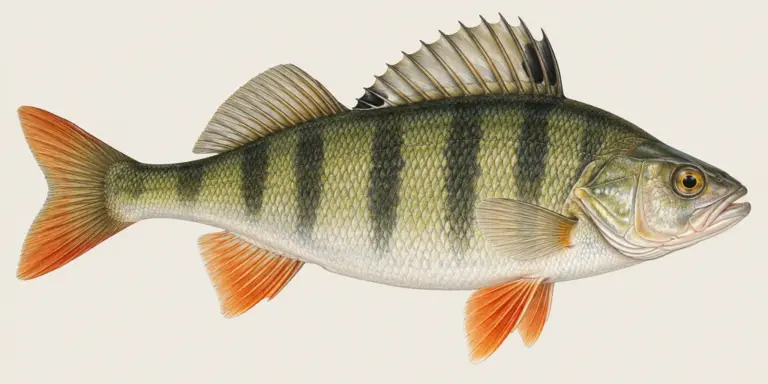
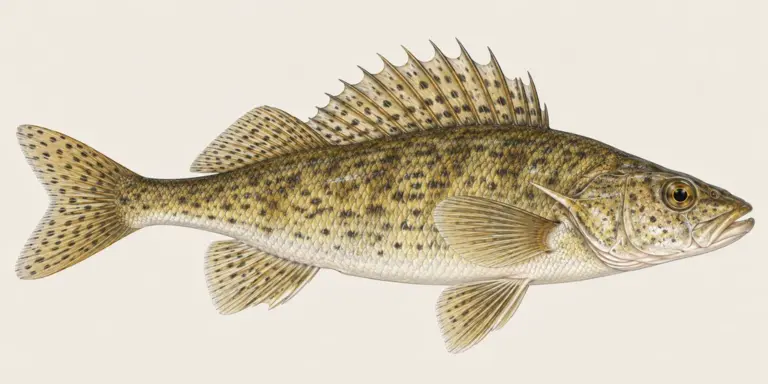
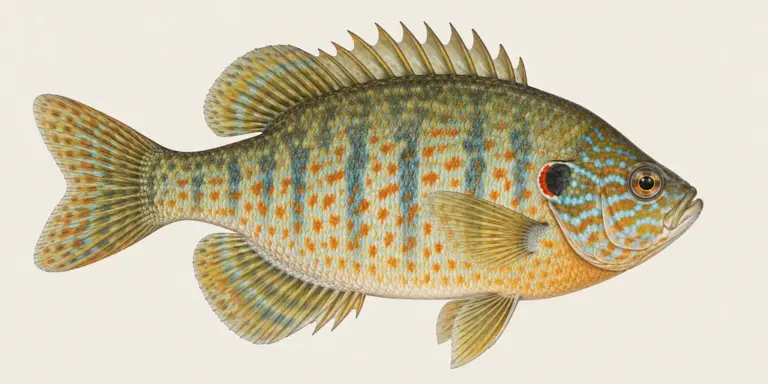
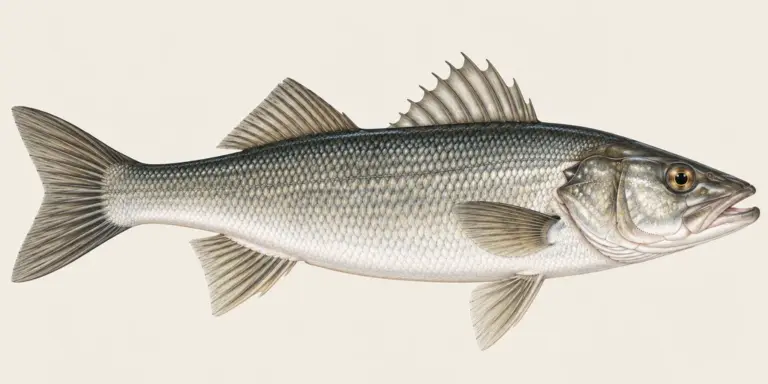
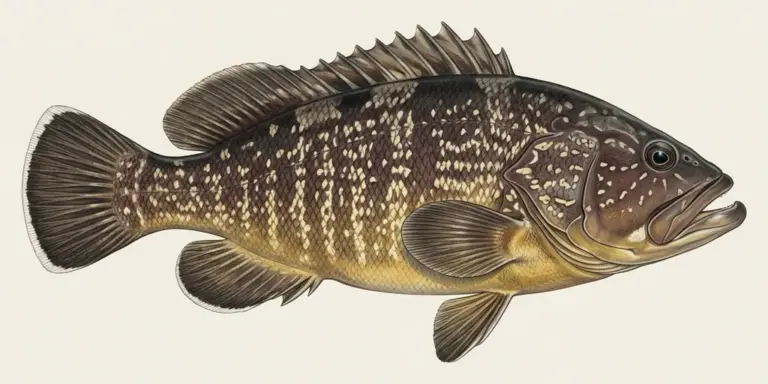
AI-generated illustrations.
Where the zander lives
Zander prefer larger, deep, plankton-clouded waters with a firm bottom, still or flowing. FishBase lists large turbid rivers, nutrient-rich lakes, and brackish coastal lakes and estuaries, mostly at depths of 2 to 3 metres. According to a LAWA report, the upper lethal temperature at which adult fish die is 35 °C. Being shy of light, zander prefer darker zones of the water.
The zander is native to the Elbe, Oder and Danube catchments; through stocking it now also occurs in the Rhine, Moselle and Weser catchments. By now it even turns up in smaller rivers and lakes. Unlike the pike, it is hardly tied to cover: it hunts in open water and also sits over smooth sandy bottom.
In rivers, zander sit in the hollows of groyne pools, at the steps of rock armouring, along sheet piling and at current edges. In lakes, sandbanks, underwater humps, sunken trees and rocky edges are worth trying. In autumn they often sit shallower in lakes and move down into the depths as the temperature falls. You will find more about the waters under fishing on rivers, on canals and on lakes.
Holding spots in the picture
Choose a season and time of day: the picture shows where the species sits then. Tap a fish or a spot in the list to bring it closer. The picture is schematic and AI-generated, every water is different.
Catch chance in springpossibleSpawning season, observe closed seasons
Catch chance in summergood
Catch chance in autumnPeak season
Catch chance in winterpossible
- J
- F
- M
- A
- M
- J
- J
- A
- S
- O
- N
- D
Spawning season
Active time The zander hunts at dusk and at night; its eye is adapted to low light.
Not the main time The zander hunts at dusk and at night; its eye is adapted to low light.
Active time The zander hunts at dusk and at night; its eye is adapted to low light.
Active time The zander hunts at dusk and at night; its eye is adapted to low light.
In the river
Groyne scour hole
Zander are present here all year round.
riprap, sheet piling, harbour
Zander are present here all year round.
Current seam
Zander are present here all year round.
In the river the zander holds in the depressions of the groyne pools, on the steps of rock armouring, at sheet piling and on current seams.
Spring: chance of a catch possible according to the catch calendar. The spawning season falls in this period, observe the closed seasons. In spring the zander spawns and is protected in many places.
Summer: chance of a catch according to the catch calendar possible in June, good in July and August. After the closed season the real fishing time begins. Overcast days are considered favourable.
Autumn: chance of a catch according to the catch calendar peak season. September to December are among the most productive months.
Winter: chance of a catch according to the catch calendar peak season in December, possible in January and February. In frost it is worth trying rather in the midday hours. Big zander are often caught in the cold season.
In the lake
Shelf edge
Zander are present here all year round.
Sunken tree
Zander are present here all year round.
Open water
Zander are present here all year round.
plateau, underwater hump
Zander are present here all year round.
In a lake it keeps to sandbars, underwater humps, drop-offs and sunken trees. It needs less cover than the pike and also hunts in open water.
Spring: chance of a catch possible according to the catch calendar. The spawning season falls in this period, observe the closed seasons. In spring the zander spawns and is protected in many places.
Summer: chance of a catch according to the catch calendar possible in June, good in July and August. After the closed season the real fishing time begins.
Autumn: chance of a catch according to the catch calendar peak season. September to December are among the most productive months.
Winter: chance of a catch according to the catch calendar peak season in December, possible in January and February. Big zander are often caught in the cold season.
Depth: It prefers large, rather murky waters with a firm bottom. FishBase gives depths of 2 to 30 metres, mostly 2 to 3 metres.
Size comparison: AI-generated drawing, schematic.
How it hunts and spawns
Zander larvae first feed on zooplankton. From their first summer the fish mostly feed on other fish and partly on their own kind. Because of their limited gape, they prefer fairly small, slim prey: typical are white fish, ruffe, perch and gobies. According to the Anglerverband Niedersachsen, the zander feeds mainly at night in open water.
According to FishBase, zander mature at three to ten years, usually at four. Spawning takes place from April to June, at water temperatures of roughly 10 to 15 °C at the spawning site, depending on the source. The male makes a shallow hollow about 50 centimetres across, in sand, gravel or among exposed roots, mostly at a depth of 1 to 3 metres. The pairs spawn at dusk or at night. The female leaves the nest after laying, and the male guards the clutch and fans fresh water over the sticky eggs.
When it bites
In winter zander no longer move about actively and mostly sit in the deepest spots. From February and March the big fish in particular move towards the spawning grounds and then sit unusually shallow. At spawning time they should be left in peace, and in many places they are protected.
After the closed season (Schonzeit) the fishing season begins and runs through the summer into late autumn. In summer waters are often clouded by algae, and then you can catch fish in daytime too. In autumn the rivers clear, and the chances at night improve.
Dusk and the hours after it are best. On dark days with cloud cover, or in murky water, zander bite all day. Rising water clouds the river, and then they also bite during the day; at low water they bite mostly at dusk and at night.
Today’s catch index needs JavaScript. Season and spawning time are in the catch calendar.
You will find the monthly overview of all species and the water temperature check in the catch calendar.
From the blog: Fishing in November: which fish bite now and where I look for them · Fishing in an east wind: what the wind really changes at the water · Riprap and groynes: reading current from the bank, working lures and freeing snags
What you catch it with
Step by step: Zander fishing: tips on bait, rigs and tackle – season, spots, baits, tackle and rules on one page.
The soft plastic shad on a jig head is the most common choice. Soft plastic shads of 8 to 14 centimetres are usual, up to 25 in winter. You work them along the bottom, and most bites come as the bait sinks. When lift-and-drop fishing, you lift the bait off the bottom with two or three turns of the handle; below a water temperature of 10 °C slow retrieves work particularly well. Because zander have bony mouths, you need a stiff rod with a fast tip action and a firm strike. Zander also take the spoon.
The zander rod is usually 2,40 to 2,70 metres long, and the fixed-spool reel is size 2500 to 4000. A braided line of 0,12 to 0,16 millimetres with one to two metres of fluorocarbon in front is usual.
On heavily fished waters the dead baitfish is often the key. You offer it on the bottom, for example on the baitfish rig. Fresh roach of up to 12 centimetres catch well; zander rarely take sea fish. Many federal states (Bundesland) expressly ban live baitfish.
At night zander move into the shallows, a metre deep or less. Then shallow-running, suspending plugs of 10 to 12 centimetres catch fish, retrieved slowly and evenly with pauses of two to three seconds. Cast parallel to the bank and do not shine your light straight onto the water. More under night fishing.
Zander do not bite through line, but pike do: where both occur, a thin wire hooklength belongs in front of the bait. In the fight the zander thumps much like a perch, and it usually fights more sluggishly than a pike. Take care after landing, because the gill covers and scales are spiny. Gentle landing is explained under Landing and unhooking fish.
Slim baits, not too big: The zander’s mouth is small compared with the pike’s. Do not reach for the biggest baits and choose slim shapes, because zander prefer fairly small, slim fish as prey.
On the bottom by day, in the shallows at night: In daylight the light-shy zander sit almost always at the bottom, and a soft plastic shad in mid-water is not seen at all. At night, by contrast, you look for the shallow spots.
Do not wind up from the depths too fast: Perch and zander have no duct to the swim bladder and are therefore more prone to barotrauma, that is, damage from the lack of pressure equalisation. Do not fish deeper than 10 metres for them, and build in playing pauses so that the pressure can at least equalise somewhat.
Suitable lures
A dead baitfish or fish strips on the bottom; soft plastic shad, twister, spoon or plug.
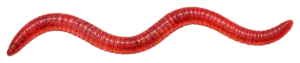
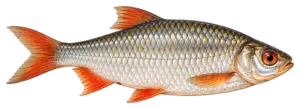
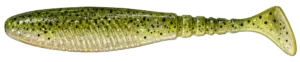
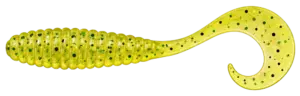

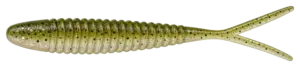
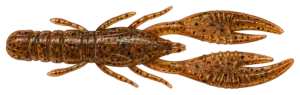
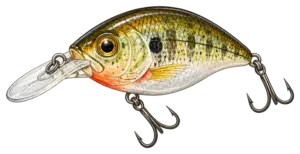
AI-generated illustrations. A click opens the lure’s page.
Also suitable: twitchbait, lipless crankbait, spinner, spoon, bladed jig.
Rigs for these baits: jig head rig, baitfish rig, drop-shot rig, float rig, running ledger rig.
What the zander tastes like and what to do with it
The zander is one of the most popular food fish. Its flesh is firm, white, mild and very lean. A kitchen size is considered to be 50 to 70 centimetres. Smaller zander yield hardly any flesh, and with very large ones the flavour of the fish itself can be stronger.
With its few bones it is easy to fillet. If you want the full flavour, cook it whole, because bones and skin give the flesh extra taste. A classic is the fillet fried in butter with crispy skin. Before that, the fish must be stunned and killed; how to smoke fish is also covered in the encyclopaedia.
What you need to observe
Closed seasons (Schonzeit), minimum sizes (Mindestmaß) and harvest windows are set by the federal states (Bundesland), and on many waters additionally by the club or leaseholder. They differ depending on the water and the time of year. We give figures only with a date and a source; always binding are the fisheries regulation of your federal state and your fishing permit (Erlaubnisschein). You will find a list of links to the official sources in the catch calendar.
A fish of legal size that you want to keep you stun and kill at once, in line with animal welfare rules. Protected, undersized fish or fish too large under a harvest slot you unhook, if possible still in the water and with wet hands, and release gently. What exactly applies is regulated by state law and your fishing permit (Erlaubnisschein).
There is no nationwide uniform minimum size (Mindestmaß); fisheries law is a matter for the federal states. In many waters a predator closed season also applies, during which fishing with artificial lures and baitfish is often banned. Many federal states expressly ban live baitfish; in Brandenburg the fisheries authority (Fischereibehörde) can allow an exception in individual cases. The IUCN lists the zander as least concern. Water regulations and permits are provided by the state associations, such as the Landesanglerverband Brandenburg.
What closed season, minimum size and harvest slot mean and where to find them is explained on the page Closed season and minimum size explained.
What state law specifies on the closed season (Schonzeit) and minimum size (Mindestmaß) for this species can be found in the “At a glance” box on all 16 state pages: Baden-Württemberg, Bavaria, Berlin, Brandenburg, Bremen, Hamburg, Hesse, Mecklenburg-Western Pomerania, Lower Saxony, North Rhine-Westphalia, Rhineland-Palatinate, Saarland, Saxony, Saxony-Anhalt, Schleswig-Holstein and Thuringia.
Frequently asked questions (FAQ)
How do I tell a zander from a perch?
The zander is long and carries large fangs. The perch is stockier and deeper in the back, has reddish fins, a dark spot at the end of the first dorsal fin and only small brush-like teeth.
When do zander bite best?
Mostly at dusk and at night. In murky water or on dark days they also bite during the day. The fishing season begins after spawning and runs until late autumn.
Do I need a wire hooklength when fishing for zander?
Zander do not bite through line, but pike do. Where pike occur, a thin wire hooklength protects against bite-offs, and the zander does not mind it.
Sources
The rating of catch chances is an editorial assessment. The facts come from these sources, and the text is worded in our own words. The illustration is an original design by Angel Momente in the style of a natural history plate (AI-generated, see the AI notice).
- Landesfischereiverband Bayern: Fischlexikon (Laichzeit, Lebensraum, Nahrung, Aktivität)
- FishBase: Sander lucioperca (Größe, Alter, Lebensraum, Laichverhalten, Gefährdung)
- Blinker: Steckbrief Zander (Merkmale, Unterscheidung, Fangplätze, Köder)
- Anglerverband Niedersachsen: Zander (Fische in Niedersachsen)
- Institut für Binnenfischerei Potsdam: Reproduktionsstärke von Zandern in Abhängigkeit von der Größe der Elterntiere (Endbericht 2025)
- Freistaat Sachsen, Fischerei: Stand der Zanderaquakultur (Fachtag Fischerei 2022)
- Wikipedia: Zander
- Blinker: Zanderangeln mit Gummifisch (Köderlängen, Köderführung, Temperatur)
- Blinker: Zanderangeln, die 12 wichtigsten Fragen (Jahreszeit, Trübung, Rute, Köder)
- Blinker: Zanderangeln bei Nacht, fünf Tipps (Stellen, Wobbler, Köderführung)
- Blinker: Zeit für Zetti, sechs Tipps für Zander (Tageszeit, Vorfach)
- Blinker: Zanderangeln mit Köderfisch (Fresszeiten, Köderwahl, Standorte im See)
- Fisch & Fang: Mit Köderfisch auf Winter-Zander (Köderfische, Standplätze im Winter)
- Blinker: Barotrauma bei Fischen, wie tief darf ich angeln (Zander und Barsch)
- Land Brandenburg: Fischereiordnung des Landes Brandenburg (BbgFischO), Köder
- Deutscher Angelfischerverband: Fisch des Jahres 2023, der Flussbarsch (Broschüre)
- LAWA-Projekt O 10.20 (Leibniz-IGB, 2021): Temperaturempfindlichkeiten der Fischgemeinschaften
- Landesanglerverband Brandenburg
- Bundeseinheitlicher Fragenkatalog der Fischerprüfung (Fassung Hessen 2025)
Created with AI support from the sources listed. Figures only appear in the text if a source gives them. Last updated: 23 November 2026. Found a mistake? Write to us. Who is behind this site: About me.
More in the lexicon
- All fish species at a glance
- Catch calendar – month, water temperature and profile for 93 species
- Line calculator – breaking strain after the knot, drag guideline, backing
- Angling methods