
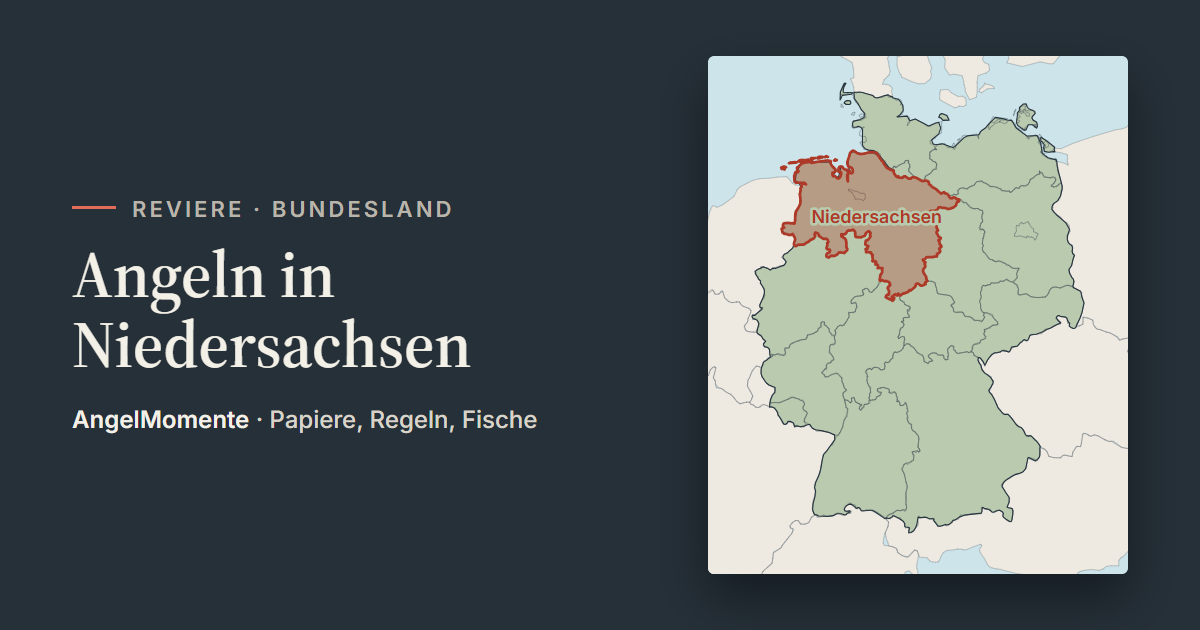
Waters · Federal state
Fishing in Lower Saxony: Fishing licence, rules, closed seasons and waters
Fishing in Lower Saxony is possible on inland waters without a fishing licence (Fischereischein), colloquially an Angelschein. You need your ID card and the fishing permit (Erlaubnisschein) for the water, and with most issuers also proof of the angling exam (Fischerprüfung). Fishing is free on the North Sea coast, but separate minimum sizes and fishing bans apply there.
- Papers
- Fishing permit (Erlaubnisschein) and ID (Ausweis), usually proof of the angling exam (Fischerprüfung)
As of October 2026
At a glance
- Papers
- Fishing permit (Erlaubnisschein) and ID (Ausweis), usually proof of the angling exam (Fischerprüfung)
| Fish | Minimum size | Closed season | Catch limit | Note |
|---|---|---|---|---|
| Pike | 40 cm | 1.2.–15.4. | – | Coast: 45 cm |
| Zander | 35 cm | 15.3.–30.4. | – | Coast: 40 cm, closed season 15.3.–15.5. |
| Perch | – | none | – | |
| Eel | 35 cm | none | – | 28 cm in the coastal districts (Landkreis); fishing ban all year round in coastal waters |
| Carp | – | none | – | |
| Brown trout | 25 cm | 15.10.–15.2. | – | |
| Grayling | 30 cm | 1.3.–15.5. | – | |
| Barbel | 35 cm | none | – | |
| Wels catfish | 50 cm | none | – | |
| Burbot | 35 cm | none | – | |
| Asp | 40 cm | protected all year round | – | catch only in stocked waters, then minimum size (Mindestmaß) 40 cm |
| Sea trout | 40 cm | protected all year round | – | Inland only in stocked waters; coast: closed season 1.10.–15.2. |
| Sea bass | 42 cm | 1.2.–31.3. catch and release only | 3 per day | coast only, EU rule 2026; fisheries office (Fischereiamt): as a rule no fishing in February and March |
| Plaice | 27 cm | none | – | coast only, EU minimum size (Mindestgröße) |
| Common nase | – | protected all year round | – | fishing only in stocked waters |
Inland fisheries regulation of Lower Saxony; coast under the coastal fisheries regulation and EU law, see the note. The fishing permit may be stricter. Status: October 2026. What counts are the regulation and your fishing permit.
The key points in brief
- Inland waters: A fishing licence is not required. When fishing you carry the fishing permit and your ID card.
- Angling exam: It is run by the Anglerverband Niedersachsen and the Landesfischereiverband Weser-Ems. You can sit it from the age of 14. Most fishing permits require it.
- Coast: Fishing is free in the coastal waters. For the Lower Weser and Hunte you need the state’s Weser permit.
- Eel: Fishing for eel is banned all year round in the coastal waters.
- Protected species: Inland, asp, salmon, sea trout and common nase are protected. You may only catch them where they have been stocked.
Fishing licence and exam No fishing licence on inland waters in Lower Saxony
Lower Saxony does not require a fishing licence (Fischereischein) for fishing in inland waters. Anyone who fishes proves their identity with the fishing licence or ID card (§ 57 Niedersächsisches Fischereigesetz). You can still have a licence issued. The municipality of your main residence does that if you are at least 14 and have passed an angling exam. It is valid indefinitely (§ 59). It is mainly useful in other federal states, where the fishing permit often requires a fishing licence.
The two recognised state fisheries associations hold the exam, the Anglerverband Niedersachsen (AVN) and the Landesfischereiverband Weser-Ems. You can prepare in a course run by an angling club, which takes about 30 hours at the AVN, or in an online course. You take the exam on site on a set date, with a written and a practical part at the Landesfischereiverband Weser-Ems. Afterwards you receive an exam certificate. Most issuers require it before they give you a fishing permit.
For the coastal waters, the state’s implementing provisions of 1978 still name a fishing licence requirement, based on a law of 1939. Guests on angling cutters who pay for the trip are exempt. If you fish from the shore or from your own boat on the coast, ask the Staatliches Fischereiamt Bremerhaven beforehand.
No exam: guests, holidaymakers, children Fishing with ID and a fishing permit, also as a guest
Because no fishing licence is required inland, there is no separate holiday licence either. Guests fish with ID and a fishing permit (Erlaubnisschein). Whether the issuer asks for proof of the angling exam is set out in its terms. According to the AVN you need it in the great majority of cases.
- Angling cutters: Anyone who fishes for payment on a fishing vessel at the coast needs no fishing licence. Only the skipper must hold one.
- Weser and Hunte: For the Weser permit the fisheries office accepts fishing licences from all federal states or proof of an angling exam taken in Germany. Schoolchildren have a permit of their own from age 14.
- Children: Ask the issuer of the fishing permit what applies to children. On the Steinhuder Meer, for example, children under 14 may fish only to prepare for the angling exam, supervised by an adult who has passed the exam and holds their own fishing permit.
Fishing permit and levy Fishing permit, usually from the angling club
Anyone fishing on someone else’s water needs the written permission of the rights holder, the fishing permit (Fischereierlaubnisschein). It states the water, the duration and the permitted tackle and boats (§ 58). Angling clubs lease most inland waters.
- Anglerverband Niedersachsen: For its association waters, including the Mittellandkanal, Steinhuder Meer, Dümmer, Elbe and Oste, the AVN sells day, week and annual permits online, depending on the water.
- Landesfischereiverband Weser-Ems: Guest permits for example for the Thülsfelder Talsperre, also online.
- Weser and Hunte: The fishing rights belong to the state and are managed by the Staatliches Fischereiamt Bremerhaven. You order the Weser permit online or collect it on site. It is valid for a calendar year and until 15 January of the following year.
The Lower Saxony fisheries act does not provide for a fishing levy (Fischereiabgabe) like the one in Mecklenburg-Western Pomerania.
Closed seasons and minimum sizes Inland fisheries regulation of Lower Saxony and coast
The values in the box „At a glance“ come from the inland fisheries regulation of 1989. Where the coast differs, the note explains it; the coastal fisheries regulation and the EU minimum sizes apply there. Inland, brook lamprey, bitterling, minnow, bullhead, weatherfish and spined loach are also protected all year round. In the districts (Landkreis) of Leer, Aurich, Friesland, Wittmund, Ammerland, Wesermarsch, Cuxhaven and Stade and in Emden and Wilhelmshaven you may keep eels from 28 cm.
The leaseholder can raise minimum sizes and extend closed seasons. On the Steinhuder Meer a harvest slot of 50 to 90 cm has applied to pike since 2026, and a limit of 15 fish a day to perch. On the coast in 2026 you may keep no more than three sea bass a day, each at least 42 cm long.
Status: October 2026. The inland fisheries regulation has been unchanged in the parts mentioned here since 1989. The EU rules for sea bass apply for 2026, the eel ban on the Lower Weser until 31 March 2027. What counts are the regulations and the terms of your fishing permit.
Special rules Returning fish, baits and fish passes
- Returning fish: Protected fish, undersized fish and fish caught in the closed season go straight back alive. Dead fish or fish that can no longer survive must be disposed of harmlessly.
- Baits: You may not use fish of protected species or species with a minimum size as bait.
- Fish passes: Fishing is banned in fish passes. As long as a fish pass has to be open, the same applies to the adjoining stretches (§ 49).
- Eel on the coast: Fishing for eel is banned all year round. For the Lower Weser as far as the Bremen border, the fisheries office expressly names a ban from 1 January 2026 to 31 March 2027.
- Sea bass in February and March: In 2026 the EU allows only catch and release during this period. The fisheries office therefore regards fishing as generally banned in view of the Animal Welfare Act (Tierschutzgesetz).
- Wadden Sea National Park: Fishing is expressly allowed in the recreation zone. You may enter the quiet zone only on the approved paths.
Waters in the state North Sea coast, Weser, Elbe and Hanover region
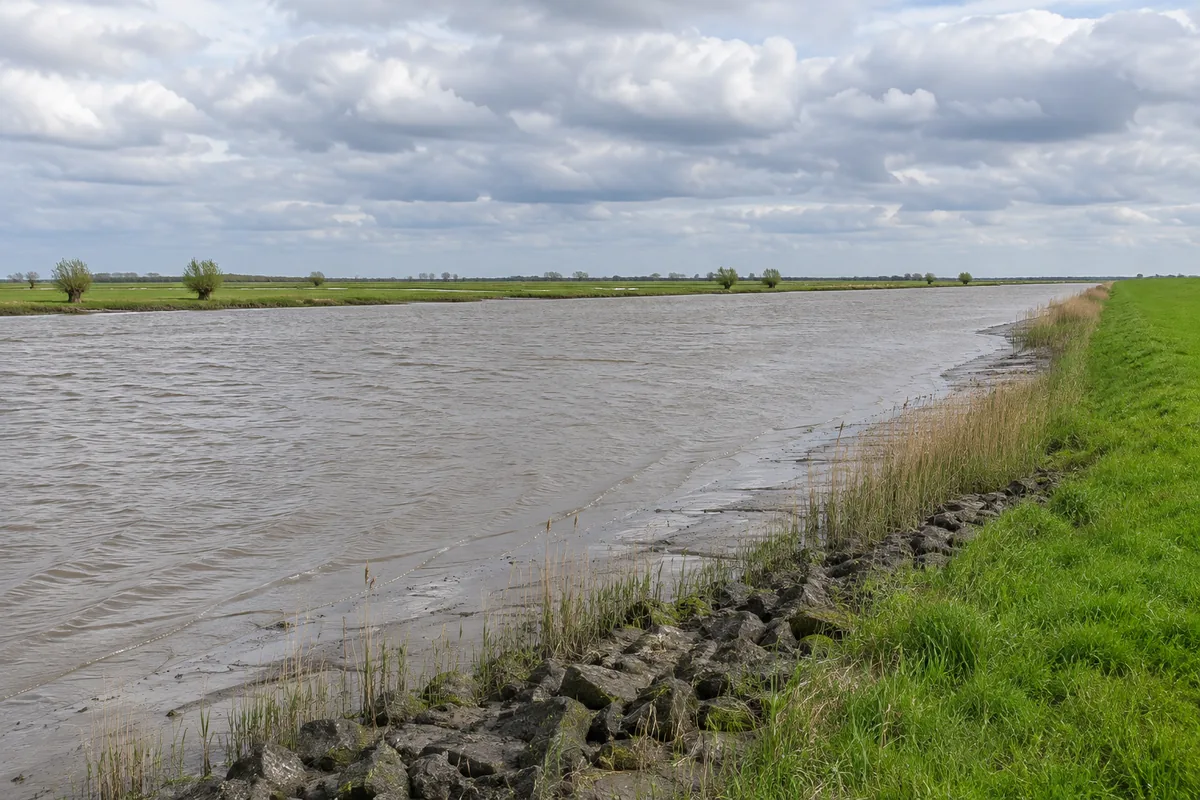
In law, the coastal waters include not only the North Sea but also the lower reaches of the Elbe, Oste, Weser, Hunte, Ems and Leda. The profile North Sea coast describes the Wadden Sea and the estuaries. Inland, the Weser and Elbe run through the state. Around Hanover lie the Mittellandkanal, the Leine and the Steinhuder Meer, covered together in the profile Hanover region. All the states are on the page Fishing in Germany, and the waters atlas shows every river and lake.
Related
- Fishing licence and angling exam and Fishing permit and water map
- Closed season and minimum size explained and the catch calendar
- Fishing on the coast and in the surf and Fishing on a canal
- Neighbouring states: Bremen, Hamburg, Schleswig-Holstein, Mecklenburg-Western Pomerania, Saxony-Anhalt and North Rhine-Westphalia
- Fishing ponds and trout lakes in and around Lower Saxony: search by postcode and radius, also across the state border
Sources
- Niedersächsisches Fischereigesetz im NI-VORIS: § 16 Küstengewässer, § 57 Erlaubnisschein, § 59 Fischereischein
- Ausführungsbestimmungen zum Niedersächsischen Fischereigesetz, Abschnitt V Fischereischein (1978)
- Binnenfischereiordnung: § 2 Fangverbote, § 3 Mindestmaße, § 4 Schonzeiten, § 5 Zurücksetzen und Köder
- Staatliches Fischereiamt Bremerhaven: Rechtlich gebotene Einschränkungen in den Küstengewässern, Informationen zum Wolfsbarsch, Fischfang in Weser und Hunte 2026
- Portal Fischerei von Bund und Ländern: Niedersachsen
- Anglerverband Niedersachsen: Fischerprüfung und Fischereiordnung Steinhuder Meer (Stand 08/2026); Landesfischereiverband Weser-Ems: Fishing in Lower Saxony
- Gesetz über den Nationalpark Niedersächsisches Wattenmeer, § 15 und Nationalparkverwaltung Niedersächsisches Wattenmeer
A guide without guarantee, status October 2026. What counts is the Lower Saxony fisheries act, the inland fisheries regulation, the coastal fisheries regulation, EU law and the terms of your fishing permit.