
Knowledge – Fish
Plaice: Features, difference from the flounder, baits
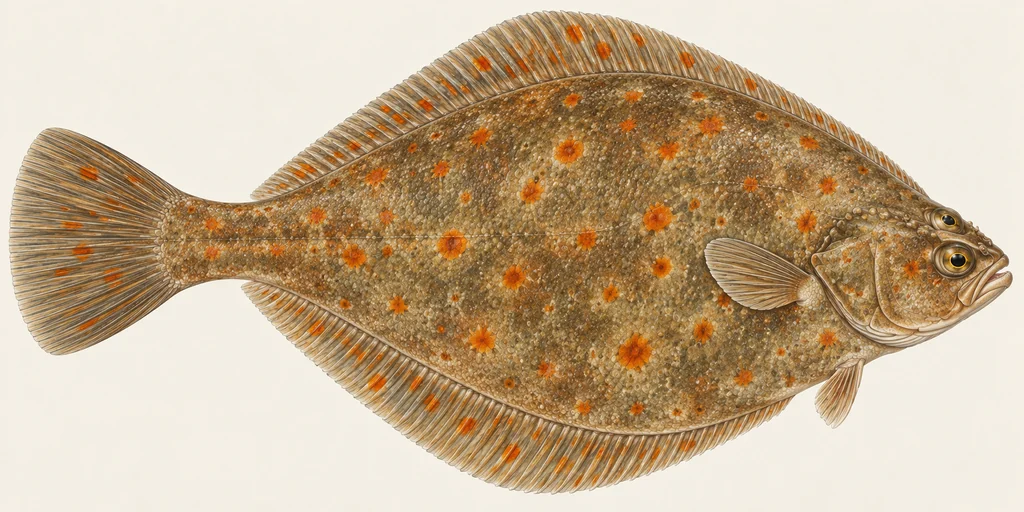
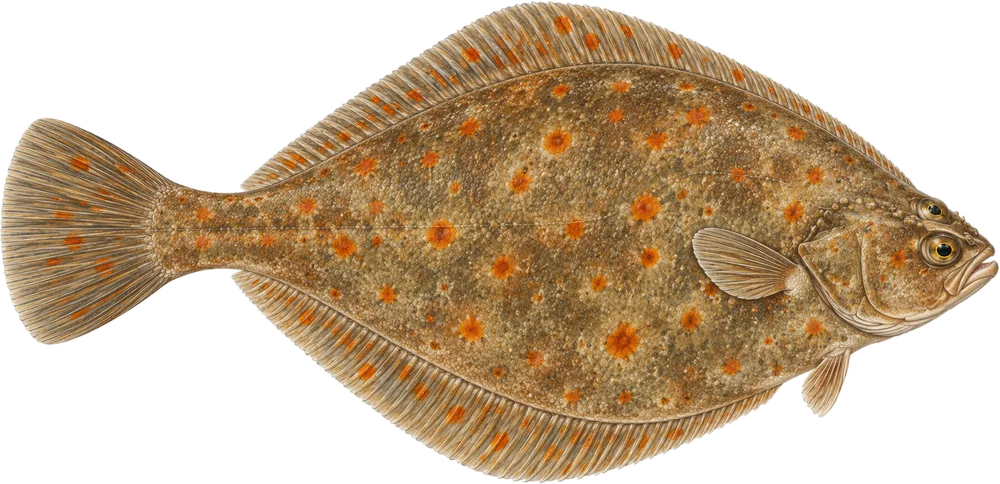
The plaice (Pleuronectes platessa), also called Goldbutt, is the best-known flatfish in Europe. It lives on sand and mud in the North Sea, Skagerrak, Kattegat and the western Baltic Sea. You recognise it by the red spots and the skin that is smooth all round.
In short: You catch the plaice best from May to September, above all in the evening and at night. Good spots on the coast: sandy ground and deep water. Proven baits: lugworm and ragworm; from a boat also the flatfish spoon (Buttlöffel) with a worm hook. Step by step: plaice fishing.
- Red to orange spots on the brown to greenish-brown eyed side
- Smooth skin with small scales and a row of bony bumps on the head behind the eyes
- Both eyes lie on the right side of the body
Catch chances through the year
- Hardly any chance
- Possible
- Good
- Peak season
- Spawning (observe the closed season)
Editorial assessment for waters in Germany, not a measured value and no guarantee. Spawning time is not the same as the legal closed season.
Species profile and sources in the catch calendarAll species compared month by monthThe rules of your federal state
How to recognise it
The plaice is a right-eyed flatfish with an oval, flat body. The larvae first swim upright like any other fish. At a length of about ten millimetres the left eye migrates to the right side, and the fish lies down on the bottom on its left side.
The eyed side is brown to greenish-brown with pale to dark red or orange spots that extend onto the fins. On fish ready to spawn the spots are also edged in pale. The colouring adapts to the ground, so the spots are not always equally distinct. The blind side is white.
More reliable than the colour is the skin. The scales are so small that the plaice feels smooth in every direction, which makes it hard to grip when wet. A ridge of bony bumps runs from the eyes to the gills; behind the eyes there are four to seven, forming an arch. The lateral line runs almost straight and curves slightly only over the pectoral fin.
Most often you catch plaice of 20 to 40 centimetres; in the North Sea, according to Norwegian marine researchers, fish over 40 centimetres and half a kilo are rare. FishBase gives 100 centimetres, 7 kilograms and 50 years as the maximum values. Females grow faster than males and become considerably larger.
The plaice is confused with the flounder and the dab, partly because many anglers simply call all three Butt. The flounder is rough as sandpaper behind the head and along the lateral line. The dab is smooth in one direction only, and its lateral line makes an arch directly behind the head. If the fish is smooth all round and has bumps on the head, it is a plaice.
Plaice and flounder occasionally interbreed, so if in doubt check several features.
Side by side
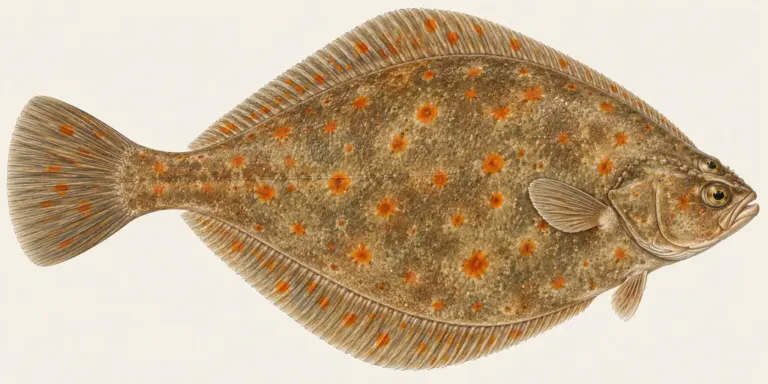
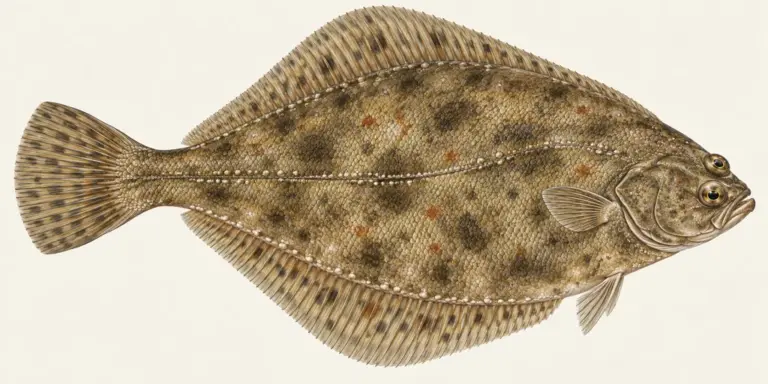
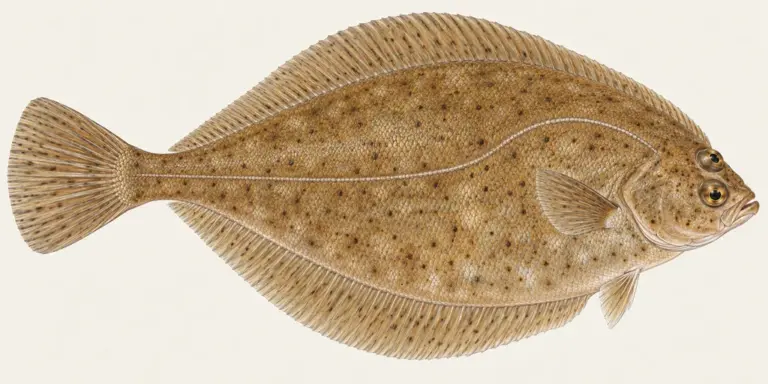
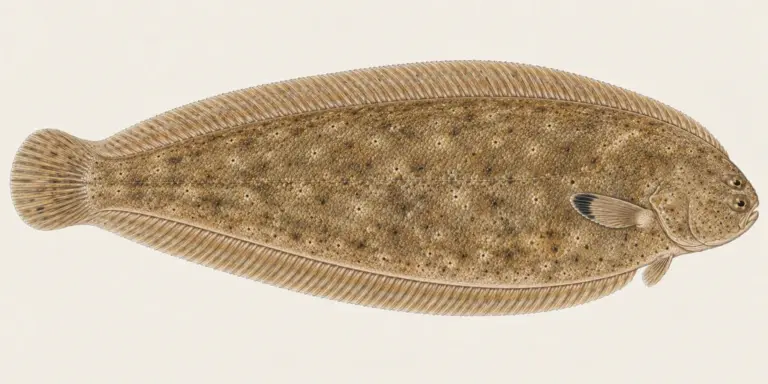
AI-generated illustrations.
Where it lives
The plaice lives in the north-east Atlantic from the White Sea to the Iberian Peninsula. The main areas are the North Sea, Skagerrak and Kattegat. In the Baltic Sea, according to the Thünen Institute, it reaches roughly to a line from Gotland to Gdańsk, according to Danish fisheries biologists to around Bornholm.
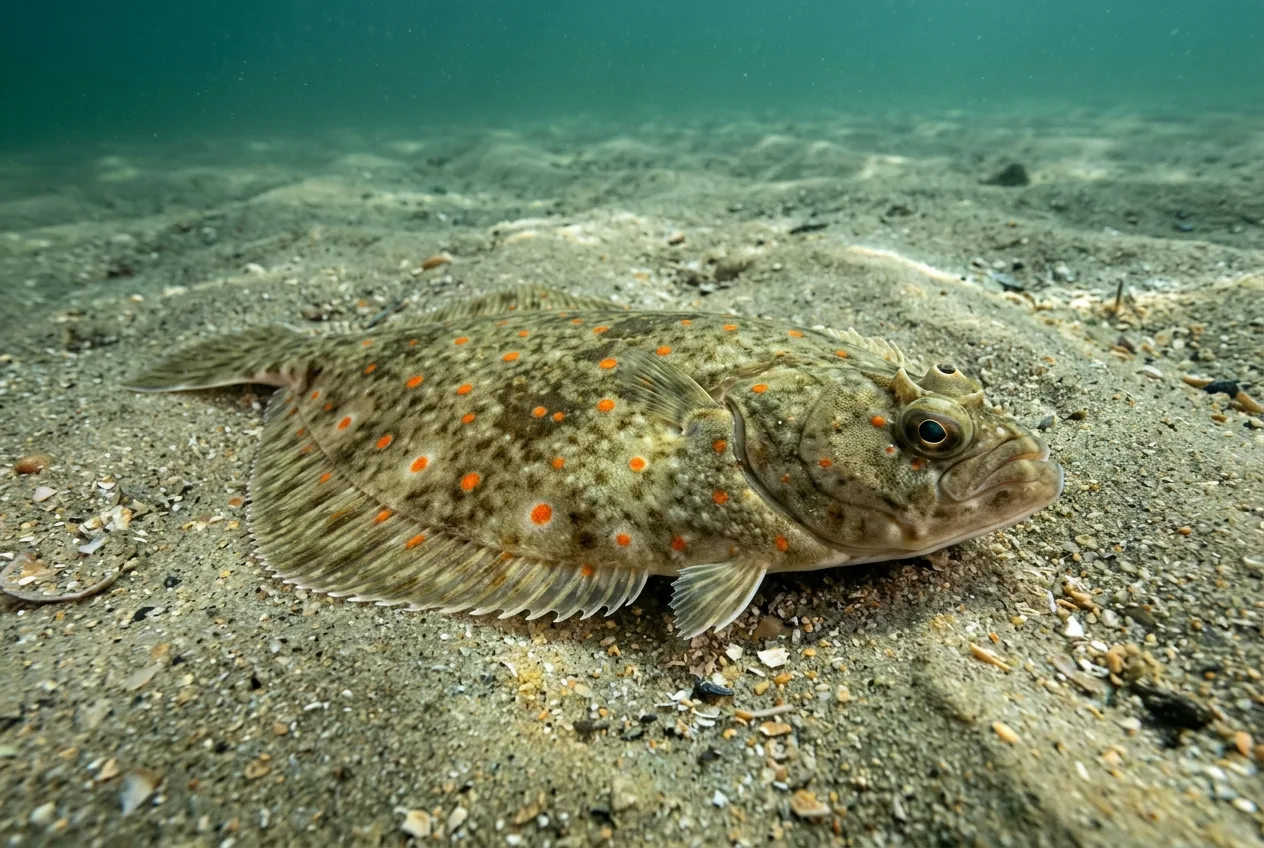
It lies on sand, mud or mixed ground, from shallow water to about 200 metres. Most adult fish stand at 10 to 40 metres. The older the fish, the deeper their spot, while you often find small plaice on bathing beaches.
The plaice needs more salt than the flounder. It does go into slightly brackish water, but avoids freshened river mouths and the northern Baltic Sea. There you catch flounders. In the German Baltic Sea too, flounders clearly outnumber them; plaice tend to stay in the western Baltic and the Kattegat, above all in deep areas.
Holding spots in the picture
Choose the season and time of day: the picture shows where the species stands then. Spots outlined in red apply only in the chosen season. Tap a fish or a spot in the list to bring it closer. The picture is schematic and AI-generated, every water is different.
Catch chance in springpossibleSpawning season, observe closed seasons
Catch chance in summerPeak season
Catch chance in autumngood
Catch chances in winterpossiblespawning season, observe the closed seasons
- J
- F
- M
- A
- M
- J
- J
- A
- S
- O
- N
- D
Spawning season
Not a prime time Plaice mostly feed at night and often rest buried in the sand during the day. In the western Baltic, however, they are now also caught in broad daylight in very shallow water.
Not a prime time Plaice mostly feed at night and often rest buried in the sand during the day. In the western Baltic, however, they are now also caught in broad daylight in very shallow water.
Active time Plaice mostly feed at night and often rest buried in the sand during the day. In the western Baltic, however, they are now also caught in broad daylight in very shallow water.
Active time Plaice mostly feed at night and often rest buried in the sand during the day. In the western Baltic, however, they are now also caught in broad daylight in very shallow water.
On the coast
Surf close to the shore
Plaice are only found here in summer.
Sandy bottom
Plaice are only found here in spring, summer and autumn.
Deep, colder water
Plaice are found here all year round.
The plaice lives on the bottom over sand and silt and buries itself for camouflage. Larger fish sit in medium-deep to deep water, on banks of sand and silt off the coast. In the Baltic Sea it occurs mainly in the west and above all in deep areas.
Spring: catch chances according to the catch calendar possible in March and April, peak season in May. Spawning falls in this period, so observe the closed seasons (Schonzeit). The season begins in May. The biggest fish are caught from May to July.
Summer: catch chances according to the catch calendar: peak season. Smaller plaice also stay in the shallow beach zone. At night plaice are active in very shallow water. In the western Baltic, larger plaice now also come in to a depth of one and a half metres, even during the day; in a diary study almost half of the plaice came from the shore.
Autumn: catch chances according to the catch calendar: peak season in September, good in October and November.
Winter: catch chances according to the catch calendar: possible. Spawning falls in this period, so observe the closed seasons (Schonzeit). In the winter half-year the plaice move into deeper water and can only be reached from a boat. Spawning takes place in the winter months.
Depth: Plaice live down to 200 metres, usually at 10 to 50 metres. The older the fish, the deeper they sit.
Size comparison: AI-generated drawing, schematic.
How it hunts and spawns
By day the plaice lies half buried in the sand, at night it goes foraging. It hunts by sight. On the menu are thin-shelled mussels and bristle worms, plus crabs; large fish also eat starfish and small fish. In spring many plaice move into shallower water, in autumn back out into deeper water.
Spawning takes place in winter at about 6 °C at 20 to 40 metres. In the North Sea the spawning season is January to April, in the Baltic Sea from November to March. Depending on size, a female lays up to 500,000 eggs. They drift freely in the water and need a minimum salinity that the eastern Baltic does not reach. After 10 to 20 days the larvae hatch and drift to the nursery areas on the coast.
Males mature after two to four years, females after three to five. Some stocks migrate far to spawn, others stay faithful to a site.
When it bites
The season runs from May to September, and the biggest plaice bite from May to July. In the winter half-year the fish stand deeper and can only be reached from a boat.
Overcast, windy weather and darkness are considered favourable, while in glaring sun catches are usually modest. In calm seas and clear water, catches usually come only in the evening and at night or in deeper water from a boat, in stirred-up water often all day. From a charter cutter you fish over sandbanks with sand eels best on the flood tide. In the western Baltic, however, Blinker now reports plaice in a metre and a half of water, often in broad daylight and sunshine.
Today’s catch index needs JavaScript. Season and spawning time are in the catch calendar.
You will find the monthly overview of all species and the water temperature check in the catch calendar.
What to catch it with
Step by step: Plaice fishing: best months, lugworm rig & tackle – season, spots, bait, tackle and rules on one page.
You usually catch larger plaice from a boat or charter cutter, over banks of sand and mud with 10 to 20 metres of water above your back. In the western Baltic many plaice are now also caught from the beach when surf fishing: in a diary study by the Thünen Institute almost half of the plaice came from the shore, and Blinker reports beach fish of over 50 centimetres. Per fishing day, however, the boat usually brings more. If you do not know the spots, you drift slowly and draw baited rigs across the bottom. When a fish bites, you can anchor and search the spot more thoroughly. Plaice stand in groups, and a flatfish rarely comes alone.
A running-weight rig with a long trace is proven. The weight runs on a boom stopped by a bead and a swivel, and the trace hangs from the swivel. It should be at least a metre long, better two to three metres. One or two attractor beads or a small spinner blade belong in front of the hook. Alternatively you fish a paternoster with two baited side arms, because often a second fish takes along at once.
Lugworm and ragworm serve as bait, as well as mussel meat and small shrimps and sand eels. They go on a long-shanked flatfish hook. Sizes 4 to 2 are usual, but larger hooks spare the fish: in the Thünen study, size 2/0 hooks caught no fewer flatfish but were swallowed deep less often. The institute advises a gape of more than 13 millimetres. The mouth is small, so split large worms and keep baits compact. If you fish from a boat with the flatfish spoon (Buttlöffel), use a spinning rod and a trace about 30 centimetres long with a single hook.
If you feel a tremble or a jerk, give a little line briefly and then take up contact again. You should not wait long, otherwise the plaice sucks the bait in deep. Blinker and the Thünen Institute advise following bites attentively and striking or winding in promptly once the pull becomes steady. A finger on the line helps you feel even tentative plucks. The plaice is often hooked only in the lip. So have a landing net ready; more on landing under landing and unhooking fish.
Choose a long trace: A trace of two to three metres still tempts by day when the plaice lie sluggishly in the sand.
Keep the bait moving: Flatfish hunt by sight. A bait that is slowly plucked across the bottom or shifted by the current catches more than one that lies fixed.
Stay at the spot: Plaice move in groups. Where one has bitten, there are usually more.
Suitable lures
Lugworm and ragworm; from a boat also the flatfish spoon (Buttlöffel) with a worm hook.
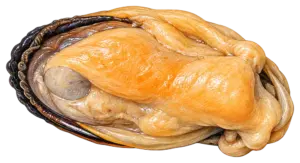
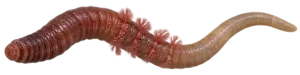
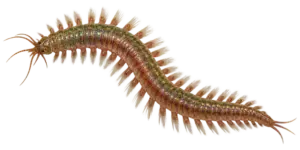
AI-generated illustrations. A click opens the lure’s page.
Rigs for these lures: surf rig.
What the plaice tastes like and what you can do with it
The plaice is one of the best-known food fish in Germany. Its flesh is white, firm and tasty. In the shops you can also get it frozen, smoked or as a fillet.
Beforehand the fish must be stunned and killed. How to gut, fillet and smoke it is covered in the encyclopaedia.
What you need to observe
Closed seasons, minimum sizes and harvest slots are set by the federal states (Bundesländer) and by the fisheries authorities of the neighbouring countries on the coast (Denmark, Norway, Poland). They vary by type of water, stretch of coast and time of year. We only give figures together with the date and source; the fisheries regulation of your federal state and your fishing permit (Erlaubnisschein) are always what is binding. You will find a list of links to the official sources in the catch calendar.
A fish of legal size that you want to keep you stun and kill at once, in line with animal welfare rules. Protected, undersized fish or fish too large under a harvest slot you unhook, if possible still in the water and with wet hands, and release gently. What exactly applies is regulated by state law and your fishing permit (Erlaubnisschein).
For the Baltic Sea the catch rules for sea anglers change from year to year, so check them before every trip for your coastal state. According to the Thünen Institute, the IUCN rates the plaice as not threatened in Europe and worldwide. According to the Danish fisheries biologists, the biomass of both stocks is at record level (as of 2024), but the fish are currently growing more poorly, and locally the stock may decline.
What closed season, minimum size and harvest slot mean and where to find them is explained on the page Closed season and minimum size explained.
What state law prescribes for the closed season and minimum size of this species is given in the box “At a glance” on the state pages for Lower Saxony and Schleswig-Holstein. For the other states our overview does not list this species; there the state fisheries regulation is what counts.
Frequently asked questions (FAQ)
How do I recognise a plaice when the spots are hardly visible?
The colouring adapts to the ground. Rely on the skin: it is smooth in all directions, and a ridge of bony bumps runs from the eyes to the gills.
How long should the long trace be?
At least a metre, better two to three metres.
Why do I catch more flounders in the Baltic Sea?
The plaice needs more salt than the flounder. In the German Baltic Sea flounders therefore predominate, while plaice stand more in the western Baltic and the Kattegat, there mainly in deeper water.
Sources
The rating of catch chances is an editorial assessment. The facts come from these sources, and the text is worded in our own words. The illustration is an original design by Angel Momente in the style of a natural history plate (AI-generated, see the AI notice).
- Thünen-Institut, Fischbestände online: Scholle
- FishBase: Pleuronectes platessa
- Havforskningsinstituttet: Rødspette (Laichzeit, Laichgebiet, Wanderung)
- DTU Aqua, Fiskepleje.dk: Rødspætte (Laichzeit nach Seegebiet, Laichtiefe)
- Havs- och vattenmyndigheten: Rödspätta (Laichzeit, Laichtiefe)
- Blinker: Steckbrief Scholle
- Blinker: Plattfische unterscheiden, Flunder, Kliesche und Scholle
- Blinker: Plattfischangeln, 10 Tipps
- Blinker extra: Die Fische der Ostsee und wie man sie beangelt (Stand 2007)
- Thünen-Institut: Working Paper 262, Selektivität und Überlebensraten nach dem Zurücksetzen in der Angelfischerei auf Plattfische (Hakengröße, schneller Anhieb, Uferanteil der Fänge)
- Blinker: Plattfische angeln mit Wurm vom Ufer (Schollen und Klieschen am Strand)
- Blinker: Plattfisch in der Ostsee, Angeln mit leichtem Gerät (Bisserkennung, nicht zu lange warten)
- Blinker: Das Schollenwunder in der Ostsee (Schollen im Flachwasser und am hellen Tag)
- Wikipedia: Scholle (Fisch)
Created with AI support from the sources listed. Figures only appear in the text if a source gives them. Last updated: 23 November 2026. Found a mistake? Write to us. Who is behind this site: About me.
More in the lexicon
- All fish species at a glance
- Catch calendar – month, water temperature and profile for 93 species
- Line calculator – breaking strain after the knot, drag guideline, backing
- Angling methods