

Knowledge · Rigs & setups
Surf rig
The surf rig is the standard rig for fishing from the beach: a heavy weight lies at the end, plus one or two hook snoods, as the side arms with the hooks are called. The rig has to survive a long cast and still offer the worm freely on the bottom. Here you will find the build, measurements from specialist sources and the most common mistakes.
What you need
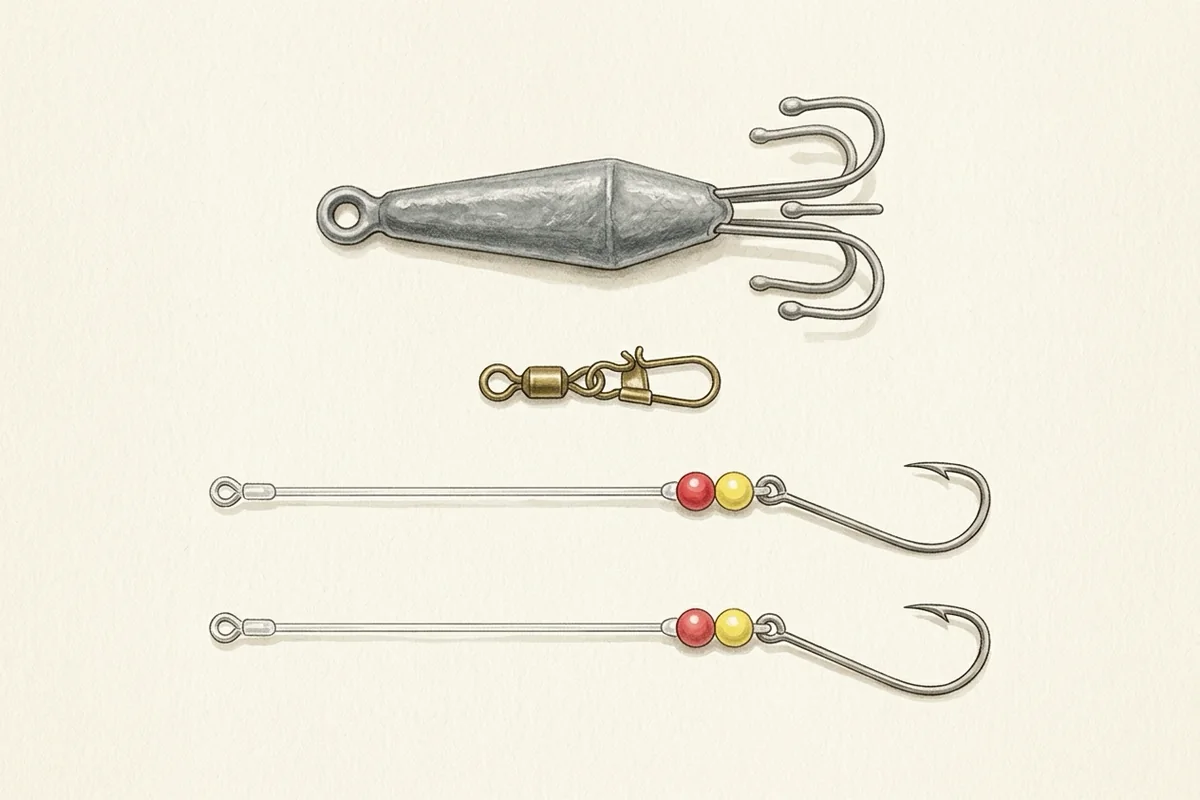
- monofilament for the main part of the rig: Blinker gives 0,60 to 0,80 millimetre, in another article mostly 0,70
- hook snoods of 0,35 to 0,40 millimetre monofilament
- two hooks, small swivels and attractor beads
- a snap swivel to clip the weight into
- a grip lead, 125 to 200 grams according to Blinker
- a shock leader in front of the thinner main line
According to Blinker, the main baits in the surf are lugworm and ragworm, optionally also herring strips or prawns (Crustaceans and mussels). One Blinker author threads the worms onto a baiting needle; only that way, he says, does the worm survive the powerful cast.
On the shock leader: In power casts, forces arise that, according to Blinker, would snap a thin main line; a shock leader absorbs them. For the sea the magazine names monofilament up to 0,70 millimetre. A tapered line that narrows conically (say from 0,58 to 0,33 millimetre) replaces both without a knot. If you cast with braided main line, you can also use braid of 0,25 to 0,30 millimetre as the shock leader, according to Rute & Rolle; it slides through the rings better than thick monofilament. Length, rod and reel are covered under Surf rod, and the Shock leader knot shows the connection.
Build in six steps
The flatfish rig described by Blinker has two hooks: the upper snood sits just in front of the weight, and the lower one runs behind it as a long trailing snood. This is how you go about it:
- Knot a swivel to the top end of the rig line. The shock leader will be tied on here later. Overview of knots: Knots.
- Fit the upper hook snood. You can tie it on with a simple dropper knot (Dropper loop) or with a swivel, which according to Blinker makes the arm more mobile.
- Check the spacing. The two hook snoods must not be able to tangle in each other; Blinker solves this with the right spacing.
- Fit a snap swivel for the weight and the lower snood as a trailing snood.
- Thread on beads, tie on hooks. More on size and colour in the next section.
- Secure the hooks for the cast. With systems that have clips, you clip the baited hooks in before the cast.
Lengths, hooks and beads
For the flatfish rig Blinker gives usual measurements: about 100 centimetres overall length, the lower snood 40 and the upper 25 centimetres. Wind and waves shift that. In light wind and little swell the snood may be up to 70 centimetres long, according to Blinker. In strong wind and waves you shorten it to 10 or 20 centimetres, because flatfish are reluctant to chase a bait that wags wildly.
For hooks, the counting from the angling exam (Fischerprüfung) applies: from size 20 to 1 the hook gets smaller as the number rises, from 1/0 it gets bigger as the number before the zero rises (Gerätekunde des Fischereivereins Löningen). For a single worm Blinker counts on size 4 to 1, for two worms about 1/0 to 4/0. The DAFV report lists hooks of size 4 to 1/0; depending on the source and the number of worms the range therefore runs from 4 to 4/0. In a second article the magazine expressly recommends small-bend Aberdeen hooks with a long shank in size 2 to 4: an average flounder has a mouth barely bigger than that of a medium bream, a dab barely bigger than a large roach. The baits should be correspondingly small. The biggest worms in the pack are not the best, and ragworms that are too big should be divided.
According to Blinker, beads should be buoyant and glowing. The flatfish rig carries small coloured or self-luminous beads of about 6 millimetres. One to three sit above the hook; a few small ones are better than many big ones, and so is a small spinner blade. As colours a Blinker author names red, yellow and mother-of-pearl, expressly from his own point of view.
Three types of rig compared
Blinker presents several flatfish rigs, three of which belong on the beach. The magazine also advises keeping a few of each of the usual systems, such as the trailing, running and grip-lead rigs, in the rig wallet.
| Design | Hooks | Measurements | Special feature |
|---|---|---|---|
| Standard | two, size 4 to 1 | 100 cm; hook snoods 25 and 40 cm | upper snood in front of the weight, lower behind it |
| Long cast | one, for example 1/0 offset | 70 cm; hook snood 50 cm | hook in the clip, casts over 100 m |
| Double hook, short | two, size 4 to 1 | short hook snoods of 0,30 mm | two wire-arm spacers against tangling |
Clips and casting distance
A bait that flutters in flight slows the weight. Sea Angler writes that rigs with a bait clip fly further than those without; fixed close behind the weight, the bait disturbs it least. On the long-distance rig the hook with the worm sits in the clip and, according to Blinker, releases again on hitting the water. An impact shield, a small aerodynamic shield above the weight, takes the lower hook and improves flight. For a heavy feeder rod on the beach, Fisch & Fang describes a half-metre rig with just one hook, a buoyant bead, a clip-on link and a 100 gram pear lead. According to Blinker, beginners start with simple clip rigs.
The weight
Blinker advises always having a few grip leads with you, because only they hold the rig in place in heavy surf; the magazine gives 125 to 200 grams as the weight. The wire arms do collect weed, however. In light wind, according to Blinker, plain leads from carp fishing also come into question. Against a headwind, Sea Angler says heavier leads of six and seven ounces (around 170 and 200 grams) help: they sink faster and sit better. In weak current you can go lighter. The DAFV reports leads of 100 to 125 grams that could still drift there, and hooks of size 4 to 1/0, partly in front of and partly behind the weight. Blinker too advises doing without the grip lead whenever conditions allow: a bait that is inched slowly across the bottom or drifts with the current catches more fish, it says, than one firmly anchored. You can compare weights and shapes under Fishing weights.
Lead and the law: The EU has adopted the restriction on lead in fishing tackle with Regulation (EU) 2026/2501, which applies from 3 December 2026 (as of November 2026). It governs sales, not recreational angling. Weights and lures containing lead up to 50 grams may no longer be sold from 3 December 2029, heavier ones up to 1 kilogram from 3 December 2031, and lead wire and drop-off leads from as early as 3 June 2027. What applies at the water is set by the water rules and the fishing permit (Erlaubnisschein).
Where the rig should go
Far is not always right. Blinker describes an evening when cod were hunting in the first weed channel, less than 30 metres from the shore, while the rigs lay far out. For the troughs between the beach and the first sandbank the DAFV advises: the fish feed right up front. How to read bank and channel is covered under Surf fishing, the gear under Sea rod. Target fish are flounder, plaice and dab.
Common mistakes
- Cast without a shock leader: The thin main line can snap in a power cast.
- Hook snoods set too close together: They tangle in each other.
- Hook snood too long in strong wind: The bait wags in the swell, and flatfish are reluctant to follow it, according to Blinker.
- Hook and bait too big: A flatfish’s mouth is small, and the result is missed bites.
- Worm put on without a needle: It survives the cast less well.
- Too much tackle on the long-distance rig: For reasons of aerodynamics, Blinker does without excessive decoration in front of the hook there.
- Always fishing with a grip lead: An anchored bait catches less than a drifting one, according to Blinker.
Frequently asked questions
How long should the hook snoods be?
It depends on the weather. In light wind Blinker gives up to 70 centimetres, in strong wind and waves 10 to 20 centimetres. The standard for the flatfish rig is 25 and 40 centimetres.
Which hook size suits the surf rig?
For flatfish it stays small: size 4 to 1 for one worm, 1/0 to 4/0 for two, and in another Blinker article Aberdeen hooks of size 2 to 4.
Do I always need a grip lead?
No. It holds the rig in place in heavy surf, but it collects weed. Blinker advises doing without it when conditions allow, because a drifting bait catches more flatfish.
How many hooks may I fish on the surf rig?
The state decides. In the coastal waters of Mecklenburg-Western Pomerania, up to two baits with up to three hooks each have been permitted per hand-held rod since the end of September 2026. For other coasts the state fisheries regulation (Landesfischereiverordnung) and the fishing permit (Erlaubnisschein) apply.
Related
- Surf fishing: reading sandbank and channel, casting far, setting the rod in a tripod
- Sea rod: length and casting weight of the surf rod
- Surf rod: action, reel and shock leader in detail
- Shock leader knot: joining thin main line to thick shock leader
- Side-arm rig: the basic principle with a single arm
- Lugworm: the most important bait on the surf rig
- Swivels, snaps and split rings: connectors on the rig
- Line calculator: breaking strain and diameter of main line and shock leader
Sources
- Blinker: Brandungsangeln, alles, was man über diese Angelmethode wissen muss (Vorfach- und Mundschnurstärke, Perlen, Clips, Impact Shield, Systeme, Blei, Schlagschnur, Köder, Platzwahl)
- Blinker: Plattfisch-Vorfach für jede Situation (Maße, Hakengrößen, Perlen, Weitwurf- und Doppelhaken-Vorfach)
- Blinker: Plattfischangeln, 10 Tipps für mehr Erfolg (Länge der Mundschnüre bei Wind, Hakengröße, Köder, Perlen, Verzicht auf Krallenblei)
- Blinker: Plattfische angeln, mit Wurm vom Ufer erfolgreich (Wattwurmnadel, Perlenfarben)
- Blinker: Ein paar Meter Sicherheit, was ist eigentlich eine Schlagschnur? (Zweck und Durchmesser)
- Rute & Rolle: Brandungsangeln, 10 Tipps für mehr Meter (geflochtene Schlagschnur)
- Fisch & Fang: Zitterübung in der Brandung (kurzes Vorfach mit Clip)
- Deutscher Angelfischerverband: Steinbutt, Flundern und Sonnenbrand (Hakengrößen, Bleigewichte, Wurfweite)
- Sea Angler: Beginner’s Guide to Cod Fishing From the Shore and Beach (Hakengrößen, Köderclip, Bleigewichte)
- Fischereiverein Löningen: Gerätekunde zur Fischerprüfung (Zählung der Hakengrößen)
- EUR-Lex: Verordnung (EU) 2026/2501 der Kommission vom 12. November 2026, Blei in bestimmtem Fischereigerät und Berichtigung vom 17. November 2026 (Stichtage, Verkauf statt Verwendung)
- DAFV: EU-Bleibeschränkung für Angelgeräte, aktueller Stand (Zustimmung im Ausschuss, Verkauf statt Verwendung, Stand 4. Mai 2026)
- Land Mecklenburg-Vorpommern: Fünfte Verordnung zur Änderung der Küstenfischereiverordnung, September 2026 (Zahl der Köder und Haken je Handangel)
Text AI-assisted, drawing AI-generated. Sources opened and checked in October 2026; no graphics taken from the sources.
All figures are guide values without guarantee. Follow the water rules (Gewässerordnung) and state law; the catch rules for the Baltic Sea and North Sea are set by the EU and the coastal states.