
Knowledge · Tackle
Fishing weights: Shapes and what they are good for
A fishing weight takes the bait down to depth, holds it in place and provides the weight for the cast. Which shape you choose depends on whether the line should run through the weight, how strongly the water pulls and how far the rig has to fly.
What the weight on the line is for
The tackle guide for the angling exam (Fischerprüfung) names three jobs: the weight balances the float, holds the bait at a particular spot and increases the casting weight. Balancing means weighting the float so that only its tip sticks out of the water.
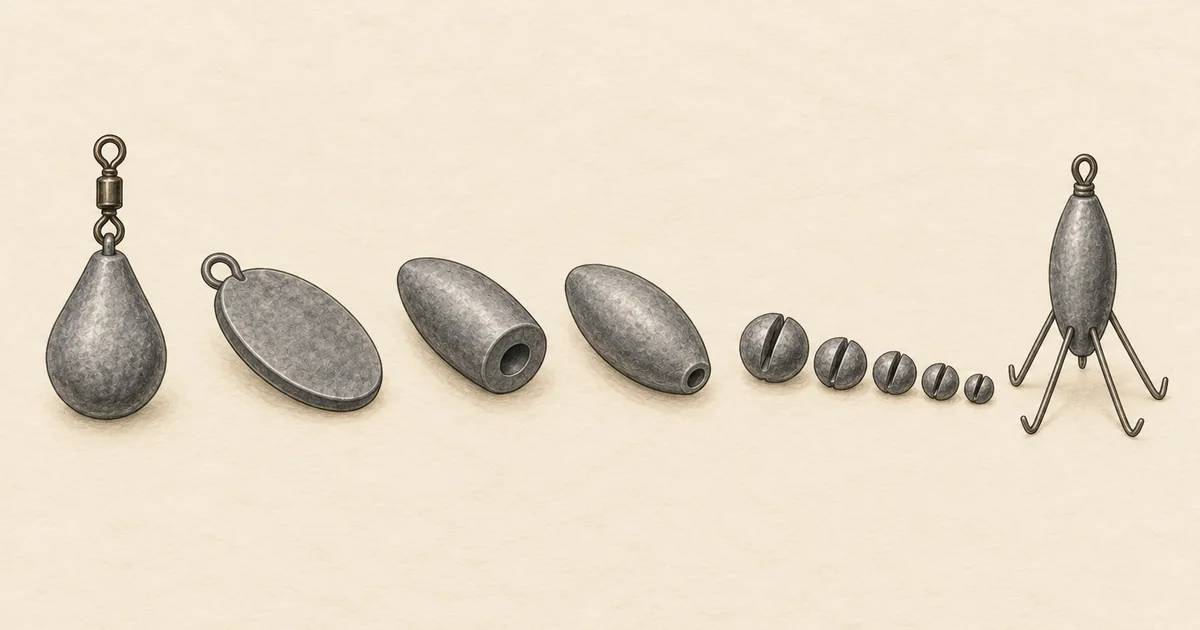
In bottom fishing, the first question is whether the weight runs or is fixed. A running weight slides on the main line. When an eel or a barbel takes the bait, the fish pulls line through the weight without moving its weight, and the bite reaches the rod tip. The fixed lead of the carp angler, by contrast, sits firmly, and together with the hair on the hook the fish hooks itself. You will find the set-up of both variants under the running bottom-lead rig and the hair rig.
With running weights, how the line is guided counts. If the weight sits on the line only through an eyelet or swivel, there is practically no friction. If the line runs through the whole body of the weight, as with a coffin lead, it rubs more, and bite indication suffers, especially when the weight lies in mud.
The shapes and how they are used
| Shape | Use | Special feature |
|---|---|---|
| Pear lead | casting lead for long casts | hangs from an eye |
| Coffin lead | running weight on the bottom, also in rivers | flat, lies still, more friction |
| Ball and olive leads | running weight, float with high buoyancy | round or oval, weight often stamped on |
| Teardrop lead | balancing the float, sliding float | with an eye or bore |
| Grip lead | Surf | wire arms hold it in place |
| Split shot | fine loading of the float | is clamped onto the line |
| Drop-shot weight | Drop-shot rig | stick or ball, hooklength clamped |
As a running weight for bottom fishing without a float, the examination catalogue from Saxony-Anhalt names ball and coffin leads. Casting leads are mostly pear-shaped, according to the training material. In carp fishing the rule is: an elongated lead flies far, a flat one with knobs flies worse but stays put better.
Current and surf
In a river a coffin lead holds the bait on the bottom and tightens the line to the rod tip, which makes eel bites in the current clearly visible. A round lead, on the other hand, can be shifted by the current. That is not always a disadvantage: for flatfish the advice is to let the bait wander quietly and to use the grip lead only when conditions demand it.
On the beach the grip lead belongs in every bag all the same. According to Blinker, only leads with wire arms hold the rig in place in heavy surf. In light wind, simple leads from carp fishing also work, picking up less weed than the wire arms. How the lead gets below the snoods is covered under the surf rig.
Weights for float and drop shot
For loading floats, the examination catalogue names shot and teardrop leads. Heavy floats with high buoyancy tend to get ball, olive or coffin leads, where the weight is usually stamped on. Light floats carry shot, wrap-on lead or a stick-shaped lead. Which shot sizes together make up your float’s buoyancy is worked out by Float loading.
Split shot is a slit little ball that is pressed onto the line with pliers. Good shot is so soft that it can be moved without damaging the line, and the slit sits in the middle. The tackle guide from Löningen points out that tightly clamped shot can become a breaking point.
On the drop-shot rig the lead sits at the end of the hooklength with the hook standing above it. The drop-shot weight is a stick or ball lead with a small swivel that clamps the end of the hooklength. If it snags, the lead slips off the hooklength. Because lure and lead are separate, the lead can be as heavy as depth and current demand.
The right weight
The rule of thumb is: as light as possible, as heavy as necessary. What weight that is, you have to try out at the water depending on the water, flow speed and casting distance. As guide values for bottom fishing, Rute & Rolle gives:
- still water: about 20 to 50 g
- slow-flowing rivers and canals: 50 to 80 g
- strong current: 100 g, sometimes 200 g
The same magazine advises taking a few grams more when in doubt, because a wandering rig settles in or picks up dirt. In surf, Blinker gives 125 to 200 g. Check beforehand that the total weight of lead, bait and rig falls within the casting weight range of your rod, for example a bottom rod. An overloaded rod can break on the cast.
Converting ounces: weights of lead are sometimes given in ounces, especially for carp leads. With 1 oz about 28,3 g, 3 oz is roughly 85 g. More values are given by the unit converter. All weights here are guide values; current and bottom change them from spot to spot.
Lead-free alternatives and rules
According to Commission Regulation (EU) 2026/2501, the European Chemicals Agency ECHA names brass, concrete, pebbles, steel, tin, zinc and tungsten among others, although brass and zinc can also harm the environment. For the size of a weight, density is what counts. Blinker gives 11,34 g/cm³ for lead, 7,87 g/cm³ for iron and 19,25 g/cm³ for tungsten. An iron weight of the same mass therefore turns out considerably larger, a tungsten one smaller but more expensive. Tin and steel are also less dense than lead, which can change casting distance and bait presentation.
On the bottom stones also work: in the stone rig an ordinary stone is held in a holder and releases after the bite. It stays in the water and does not pollute it.
On the legal situation, this is only a pointer, not legal advice (as of November 2026): the EU has restricted lead in fishing tackle with Regulation (EU) 2026/2501. It appeared in the Official Journal on 13 November 2026 and applies from 3 December 2026. After that, fishing tackle containing 1 per cent lead or more may no longer be sold, in three stages: lead wire and drop-off leads from 3 June 2027, leads and lures up to 50 grams from 3 December 2029, heavier ones up to 1 kilogram from 3 December 2031. A corrigendum of 17 November 2026 moved the first cut-off date from March to June. The regulation does not govern recreational angling with lead; individual countries may regulate use more strictly. What applies at your water is set out in the fishing permit (Erlaubnisschein).
Other designs
Grip lead in the river and on the canal
The wire arms are not only useful on the beach. For burbot in large rivers such as the Oder, Blinker names not only heavy pear leads but also grip leads of 100, 150 or even 200 g. If a lead drifts, the article says to go up one weight class until the rig stays put on the bottom. A report on flounder in the Kiel Canal likewise advises heavier leads or grip leads in strong wind and when large freighters pass. The ships pull hard on the water with strong suction, so you wind the rigs in a little beforehand to stop them tangling or breaking off.
Tyrolean stick (Tiroler Hölzl)
The Tyrolean stick (Tiroler Hölzl) is a green plastic tube with a lead core inside. According to Blinker you thread it directly onto the main line or hang it on an anti-tangle tube. The slim body slides over stones and rubble instead of wedging between them. Fisch & Fang describes the same for eel fishing along rock revetments in rivers. The equipment guide from Löningen counts the Hölzl among the leads with a buoyancy body, which keep the line out of a muddy bottom.
According to Blinker the range runs from 15 g to 60 or even 80 g; depending on water depth and current, the article recommends 15 to 60 g. It shows the Hölzl attached at the side on an anti-tangle boom ahead of a hooklength of about 60 cm with a dead baitfish. After the cast the rig sinks on a tight line. Then two turns of the reel handle alternate with a short pause, so that lead and bait bump over the bottom in stages and the rod tip shows the bite. How the baitfish sits on the hook is explained under the Baitfish rig.
The slim shape also works without lead. The eel angler in Fisch & Fang winds wire into a tight spiral and pushes a heavy nail into it. The whole thing hangs on a swivel that runs on the main line. Other materials and their density are compared on the page Lead-free weights.
Cheburashka for soft lures
The Cheburashka, or Chebu for short, is a ball of lead or tungsten with a removable wire clip. The hooklength goes into the eye on one side, and you hang the hook with the soft lure in the other. Blinker calls it a jig head with a joint. Because ball and hook are not cast in one piece, you can change the weight without re-threading the lure, and the soft plastic lasts longer as a result. When the ball hits the bottom, the lure tips over to the side.
A Blinker author concludes from his catches that the Chebu catches mainly on the drop on a slack line. When he could only retrieve steadily in the shallows, the perch mostly missed. Shapes and weights are compared under Jig heads, and the set-up is shown in the Jig head rig.
Split shot: shot string and tell-tale shot
For bream on the pole, Blinker describes one to three small tell-tale shot in sizes 8 to 11 that sit on the main line above the hooklength. Without a hooklength, the tell-tale shot goes about 30 cm above the hook and the string of the remaining shot at least 15 cm higher. The tell-tale shot is the lowest weight. An older Blinker article places it only a few centimetres from the bait on the bottom when fishing the waggler for bream. If the fish takes the bait and lifts the shot in the process, the float rises a little out of the water.
You can make up the shot for a long float at home. Blinker shows this with a float shotting tool, a small tube with a little basket that hangs suspended in the water:
- Fill a water butt or another sufficiently deep container with water.
- Clamp the shotting tool to the bottom of the float’s stem and put the float in the water.
- Put shot into the basket until the float sits almost right, and make up the rest with very small shot.
- At the water, thread the float onto the line and pinch the same shot onto the main line and hooklength. Then all you need to do is plumb the depth.
Shot without lead
According to Blinker, lead-free shot has been around since the end of the 1980s as a result of the British ban. The British regulation of 1986 prohibited the import and sale of lead fishing weights, shot included, but allowed weights up to 0,06 g and above 28,35 g. The same 0,06 g limit is in the EU regulation: very small shot up to this weight may still be sold if it comes in leak-proof and child-resistant packaging. The Commission’s reasoning is that for such tiny shot a substitute that is soft enough to pinch on and at the same time heavy enough is hard to find. The exemption will be reviewed on the basis of an ECHA report after 3 December 2036. Under the regulation, heavier shot counts among the leads to which the cut-off dates in the legal paragraph under “Lead-free alternatives and rules” apply. Lead-free materials are explained on the page Lead-free weights, the background on birds and waters on Lead in angling.
Common mistakes
- Running weight in mud. The lead sinks in and the line no longer runs freely. Rute & Rolle then recommends a lead with an eye on a short, bent tube with a snap. The tackle guide also names leads with a buoyancy body that keep the line out of the mud.
- Grip lead out of habit. If conditions allow, a round lead is the better choice for flatfish. A bait that wanders slowly over the bottom catches more there than a firmly anchored one.
- Split shot squeezed too hard. Hard crimping leaves pressure marks that weaken the line. Use soft shot and squeeze only hard enough for it to hold.
- Swapping lead-free by size. An iron weight of the same size weighs less than lead, and the float is then no longer balanced. Go by the stated number of grams.
Frequently asked questions
Which weight should I take to a lake to start with?
A ball or coffin lead as a running lead. Rute & Rolle gives about 20 to 50 g for still water. If you want to see bites more clearly, take a shape with an eye.
May I still fish with lead?
Yes. EU Regulation 2026/2501 governs the sale of lead, not recreational angling with it; its sales bans take effect in stages from June 2027 (as of November 2026). Water rules or national law can be stricter, though. You can find out the situation for your water from your club or association.
What is a plummet?
A bottom finder: with it you work out the water depth when float fishing. The tackle guide names plummets and snap leads for this. How to plumb is explained on the page Plummet.
What is a Tyrolean stick (Tiroler Hölzl)?
A bottom lead for stony rivers: a green plastic tube with a lead core that slides over rubble instead of getting stuck. According to Blinker the range runs from 15 to 80 g; depending on depth and current, it recommends 15 to 60 g.
Related
- Running bottom-lead rig: lead, bead, swivel and hooklength in the right order
- Surf rig: paternoster with grip lead for the beach
- Drop-shot rig: setting the distance between hook and lead
- Float loading: list of shot to match the buoyancy
- Line calculator: working out the breaking strain after the knot
- Feeder: the weight that also feeds
- Bottom fishing: spots, baits and bite indication
- Lead-free weights: stone, iron, tungsten and bismuth compared
Sources
- Fischereiverein Löningen: Gerätekunde zur Fischerprüfung (PDF) (Aufgaben, Formen, Pose, Auftriebskörper, Lotblei) und Land Sachsen-Anhalt: Fragenkatalog Fischerprüfung (PDF) (Kugel- und Sargblei beim Grundangeln)
- Blinker: Grundangeln mit Laufblei, welche Bleiform ist die richtige? (Reibung, Festblei, Gewichtsregel) und Blinker: Methoden zum Aalangeln (Sargblei in der Strömung)
- Rute & Rolle: Grundangeln, so gelingt der Einstieg (Richtwerte, weicher Grund)
- Blinker: Brandungsangeln (Krallenblei, Gewicht) und Blinker: Plattfischangeln, 10 Tipps (rundes Blei)
- Blinker: Karpfenblei (Form, Unzen), Blinker: Angeln, alles Wichtige für deinen Einstieg (Posenbleie, Schrot, Wurfgewicht) und Blinker: Bleie im Vergleich (Druckstellen durch Schrot)
- Blinker: Drop-Shot, alles über die Montage (Dropshot-Blei)
- Blinker: Bleifrei angeln, wie funktioniert das? (Dichte, Steinmontage) und Blinker: Bleiverbot beim Angeln, das plant die EU (Ersatzstoffe)
- EUR-Lex: Verordnung (EU) 2026/2501 der Kommission vom 12. November 2026, Blei in bestimmtem Fischereigerät und Berichtigung vom 17. November 2026 (Verkauf, Freizeitangeln, Stichtage, Ersatzstoffe) und DAFV: EU-Bleibeschränkung für Angelgeräte (Stand 4. Mai 2026)
- Blinker: Tiroler Hölzl Montage, erfolgreich am Grund angeln (Aufbau, Gewichte, Führung) und Fisch & Fang: Einfach auf Aal am Fluss (schlanke Gewichte über Steinen, Nagel als Ersatz)
- Blinker: Jigköpfe, Formenvielfalt verständlich erklärt (Cheburashka als Jigkopf mit Gelenk) und Blinker: Cheburashka-Jig, Montage für Raubfische (Spange, Gewichtswechsel, Absinkphase)
- Blinker: Quappen im Winter, 5 Tipps (Krallenblei im Strom) und Blinker: Plattfischangeln im Nord-Ostsee-Kanal (Wind, Sog der Schiffe)
- Blinker: Brassen angeln, die Grundlagen (Anzeigebleie, Abstände), Blinker: Frühlings-Brassen und das sprechende Bleischrot (Anzeigeschrot am Waggler) und Blinker: Posen lassen sich schon zu Hause austarieren (Posenausloter)
- legislation.gov.uk: The Control of Pollution (Anglers’ Lead Weights) Regulations 1986 (englisch) (britisches Verbot, Grenzen 0,06 und 28,35 g) und EUR-Lex: Verordnung (EU) 2026/2501, Anhang Nummer 23 (Ausnahme für Schrot bis 0,06 g, Überprüfung)
Text AI-assisted, drawing AI-generated. Sources opened and checked in October and November 2026, no graphics taken from the sources.
All figures are guide values without guarantee. Which lead and which weight suit depends on the water, current, casting distance and the rules at your water.