
Knowledge · Tackle
Lead-free weights: Stone, iron, tungsten and bismuth
If you want to fish lead-free, you weight your rig with stone, iron, tungsten, bismuth or tin. The difference lies in the density: it determines how big a weight gets for the same number of grams and how much of it still presses down on the bottom under water.
Why lead is being replaced and what the EU has decided
Under EU chemicals law, lead is classified as very toxic to aquatic organisms and as toxic to reproduction; Commission Regulation (EU) 2026/2501 relies on this. Whatever breaks off while fishing or gets lost on the bank stays in the water. How much that amounts to, why dabbling ducks swallow small shot and how the anglers‘ association sees the situation is covered in detail under Lead in angling.
On the legal situation, this is only a pointer, not legal advice (as of November 2026): the EU is ending the sale of fishing weights and lures containing 1 per cent lead or more in stages. According to Blinker, a motion in the European Parliament to stop the plans failed to win a majority on 8 July 2026. The Commission adopted Regulation (EU) 2026/2501 on 12 November 2026; it appeared in the Official Journal on 13 November and applies from 3 December 2026. The official text sets these cut-off dates:
- from 3 June 2027: no more sales of lead wire and drop-off leads, i.e. weights intended to come off deliberately while fishing (called “Drop-Shot-Gewichte” in the German official text)
- from 3 December 2029: no more sales of weights and lures up to 50 grams
- from 3 December 2031: no more sales of weights and lures over 50 grams up to 1 kilogram, which includes heavy ledger and grip leads made of lead
The regulation does not harmonise recreational angling with lead; that remains a matter for the member states. Whether rules on lead already apply at your water is set out in the water rules and the fishing permit (Erlaubnisschein).
Density decides size and holding power
Density tells you how many grams one cubic centimetre of a substance weighs. The lower it is, the larger a weight of the same number of grams turns out. The values for the metals come from the periodic table of Spektrum der Wissenschaft; the value for stone applies to quartz according to the Lexikon der Geowissenschaften. Real pebbles differ from this, because the density of a rock depends on its composition and its pores.
| Material | Density in g/cm³ | Strength | Weakness |
|---|---|---|---|
| Tungsten | 19,26 | smaller than lead, hard, direct feedback | expensive, scarce raw material |
| Lead (comparison) | 11,34 | soft, can be pinched on | toxic, sales are to end |
| Bismuth | 9,80 | closest to lead, non-toxic according to Spektrum | brittle |
| Iron, steel | 7,87 (iron) | cheap, e.g. as a nail | rusts, around 1,4 times the volume |
| Tin | 7,29 | named by ECHA as a substitute | around 1,6 times the volume |
| Stone (quartz) | 2,65 | almost free, lies harmlessly on the bottom | a good 4 times the volume, little holding power under water |
The volume figures are relative to lead and calculated from the densities. According to Blinker, steel, tin, bismuth and brass are larger for the same weight, which can change casting distance and bait presentation. Tungsten, on the other hand, is more compact and harder, so the feedback when working the lure comes through more directly.
Worked example: stone instead of 60 grams of lead in a river
Under water, every body becomes lighter by the weight of the water it displaces. That is how Archimedes‘ principle is described in the lecture “Physik überall” at Heidelberg University. Water has a density of around 1,0 g/cm³. The calculation uses spheres; real weights have other shapes.
- Volume: mass divided by density. 60 g of lead take up 60 : 11,34 = 5,3 cm³, 60 g of quartz 60 : 2,65 = 22,6 cm³, so a good four times as much.
- Weight under water: mass minus displaced water. For the lead, 60 − 5,3 = 54,7 g remain; for the stone of the same weight only 60 − 22,6 = 37,4 g. So the stone presses down on the bottom about a third less.
- Same holding power: for the stone to bring 54,7 g down onto the bottom under water again, it needs 54,7 : (1 − 1 : 2,65) = around 88 g. It then measures around 33 cm³.
- Current: as a sphere, the lead is 21,6 mm in diameter, the 88 g stone around 40 mm. Its area facing the flow is therefore about 3,4 times as large. According to the same lecture, the flow resistance grows with this area, so the stone gets pushed harder (Fig. 1). In a strong current it needs even more weight or a flatter shape.
- Cross-check with iron: 60 g of iron bring 52,4 g down onto the bottom under water. Around 63 g of iron are enough to match the holding power of 60 g of lead.
Rule of thumb from the calculation: you can swap metals almost gram for gram. Tungsten, bismuth, iron and tin are at most around 6 per cent off lead in their weight under water. A pebble needs about one and a half times the weight for the same holding power, more in a current. These are calculated guide values for spheres, not measurements at the water. Before casting, check whether the heavier weight fits within the casting weight range of your ledger rod.
Designs by material
Stone: the stone rig
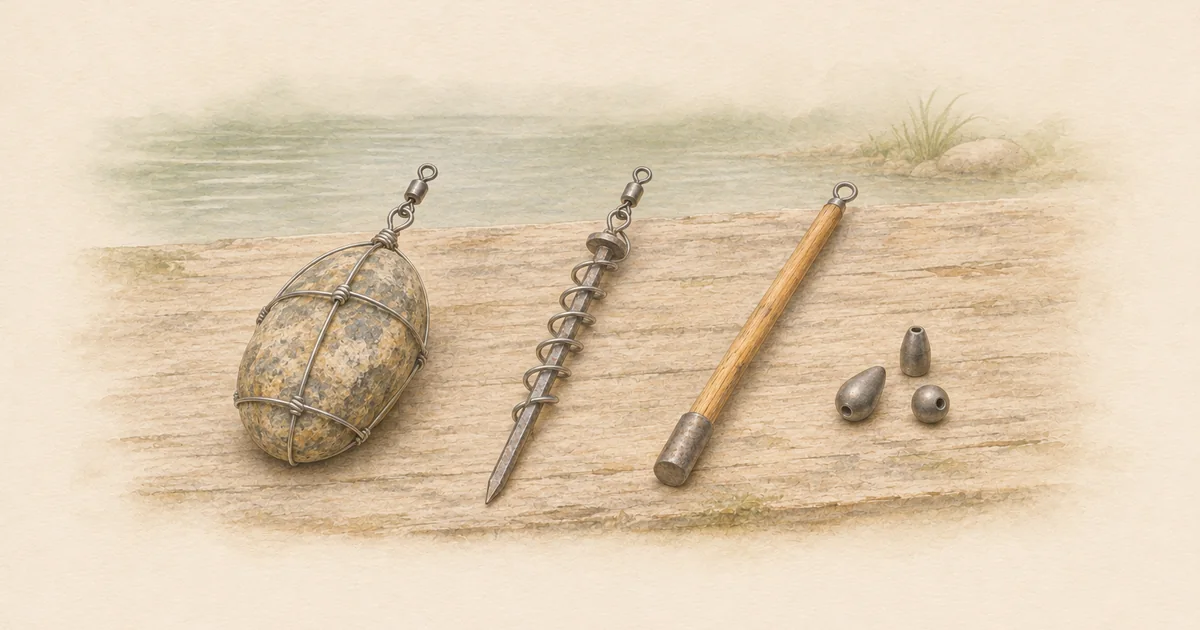
In the stone rig, an ordinary stone sits in a holder. It releases after the bite. According to Blinker, this lowers the risk of the fish getting off, and the stone left behind does not pollute the water. The stone rig therefore also replaces the drop-off lead, for which, according to the regulation, other techniques are a suitable substitute. Going by the worked example, choose a stone one size heavier.
Iron and steel: nails and stainless steel
An article in Fisch & Fang describes a home-made weight for eel fishing in a river: a large nail in a wire spiral, clipped into a swivel that slides on the main line. According to the article, slim weights of this kind slide over stones instead of getting stuck. According to Spektrum, bare iron becomes coated over time with a reddish layer of oxides, in other words rust. Steel is an alloy of iron with up to 2 per cent carbon; as ready-made weights, Blinker mentions ones made of stainless steel.
Tungsten: small and hard
Tungsten (Wolfram in German) is the only one of the common substitutes that is denser than lead. It is found in jig heads, in bead heads for fast-sinking nymphs and, according to Rute & Rolle, as dumbbell eyes on heavy streamers. For the trout lake, Blinker describes small tungsten weights that are held on the hooklength by two pieces of silicone tubing and do not damage the line the way pinched-on shot does.
Carp anglers sometimes balance the bait on the hooklength with mouldable tungsten putty. Where many crayfish live, Blinker advises against it, because the animals poke their claws into the soft putty and pull it off the hooklength; hard weights hold better there. Then there is the price: according to Blinker, tungsten is a scarce raw material in high demand and considerably more expensive than lead.
Bismuth, tin and split shot
Small shot is the most difficult case. The EU Commission admits that it is hard to find a substitute that is soft enough to pinch on and at the same time heavy enough for very small shot. Under the regulation, shot up to 0,06 grams may therefore still be made of lead if it is sold in leak-proof, child-resistant packaging. Bismuth comes closest to lead in density and, according to Spektrum, has prospects as a non-toxic substitute, but it is a brittle metal. Tin, at 7,29 g/cm³, is considerably lighter. So neither of the two is both heavy and easy to pinch on.
Lead-free shot is nothing new. In the United Kingdom, a 1986 regulation banned the import and supply of anglers‘ lead weights weighing more than 0,06 and no more than 28,35 grams from 1 January 1987. According to Blinker, lead-free shot has therefore been available since the late 1980s. After switching, re-balance your float. The yardstick remains the weight in grams that Float shotting works out for your float’s carrying capacity.
Grip leads and the Tyrolean stick
Neither shape holds by its weight alone. With a grip lead, wire arms keep the surf rig in place. Made from a lighter material, the body becomes larger and offers more surface to waves and current; going by the worked example, even more then depends on the arms. Under the EU regulation, grip leads made of lead over 50 grams may no longer be sold from 3 December 2031, lighter ones from as early as 3 December 2029.
The Tyrolean stick (Tiroler Hölzl) is a ledger weight with a buoyant body. The tackle course notes of the Fischereiverein Löningen list it alongside stand-up and Perfekt leads among the weights that do not pull the line into a muddy bottom. Rute & Rolle mentions it at the trout pond as an alternative to the bottom bouncer (Bodentaster), which stands upright on the bottom. Fisch & Fang highlights slim shapes such as the Tyrolean stick because they slide over stones.
Which substitute for what
- Small bait needs to sink fast: tungsten, as a jig head, bead head or weight on the hooklength. Size matters more than price here.
- Lots of snags on the bottom, e.g. on rip-rap: stone or a nail weight. A break-off costs almost nothing; an expensive tungsten weight would soon be gone there.
- Soft, muddy bottom: a design with a buoyant body such as the Tyrolean stick (Tiroler Hölzl). Make sure its weight is lead-free too.
- Shotting a float: lead-free shot or a tungsten weight with silicone tubing, then re-balance.
- Strong current: metal rather than stone. If you use stone, reckon on one and a half times the weight and more.
- Long casts: a compact shape made of dense metal, because according to Blinker large bodies change the casting distance.
Common mistakes
- Swapping stone gram for gram. Under water, 60 g of stone press only a good 37 g down onto the bottom, and the rig drifts. Reckon on around 88 g to match the holding power of 60 g of lead.
- Putting iron weights in the box wet. Bare iron becomes coated with rust. Let the weights dry after fishing before you close the box.
- Tungsten putty in water with crayfish. Crayfish pick the soft putty off the hooklength, and the bait no longer sits as planned.
- Pinching lead-free shot on like lead. According to the Commission, there is hardly any substitute for small shot that is as soft and as heavy as lead. When you first fit it, check whether the shot can still be moved without crushing the line. For fixed points on the hooklength there are tungsten weights with silicone tubing.
- Assuming brass or zinc is the clean solution. The European Chemicals Agency ECHA does list both as substitutes, but considers them harmful to the environment as well.
Frequently asked questions
What happens to my old leads?
The EU regulation restricts sales and leaves recreational use to the member states. Whether your club or your country already restricts lead at the water is set out in the water rules and the fishing permit (Erlaubnisschein). Where lead scraps belong is explained under Lead in angling.
How heavy does a stone need to be as a ledger weight?
About one and a half times as heavy for the same holding power as a lead weight: 60 g of lead becomes around 88 g of stone. In a current you need more, because the larger stone offers more surface. This is a calculated guide value for quartz; real stones vary.
Why are tiny lead shot still allowed?
In the EU Commission’s view, there is still no substitute for very small shot that is both soft and heavy. Retailers may therefore continue to sell shot up to 0,06 grams, but only in leak-proof and child-resistant packaging. The exemption will be reviewed on the basis of an ECHA report after 3 December 2036.
Is brass a good alternative?
According to the Commission, brass is the most common alternative to lead lures, but currently contains 1 to 3 per cent lead. Lures made of copper alloys may therefore contain up to just under 3 per cent lead. Even so, in ECHA’s assessment brass is not environmentally friendly.
Related
- Fishing weights: shapes from pear lead to drop-shot weight and how to use them
- Lead in angling: birds, deadlines, casting your own, health and disposal
- Jig heads: head shapes and weight by sink time
- Leadcore and safety clip: shedding the weight on a break-off
- Float shotting: weight to match the float’s carrying capacity
- Line calculator: check the line’s breaking strain before heavier stones fly
- Unit converter: converting weights in ounces to grams
- Nature conservation on the bank: consideration for birds and bankside plants
Sources
- EUR-Lex: Verordnung (EU) 2026/2501 der Kommission vom 12. November 2026, Blei in bestimmtem Fischereigerät und Berichtigung vom 17. November 2026 (Einstufung von Blei, Ersatzstoffe, Abwurfbleie, Schrot bis 0,06 g, Messing, Stichtage, Inkrafttreten, Freizeitangeln)
- Spektrum der Wissenschaft, Periodensystem: Blei, Wolfram, Bismut, Eisen, Zinn (Dichten, Bismut spröde und ungiftig, Rost, Stahl)
- Spektrum Akademischer Verlag, Lexikon der Geowissenschaften: Dichte und Gesteinsdichte (Quarz, Wasser, Schwankung bei Gestein)
- Universität Heidelberg, Institut für Theoretische Physik: Physik überall, Kapitel 6 Auftrieb und Schwimmen (PDF) (archimedisches Prinzip, Strömungswiderstand und Fläche)
- legislation.gov.uk: The Control of Pollution (Anglers‘ Lead Weights) Regulations 1986 (English) (Einfuhr- und Abgabeverbot ab 1. Januar 1987, Grenzen 0,06 und 28,35 g)
- Fischereiverein Löningen: Gerätekunde zur Fischerprüfung (PDF) (Bleie mit Auftriebskörper, Tiroler Hölzl)
- Blinker: Bleifrei angeln, wie funktioniert das? (Steinmontage, bleifreies Schrot seit den 1980ern) und Blinker: Bleiverbot beim Angeln, das plant die EU (Abstimmung im Parlament, Wolfram, Größe der Ersatzstoffe, Preis)
- Blinker: Bald angeln ohne Blei? (Edelstahl), Blinker: Frühling am Forellensee (Wolframgewicht mit Silikonschläuchen) und Blinker: Karpfenangeln, 10 Tipps gegen Krebse (Wolframpaste)
- Fisch & Fang: Einfach auf Aal am Fluss (Nagelgewicht, schlanke Gewichte, Tiroler Hölzl)
- Rute & Rolle: Forellenteich, die besten Montagen (Bodentaster und Tiroler Hölzl) und Rute & Rolle: Heavy Metal im Gebirgsbach (Wolfram an Streamern)
Text AI-assisted, drawings AI-generated. Sources opened and checked in November 2026, no graphics taken from the sources.
All information is for guidance only and without guarantee. The calculations apply to spherical shapes and average densities, and the legal position as of November 2026 is not legal advice; what applies on your water is governed by state law and the water rules.