
Knowledge · Nature & environment
Nature conservation on the bank
Nature conservation on the bank is about rules that apply alongside fisheries law. Reed beds are protected nationwide as a biotope, even far away from any protected area. In nature reserves, national parks and Natura 2000 sites, a separate regulation often sets out where and how you may fish. The states‘ map services and the regulation for the area show which rules apply on your bank.
Protected areas at a glance
The Federal Nature Conservation Act (Bundesnaturschutzgesetz, BNatSchG) only sets the framework; the details are in the regulation for the area. So fishing there is neither automatically banned nor automatically allowed.
- Nature reserve (Naturschutzgebiet, NSG): Prohibited, as specified in the regulation, is anything that can destroy, damage, alter or permanently disturb the area (§ 23 Abs. 2 BNatSchG). The Brandenburg regulation for the “Streganzsee-Dahme” NSG, for example, allows fishing, but only in areas agreed with the lower nature conservation authority (untere Naturschutzbehörde) and with fishing gear in which otters are as unlikely as possible to come to harm (§ 5 Abs. 1 of the regulation).
- National park: Here nature is meant to run its course as undisturbed as possible over most of the area (§ 24 BNatSchG). The Bundesamt für Naturschutz (BfN) counts fishing among the economic uses that are largely excluded there or allowed only under strict conditions (BfN).
- Natura 2000: The European network of FFH areas (Habitats Directive) and bird protection areas (§ 7 Abs. 1 Nr. 8 BNatSchG). Anything that can significantly impair such an area in terms of its conservation objectives is not permitted (§ 33 Abs. 1). What that means for angling is set by the states.
- Landscape protection area (Landschaftsschutzgebiet, LSG): Prohibited is anything that changes the character of the landscape or runs counter to the purpose of protection (§ 26 Abs. 2). According to the BfN, most LSGs hardly restrict use and access, but some are almost as strict as an NSG.
Whether you may fish in a nature reserve is set out in the regulation for that particular area, and the answers vary widely. Three examples show the range:
- Allowed with conditions: At the Streganzsee, in addition to the fishing areas and the otter-friendly fishing gear (see above), it is forbidden to enter the area away from the paths. Watercraft of any kind are prohibited outside the navigable state waters (§ 4 Abs. 2 of the regulation).
- Only at certain spots: In the Vorpommersche Boddenlandschaft National Park you may only fish from land at designated beaches; elsewhere it is prohibited on the shore and in the shallow water in front of it (Nationalparkamt Vorpommern).
- Prohibited: In the core zone of the same national park, fishing by anglers is prohibited in principle (Nationalparkamt, same page). Fishing is also banned in the coastal waters of Jasmund National Park between Sassnitz and Lohme (LALLF Mecklenburg-Vorpommern).
If the regulation says nothing about fishing, don’t assume it is allowed; ask the lower nature conservation authority (untere Naturschutzbehörde) before your first session. How to find the regulation is explained below in the section on the map services.
In Saxony-Anhalt, for example, fishing remains allowed in FFH and bird protection areas as long as it does not run counter to the purpose of protection. You may neither walk into nor boat into reed beds; floating-leaf beds, silting-up zones and shallow-water zones are off limits to boats, and noise, for example from music players, is prohibited. In bird protection areas, fishing also stops within 50 metres of visible flocks of ducks, geese or waders (§ 11 of the state Natura 2000 regulation, according to the Landesverwaltungsamt).
| Type of area | What usually applies | Where to look it up |
|---|---|---|
| Nature reserve | Fishing only as far as the regulation allows | NSG regulation, lower nature conservation authority |
| National park | Use heavily restricted, boat rules per lake | National park regulation, national park office |
| FFH and bird protection area | no significant impairment, details per state | State or area regulation, state map service |
| Landscape protection area | usually few restrictions | LSG regulation |
| Reed beds as a biotope | protected everywhere, even outside protected areas | § 30 BNatSchG, state nature conservation act |
Reed beds are protected even outside protected areas
Reed beds are legally protected biotopes, as are natural banks with their vegetation and silting-up zones, i.e. shallow areas where a lake is slowly growing over. Anything that can destroy or significantly impair them is prohibited (§ 30 Abs. 2 Nr. 1 and 2 BNatSchG). Several states such as Bavaria, Lower Saxony and Thuringia deviate with their own rules (footnotes to § 30).
Reeds may not be cut back from 1 March to 30 September, and only in sections during the rest of the year. In the same period, trees outside woodland, hedges and bushes may not be cut, with the exception of gentle maintenance cuts (§ 39 Abs. 5 BNatSchG). The states may extend these periods. Cutting a gap for your own spot between March and September is therefore covered by the ban, and biotope protection applies all year round.
If spots become overgrown, that is a matter for the club and whoever manages the water. In Natura 2000 areas in Saxony-Anhalt, only gaps that already existed when the regulation came into force may be kept open. Cutting back for angling requires a stock management plan and notification at least two weeks in advance (Landesverwaltungsamt Sachsen-Anhalt).
Nursery for pike and great crested grebe
The Fischereiamt Berlin describes reeds and floating-leaved plants as important for the development of fish, because they find food, shelter and peace there. The pike attaches its sticky eggs to aquatic plants, roots or branches. Its young need calm areas with cover (KEA Baden-Württemberg, pike profile). The IGB, the Leibniz-Institut für Gewässerökologie und Binnenfischerei, calls plant-rich shallow water a nursery for young fish, which many gravel pits lack. More on spawning under Reproduction and spawning.
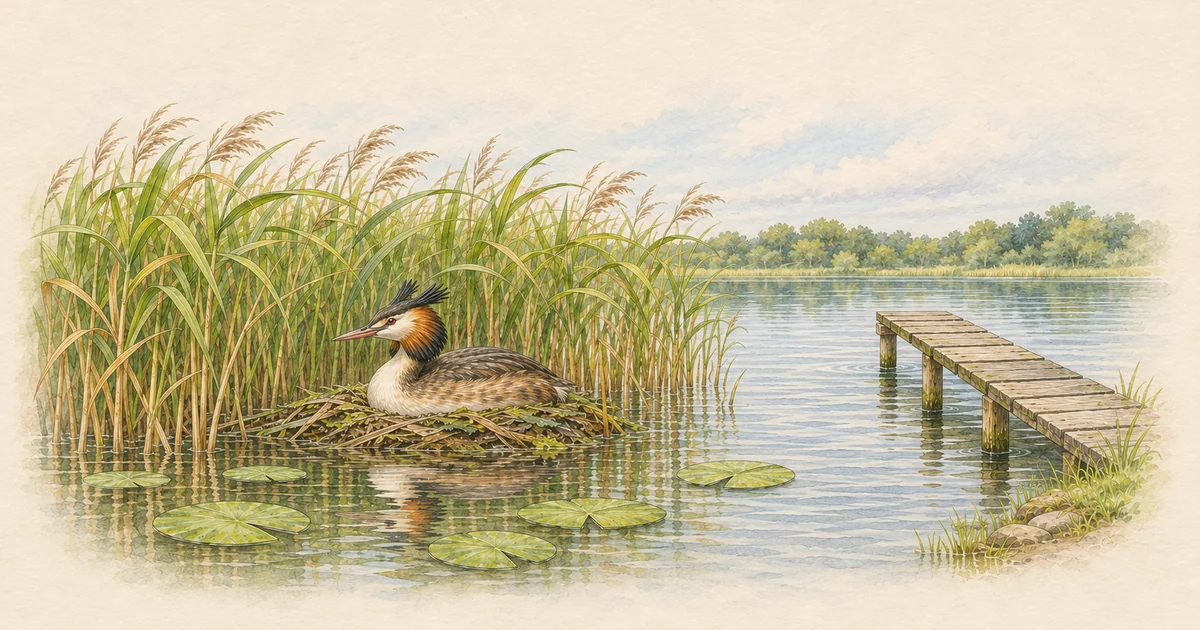
The great crested grebe only builds its nest where there is a reed belt several metres wide and bushes reaching into the water. That is stated in a management sheet from the state bird conservation centre (Vogelschutzwarte) for Hesse, Rhineland-Palatinate and Saarland, which lists among the threats that recreational anglers and water sports enthusiasts disturb breeding or resting birds. On Bavarian gravel pit lakes closed to leisure use for nature conservation reasons, pairs raised an average of 1,8 fledged young, on lakes in use 0,9 (Maßnahmenblatt Haubentaucher, HLNUG).
According to an analysis of studies worldwide summarised by the IGB, plants and invertebrates suffered most from trampling on the bank and from boat wash. The effect of angling on waterbirds was negative on average, but not statistically certain (IGB, gravel pit lakes brochure). You avoid trampling damage by staying on paths, jetties and existing spots.
Boat and belly boat by the reeds
The Fischereiamt Berlin asks boat anglers to keep at least 10 metres from reeds and water lilies. The Nationalparkamt Müritz requires you not to go into reed beds, not to pass over shallow spots and plant stands, and to give gatherings of birds a wide berth. On most waters there away from the canoe touring routes only rowing boats are allowed, not belly boats.
European bird species must not be significantly disturbed during breeding, rearing, moulting, wintering and migration, i.e. not in a way that worsens the state of the local population (§ 44 Abs. 1 Nr. 2 BNatSchG). According to the Bayerische Akademie für Naturschutz und Landschaftspflege (ANL), waterbirds usually first move away from water sports enthusiasts by swimming or diving and take flight if approached further. Every escape costs energy and interrupts feeding. In Bavaria, 18 of the 37 bird species disturbed in the winter half-year were on the Red List or the early warning list (ANL, short analysis of birds and water sports). If a flock swims away in front of you, turn away.
Dogs, light and noise
Whether your dog may run free on the bank is regulated by the state and the protected area. In Lower Saxony, the state forest act (NWaldLG) requires dogs to be on a lead in woodland and open countryside from 1 April to 15 July. Even short disturbances can let a clutch of eggs cool down, writes the Landeshauptstadt Hannover. At the Streganzsee, the regulation does not allow dogs to run free at all.
In an IGB experiment, considerably more insects, mainly aquatic insects, left the water at street lamps next to waters than at a dark comparison site (IGB). A head torch is not a street lamp, but the rule still applies: switch it on only when needed and point it at the ground, not at the reeds. More on fishing in the dark under Night fishing.
Nationwide, § 39 Abs. 1 Nr. 1 BNatSchG prohibits disturbing wild animals wantonly. At the Streganzsee, noise is also expressly prohibited.
Camping and fires
The Streganzsee regulation prohibits camping out, lighting fires, pitching tents or setting up a caravan. In the Müritz National Park, camping is allowed only at official sites, not at rest areas. Where the line between a fishing umbrella and a tent lies is explained in Night fishing and weather protection at the water. What applies to barbecues and rubbish is covered under Leaving your fishing spot clean.
Where to find protected areas and their rules
Whether your spot is in a protected area is shown by the BfN’s map application “Schutzgebiete in Deutschland”. It shows nature reserves, national parks, landscape protection areas, FFH and bird protection areas nationwide. The states‘ map services are more precise; for the Natura 2000 one in Saxony-Anhalt there is even a dedicated booklet for anglers.
You can find the binding wording via the name of the area in the state’s legislation portal, in Brandenburg for example in BRAVORS. The lower nature conservation authority of the district (Landkreis) can give you information. What the water’s manager regulates is covered under Fishing permit (Erlaubnisschein) and water map.
Note, as of November 2026: The examples come from Brandenburg, Mecklenburg-Western Pomerania, Saxony-Anhalt, Berlin, Lower Saxony and Müritz National Park. An area regulation applies even if your fishing permit (Erlaubnisschein) does not mention it.
Frequently asked questions
May I fish in a nature reserve?
That is decided by the area’s regulation. It can limit fishing to agreed areas and paths, as at the Streganzsee in Brandenburg, restrict it to designated spots on the bank, as in the Boddenlandschaft, or prohibit it, as in the core zone there and in the coastal waters of Jasmund National Park. Under § 23 Abs. 2 BNatSchG, actions that can alter a nature reserve or disturb it lastingly are prohibited there, subject to the more detailed provisions.
May I cut back reeds to get to the water?
Not on your own initiative. From 1 March to 30 September § 39 Abs. 5 BNatSchG prohibits cutting back, and reed beds are protected as a biotope all year round. If a spot is becoming overgrown, talk to whoever manages the water.
How far should I keep my boat from the reeds?
The Fischereiamt Berlin asks for at least 10 metres from reeds and water lilies. Other distances are set in the area regulation or water rules.
Related
- Reproduction and spawning: when and where pike and others spawn
- Pike: profile of a plant spawner
- Belly boat: set-up and safety on the lake
- Night fishing and weather protection at the water: umbrella, tent and night-time rules
- Bird or wild animal on the hook: what to do in an emergency
- Leaving your fishing spot clean: rubbish, fire and leftover groundbait
Sources
- Bundesnaturschutzgesetz (gesetze-im-internet.de, Bundesministerium der Justiz): § 7, § 23, § 24, § 26, § 30, § 33, § 39, § 44 (Gebietsarten, Biotope, Schnittzeiten, Störung)
- Bundesamt für Naturschutz: Kartenanwendung Schutzgebiete in Deutschland, Landschaftsschutzgebiete, Nationalparke (Karte, Schutzintensität)
- Landesverwaltungsamt Sachsen-Anhalt: Begleitdokument zum Natura-2000-Kartendienst, Angelfischerei (Regeln für Angler)
- Land Brandenburg: Verordnung über das Naturschutzgebiet „Streganzsee-Dahme“ (Beispiel einer NSG-Verordnung)
- Nationalparkamt Müritz: Wasserwandern im Müritz-Nationalpark (Bootsregeln, Campen)
- Fischereiamt Berlin: Die Angelkarte und ihre Auflagen (Röhricht, Abstand)
- KEA Klimaschutz- und Energieagentur Baden-Württemberg: Steckbrief Hecht (Laichsubstrat, Jungfische)
- Leibniz-Institut für Gewässerökologie und Binnenfischerei: Naturnahe Gestaltung von Uferzonen an Baggerseen (Flachwasser, Trittschäden), Fataler Insektenstaubsauger: Uferbeleuchtung (Licht)
- HLNUG und Staatliche Vogelschutzwarte: Maßnahmenblatt Haubentaucher (Nest, Bruterfolg)
- Bayerische Akademie für Naturschutz und Landschaftspflege: Vögel und Stand-up-Paddling, Kurzanalyse (Fluchtverhalten)
- Landeshauptstadt Hannover: Anleinpflicht für Hunde während der Brut- und Setzzeit (Leinenpflicht)
- Landesamt für Landwirtschaft, Lebensmittelsicherheit und Fischerei Mecklenburg-Vorpommern: Verhalten beim Angeln (Nationalpark Jasmund)
- Nationalparkamt Vorpommern: Angeln im Nationalpark Vorpommersche Boddenlandschaft (Angelstrände, Kernzone)
Text AI-assisted, drawing AI-generated. Sources opened and checked in November 2026; no graphics taken from the sources.
All information is indicative and without guarantee. What counts is the regulation for the area, the law of your federal state and your fishing permit.