
Knowledge · Fish biology
Reproduction and spawning
During the spawning season fish lay their eggs, each species in its own season and at its own place: brown trout in winter in gravel, pike in spring in weed. Because water temperature helps trigger spawning, the spawning season shifts from year to year and from water to water.
Where fish spawn
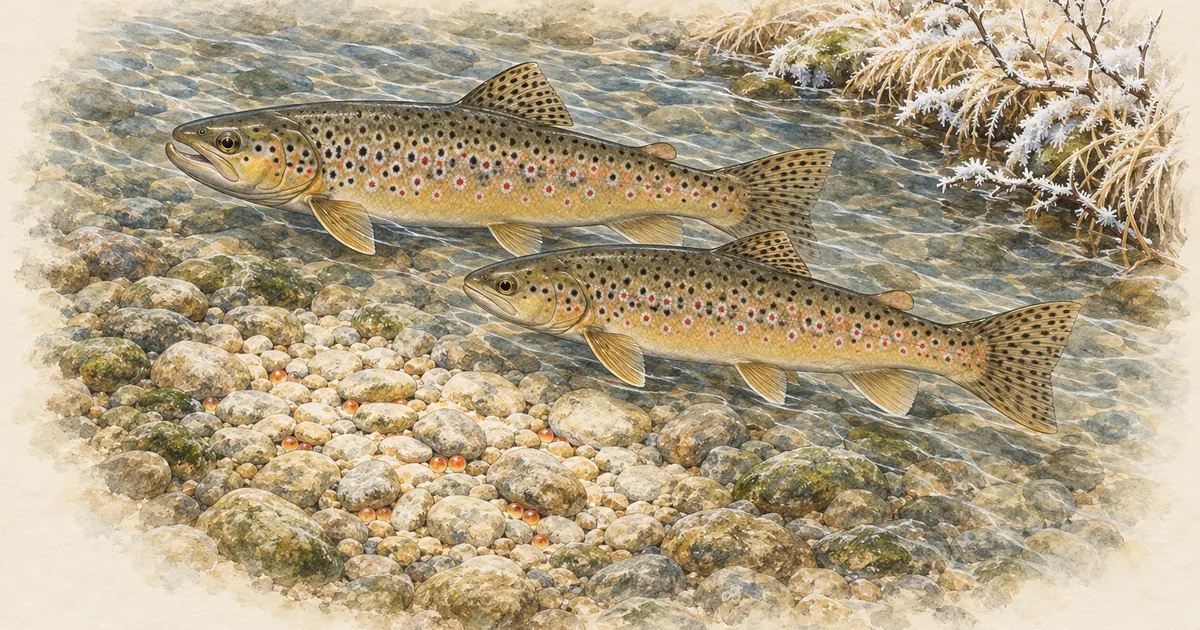
The Lexikon der Biologie distinguishes two forms: adhesive spawners stick their eggs to a surface, free spawners release them into the water. Sorted by spawning site:
- Gravel spawners: Brown trout, grayling, barbel, common nase and salmon spawn on shallow, flowing gravel bars. In the brown trout the hen fish, the female, digs a redd into the gravel bed and covers the fertilised eggs with gravel. The grayling digs no redd and avoids gravel covered with suspended matter or algae (Landesfischereiverband Bayern). The eggs develop in the flowing gaps between the stones. There is enough oxygen there only as long as no silt clogs the gaps (TU München).
- Weed spawners: According to the Saxon exam catalogue, typical examples are carp and tench. Pike, bream and crucian carp also lay their sticky eggs in shallow, plant-rich water, the pike also on flooded meadows. Its larvae hold on to the plants with adhesive glands until the yolk sac, their food supply, is used up.
- Plants, roots, stones: The roach spawns in groups in shallow water on plants, roots or stones. The perch hangs its spawn in long ribbons on water plants and root systems.
- Open water, sand and gravel: Whitefish (vendace) spawn in open water or over sandy or stony ground near the shore, and the eggs sink to the bottom. The burbot spawns over sandy-gravelly spots. Its eggs contain a large oil droplet and drift easily.
Winter, spring and summer spawners
Trout and burbot spawn in winter, and the exam catalogue of the Saxon state office lists the cyprinids as summer spawners. Most fish of the temperate zones spawn in spring (Lexikon der Biologie). The boundaries are not sharp: the roach is a cyprinid and, according to LFV Bayern, already spawns in April and May.
| Species | Spawning season | Spawning site |
|---|---|---|
| Brown trout | October to February | redd in flowing gravel |
| Whitefish (vendace) | November to January (Alpine lakes) | open water, sand and gravel near the shore |
| Burbot | November to March | sandy-gravelly spots |
| Pike | February to May | weedy shallows, flooded meadows |
| Perch | March to June | water plants and root systems |
| Zander | April to June | nest at roots or sunken branches |
| Carp | May to June | shallow, weedy bank areas |
| Wels catfish | May to July | nest hollow in the vegetated bank |
The figures come from the LFV Bayern fish encyclopaedia, for the carp from FishBase, the months for the wels catfish from the Saxon catalogue. The sources differ in places. For the wels catfish the LFV gives April to July. For the carp the Saxon catalogue gives May to July, for the pike February to April and for the zander April and May. The catch calendar also shows the spawning time of each species.
What triggers spawning
Two clocks control spawning: water temperature and day length. According to the Lexikon der Biologie, the spawning periods depend on both without exception. The interplay is described by a literature study commissioned by the Bavarian Environment Agency. In spring spawners such as many cyprinids, the eggs ripen as the days get longer, and the spawning itself is triggered by a rise in water temperature. Summer spawners often spawn in several batches for as long as the water is warm and the days are long.
Each species has its own range. According to the study, tench were observed spawning at 19 to 25 °C, and for the zander it gives 13 to 15 °C at the start. According to FishBase the burbot spawns below 6 °C, the study says below 4 °C.
That is why the date moves with the weather. The study gives Lake Geneva as an example. There, roach in a 19-year study most recently spawned in mid-May instead of the end of May or the beginning of June. The surface water had become 1 °C warmer.
The eggs also follow the temperature. Their development is counted in degree days: pike eggs need around 120, and at a steady 10 °C the fry hatch after twelve days (LfULG Sachsen). According to FishBase, burbot eggs need 40 to 70 days.
Note: All months are guide values. The spawning time shifts with the water temperature from year to year and from water to water.
Hen fish, milter and spawning dress
The explanations follow the exam catalogue of the LfULG Sachsen and the LFV Bayern fish encyclopaedia.
- Hen fish (Rogner): female fish after reaching sexual maturity. Its eggs are called roe.
- Milter (Milchner): sexually mature male fish, its sperm is called milt. Milters usually mature earlier than hen fish.
- Spawning tubercles: pearl-like bumps on the skin, in many cyprinids on the head. They are triggered by hormones, not by parasites or injuries. They are pronounced in roach and bream.
- Spawning dress: strong, hormone-controlled colouring at spawning time, also called nuptial colouring. In the Alpine char the belly of the milters turns bright red, in the grayling both sexes take on bright colours.
- Kype: the upward-curved lower jaw of the males of some salmonids, i.e. trout-like fishes, for example in salmon, lake trout and older brown trout.
Nests and brood care
Zander and wels catfish guard their eggs (Saxon catalogue), the details are described by the LFV Bayern.
- Zander: The male makes a nest hollow, for example at roots or sunken branches. The female sticks the eggs to it. The male keeps egg robbers away and fans fresh water over the eggs with his fins.
- Wels catfish: The sticky eggs lie in a nest-like hollow in the vegetated bank area. The male guards them until they hatch.
- Three-spined stickleback: The male builds a nest from plant parts, glues it together with kidney secretion and leads the female there with a zigzag dance. He then guards the eggs and still defends the hatched fry.
- Bitterling: The female lays the eggs with an ovipositor up to 6 cm long into the gill chamber of a swan mussel or painter’s mussel. The larvae leave the mussel after three to four weeks.
Migrations to the spawning ground
A spawning migration is the journey to a suitable spawning site. Far travellers are mainly species that move between the sea and fresh water on the way (Lexikon der Biologie).
- From the sea into the river: Salmon and sea trout migrate from the sea into fresh water to spawn, they are anadromous. In autumn the salmon climbs up to the upper reaches and spawns in a redd in the gravel. Most of the parent fish die afterwards. According to the Bundesamt für Naturschutz, a female produces 1,200 to 2,000 eggs per kilogram of body weight.
- From the river into the sea: The eel is catadromous. Silver eels, the migrating fish, usually head for the sea at high water in late summer and autumn. Their spawning area is the Sargasso Sea, up to 7,000 km away. The eel spawns only once and dies afterwards (Thünen-Institut).
- In fresh water: Barbel and common nase move upstream in shoals, lake trout and brown trout into the tributaries.
Closed season and minimum size protect spawning
Closed seasons are set to ensure undisturbed spawning, according to the exam catalogue of the LfULG Sachsen. The minimum size (Mindestmaß), also called Schonmaß, is meant to ensure that a fish has spawned at least once before it reaches this size. The LFV Bayern sums it up: closed seasons and minimum sizes protect the reproduction of fish.
Spawning fish are often conspicuous: according to LFV Bayern, bream form huge shoals, silver bream spawn with much splashing. The sites are protected too: in Saxony the fisheries authority (Fischereibehörde) can declare waters with especially suitable spawning sites to be spawning sanctuaries (§ 25 Sächsisches Fischereigesetz). For Bavaria the LFV names protecting spawners as one reason to release even a fish of moderate size if it serves the management goal.
Note, as of October 2026: This page does not state closed seasons or minimum sizes. Your federal state (Bundesland) regulates both, and stricter rules are often added in the fishing permit (Erlaubnisschein). More under Closed season and minimum size explained.
Frequently asked questions
Is the spawning time the same as the closed season?
No. The spawning time is a biological period and varies with the water temperature. The closed season is a legal requirement of your federal state and may differ from it.
Why does the trout spawn in winter and the carp in summer?
Their eggs need different temperatures. According to the literature study, brown trout eggs survive only between 0 and 13 °C, while according to FishBase the carp spawns at 15 to 20 °C. Fish typically spawn close to the temperature their eggs tolerate best.
May you fish at a spawning site?
What counts is the closed season of your federal state, designated sanctuaries and your fishing permit. The Saxon exam catalogue gives an example: a large pike standing in shallow, weedy water in spring is probably spawning. The right thing there is to observe the closed season and to refrain from catching it for the sake of the stock.
Related
- Closed seasons and minimum sizes explained: terms and official sources of the 16 states
- Catch calendar: spawning time and catch chances by species and month
- The year at the water: the water from spring to winter
- Water temperature and oxygen: cold- and warm-water species, layering in a lake
- Fishing on the river: reading spots between groyne, eddy and pool
- Age and growth of fish: spawning maturity and minimum size
- Fish zones of a river: which species live in which stretch
Sources
- Landesfischereiverband Bayern: Fischlexikon (Laichzeit, Laichplatz, Brutpflege, Laichkleid)
- Landesfischereiverband Bayern: Schonzeiten und Schonmaße (Zweck, Schonen von Laichfischen)
- Sächsisches Landesamt für Umwelt, Landwirtschaft und Geologie, Fragen für die fischereiliche Sachkundeprüfung: Allgemeine Fischkunde, Spezielle Fischkunde, Gesetzeskunde (Begriffe, Laichgruppen, Tagesgrade, Zweck von Schonzeit und Schonmaß)
- Freistaat Sachsen: Sächsisches Fischereigesetz, § 25 (Schonbezirke)
- Spektrum, Lexikon der Biologie: Laichperioden, Laich, Laichwanderungen, anadrome Fische (Auslöser, Laichformen, Wanderfische)
- Bayerisches Landesamt für Umwelt: Auswirkungen der Gewässererwärmung auf die Physiologie und Ökologie der Süßwasserfische Bayerns, Literaturstudie (Tageslänge, Laichtemperaturen, Rotauge im Genfer See)
- Technische Universität München, TUM-Mitteilungen 4/2004: Aktion »Saubere Kinderstube« (Eier im Kieslückensystem)
- Bundesamt für Naturschutz: Artenporträt Lachs (Aufstieg, Laichgrube, Eizahl)
- Thünen-Institut, Fischbestände online: Europäischer Aal (Sargassosee, Abwanderung)
- FishBase: Cyprinus carpio, Lota lota (Karpfen und Quappe: Monate, Laichtemperatur, Schlupf)
Text AI-assisted, drawing AI-generated. Sources opened and checked in October 2026; no graphics taken from the sources.
All figures are guide values without guarantee. Spawning times vary with water temperature and from water to water, binding closed seasons and minimum sizes are set out in the law of your federal state and in your fishing permit.