
Knowledge – Fish
Roach (Plötze): Comparison with rudd, float and baits
The roach (Rutilus rutilus), regionally called Plötze, is an adaptable shoaling fish found almost everywhere except cold, fast trout streams. For beginners it is a common catch, and for pike and zander an important prey fish.
In short: You catch roach best from July to October, above all in the evening. Good spots on a lake: open water and weed beds; on a river: rock armouring and a quiet bay. Proven baits: worms and maggots, plus sweetcorn or bread on a light float. Step by step: Fishing for roach.
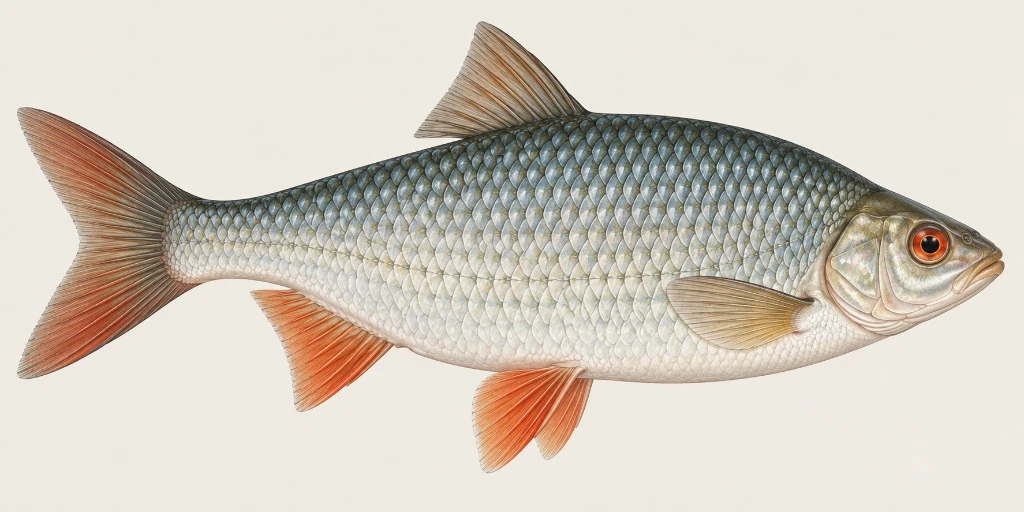
- Bright red iris
- Reddish fins
- Terminal mouth without jaw teeth
Catch chances through the year
- Hardly any chance
- Possible
- Good
- Peak season
- Spawning (observe the closed season)
Editorial assessment for waters in Germany, not a measured value and no guarantee. Spawning time is not the same as the legal closed season.
Species profile and sources in the catch calendarAll species compared month by monthThe rules of your federal state
How to recognise a roach
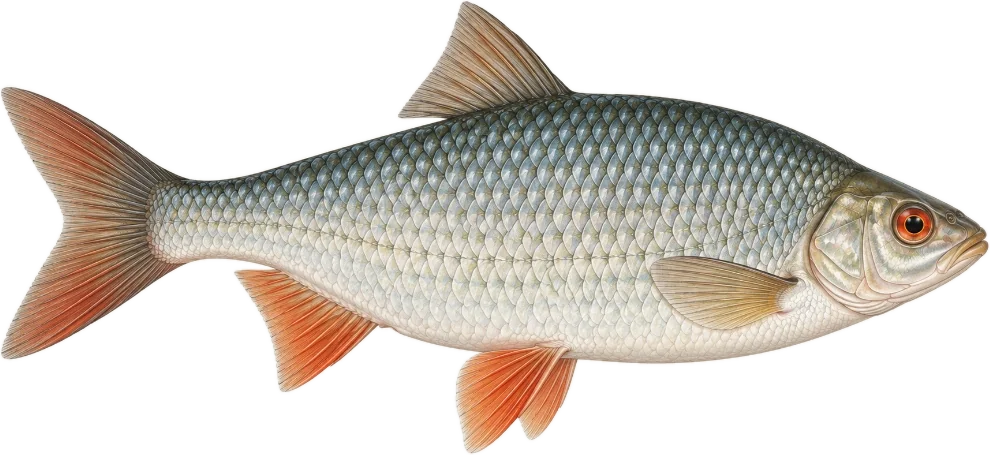
Depending on the water, the body is more or less deep-backed, greenish above, silvery on the flanks, white on the belly. The name comes from the iris: it is yellow in young fish and turns deep red in adults. The pectoral, pelvic and anal fins are orange to red. The mouth is small and terminal, jaw teeth are missing, and the food is crushed by pharyngeal teeth in the throat.
In rivers roach are slimmer and silvery, in gravel pits deeper-bodied with a slight golden tone. LFV Bayern gives 15 to 20 centimetres as the average and 40 as the maximum. FishBase gives 25 centimetres as a common length and 50 centimetres at most, at 1,8 kilograms. According to DTU Aqua, Danish roach take seven to twelve years to reach 25 centimetres, and they usually only grow beyond 35 centimetres in clear lakes. Roach over two pounds remain a dream for many match anglers. Where predators are absent, the fish often stay at around 100 grams.
Roach or rudd?
| Feature | Roach | rudd |
|---|---|---|
| Mouth | terminal | clearly upturned |
| Dorsal fin | starts above the base of the pelvic fins | starts clearly further back |
| Belly edge | rounded | keeled like a roof tile |
| Iris | yellow-red to deep red | more or less yellowish |
The rudd is the most common look-alike; the table shows the differences. The ide grows clearly larger, averaging 30 to 50 centimetres, usually has a golden-yellow iris and smaller scales than roach and rudd.
If roach and bream spawn at the same time in the same place, fertile hybrids result. Crosses with rudd and bleak are also possible.
Side by side
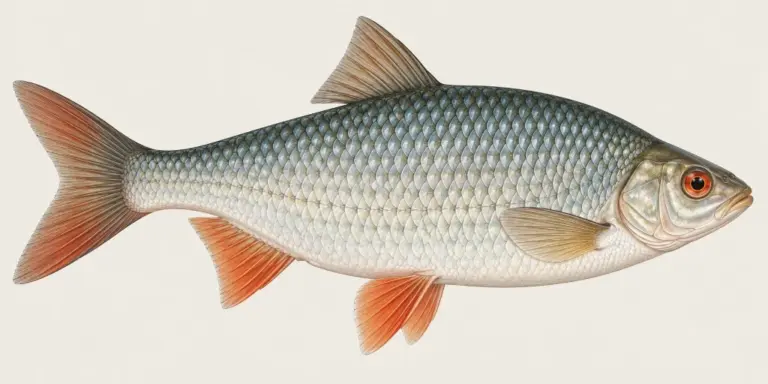

AI-generated illustrations.
Where the roach lives
The roach lives in lakes, rivers, canals, harbour basins, reservoirs and small ponds, even in brackish coastal lagoons. It makes few demands on habitat and water quality. It is most common in nutrient-rich lakes and in large and medium rivers and backwaters. In fast-flowing rivers it lives only where backwaters or cover allow it to overwinter. In lakes it forms larger shoals than in flowing waters and likes to sit in mid-water.
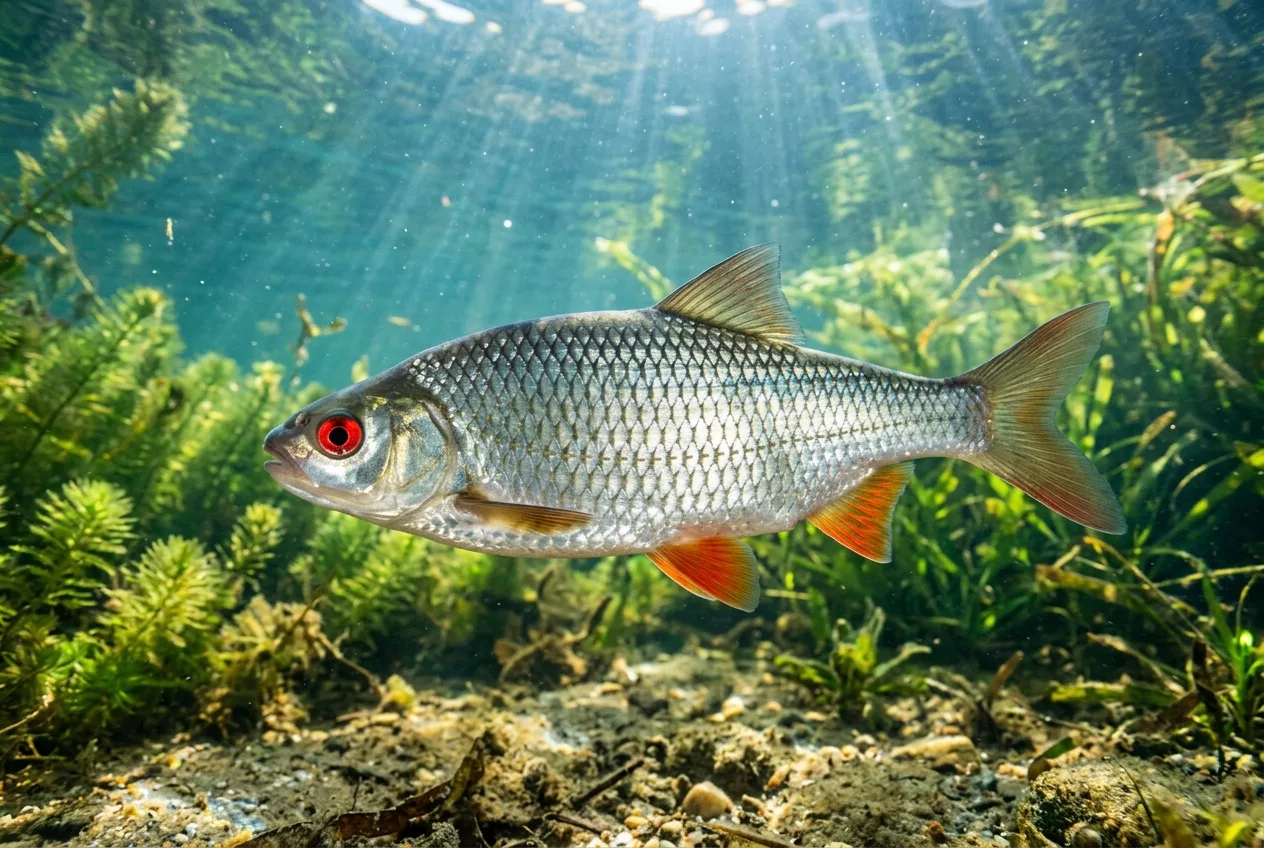
In rivers roach like to stay at rock armouring covered in algae, because they find freshwater shrimps there. In winter they retreat to deep spots. In flowing waters you then often find them packed together in quiet harbour basins. According to DTU Aqua, in Danish lakes up to 80 per cent of the stock migrate into inflows and outflows in winter, but some stay in the lake.
The Red List of Germany (2023) lists the roach as least concern and very common, stable in the long term.
Holding spots in the picture
Choose the season and time of day: the picture shows where the species stands then. Spots outlined in red apply only in the chosen season. Tap a fish or a spot in the list to bring it closer. The picture is schematic and AI-generated, every water is different.
Chance of a catch in springgoodSpawning, observe the closed seasons
Catch chance in summerPeak season
Catch chance in autumnPeak season
Catch chance in wintergood
- J
- F
- M
- A
- M
- J
- J
- A
- S
- O
- N
- D
Spawning season
Not prime time In winter, roach on rivers bite mainly at dusk.
Not prime time In winter, roach on rivers bite mainly at dusk.
Active time In winter, roach on rivers bite mainly at dusk.
Not prime time In winter, roach on rivers bite mainly at dusk.
In the lake
Water lilies and weed bed
Roach are found here only in spring, summer and autumn.
Deep bottom
Roach are found here only in winter.
Open water
Roach are found here only in spring, summer and autumn.
Just below the surface
Roach are found here only in summer.
Roach are shoaling fish. In still waters they like to stay in mid-water, and also on shallow stretches of bank with vegetation. Depending on the food supply they move between the bank zone and open water.
Spring: chances of a catch according to the catch calendar are good. This is when spawning takes place, so observe closed seasons (Schonzeit). Spawning happens in April and May in groups in shallow water, on plants, roots or stones.
Summer: chances of a catch according to the catch calendar are good in June, with peak season in July and August. In warm weather roach prefer to feed near the surface.
Autumn: catch chance according to the catch calendar is peak season in September and October, good in November.
Winter: chances of a catch according to the catch calendar are good in December and January, possible in February. In winter roach withdraw to deep spots. They are still caught even under ice.
In the river
Pools, deep spot
Roach are found here only in winter.
riprap, sheet piling, harbour
Roach are found here all year round.
Calm bay with aquatic plants
Roach are found here only in spring, summer and autumn.
Free current in mid-river
Roach are found here only in summer.
In rivers, roach prefer to stay at algae-covered stone embankments. Add to that shallow, slow-flowing stretches of bank with vegetation. The shoals here are usually smaller than on lakes.
Spring: chances of a catch according to the catch calendar are good. This is when spawning takes place, so observe closed seasons (Schonzeit). Roach make short migrations to spawn. They spawn in the shallows on plants or over gravel.
Summer: chances of a catch according to the catch calendar are good in June, with peak season in July and August. On hot summer days roach in rivers also move into strongly flowing water.
Autumn: catch chance according to the catch calendar is peak season in September and October, good in November.
Winter: chances of a catch according to the catch calendar are good in December and January, possible in February. In winter roach look for deep, calm water. In rivers and canals they like to gather then in big shoals in harbour basins, where there is hardly any current.
Depth: Roach feed at every depth. In the warm season they stay nearer the surface, in the cold season in the deep.
Size comparison: AI-generated drawing, schematic.
What it eats and when it spawns
Small roach eat zooplankton; larger ones eat worms, snails, mussels, small crustaceans, insect larvae and water plants. Water snails are part of the main diet. The mouth is very small and toothless, and roach do not eat fish. In summer they eat more than in winter, and below 12 degrees growth stops.
The daily rhythm depends on the water. In clear lakes roach stand almost motionless by day in shoals under water lilies close to the bank and break up after sunset. In cloudy lakes they are active by day and travel through the whole lake.
Males mature at two to three years, females a year later. According to LFV Bayern, spawning takes place in April and May. For Danish lakes DTU Aqua gives a start from 10 to 12 degrees, in cold springs until June. For other waters 6 to 10 degrees is also given. The shoals spawn in sheltered bays in shallow water, and the sticky eggs attach to plants, roots and stones.
Where predators are absent and food is scarce, mass populations of stunted fish develop. LFV Bayern calls the roach an important forage fish for predators; for pike and zander it is the most important prey.
When it bites
Roach can be caught all year round. According to the angling press, large specimens come mainly in autumn and winter. In early summer, after spawning, they are sometimes marked, with missing scales or ragged fins. Then you catch a lot of them.
In winter they sit in deep spots, in rivers often in slack harbour basins. Even under ice roach can still be caught, and the float works there too.
Today’s catch index needs JavaScript. Season and spawning time are in the catch calendar.
You will find the monthly overview of all species and the water temperature check in the catch calendar.
From the blog: The first fishing trip with children: plan briefly, set up safely, check the rules · Fishing in November: which fish bite now and where I look for them · Freshwater fish in Germany: which species you catch where
What to catch it with
Step by step: Fishing for roach: tips on bait, rig and tackle – season, lies, baits, tackle and rules on one page.
Roach and float fishing belong together. Whether with a pole and stick float, with a match rod and waggler, or with a long whip: hardly any fish sets the bite indicators moving so often (Float fishing, Float rig, Waggler rig, Whip fishing). In a current, holding back helps: you check the float several times at the end of the drift so that the bait rises. Most roach bite as it rises and then sinks again, and they bite hard.
Sometimes roach only pluck timidly. Then it helps to reduce the hooklength below 0,10 millimetres and use tiny size 20 hooks. On other days they also take coarse gear, carp hooks included.
Anyone who wants plenty of fish uses maggots. For bigger roach a cocktail of sweetcorn and maggot is considered good (Sweetcorn). Add paste, dung worms and large bread flakes. Big roach often bite by chance on fat lobworms when you are fishing for eel or tench.
Groundbaiting keeps the shoal in the swim. You need less groundbait, and more soluble balls, than for bream fishing. Regular topping up, for instance with maggots by catapult, often keeps the shoal there. How to land the fish is covered in Landing and unhooking.
Hold the float for a moment: Check the float several times at the end of the drift. The bait then rises and sinks again, and that is exactly when many roach bite.
Go fine: For timid plucks, go down to a hooklength below 0,10 millimetres and tiny hooks. If small fish pluck at a single maggot, switching to bigger baits often solves the problem.
Roach as baitfish: Roach are used as dead baitfish for pike, perch, wels catfish, eel and zander. Whether and where this is allowed is regulated by your federal state (Bundesland).
Suitable lures
Worms and maggots, plus sweetcorn or bread on a light float.
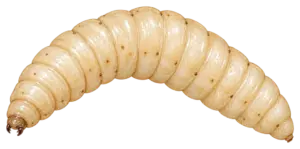
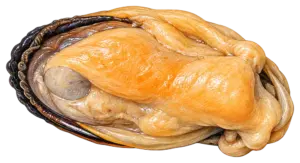
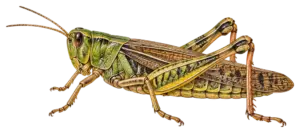
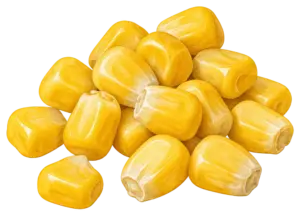
AI-generated illustrations. A click opens the lure’s page.
Rigs for these baits: Waggler rig, Feeder rig, Float rig, Running lead rig.
How to use roach and deal with the bones
Commercially the roach plays hardly any role; it is valued mainly by anglers. Fresh, you can fry, grill or bake it in the oven, and it is also salted and dried. Hot-smoked it tastes good too. The fairly large scales come off beforehand, see Scaling and skinning.
Like all carp family fish, the roach has fine Y-shaped bones that sit loose in the flesh. When scoring, you cut the fillet across at intervals of two to three millimetres so that the bones break into tiny pieces. Other approaches are a bath in vinegar brine lasting several days, or the mincer. With smoked fish the bones are mainly a nuisance once it has cooled and its flesh has become firmer. The cuts are shown in Filleting fish.
Anyone who salts and dries roach should know one thing: bacteria in the gut of the fish can form a nerve toxin without the fish visibly spoiling. Authorities therefore advise gutting fish completely soon after the catch and washing them thoroughly inside and out. You should not eat the innards of fish that have not been heated sufficiently.
What you need to observe
Whether a closed season (Schonzeit) or minimum size (Mindestmaß) applies to roach in your water is regulated by the federal states (Bundesland). We give figures only with date and source; the fisheries regulation of your federal state and your fishing permit (Erlaubnisschein) are always what counts. You will find a list of links to the official sources in the Catch calendar.
Many federal states (Bundesland) explicitly ban fishing with a live baitfish. The Animal Welfare Act (Tierschutzgesetz) makes it a criminal offence to inflict considerable pain or suffering on a vertebrate out of cruelty or over a prolonged period (§ 17). In addition, a vertebrate may only be killed under effective stunning or, where that is reasonable, avoiding pain (§ 4). How to do this with a fish is covered in Stunning and killing.
Protected, undersized or, within a slot limit, oversized roach you return gently with wet hands (Returning fish). Returning fish sits in tension with animal welfare law and is permitted only in line with the management aim and the law of your federal state. The IUCN rates the roach as least concern.
What closed season, minimum size and harvest slot mean and where to find them is explained on the page Closed season and minimum size explained.
What state law says about the closed season and minimum size for this species is in the „Auf einen Blick“ box on the state pages for Berlin, Brandenburg, Rhineland-Palatinate and Saxony. For the other states our overview does not list this species; there the state fisheries regulation (Landesfischereiverordnung) applies.
Frequently asked questions (FAQ)
How do I tell a roach from a rudd?
The roach has a terminal mouth, a rounded belly edge and a dorsal fin that starts above the base of the pelvic fins. In the rudd the mouth is upturned, the belly edge is keeled and the dorsal fin starts clearly further back.
How big do roach get?
On average 15 to 25 centimetres. LFV Bayern gives 40 centimetres at most, FishBase 50 centimetres and 1,8 kilograms. In cloudy lakes roach over 20 centimetres are rare.
Can I catch roach in winter?
Yes. In winter they sit in deep spots, in rivers often in slack harbour basins. Even under ice you can still catch them.
Sources
The rating of catch chances is an editorial assessment. The facts come from these sources, and the text is worded in our own words. The illustration is an original design by Angel Momente in the style of a natural history plate (AI-generated, see the AI notice).
- Wikipedia: Rotauge (Laichtemperatur)
- FishBase: Rutilus rutilus (Höchstalter, Lebensraum)
- LAWA-Projekt O 10.20 (Leibniz-IGB, 2021): Temperaturempfindlichkeiten der Fischgemeinschaften
- Landesfischereiverband Bayern: Fischlexikon (Laichzeit, Lebensraum, Nahrung, Aktivität)
- Blinker: Steckbrief Rotauge (Plötze): Posenangeln, Baits and lures, Anfüttern
- DTU Aqua: Fiskebiologi, Skalle (Rutilus rutilus)
- Rote-Liste-Zentrum: Plötze (Rotauge), Rote Liste der Süßwasserfische Deutschlands 2023: ungefährdet
- Tierschutzgesetz § 4: Töten von Tieren
- Tierschutzgesetz § 17: Straftaten
- Fisch & Fang: Zielfisch Rotauge, so fangen die Profis (Standplätze im Jahr, beste Jahreszeit)
- Blinker: Kaltes Silber, Rotaugen im Winter fangen (Beißzeit)
- Landesfischereiverband Bayern: Fischlexikon (Rotauge)
- Landesfischereiverband Bayern: Lernportal der Fischerjugend, Betäuben und Schlachten (Gräten)
- Blinker: Fisch räuchern, in 4 Schritten zum Räucherprofi
- BfR: Botulismus-Risiko durch gesalzene und getrocknete Plötzen (Stellungnahme Nr. 026/2017)
- Blinker: Rotaugen im Hafen (Winterstandplätze in Kanal und Fluss)
- Wikipedia (englisch): Common roach (Fresstiefe nach Jahreszeit)
Created with AI support from the sources listed. Figures only appear in the text if a source gives them. Last updated: 7 November 2026. Found a mistake? Write to us. Who is behind this site: About me.
More in the lexicon
- All fish species at a glance
- Catch calendar – month, water temperature and profile for 93 species
- Line calculator – breaking strain after the knot, drag guideline, backing
- Angling methods