
Knowledge · Rigs & setups
Feeder rig
A feeder rig connects main line, feeder and hooklength so that the hookbait lies right next to the feed and the bite shows at the rod tip. Two designs are common: with the running rig the feeder runs freely on the line, with the loop rig it slides on a large loop.
What you need
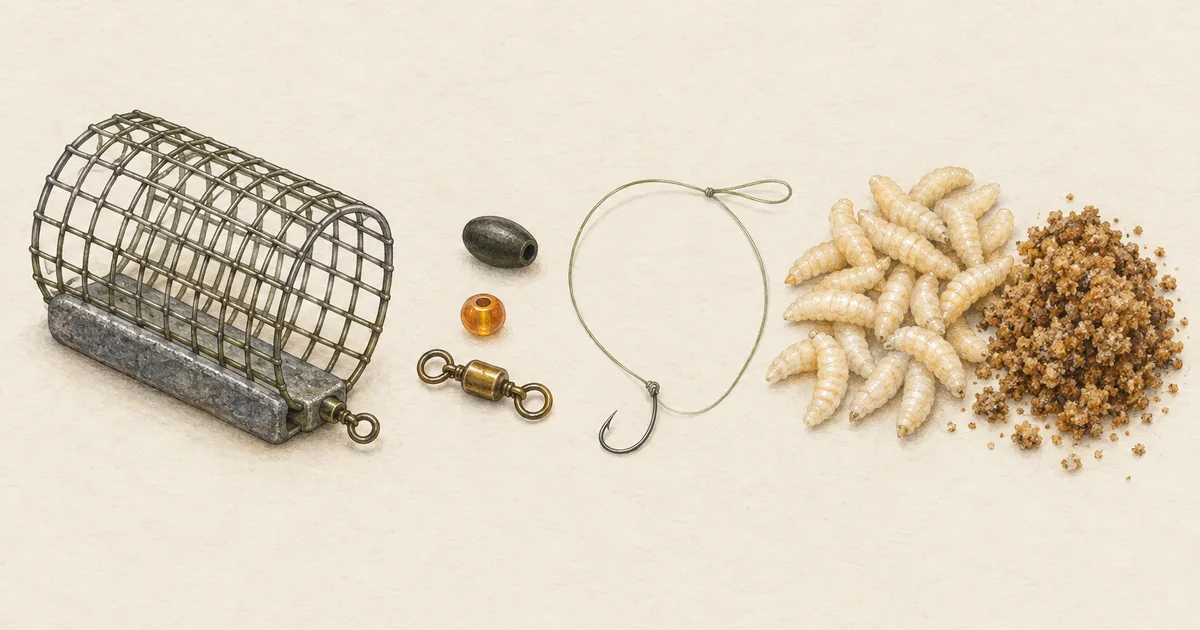
- a feeder whose weight suits the current
- a small swivel with snap link for the feeder, ideally a double snap link
- a rubber bead or a short piece of silicone tubing as a buffer
- a second small swivel for the hooklength, preferably with a snap link
- hooklengths with hooks, bought or tied yourself
This applies to the running rig. The loop rig, by contrast, is made almost entirely from the line itself; Blinker lays it directly into the end of the main line or shock leader. Which rod and reel suit is covered under feeder rod, the procedure at the water under feeder fishing, the standard bait under Maggots & larvae.
Set-up: running or loop
The feeder is weight and feed container in one, and the bait lies only one hooklength away, according to Rute & Rolle 60 to 100 centimetres. After casting, the line is drawn lightly taut, and then the tip shows what is happening at the hook. The two rigs differ in how the feeder hangs on the line.
Running rig
The feeder hangs on a swivel with a snap link that runs freely on the main line. Below it come a rubber bead as a buffer and a tied-on swivel for the hooklength. On the bite the fish pulls the line through the swivel at the feeder, and the feeder stays put. According to Blinker, the fish feels no resistance. If the main line breaks, it can free itself from the feeder.
Loop rig
The line ends here in a large loop, and the feeder slides along it on a swivel. Blinker gives 20 to 30 centimetres, Fisch & Fang about 25; another guide in Blinker starts at 40 to 70. Below that sits a short, stiff section with a small loop for the hooklength. Fisch & Fang twists it for this. Because one leg of the large loop is a little longer, the feeder hangs to the side, and the stiff section holds the hooklength away from the main line like a side arm.
When a fish bites, it pulls the loop through the swivel until the top end of the loop reaches the feeder. The weight of the feeder then stops it and it hooks itself. How far it gets first depends on the length of the loop. Blinker compares this to a delayed fixed-lead rig. In such a rig the weight sits fixed on the line. If the main line breaks during the fight, Fisch & Fang says the rig becomes a problem: the feeder is left hanging in a closed loop.
| Feature | Running rig | Loop rig |
|---|---|---|
| Cup | runs freely on the main line | slides in a loop of 20 to 30 cm |
| Bite | the fish pulls line through the swivel and you strike | free run to the end of the loop, then the feeder sets the hook |
| Line break | the fish can shed the feeder | the feeder stays in the loop |
| Parts | two swivels, one bead | two loops, one swivel |
Running rig in five steps
- Thread on a swivel with a clip. The main line runs through the eye, and the feeder is clipped on later.
- Slide on a rubber bead. It protects the knot below it.
- Tie a second swivel to the end of the line, for example with the improved clinch knot.
- Attach the hooklength. Hooklengths you tie yourself get a surgeon’s loop, and spade-end hooks are tied on with the spade-end hook knot.
- Clip on the feeder and check the run. Pull on the hooklength: the line must slide freely through the swivel at the feeder.
Tying the loop rig
This is how Fisch & Fang builds it at the end of the line:
- Thread on a small swivel for the feeder, twist the end of the line and tie a small loop at the bottom, for example as a figure-of-eight loop.
- Above that, tie a large loop of about 25 centimetres in which the swivel runs. You leave one leg about two centimetres longer.
- Attach the hooklength to the small loop with a loop-to-loop connection.
Feeders: open, closed, flat
- Open feeder: a cage of wire or plastic from which, according to Blinker, the groundbait falls out or is washed out fairly quickly. According to Rute & Rolle, the stronger the current, the finer the mesh should be.
- Closed feeder: closed at the top and bottom, with just a few holes. As a maggot feeder it carries maggots or pieces of worm to the spot. In a current, Blinker says they are washed out after one to two minutes; in still water it takes longer.
- Flat feeder: anglers call it a method feeder. The groundbait is pressed onto the feeder with a mould or by hand, and the bait lies on a short hooklength in the middle of it. The swivel is fixed in the feeder and the fish hooks itself on the weight of the feeder, from about 30 grams according to Blinker. Its home is still water.
Guide values for hooklength, hook and feeder
The figures are starting values from angling magazines and differ from one another.
- Hooklength length: Fisch & Fang starts at 80 centimetres in still water and 50 in rivers. Rute & Rolle gives about 50 centimetres. Blinker’s rule of thumb: if you only get cautious bites, lengthen the hooklength.
- Hooklength strength: According to Fisch & Fang, an 18 hook goes with a 0,12 hooklength and an 8 with one from 0,20 millimetres. For bream fishing Blinker uses 0,16 to 0,18 millimetres. Training material for the angling exam (Fischerprüfung) describes the hooklength as a weak link, a line thinner than the main line.
- Hook size: Larger numbers mean smaller hooks. Fisch & Fang gives 18 for shy roach up to 8 for carp and barbel. Blinker uses 18 for two maggots and 10 for sweetcorn with a worm, Rute & Rolle 14 to 16 for starters.
- Feeder weight: In still water Blinker gets by with 10 to 20 grams, in a small river it needs 30 to 50 and in a strong current up to 150 grams. In a current Fisch & Fang uses 80 to 120 grams, and on poor bite days also a lighter feeder of 30 to 50 grams that rolls slowly. Which rod will cast that together with the groundbait is covered under feeder rod.
Which rig suits which situation
A running rig is enough to start with, and Fisch & Fang often considers the simplest rig the best. For still waters the magazine regards the loop rig as a strong alternative. Blinker prefers to use it for bream, in still water and in rivers; especially in a current the fish often hooks itself on it. Blinker uses the method feeder in still water, especially for carp.
Rules at the water, as of October 2026: For its management angling with the feeder rod, a joint fishing session for stock control, the Landesanglerverband Sachsen-Anhalt requires a “rig with a freely running feeder”. According to Blinker, this rig is used in management fishing because the fish can free itself from the feeder if the line breaks. The water rules of the Landesverband Sächsischer Angler ban groundbaiting at drinking-water reservoirs, expressly including with the feeder. What applies to you, including rod numbers, baits and lead, is set by your federal state (Bundesland), the water rules and the fishing permit (Erlaubnisschein).
Tip trembles, hook empty
According to Blinker, short twitches of the tip indicate plucks from smaller fish, which are hard to hit. If the tip bends steadily, on the other hand, it is time to strike. If the hook comes back empty, check in this order:
- Shorten the hooklength. If hooks come back empty and baits nibbled away, Blinker shortens the hooklength. Fisch & Fang advises the same when maggots come back sucked out. The shorter it is, the sooner you see the bite on the tip.
- Match the hook to the bait. Blinker chooses the size by the bait, from 18 for two maggots to 10 for a grain of corn with a worm. Rute & Rolle gives size 14 to 16 for everything from big bream to bleak.
- Check bite transmission. Because it has no stretch, braided line shows even the faintest plucks, according to Fisch & Fang. Rute & Rolle recommends interchangeable tips of different strengths for cautious small fish and for bream.
- Adjust the groundbait. On rivers with lots of bleak, professionals dampen the groundbait the day before, according to Fisch & Fang. That way fewer particles rise, and no small fish are drawn down to the bottom.
If, on the other hand, you get quick, clear bites and the strike meets nothing, lengthen the hooklength (Blinker). The hook position in the mouth helps you decide: if the hook is deep in the throat, the hooklength is probably too long; if it sits well forward, it can be longer.
Common mistakes
- Hooklength tangles: Wire ends sticking out of the clip catch it, so Fisch & Fang recommends a double clip. With the loop rig, a slightly longer leg of the large loop helps: the feeder then hangs to the side and the twisted section keeps the hooklength away.
- Rig tied to thin braid: According to Fisch & Fang it tangles on every cast. A shock leader belongs in front of it, a length of thicker monofilament.
- Hooklength too long or too short: Fisch & Fang advises: if the maggots come back sucked out without the tip having shown a bite, shorten the hooklength. If jerky bites cannot be struck, use a longer one.
- Feeder too light for the current: It rolls away from the baited spot and, according to Fisch & Fang, finds not only fish but also snags. Blinker advises beginners to choose a feeder slightly too heavy rather than too light. More under reading the current.
Frequently asked questions
Which feeder rig is right for beginners?
The running rig: two swivels, one bead, and if the line breaks the fish gets free of the feeder. According to Fisch & Fang, the loop rig is somewhat more complicated.
How long should the hooklength be when feeder fishing?
The sources give 50 to 100 centimetres. Start at about 80 in still water and 50 centimetres in rivers, and adjust the length to the bites. With the method feeder it is much shorter; for small baits Blinker gives under 10 centimetres.
Does the fish hook itself on the loop rig?
Often. At first the fish can pull off freely, so you can strike yourself too. If the feeder stops it at the end of the loop, it can hook itself according to Blinker, usually in a current.
Why does the feeder tip tremble but the hook comes back empty?
Usually smaller fish are plucking at the bait. Shorten the hooklength, choose a hook to match the bait and use a low-stretch main line so that you recognise bites reliably.
Related
- Feeder fishing: principle, baited spot and routine at the water
- Feeder rod: classes, interchangeable tips and casting weight for heavy feeders
- Running ledger rig: the same running principle, but with a lead instead of a feeder
- Figure-of-eight loop and loop-to-loop connection: the knots of the loop rig
- Maggots and grubs: the standard bait for feeder fishing
- Line calculator: compare the breaking strain of hooklength and main line
Sources
- Blinker: 3 erfolgreiche Montagen zum Feederangeln, Grundangeln, dein Weg zum Fangerfolg und Brassen angeln: Alle Grundlagen (Montagen, Selbsthaken, Schnurbruch, Hegefischen)
- Blinker: Was ist die richtige Vorfachlänge beim Feedern? (leerer Haken, ins Leere gehender Anhieb, Hakenposition), Angeln mit Futterkorb: Ein Grundkurs, Feederangeln: Friedfische füttern und fangen und Method Feeder: Die Methode für dicke Friedfische (Korbtypen, Korbgewichte, Hakengrößen, Method-Feeder)
- Fisch & Fang: Das brauchen Sie zum Feedern und 10 Tipps zum Heavy-Feedern im Strom (Montagen, Vorfach, Haken, Körbe im Strom, Geflecht, Futter gegen Kleinfische)
- Rute & Rolle: Feedern für Einsteiger und Erfolg mit der Feederrute (Grundmontage, Vorfach, Haken, Korbgewichte)
- Fischereiverein Löningen: Gerätekunde zur Fischerprüfung (Vorfach als Sollbruchstelle, Hakengrößen)
- Landesanglerverband Sachsen-Anhalt: Ausschreibungen 2026 (Montage mit freilaufendem Futterkorb beim Hegeangeln)
- Landesverband Sächsischer Angler: Gewässerordnung, Ausgabe 2024 (Anfütterverbot an Trinkwassertalsperren)
Text AI-assisted, drawing AI-generated. Sources opened and checked in October and November 2026, no graphics taken from the sources.
All figures are guide values without guarantee. Which rigs, baits and amounts of groundbait are allowed is governed by state law, the water rules and the fishing permit (Erlaubnisschein).