
Knowledge · Knots
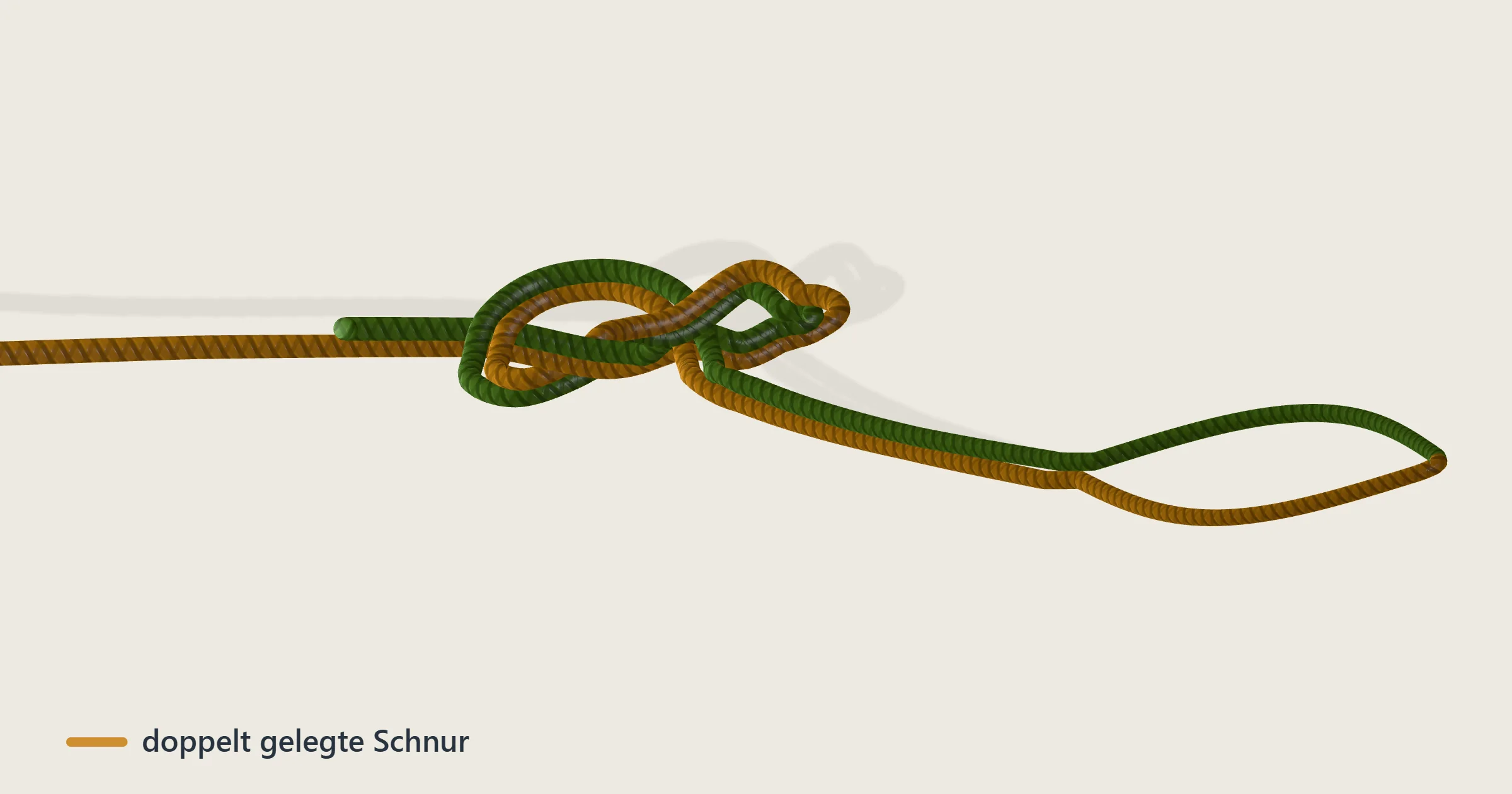
How to tie a figure-of-eight loop
The figure-of-eight loop is an end loop tied from doubled line as a figure-of-eight knot. Like the surgeon’s loop, it is used for hanging leaders and for loop connections.
What is the figure-of-eight loop good for?
Blinker lists the figure-of-eight loop as the second common loop knot alongside the surgeon’s loop, for monofilament and braided line, with a strength of around 80 per cent. It is a little harder to tie because the opening is not round but shaped like an eight.
Wikipedia points out that the knot is hard to undo after heavy loading.
Tying the figure-of-eight loop step by step
- Doubling the line. Double the end of the line. The closed end will later become the loop.
- Making a bight. Lay a bight with the doubled section.
- Once round. Take the closed end once round the doubled line.
- Through the bight. Pass the closed end through the bight laid first. The knot now clearly has the shape of an eight.
- Tightening. Arrange the strands so that they run parallel side by side. Then pull the knot up firmly.
- Trimming. Cut off the short end.
Common mistakes
- Only one strand threaded: For the loop, the whole doubled line must always go through the bight.
- Smooth braided line: It slips more easily than monofilament. Blinker advises more turns for braid, but the figure-of-eight loop cannot be tied with more turns. So pull it up slowly and firmly and do a pull test. The surgeon’s loop allows more turns.
- Strands twisted: If they run across each other, arrange them parallel before you tighten.
Pull test and knot strength
First check that the knot sits neatly and the line is undamaged. Hang the loop over a blunt hook or ring and pull steadily on the main line. Do not wrap thin line round bare fingers. If the end slips or the knot distorts, tie it again. A pull test does not measure breaking strength, it only shows gross tying faults.
Material, diameter and tying technique affect every connection. The line calculator gives you a rough guide using cautious knot factors of our own.
Related knots
The surgeon’s loop is quicker to tie. You join two loops with the loop-to-loop connection. As a hair loop, the figure-of-eight loop is used in the no-knot rig.
Used in this rig: feeder rig.
Note: Blinker gives a strength of around 80 per cent, and in an article on fly fishing a loss of about 25 per cent. The figures do not come from published test series.
Sources
- Blinker – Einfache Schlaufenknoten binden
- Blinker – Der Schlaufenknoten
- Blinker – Die wichtigsten Knoten zum Fliegenfischen
- Wikipedia (englisch) – Figure-eight loop
- Wikipedia – Achterknoten (Schlaufe)
Sources opened and checked on 2 October 2026. Texts in our own words, sketch drawn independently; no graphics taken from the sources. You will find all knots in the overview of fishing knots.
All figures are guide values without guarantee. Follow the line manufacturer’s instructions.