
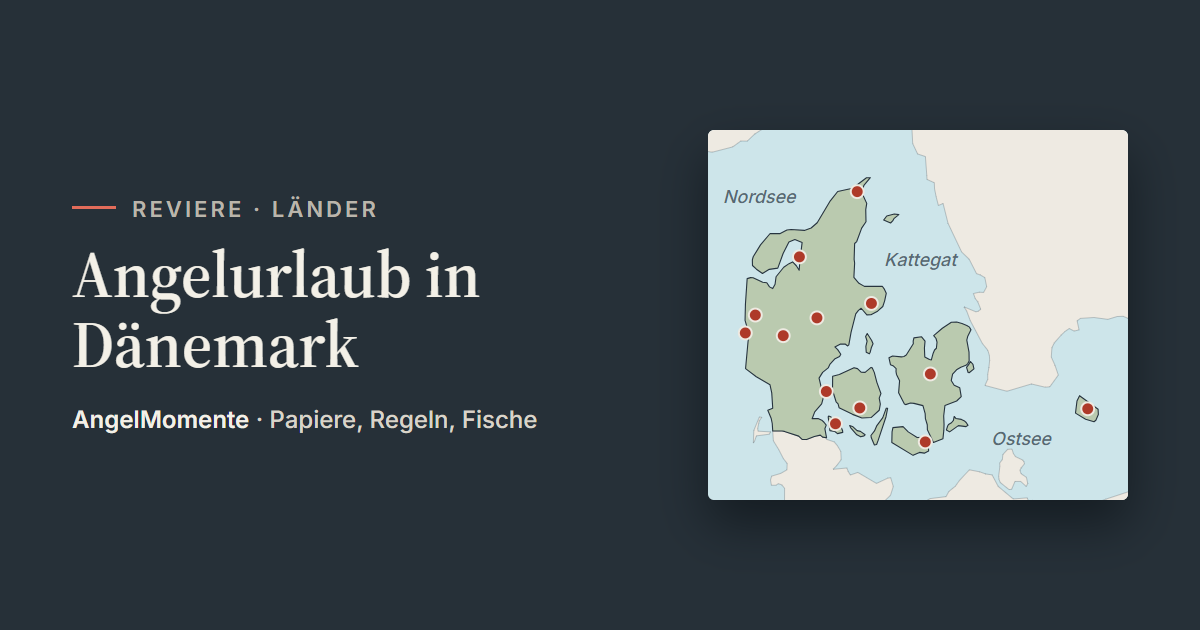
Waters · Denmark
Fishing holiday in Denmark
A fishing holiday in Denmark begins with the state fishing licence (Fischereischein), the fisketegn. On streams and lakes, the rights holder’s permission is added.
- Rivers
- 418
- Streams
- 2.114
- Lakes and reservoirs
- 2.130
- Canals
- 67
- Regions in the water atlas
- 5
As of October 2026 · waters with a name in OpenStreetMap, as of 3 October 2026
The key points in brief
Fishing licence (fisketegn)
Compulsory from the age of 18 up to the Danish retirement age. You buy it online at fisketegn.dk or in the app, for one day, one week or twelve months.
Children and pensioners
no licence, but registration at fisketegn.dk before fishing in salt water.
Fresh water
plus the rights holder’s permission. At a put-and-take lake, the state licence is not needed.
Baltic 2026
Cod is banned; one salmon with a clipped adipose fin per day may be kept. For the Kattegat, Skagerrak and North Sea, the authority gives only minimum sizes for cod.
Eel
banned in salt and fresh water.
Boat
a life jacket or buoyancy aid for each person on board.
As of October 2026. Fishing bans, sizes and closed seasons change regularly. The linked regulations and authority pages are authoritative, not this overview.
Which papers where?
On the left is where you fish, on the right what you need for it. The details are further down this page.
- Sea and coastFishing licence (fisketegn), compulsory from the age of 18 up to the Danish retirement age.
- Lake and riverFishing licence (fisketegn) plus the rights holder’s permission, often a club fishing permit.
- Put-and-take lakeOnly the owner’s permit. The state licence is not needed.
- Children and pensionersNo licence. Before fishing in salt water you register at fisketegn.dk.
Find fishing ponds
177 fishing ponds and 0 fish farms with fishing for guests in Denmark, 139 of them individually confirmed. Enter a postcode or place and the pond finder sorts all sites by distance. All 8 checked fish farms, including those without fishing, are in the fish farm finder.
Sea and inland
Sizes, closed seasons and protected zones
Minimum sizes (Mindestmaß)
Measure from the tip of the snout to the tip of the tail. The values are set out in the regulations for salt water and fresh water. For sizes, the Limfjord counts as the North Sea.
- Sea trout: 40 cm in the sea and in fresh water
- Cod: 35 cm in the North Sea, 30 cm in the Skagerrak and Kattegat, 35 cm in the Belts and the Baltic
- Plaice: 27 cm in the North Sea, Skagerrak and Kattegat, 25 cm in the Belts and the Baltic
- Flounder: 23 cm in the Belts and western Baltic, turbot and brill 30 cm there
- Salmon: 60 cm in the sea, 40 cm in fresh water
- The authority gives no minimum size for garfish and rainbow trout (overview by species).
Fish that are too small and fish in the closed season go back immediately and, where possible, alive. See Releasing fish.
Closed seasons and fishing bans
- Sea trout and salmon in the sea: Coloured fish in spawning dress are protected from 16 November to 15 January, bright fish with loose scales are not (regulation). Different periods apply in the Wadden Sea and around Bornholm, see “The regions”.
- Sea trout, lake and brown trout and salmon in fresh water: 16 November to the end of February.
- Pike: in salt water from 1 April to 15 May, in fresh water from 15 March to 30 April. Zander: in May.
- Cod in the Baltic: banned in 2026, from a boat and from the shore. Every cod caught by accident goes straight back (Verordnung (EU) 2025/2454, Artikel 10). Affected are the waters around Funen, off eastern Jutland and eastern southern Jutland, around Bornholm and most of the coasts of Zealand, that is Baltic subdivisions 22 to 26. The ban also applies on fishing charters and to everyone who does not need a licence (fisheries authority).
- Cod in the Kattegat, Skagerrak and North Sea with the Limfjord: Here the authority names neither a closed season nor a fishing ban, only the minimum sizes (species page on cod).
- Salmon in the Baltic: One salmon with a clipped adipose fin per person and day may be kept, after which salmon fishing ends for the day. Retained fish stay whole until landed (Article 11).
- Eel: Banned in salt and fresh water since 1 August 2026. Eels you catch go straight back (Verordnung Nr. 670). For fresh water, the authority’s eel page still gives a minimum size (Mindestmaß) of 45 cm. The regulation applies.
- Reporting your catch: Anyone who catches a protected species in salt water, such as Baltic cod or Baltic salmon, enters it in the RecFishing app on the same day, even after releasing it (fisheries authority).
The authority names no closed season for plaice and flounder. The terms are explained under Closed season and minimum size.
Protected zones at river mouths
Where streams and rivers flow into the sea or a fjord, there are protected zones (fredningsbælter), usually 500 m around the mouth. If the mouth is 2 m wide or wider, the fishing ban applies all year, otherwise from 16 September to 15 March (fisheries authority with map). Different boundaries are given in the regional regulations.
Reading the protection zones on the map
Where the protection zones (fredningsbælter) are is shown on a map of the fisheries agency. Since July 2026 the fisheries department has been part of the environmental agency Miljøstyrelsen (fisheries agency). The colours mean:
- Red: fishing banned all year.
- Blue: fishing banned from 16 September to 15 March.
- Yellow: its own period or its own rules. What applies is in the regulation for that specific zone.
This is how I go about it: I type the place into the map’s search box, zoom in close to the mouth and tap the coloured area. A window then shows the details of the zone. Under “www/Flere oplysninger” a link leads to the regulation on retsinformation.dk, and that is where the binding boundary is set out.
- White patches: If a zone has no colour, fishing there is still not free. This happens with some base maps and zoom levels.
- Measuring point: The 500 m are counted from the mouth at normal daily high water (almindeligt dagligt højvande), as laid down in § 2 of Regulation No. 769 on protection zones.
- Other shapes: Some zones are larger or smaller than 500 m. Their boundary is then formed by beacons (båker) or coordinates given in the regulation for the zone.
- Fish passes: In artificially built fish passes and within 50 m of their entrance and exit you may not fish at all, not even with a rod (§ 5).
- Lakes: In lakes of 10 ha or more there are 50 m zones at inflows and outflows at least 1 m wide and at culverts under bridges and dams. You may fish there with rod and line (§ 4).
- Violations: Anyone who fishes in a protection zone must expect a fine (§ 9).
As of: October 2026. The map helps you find the zones. The regulation linked to the zone is authoritative: either No. 769 or a separate regulation for the area.
Regions and waters
Individual coasts, islands, rivers and lakes have profiles of their own: where they are, which fish are recorded there, and which protected zones and local rules apply in addition.
Jutland
North Jutland and Skagen
The northern tip with Hirtshals and Skagen between the Skagerrak and the Kattegat
Limfjord
The fjord across North Jutland
West coast of Jutland
From the Wadden Sea via Ringkøbing and Nissum Fjord to Hanstholm
Hvide Sande and Ringkøbing Fjord
A harbour town on the North Sea and the fjord behind it
Salmon rivers of western Jutland
Skjern Å, Storå, Varde Å and Sneum Å
Gudenå and the Silkeborg lakes
River and lakes in Central Jutland
East Jutland and Djursland
Fjords and coast on the Kattegat
Als and South Jutland
Fjords and Baltic coast near the German border
Islands
Lillebælt
The strait between Jutland and Funen
Funen, Langeland and the South Funen Archipelago
Belts and island coasts
Zealand and Møn
Kattegat, Øresund and brackish water with perch and pike
Lolland and Falster
The southern islands on the Baltic
Bornholm
Rock in the north, sand in the south, separate rules for sea trout
Location maps: AI-generated, outlines from Natural Earth (public domain)
The state licence
- Anyone fishing with a rod needs the licence for anglers (lystfiskertegn, Fischereischein). People under 18 and everyone who has reached the Danish retirement age are exempt (Fischereigesetz, § 54). More on this in the next section.
- The prices are set by the Verordnung über das Freizeitfischen (§ 6): 46 kroner for one day, 150 kroner for one week, 214 kroner for twelve months. Day and week licences may start up to 30 days after purchase.
- You buy it online at fisketegn.dk or in the MitFisketegn app (fisheries authority). Without a Danish personal number, you give your date of birth when buying (§ 9).
- At the water you give the licence number and show valid ID, such as a driving licence (§ 10).
- In salt water the licence is enough. On streams, rivers and lakes you also need the rights holder’s permission, see “Lakes and rivers”.
Fishing without a fishing licence
Three groups do not need the state licence. Minimum sizes (Mindestmaße), closed seasons and fishing bans apply to them just the same.
- Children and teenagers under 18.
- Pensioners: Anyone who has reached the Danish retirement age fishes without a licence. This also applies to guests from abroad. The authority names 67 years for everyone born on or after 1 July 1955. From 2030 it is 68 years for everyone from the 1963 birth year (fisheries authority).
- Put-and-take lakes: The state requires no licence there, see the next section.
Since January 2026, children and pensioners have to do the following: before fishing in salt water, you register as a recreational angler at fisketegn.dk. The registration is valid for 365 days (fisheries authority). No licence also does not mean no permission: on streams and lakes you still need the rights holder’s consent. The exception is the free lakes in the state forests.
Put & take
At a put-and-take lake, the operator releases farmed fish of catchable size into a closed pond or small lake. Anglers usually catch them again within a few days. The stock is mainly trout and rainbow trout (Den Store Danske). In Denmark these sites are also called trout lakes (ørredsøer). For many families they are a popular day out (strategy of the Ministry of Fisheries).
- You do not need the state licence there (fisheries authority). The exception applies to waters without an outflow through which fish could reach a stream, lake or the sea (Verordnung über das Freizeitfischen, § 3).
- You may fish with the owner’s permit. Read their conditions first, for example on catch limits, baits and number of rods.
- There is no state minimum size for rainbow trout (fisheries authority).
How to approach a trout lake is explained under Fishing a trout pond.
Lakes and rivers
In fresh water the fishing right belongs to the owner of the riparian land, unless someone else has acquired a right of their own. They may lease it for no more than 25 years at a time (Fischereigesetz, § 28). A local angling club often holds the right. For such pay waters you buy a fishing permit (Erlaubnisschein), the fiskekort, from the club, which is valid for that one water. A permit for one day is called a dagkort (Naturstyrelsen).
The state manages a large part of the lakes and streams. In many lakes in the state forests, fishing is free of charge (frit fiskeri). Anyone under 18 or at retirement age does not even need the state licence there. For these free waters the following applies:
- Fly fishing, spinning, jigging and still-fishing are allowed, with one to two rods per person.
- From a boat you fish only with the permission of the local forest district.
- Groundbaiting is banned, as are baitfish and roe from other waters.
- You do not enter the reed belts on the bank.
The free lakes are shown by the Naturstyrelsen on its map udinaturen.dk. Other state waters it prefers to lease to local angling clubs.
Inland you fish in streams and rivers (å) and in lakes. The closed seasons and minimum sizes for fresh water are given above. There are profiles of their own for the Gudenå and the Silkeborg Lakes and for the salmon rivers of West Jutland.
In the eight largest rivers of West and South Jutland, salmon is protected. The fisheries authority (Fischereibehörde) can allow anglers there to take a small part of the stock through a salmon quota (laksekvote). The basis is a biological assessment by DTU Aqua. You report every salmon, whether kept or released. The river systems are also subject to regulations of their own (DTU Aqua: salmon management). Ask whoever issues your permit whether the quota is open for your stretch and how to report the catch.
Permitted tackle
- A rod, pilker and similar light hand tackle are allowed. Snagging fish is banned (Verordnung über das Freizeitfischen).
- Trolling behind a motorboat is allowed only from 100 m off the low-water line. In parts of Isefjord, Roskilde Fjord, Øresund and Køge Bugt, no more than two rods per person and four per boat apply.
- Nets, traps and longlines require the fritidsfiskertegn. It applies from the age of 12 and in salt water for no more than six devices (regulation, §§ 4 and 16).
- You may not sell your catch (fisheries authority).
Taking fish home
Daily limits exist for individual species, for example Baltic salmon and sea trout around Bornholm. If you want to take larger quantities home, ask whoever issues your permit or the fisheries authority beforehand. For the journey home, German customs rules apply: goods from an EU country stay duty-free if they are intended for personal use (zoll.de).
In the boat
- Every leisure boat outside the harbour carries a life jacket or buoyancy aid of the right size for each person (Verordnung Nr. 765).
- Planing motorboats under 4 m with 19 kW (25 hp) or more require the Danish speedboat licence. For 4 to 15 m, engine power decides. Minimum age at the helm: 16 years (Søfartsstyrelsen).
- Foreign boat licences are not valid on Danish-registered boats. So you cannot hire a boat that requires a licence with a German licence (Søfartsstyrelsen).
Hiring a boat for fishing: boats for hire for fishing are rare in Denmark. I checked these seven hire businesses on their own websites in November 2026. Prices and free dates are only listed there. The same licence rules as above apply when fishing from a boat.
- Bornholm (Boderne): Hesthavens Bådudlejning – motor boats with fish finders, which the hire business describes as suitable for fishing.
- Langeland (Spodsbjerg): IBI Bootsverleih – motor boats in Spodsbjerg marina; the hire business also gives information on fishing in the Langeland Belt.
- Svendborg: Sydfyns Bådudlejning – motor boats and its own fishing dinghy.
- Silkeborg: Silkeborg Kanocenter – motor boats from the harbour. Whether you may fish from the boat is not stated there, so ask beforehand.
- Ry: Holmens Camping – rowing boats with its own section on fishing from a boat.
- Haderslev Dam: Sønderjysk Sportsfiskerforening – the club’s rowing boats, only for fishing and only with its day ticket.
- Kongens Lyngby: Nybro Båd- & Kanoudlejning – rowing boats, expressly also for fishing.
More on this: Boat and life jacket.
Children and family
- Under 18, your child needs no state licence. Before fishing in salt water, however, they must be registered at fisketegn.dk.
- Minimum sizes, closed seasons and the cod ban in the Baltic apply to children just as to adults.
- Only someone aged 12 with their own fritidsfiskertegn may fish with a net or trap.
- Only someone aged at least 16 who holds the licence may steer a speedboat that requires one.
- In the boat every child needs a life jacket in their size.
- Put-and-take lakes and the free lakes of the state forests are good for a first day’s fishing. Children fish there without the state licence, and at the free lakes even at no cost.
The parts of the country
- North Sea coast of Jutland from the Wadden Sea to the Skagerrak: In the Wadden Sea, salmon and sea trout are protected from 15 September to the end of February (regulation), in Ringkøbing, Nissum and Stadil Fjord all year.
- Limfjord in the north of Jutland: The minimum sizes of the North Sea and protected zones of its own apply.
- East Jutland with Funen and the southern islands: Kattegat in the north, Belts and western Baltic in the south. The cod ban applies in the Belts and the Baltic. In the waters between southern Zealand, Møn, Lolland and Falster, such as Guldborgsund, Storstrømmen and Grønsund, you may not take any pike ashore. Nakskov Fjord and Smålandsfarvandet are not included (regulation).
- Zealand with Møn: Kattegat, Øresund and Baltic. In designated areas from Køge Bugt to Falster, a slot of 24 to 30 cm applies for perch, with three fish per day.
- Bornholm: Sea trout in spawning dress are protected from 16 September to the end of February. Three sea trout per angler and day may be kept, and no more than three per boat in total (regulation).
Related
- Water atlas: Denmark: all rivers, streams and lakes on one map
- Find fishing ponds in Denmark: put-&-take lakes by postcode, region and fish species
- Other countries: Germany, Sweden, Norway and Poland
- Fishing on the coast and in the surf and Fishing in harbours and from the mole
- sea fishing with Surf rig and Natural bait rig
- bank and waders and Fishing permit (Erlaubnisschein) and water map
- Catch calendar
Sources
- fisketegn.dk: staatlicher Schein, Registrierung und Preise (abgerufen 04.10.2026)
- Dänische Fischereibehörde: Mindestmaße und Schonzeiten nach Arten, Fragen und Antworten zum Schein und Registrierung seit 2026
- Verordnung Nr. 1429 über das Freizeitfischen (05.12.2024) und Fischereigesetz
- Verordnung über Mindestmaße im Salzwasser, Schonzeiten im Salzwasser und Mindestmaße und Schonzeiten im Süßwasser
- Verordnung Nr. 670 über das Aalfangverbot (15.07.2026)
- Verordnung (EU) 2025/2454: Fangmöglichkeiten Ostsee 2026 und Verordnung (EU) 2026/249
- Naturstyrelsen: Angeln und freie Gewässer und DTU Aqua: Lachsverwaltung und Lachsquoten
- Verordnung Nr. 765 über die Sicherheit auf Freizeitbooten (20.06.2024)
- Søfartsstyrelsen: Speedbootschein und ausländische Bootsscheine
- Zoll: Reisen innerhalb der EU
- Fischereibehörde: Karte der Schutzzonen (abgerufen 28.10.2026) und Verordnung Nr. 769 über Schutzzonen (09.07.2004)
Guide without guarantee, as of October 2026. The Danish regulations and EU regulations in their current versions are authoritative.