
Waters · Denmark
Fishing on Funen and Langeland
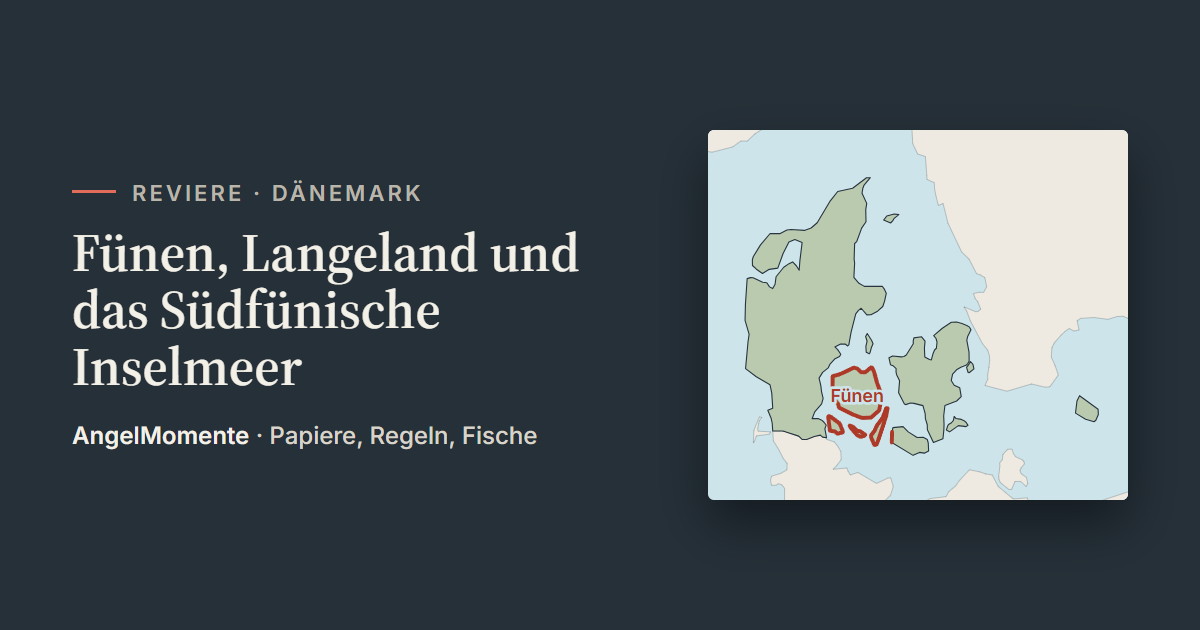
Funen lies between the Little and Great Belt, with Langeland, Ærø and the South Funen Archipelago following in the south. The coasts are mostly flat, the water is brackish. Since 1990 the island’s municipalities have been working to strengthen the sea trout.
- Papers
- Fishing licence (fisketegn), on streams and lakes the owner’s permission
As of October 2026
At a glance
- Papers
- Fishing licence (fisketegn), on streams and lakes the owner’s permission
| Fish | Minimum size | Closed season | Catch limit | Note |
|---|---|---|---|---|
| Sea trout | 40 cm | 16.11.–15.1. | – | Closed season only in spawning dress; Odense Fjord 45 cm |
| Atlantic salmon | 60 cm | 16.11.–15.1. | 1 with clipped adipose fin per day | Closed season only in spawning dress; report your catch |
| Cod | 35 cm | Fishing ban 2026 | – | also from the shore; report your catch |
| Garfish | – | none | – | |
| Herring | – | none | – | no size limit for the Belts and the Baltic Sea |
| Plaice | 25 cm | none | – | |
| Flounder | 23 cm | none | – | |
| Turbot | 30 cm | none | – | |
| Eel | – | protected all year round | – | fishing ban since 1.8.2026; report your catch |
Danish regulations for salt water in the Belts and the Baltic Sea (Nos. 791 and 1473), Funen Regulation No. 1481 and Regulation (EU) 2025/2454. As of: October 2026. The regulation and your fishing permit are what count.
Location and waters Little and Great Belt, Langeland and Ærø
Funen borders the Little Belt in the west and the Great Belt in the east. Langeland and Ærø lie to the south. The South Funen Archipelago is protected as Natura 2000 site No. 127 (Naturstyrelsen). The Little Belt between Funen and Jutland is presented in a separate profile: Lillebælt.
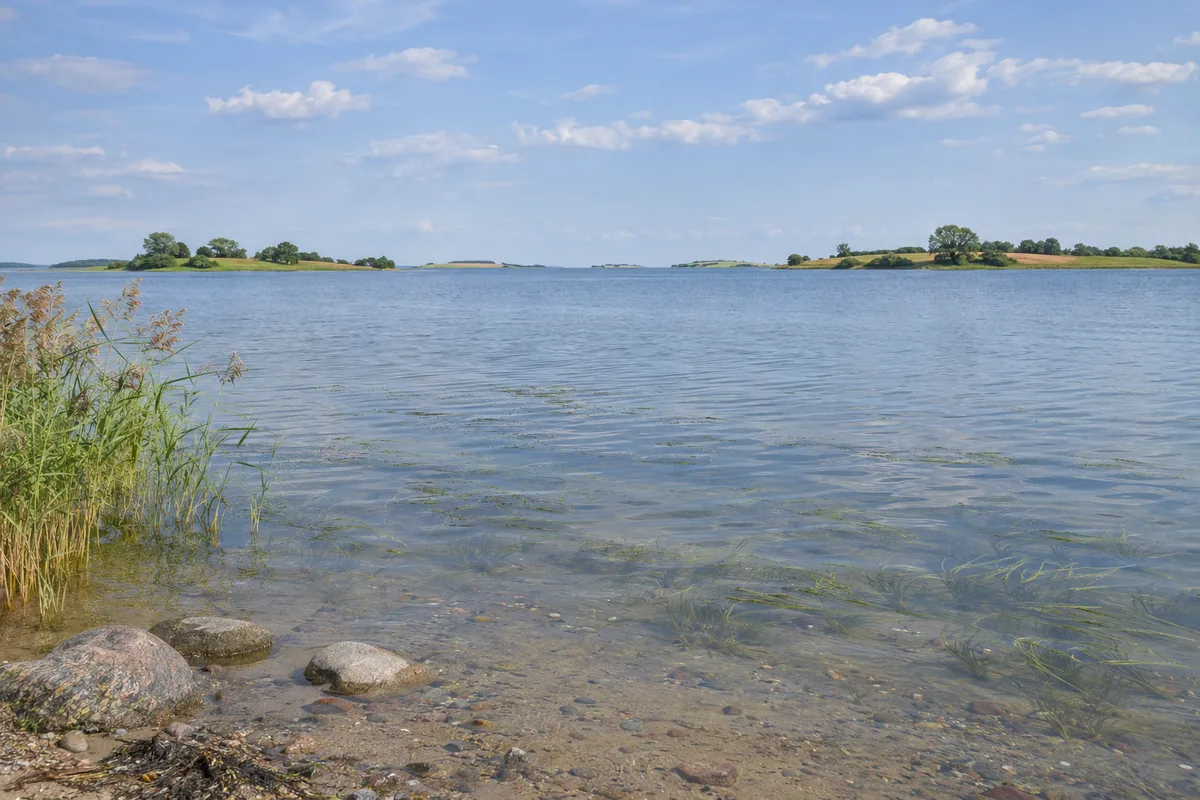
Most coasts of the inner Danish waters are flat, sheltered from the wind and brackish. The salinity lies between the Baltic Sea at 8 to 9 per mille and the open North Sea at 32 to 34 per mille, and streams and rivers dilute it further. Eelgrass meadows give small fish and crustaceans food and shelter (DTU Aqua: Küstenökologie).
Stone fishing has damaged former stone reefs. In the Little Belt the environment agency is therefore having four of them rebuilt (Miljøstyrelsen).
Fish and best time Sea trout, garfish, herring and flatfish
- Sea trout: The Havørred Fyn project of the ten Funen municipalities has opened more than 500 km of stream for spawning runs since 1990. Today 25 streams on Funen have a stock of their own (Havørred Fyn). Every year around 350.000 young sea trout are put into the water on Funen, Langeland and Ærø (stocking). Spawning takes place in the stream from October to February (DTU Aqua).
- Garfish: It usually arrives in Danish waters from mid-April to mid-June and stays until autumn. It spawns in the inner Danish waters over seaweed and eelgrass (DTU Aqua).
- Herring: In large shoals it moves into the Belts and fjords, especially at spawning time in spring and autumn (DTU Aqua).
- Flatfish: Flounder, plaice and turbot are the most common flatfish of the shallow coastal zone. They need a sandy or muddy bottom (DTU Aqua).
The catch calendar shows when each species is worth fishing for.
Papers and permission Fishing licence (fisketegn), permission at the stream
On the coast you only need the Danish fishing licence (fisketegn) from the age of 18. Purchase, prices and exceptions are covered under Fishing in Denmark. On streams and lakes the fishing right belongs to the owner of the bank, and there you also need the owner’s permission (Fischereigesetz, § 28).
Special rules Cod ban in 2026 and salmon limit
All waters around Funen, Langeland and Ærø count as the Belts and the western Baltic Sea. Sizes and closed seasons are in the box “At a glance”. In addition, these rules apply:
- Cod: Fishing for cod is banned, from the boat and from the shore. Every cod goes straight back (Regulation (EU) 2025/2454, Article 10; fisheries authority).
- Salmon: You may keep one salmon with a clipped adipose fin per day. After that, salmon fishing is over for the day. Whatever you keep when salmon fishing must stay whole until landed ashore (Article 11).
- Eel: Banned in salt and fresh water since 1 August 2026. Eels you catch go straight back (Regulation No. 670).
- Reporting your catch: You enter cod, salmon and eel in the RecFishing app on the same day, even if the fish goes back into the water (fisheries authority).
- Sea trout in winter: From 16 November to 15 January you may take only fully silver-bright fish with loose scales. Coloured fish go back gently (fisheries authority).
Protection zones (fredningsbælter): A separate regulation for Funen, Langeland and Ærø sets out in front of which river mouths you may not fish. The zone mostly extends 500 m, at the Odense Å 600 m. One part applies all year, the other from 16 September to 15 March. Some zones are larger: the harbour of Bogense is included together with 500 m in front of it, and in Holckenhavn Fjord fishing is banned entirely. There are no other protection zones on these coasts (Funen Regulation No. 1481, fisheries authority map).
Odense Fjord: In the inner fjord and in the lower reaches of the Odense Å, fishing is suspended from 1 October to the first Friday in March. Up to the line Enebærodde–Lodshuse, a minimum size (Mindestmaß) of 45 cm applies for sea trout (Funen Regulation, §§ 8 to 10 and 13).
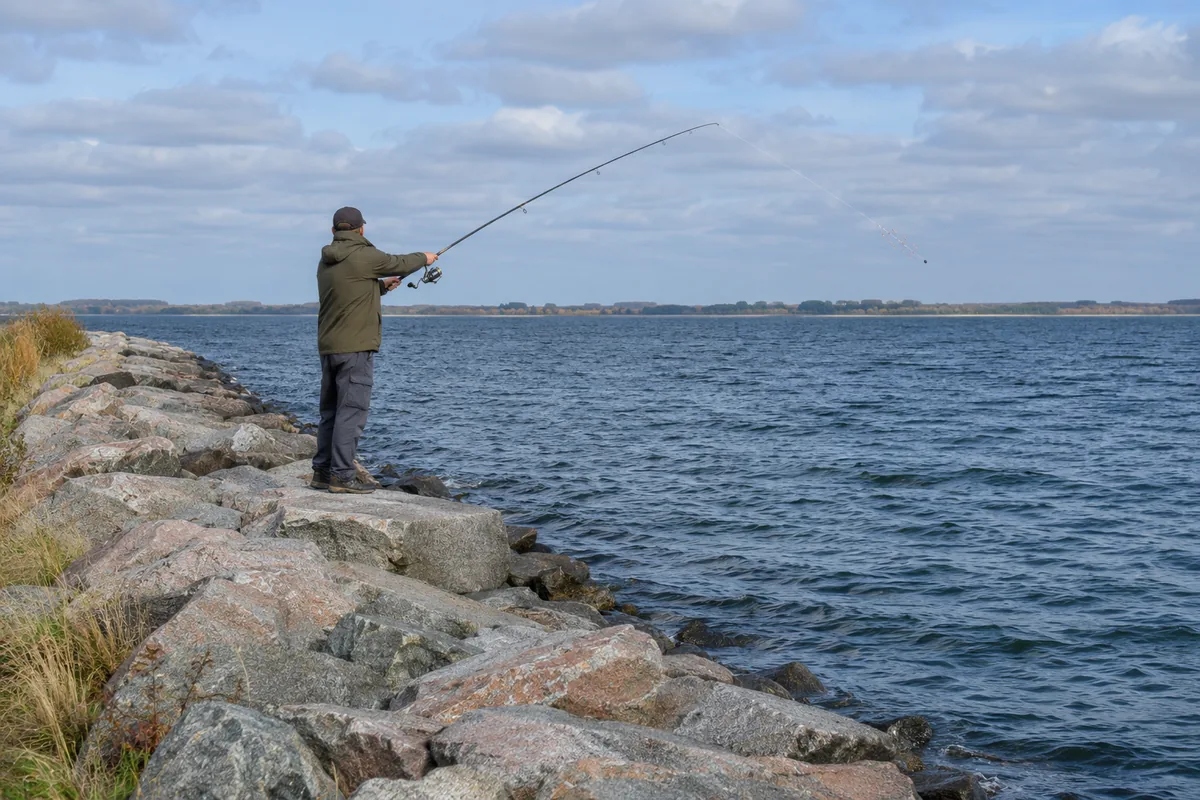
Boat and trolling: Behind a motorboat you may troll only from a distance of 100 m from the low-water line. You may spread a line out sideways only beyond 100 m and only with a device attached directly to the fishing line. Only one bait hangs on such a line (Recreational Fishing Regulation, §§ 13 and 14).
As of: October 2026. The EU rules for cod and salmon apply until 31 December 2026. The fisheries authority’s species page gives 40 cm for sea trout, the Funen Regulation 45 cm in Odense Fjord. The regulation applies.
You return undersized and protected fish at once: Releasing fish.
Safety
Tides hardly play a role on the Danish coasts, except on the west coast of South Jutland. The water level is often determined by the wind. The water temperature, too, can fluctuate strongly along the coast over the course of a day (DTU Aqua). So check the wind and your way back before wading. In the boat you carry a lifejacket or buoyancy aid for each person (Regulation No. 765). More under Shore and waders.
Related
- Fishing on the coast and in the surf and Fishing in Denmark
- Lillebælt: the Little Belt between Funen and Jutland
- Sea trout, garfish, herring and flounder in the fish encyclopaedia
- Closed seasons and minimum sizes explained and Boats and life jackets
Sources
- Verordnung Nr. 1481 über Schutzzonen bei Fünen, Ærø und Langeland (gilt seit 1. Januar 2020)
- Mindestmaße im Salzwasser, Schonzeiten im Salzwasser, Aalverbot und Verordnung über das Freizeitfischen
- Verordnung (EU) 2025/2454: Fangmöglichkeiten in der Ostsee 2026
- Fischereibehörde: Kein Dorsch, ein Lachs am Tag 2026, RecFishing, Schutzzonen und Sea trout
- fisketegn.dk (abgerufen 04.10.2026)
- DTU Aqua: Küstenökologie, Hornhecht, Hering und Trout
- Havørred Fyn: Bäche und Besatz, dazu Odense Kommune über das Projekt
- Miljøstyrelsen: Steinriffe im Kleinen Belt und Naturstyrelsen: Sydlangeland
- Fischereigesetz und Verordnung Nr. 765 über die Sicherheit auf Freizeitbooten
Guide without guarantee, as of October 2026. The Danish regulations, in particular the Funen regulation on protection zones, and the EU catch rules for the Baltic Sea in their current versions are what count.