
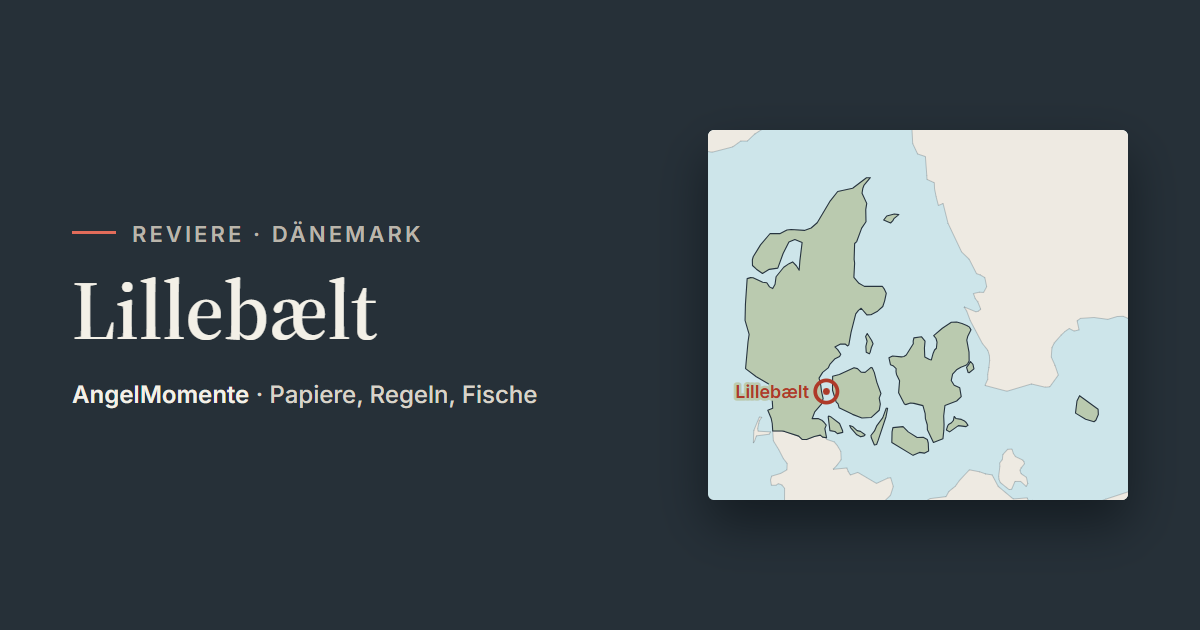
Waters · Denmark
Fishing in the Lillebælt
The Lillebælt, in German Kleiner Belt (Little Belt), separates Jutland from Funen. In the north it is a narrow, deep channel with a strong current; to the south shallow bays and fjords open up. For anglers it counts as part of the Belts and the Baltic Sea.
- Papers
- Fishing licence (fisketegn), in fresh water the owner’s permission
As of October 2026
At a glance
- Papers
- Fishing licence (fisketegn), in fresh water the owner’s permission
- Licence and permit
| Fish | Minimum size | Closed season | Catch limit | Note |
|---|---|---|---|---|
| Sea trout | 40 cm | 16.11.–15.1. | – | only fish in spawning dress protected |
| Atlantic salmon | 60 cm | 16.11.–15.1. | 1 with clipped adipose fin per day | closed season only in spawning dress |
| Garfish | – | none | – | |
| Herring | – | none | – | |
| Plaice | 25 cm | none | – | |
| Flounder | 23 cm | none | – | |
| Turbot | 30 cm | none | – | |
| Cod | 35 cm | Fishing ban 2026 | – | also from the shore; every cod goes straight back |
| Eel | – | protected all year round | – | Fishing ban since 1.8.2026 |
Danish law for the Belts and Baltic Sea (Regulations No. 791/2018 and 1473/2016) and EU catch rules 2026. Protection zones and local bans are given in the text. As of: October 2026. The regulation and your fishing permit (Erlaubnisschein) are what count.
Location and waters Middelfart, Fredericia, Kolding and Vejle Fjord
The Belt lies between the east coast of Jutland and the west coast of Funen. In the north Middelfart on Funen and Fredericia in Jutland face each other; to the west the Kolding Fjord branches off and, further north, the Vejle Fjord. The Natura 2000 site Lillebælt extends across the municipalities of Middelfart, Assens, Kolding and Haderslev (Miljøstyrelsen, baseline analysis).
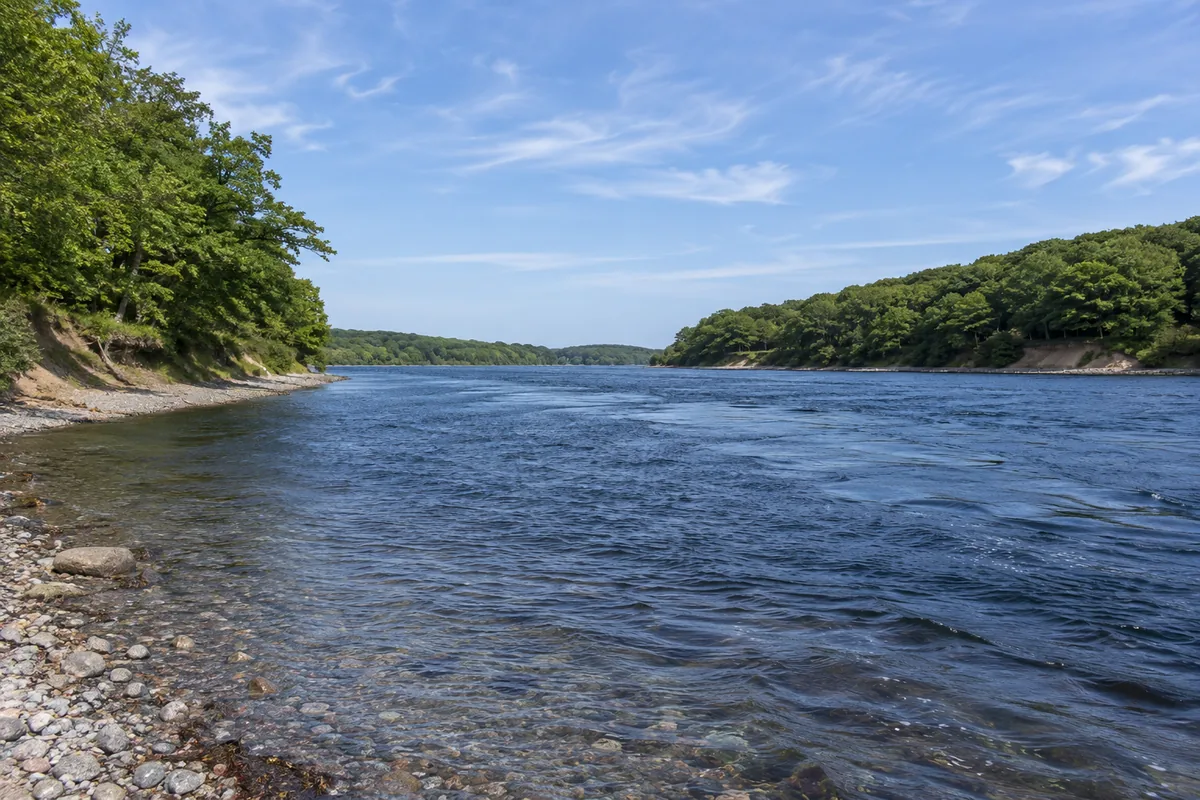
Shallow and deep areas alternate. To the north the Belt narrows into a channel resembling a river and up to 80 m deep. The strong current erodes material from the banks and deposits it elsewhere as spits and beach ridges. The rest of the sea area consists of shallow bays, sandbanks, reefs and lagoons.
Stone fishing once damaged stone reefs. The environmental agency is having four of them rebuilt in the Lillebælt (Miljøstyrelsen).
Fish and best time Sea trout and garfish
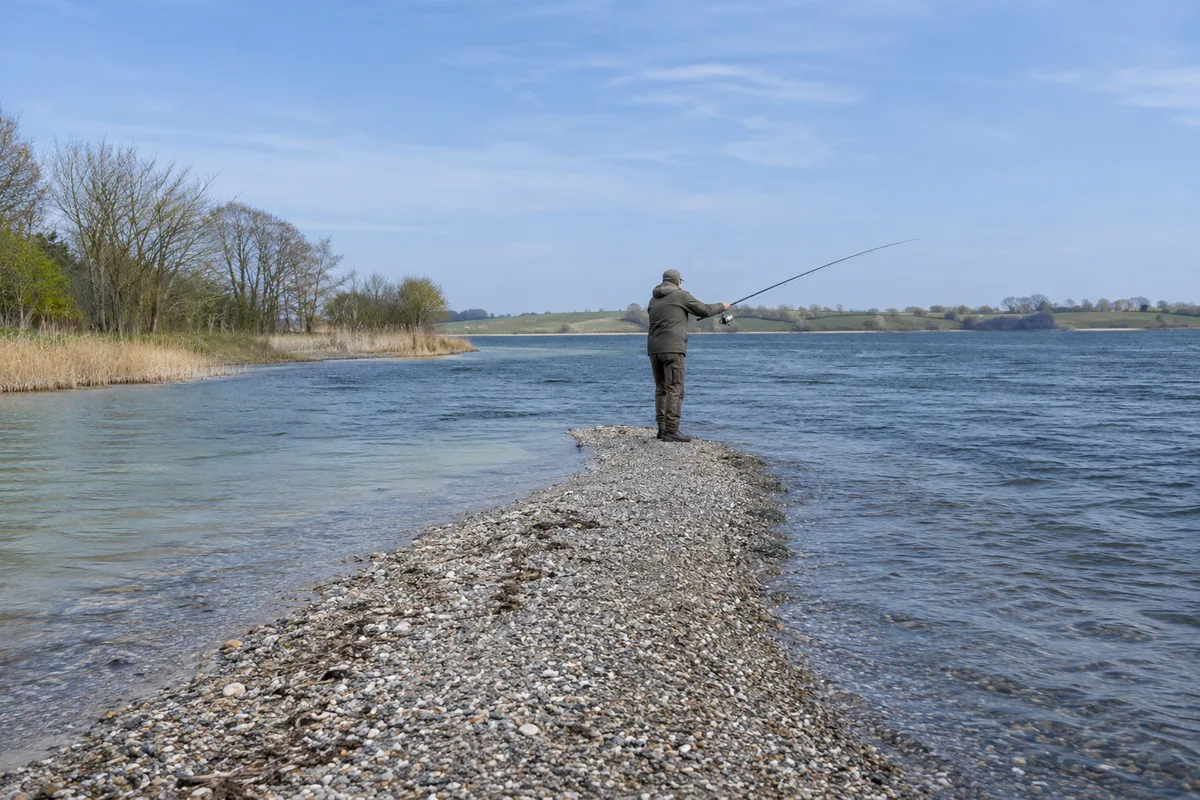
- Sea trout: On the Funen side the island’s ten municipalities have opened more than 500 km of stream to upstream migration since 1990, and today 25 Funen streams hold their own stocks (Havørred Fyn). In the stream the sea trout spawns from October to February (DTU Aqua).
- Garfish: It reaches Danish waters usually between mid-April and mid-June and stays over the summer. To spawn it looks for seaweed and eelgrass in the inner Danish waters (DTU Aqua).
- Herring: It can be found on the coast all year. It moves into the Belts and fjords in large shoals, above all at spawning time in spring and autumn (DTU Aqua).
- Flatfish: Flounder, plaice and turbot are the commonest on Danish coasts. Because they bury themselves, you find them mainly over sand and mud (DTU Aqua).
The catch calendar shows when each species is worth fishing for.
Papers and permission Fishing licence (fisketegn) from 18, registration from 67
- From the age of 18 you need the Danish fishing licence (fisketegn). Anyone who has reached Danish retirement age is exempt (Fisheries Act, § 54); fisketegn.dk gives 67 years.
- Anyone who does not need a licence registers on fisketegn.dk before fishing in salt water. The registration is valid for 365 days (fisheries authority).
- At the water you give your licence number and show valid ID (Recreational Fishing Regulation, § 10).
- In the Belt and the fjords the licence is enough. On streams and lakes you also need the owner’s permission.
Prices and purchase of the licence are covered under Fishing in Denmark.
Special rules Baltic rules: cod ban and salmon limit
Both banks of the Belt belong to the area where the Baltic rules apply in 2026. The fisheries authority names all waters around Funen, eastern South Jutland and East Jutland (fisheries authority).
- Cod: Fishing banned, from a boat and from the shore. Every cod goes straight back (Regulation (EU) 2025/2454, Article 10).
- Salmon: no more than one fish with a clipped adipose fin per person and day. Anyone fishing for salmon lands every catch whole.
- Reporting catches: If you catch a protected species, such as Baltic cod or Baltic salmon, you enter it in the RecFishing app on the same day, even if the fish goes back into the water.
- Eel: Banned in salt and fresh water since 1 August 2026 (Regulation No. 670).
- Trolling: Trolling behind a motorboat is allowed only at 100 m distance from the low-water line (Recreational Fishing Regulation, § 13).
Protection zones at river mouths: In front of stream and river mouths lie protection zones (fredningsbælter), as a rule 500 m around the mouth (map of the fisheries authority). On the Funen side, the Funen Regulation No. 1481 sets each zone. For the Jutland coast from the former boundary of Vejle County with South Jutland to the Horsens Fjord, a regulation of 1994 applies: at some of the mouths fishing is banned all year, at the others from 16 September to 15 January. In the inner Kolding Fjord and in the Vejle Fjord west of the Vejle Fjord bridge, larger areas are closed completely as an extended zone.
Vejle Fjord: In four small areas defined by coordinates, all fishing, including angling, has been banned since 2024 (Regulation No. 1657).
Porpoises: The Belt has a large population of harbour porpoises and is a Natura 2000 site partly for that reason. The regulation for marine protected areas bans bottom trawls here. For the rod it names no restriction (Regulation No. 957).
As of: October 2026. Cod and salmon rules apply for 2026 only. For the Jutland coast, the 1994 regulation gives 15 January as the end of the temporary protection zones, while the authority’s general rule gives 15 March. The regulation applies. If you want to be safe, avoid these zones until mid-March.
Minimum sizes and closed seasons are in the “At a glance” box. You return undersized and protected fish at once: Releasing fish.
Safety
In the deep channel in the north the current runs strongly. So plan boat trips with current and wind in mind; on Danish coasts the wind often decides the water level more than the tides do (DTU Aqua). In a boat you carry a lifejacket or buoyancy aid for every person (Regulation No. 765). More under Boat and life jacket.
Related
- Fishing on the coast and in the surf, Fishing from a cutter and boat and Fishing in Denmark
- Neighbouring waters: Funen and Langeland and Als and South Jutland
- Sea trout, garfish, herring and plaice in the fish encyclopaedia
- Closed season and minimum size explained
Sources
- Schutzzonen: Verordnung Nr. 163 über die Schutzzonen im Amt Vejle, Verordnung Nr. 1481 für Fünen, Ærø und Langeland, Verordnung Nr. 1657 zum Vejle Fjord und Karte der Fischereibehörde
- Mindestmaße im Salzwasser, Schonzeiten im Salzwasser, Aalverbot und Verordnung über das Freizeitfischen
- Fischereibehörde: Kein Dorsch, ein Lachs am Tag 2026, RecFishing und Sea trout; fisketegn.dk (abgerufen 04.10.2026)
- Miljøstyrelsen: Basisanalyse Natura 2000 Lillebælt 2022–27 und Steinriffe im Lillebælt; Verordnung Nr. 957 über Meeresschutzgebiete
- DTU Aqua: Küstenökologie, Hornhecht, Hering und Trout; Havørred Fyn
- Verordnung (EU) 2025/2454: Fangmöglichkeiten Ostsee 2026, Fischereigesetz und Verordnung Nr. 765 über die Sicherheit auf Freizeitbooten
Guide without guarantee, as of October 2026. The Danish regulations are what count, in particular the regulations on the protection zones on both banks of the Belt, and the EU catch rules for the Baltic Sea in their current version.