
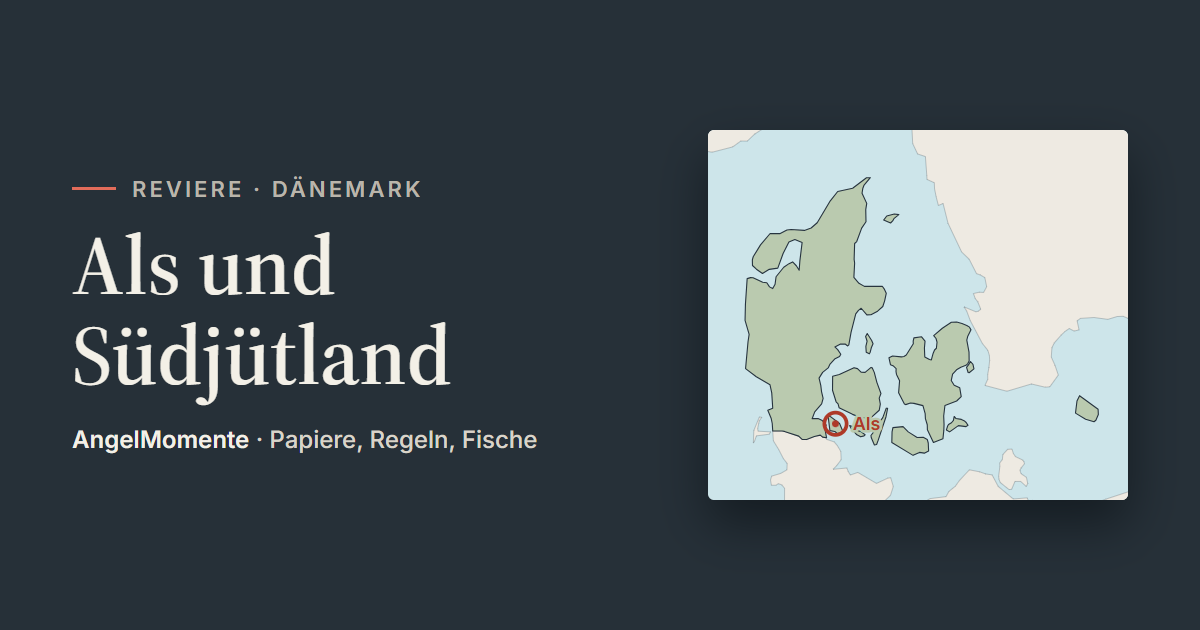
Waters · Denmark
Fishing on Als and in South Jutland
Als and South Jutland stretch along the Baltic from the Flensburg Fjord to the Haderslev Fjord. Fjords, noors and shallow bays shape the coast. The border with Germany runs through the fjord, and which licence applies depends on which side you fish.
- Papers
- DK: fisketegn; German fjord: fishing licence (Fischereischein) and fishing levy (Fischereiabgabe)
As of October 2026
At a glance
- Papers
- DK: fisketegn; German fjord: fishing licence (Fischereischein) and fishing levy (Fischereiabgabe)
| Fish | Minimum size | Closed season | Catch limit | Note |
|---|---|---|---|---|
| Sea trout | 40 cm | 16.11.–15.1. | Nybøl Nor: 2 a day | Nybøl Nor: also no more than 2 per boat; only fish in spawning dress protected |
| Atlantic salmon | 60 cm | 16.11.–15.1. | 1 with clipped adipose fin per day | closed season only in spawning dress |
| Garfish | – | none | – | |
| Herring | – | none | – | |
| Plaice | 25 cm | none | – | |
| Flounder | 23 cm | none | – | |
| Turbot | 30 cm | none | – | |
| Cod | 35 cm | Fishing ban 2026 | – | also from the shore; every cod goes straight back |
| Eel | – | protected all year round | – | Fishing ban since 1.8.2026 |
Danish side: Regulations No. 791/2018 and 1473/2016, EU catch rules 2026, Nybøl Nor under Regulation No. 1258. In German waters of the fjord the state law of Schleswig-Holstein applies. As of: October 2026. The regulation and your fishing permit (Erlaubnisschein) are what count.
Location and waters Flensburg Fjord, Als, Aabenraa, Haderslev Fjord
The Flensburg Fjord lies on the Danish-German border; its north shore and the island of Als belong to Denmark. The Nybøl Nor opens to the fjord at the Egernsund bridge (Regulation No. 1258). Further north follow the Aabenraa Fjord, the Genner Bugt and the Haderslev Fjord, then the Lillebælt adjoins.
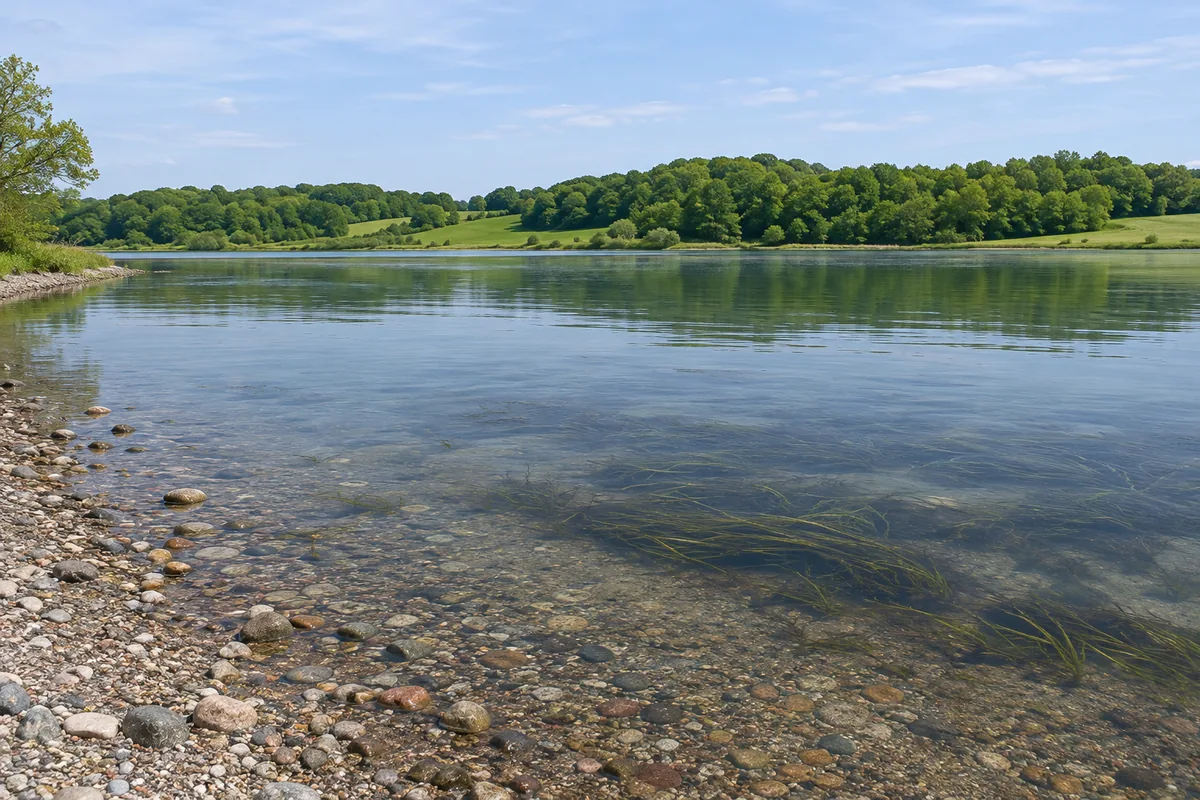
The waters around Als and the fjord are a Natura 2000 site. The regulation for marine protected areas bans bottom trawls there; for the rod it names no restriction (Regulation No. 957). As on most coasts of the inner Danish waters, the water is shallow, sheltered from the wind and brackish. Eelgrass meadows give small fish and crustaceans food and cover (DTU Aqua).
Fish and best time Sea trout, garfish and herring
- Sea trout: It runs up into the streams to spawn and spawns there from October to February (DTU Aqua). The Nybøl Nor has its own daily limit, see below.
- Garfish: It usually arrives between mid-April and mid-June and stays over the summer. It spawns in the inner Danish waters and in the Baltic Sea, readily over seaweed and eelgrass (DTU Aqua).
- Herring: It comes into the Belts and fjords in large shoals, above all at spawning time in spring and autumn (DTU Aqua).
- Flatfish: Flounder, plaice and turbot are the commonest flatfish of the shallow coastal zone. They stay mostly over sand and mud (DTU Aqua).
The catch calendar shows when each species is worth fishing for.
Papers and permission Fishing licence (fisketegn) from 18, registration from 67
- From the age of 18 you need the Danish fishing licence (fisketegn). Anyone who has reached Danish retirement age is exempt (Fisheries Act, § 54); fisketegn.dk gives 67 years. Anyone who does not need a licence registers on fisketegn.dk before fishing in salt water (fisheries authority).
- At the water you give your licence number and show valid ID (Recreational Fishing Regulation, § 10). On streams and lakes you also need the owner’s permission.
Border in the fjord: The Danish licence is valid in salt water only in the Danish fishing area (fisketegn.dk). On the German side the law of Schleswig-Holstein applies. There you need a fishing licence (Fischereischein) or holiday fishing licence (Urlauberfischereischein) on every water and always pay the fishing levy (Fischereiabgabe) (State of Schleswig-Holstein). From the shore it is mostly clear. In a boat, check the sea chart beforehand to see where the border runs on the water. If in doubt, take the papers of both countries with you. More on the German side: Baltic coast of Schleswig-Holstein and Fishing in Schleswig-Holstein.
Prices and purchase of the Danish licence are covered under Fishing in Denmark.
Special rules Cod ban, salmon limit and the RecFishing app
- Cod: In eastern South Jutland, fishing for cod is banned in 2026, from a boat and from the shore (fisheries authority, Regulation (EU) 2025/2454). On the German side of the Flensburg Fjord the ban applies equally (State of Schleswig-Holstein).
- Salmon: no more than one fish with a clipped adipose fin per person and day. Anyone fishing for salmon lands every catch whole. You enter Baltic cod and Baltic salmon in the RecFishing app on the day of the catch, even after releasing them.
- Sea trout in the Nybøl Nor: You may take no more than two per angler and day, and no more than two per boat as well. You return any others at once (Regulation No. 1258, § 4).
- Eel: Banned in salt and fresh water since 1 August 2026 (Regulation No. 670).
- Trolling: Trolling behind a motorboat is allowed only at 100 m distance from the low-water line (Recreational Fishing Regulation, § 13).
Protection zones at river mouths: In front of stream mouths lie protection zones (fredningsbælter) in which you may not fish. For the Danish side of the fjord and the waters around Als, a separate regulation sets 500 m around the mouth: at nine streams all year, at twenty more from 16 September to 15 March. Extended all-year zones apply at two noors on Als (Regulation No. 619). In the Aabenraa Fjord there are four all-year zones and four more that begin two months before the closed season for coloured sea trout and end with it, currently from 16 September to 15 January (Regulation No. 11). On the other coasts the authority’s rule applies: 500 m, all year at mouths 2 m wide or more, otherwise from 16 September to 15 March (map of the fisheries authority).
Schleswig-Holstein also has protected areas in its coastal waters. They are signposted on site (state leaflet).
As of: October 2026. Cod and salmon rules apply for 2026 only. All values in the “At a glance” box apply to the Danish side. In German waters the sizes and closed seasons of Schleswig-Holstein apply.
You return undersized and protected fish at once: Releasing fish.
Safety
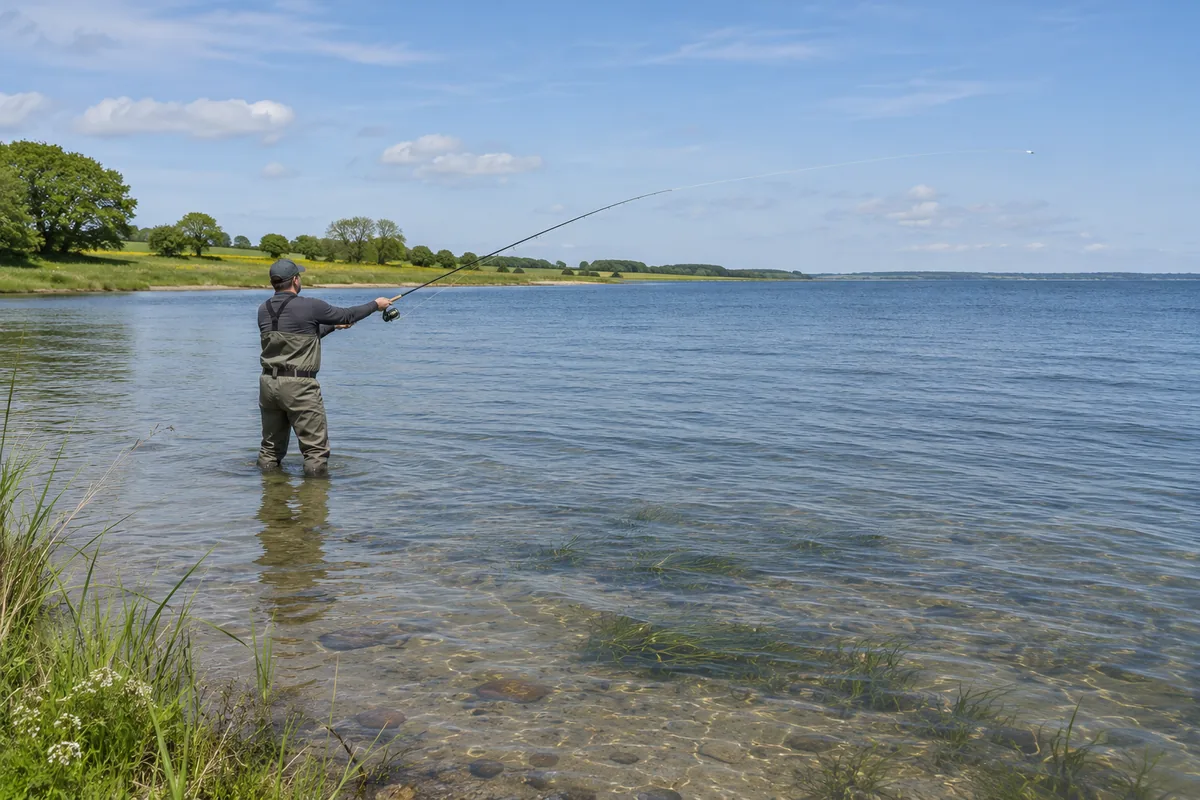
Ebb and flood play hardly any role on this coast. The water level is often determined by the wind (DTU Aqua). So check the wind and your way back before wading. In a boat you carry a lifejacket or buoyancy aid for every person (Regulation No. 765). More under Shore and waders.
Related
- Fishing in bays and fjords, Fishing on the coast and in the surf and Fishing in Denmark
- Neighbouring waters: Lillebælt, Funen and Langeland and Baltic coast of Schleswig-Holstein
- Sea trout, garfish, herring and flounder in the fish encyclopaedia
- Closed seasons and minimum sizes explained and Boats and life jackets
Sources
- Schutzzonen und Regeln vor Ort: Verordnung Nr. 619 für Flensborg Fjord und Als, Verordnung Nr. 11 für den Aabenraa Fjord, Verordnung Nr. 1258 für das Nybøl Nor und Karte der Fischereibehörde
- Mindestmaße im Salzwasser, Schonzeiten im Salzwasser, Aalverbot, Verordnung über das Freizeitfischen und Verordnung Nr. 957 über Meeresschutzgebiete
- Fischereibehörde: Kein Dorsch, ein Lachs am Tag 2026 und RecFishing; fisketegn.dk (abgerufen 04.10.2026)
- Land Schleswig-Holstein: Hinweise für Angler, Dorsch und Merkblatt zum Urlauberfischereischein
- DTU Aqua: Küstenökologie, Hornhecht, Hering und Trout
- Verordnung (EU) 2025/2454: Fangmöglichkeiten Ostsee 2026, Fischereigesetz und Verordnung Nr. 765 über die Sicherheit auf Freizeitbooten
Guide without guarantee, as of October 2026. The Danish regulations are what count, in particular the regulations on the protection zones in the Flensborg Fjord, around Als and in the Aabenraa Fjord, the EU catch rules for the Baltic Sea and, on the German side, the state law of Schleswig-Holstein, in their current version.