
Fishing waters · Norway
Fishing holiday in Norway
A fishing holiday in Norway usually means sea fishing, and with a rod no state fee is charged for it. You may take fish home only if you fished through a registered business.
- Rivers
- 11.525
- Streams
- 31.462
- Lakes and reservoirs
- 69.676
- Canals
- 65
- Regions in the water atlas
- 15
As of October 2026 · waters with a name in OpenStreetMap, as of 3 October 2026
The key points in brief
Sea
You fish without a fishing licence (Fischereischein) and without a fee. Guests from abroad may use only a rod or hand line.
River and lake
You need the fishing permit (fiskekort, Erlaubnisschein) from the rights holder. For salmon, sea trout and migratory char (sjørøye) you also pay the state fishing levy (fiskeravgift, Fischereiabgabe) from the age of 18.
Exporting fish 2026
15 kg per person, no more than twice per calendar year, from the age of 12 and only with the document of a registered tourist fishing business. From 1 January 2027 it will be 10 kg.
The 62° N line at Stad
North of it, larger minimum sizes (Mindestmaße) apply for cod and haddock. South of it, halibut is banned all year.
Fresh water
Dry or disinfect your tackle before using it on another water.
Boat
In boats under 8 m everyone wears a life jacket while under way.
As of October 2026. Norway changes quantities, sizes and closed seasons regularly, and the export quantity falls as early as 1 January 2027. The linked regulations and the pages of the Norwegian authorities are authoritative.
Which papers where?
On the left is where you fish, on the right what you need for it. The details are further down this page.
- At seaNo fishing licence, no fee. As a guest from abroad you fish only with a rod or hand line.
- River and lakeFishing permit (fiskekort) from the rights holder.
- Salmon, sea trout, sea-run Arctic charFishing permit and, from the age of 18, also the state fishing levy (fiskeravgift).
- Exporting fishOnly with the document of a registered tourist fishing business.
At sea
Fishing at sea
- Only hand-held tackle is allowed, that is a rod and hand line. Nets, traps, baskets and longlines are banned for guests from abroad (Fiskeridirektoratet, German version).
- You may not sell your catch (Fiskeridirektoratet).
- Live animals and fish are banned as bait at sea (Fiskeridirektoratet).
- Keep at least 100 m away from fish farms when fishing and 20 m when passing (Verordnung über den Betrieb von Aquakulturanlagen, § 18).
- Registered businesses report their guests‘ catches to the Fiskeridirektorat every day. Tell your business what you caught so that the report is correct.
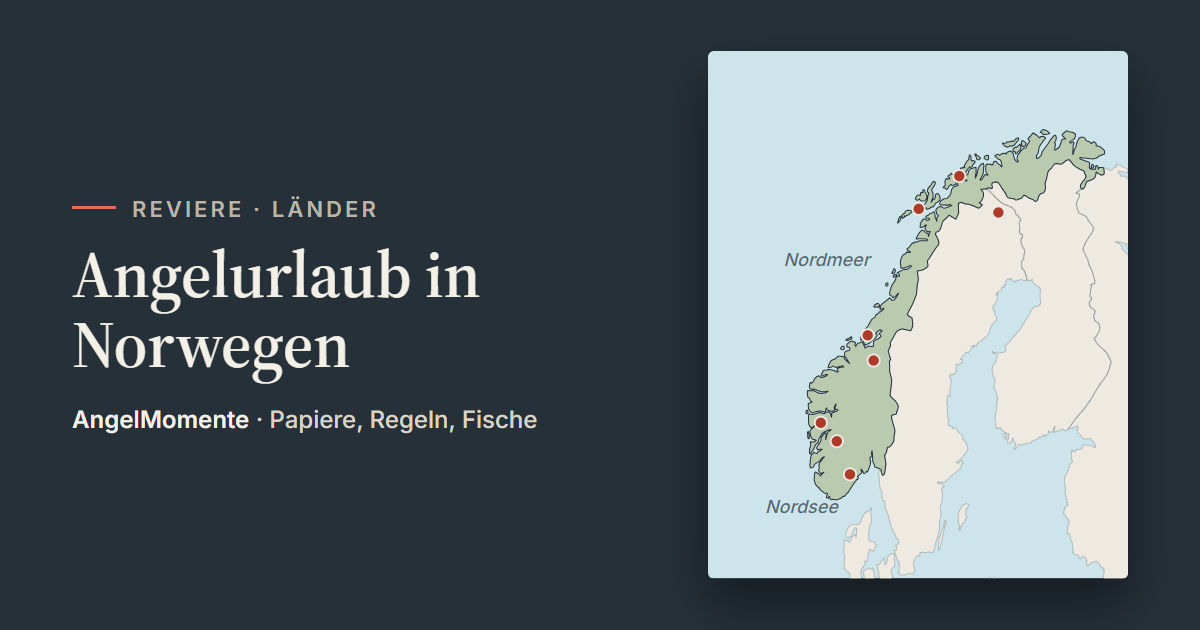
The parts of the country
Each profile describes the coast or waters, the fish recorded there, protected areas and the rules that apply there in addition.
Southern Norway
With Kristiansand, the Skagerrak coast and the Oslofjord: the shortest journey, but the strictest rules for cod and halibut.
Western Norway
Around Bergen: the great fjords, mostly south of the line at Stad.
Central Norway
Around Trondheim with Hitra and Frøya: north of the line at Stad, so the larger minimum sizes for cod and haddock apply.
Northern Norway
From Bodø to the North Cape.
Lofoten and Vesterålen
The island chains off the coast of Nordland.
Senja and Tromsø
The coast of Troms with the island of Senja and the fjords around Tromsø.
Salmon rivers in Norway
Fishing permit, fishing levy and season on the rivers with salmon and sea trout.
Inland lakes and fjell
Lakes and streams inland and in the uplands, where you fish with the rights holder’s permit.
Location maps: AI-generated, outlines from Natural Earth (public domain)
Fishing without a fishing licence
At sea in Norway you fish without a fishing licence (Fischereischein). With a rod or hand line you need no fishing permit (Erlaubnisschein) there and do not pay the fishing levy (Fischereiabgabe). This applies even if you target salmon at sea (Miljødirektoratet). Minimum sizes (Mindestmaße), closed seasons and the rules for guests from abroad apply regardless.
Fresh water is different. For every river and every lake you buy a fishing permit from the holder of the fishing right. If you fish for salmon, sea trout or migratory char in a river or lake, the fishing levy to the state is added from the age of 18. The levy alone does not yet entitle you to fish a particular water; you always need the permit as well (Lachs- und Binnenfischereigesetz, § 30).
Minimum sizes at sea
Measure from the tip of the snout to the end of the tail fin. The sizes are set out in the catch regulation (høstingsforskriften, chapter 10) and on the Fiskeridirektorat overview.
- Cod: north of 62° N, 55 cm within 4 nautical miles of the baselines and 44 cm further out; south of 62° N, 40 cm. In the fjord and close to the coast, 55 cm therefore applies.
- Haddock: 40 cm north, 32 cm south of 62° N
- Halibut: 84 cm. The minimum weight of 7,2 kg applies only to fish that is sold.
- Redfish: 32 cm within 12 nautical miles of the baselines, 30 cm further out
- Plaice 29 cm, whiting 32 cm
- Sea trout at sea: 35 cm, in Nordland, Troms and Finnmark 30 cm
- No minimum size for recreational anglers: coley and mackerel, as long as you do not sell them, as well as pollack, tusk and Atlantic wolffish
Undersized fish you release with wet hands and as gently as possible. If the fish is dead or no longer viable, you may eat it. How to release fish successfully is explained under Releasing fish.
Closed seasons and bans
- Halibut: South of 62° N, fishing for halibut is banned all year; north of it, from 20 December to 20 April. Viable fish are released during that time and in that area. Halibut over 2 m always goes back into the water, even if dead (Fangverordnung § 39, Fiskeridirektoratet).
- Oslofjord: Cod is banned all year, and fishing is with hand tackle only. In three zones, all fishing has been prohibited since 1 January 2026 (rules for the Oslofjord).
- Skagerrak coast: In the designated cod spawning areas from Lindesnes to the Swedish border, all fishing is banned from 1 January to 30 April.
- Protected all year for guests are, among others, eel, blue ling, spiny dogfish, porbeagle, basking shark, bluefin tuna, wrasse and lobster. Lobster may be caught only with lobster pots, and these are banned for guests from abroad (Fiskeridirektoratet, Hummerverordnung § 4).
- Redfish: North of 62° N it is protected. The only exception is fishing with the jukse (hand line or pilk machine) from 1 June to 31 August (Fiskeridirektoratet).
- King crab: Catching it yourself is not permitted for guests. In Finnmark, individual businesses have a quota of their own (Fiskeridirektoratet).
Oslofjord: check the bans on the official map
In the Oslofjord a separate regulation on fishing in the Oslofjord applies. It counts the whole sea inside the baseline as the Oslofjord, from Telemark to the border with Sweden (§ 2). The Fiskeridirektoratet shows the boundaries in two maps on its page for recreational anglers in the Oslofjord. There is also a poster of the no-fishing zones as a PDF, which I save for spots without mobile signal. This is how I check a spot:
- Red line: On the first map it marks the boundary of the Oslofjord. If your spot lies inside it, the cod ban and the rule to fish only with hand-held gear apply (see “Closed seasons and bans”).
- Hatched areas: These are the three no-fishing zones in the inner fjord, at Færder and at Hvaler. All fishing is banned in them, including for sea trout and salmon. Only children may catch crabs with a line (§§ 7 and 8).
- Inner fjord: The zone begins in the south at a line across the fjord at about 59° 25′ N, roughly level with Horten. All water north of it is included, as far as Oslo and into the Drammensfjord.
- Færder: In Bjørnebysundet, Ekenessundet and Vrengen the boundary runs at the bridges.
- January to April: The second map shows the cod spawning areas. All fishing is banned there from 1 January to 30 April. In the Oslofjord the regulation names the inner fjord, Frebergsvik, Mossesundet, Sletterhausen, Hvaler, Fossingfjorden and Skåtøysund (§ 5). Outside the no-fishing zones, fishing for salmon and sea trout remains allowed there.
- Coordinates: The coordinates in the regulation and in the regulation on spawning areas are binding, not the line on the screen. If my spot is close to a boundary, I fish a little further outside.
- Violations: They can lead to a fine (overtredelsesgebyr) or a penalty under the Marine Resources Act (§§ 12 and 13).
What the coast looks like there and which species are recorded is described in the profile Southern Norway and the Oslofjord.
As of: October 2026. The Oslofjord regulation applies from 1 January 2026 to the end of 2035 and was last amended on 8 October 2026. The current version on lovdata.no is authoritative.
Salmon and sea trout at sea
With a rod and hand line you may in principle fish at sea all year for salmon, sea trout and migratory char, from the shore as well as from a boat (Verordnung über den Fang von Lachsfischen im Meer, § 2). There are exceptions:
- From 1 March to 30 April this fishing is suspended in parts of the Ryfylke fjords, in the inner Hardangerfjord and in Møre og Romsdal except Smøla. In Trøndelag the ban runs from 1 March to 31 May; in Nordland it applies in the same period to fishing from a boat.
- On the coast of Finnmark, fishing for salmon at sea is not open. In the zero-fishing zones of the Oslofjord it is banned entirely.
- In front of the mouth of a salmon river, all fishing is banned within 100 m. Only fishing from the shore is allowed there, as long as the river is in season (§ 3).
- From a boat, two rods or hand lines per boat are allowed, with only one lure on each. The county governor (Statsforvalter) and the municipalities may issue stricter local rules (Fiskeridirektoratet).
Taking your catch home: export in kg
Sea fish may leave Norway only if you fished through a registered tourist fishing business (turistfiskevirksomhet). Anyone who fishes on their own, for example from a campsite, may eat the catch on the spot but may not export sea fish (Ausfuhrverordnung, § 2, version of 1 January 2026).
- 2026: 15 kg of fish or fish products per person, fillets included, no more than twice per calendar year. You must be at least 12 years old (Fiskeridirektoratet, Norwegian customs).
- From 1 January 2027: 10 kg, still no more than twice per calendar year.
- At the border you show a document from the business in your name, with date of birth, home address and the period of stay and fishing. Collective documents for groups are not valid.
- You must be present yourself when leaving the country. You may not take fish for others who are not travelling with you.
- An extra trophy fish on top of the quantity is not allowed.
- Salmon, trout, char and other freshwater fish that you caught yourself do not count towards the quantity and may be taken.
- You may export fish you have bought if you can prove the purchase from a registered shop. Goods worth more than 5.000 kroner per person must be declared to customs.
- If customs finds more than allowed, they confiscate all the fish and report you. The Fiskeridirektorat gives a fine of 8.000 kroner plus 200 kroner per kilogram (Fiskeridirektoratet).
How the catch survives the journey home is covered under Storage and hygiene.
In rivers and lakes
- The fishing permit (Erlaubnisschein) is issued by the holder of the fishing right: landowner, municipality, mountain administration (fjellstyre), landowners‘ association or angling club. You learn the local rules when you buy the permit (Miljødirektoratet).
- You pay the fishing levy (Fischereiabgabe) from the age of 18 if you fish for salmon, sea trout or migratory char in a salmon water. It is not charged for inland fish such as resident trout and char, unless you fish in a salmon water while the salmon season is running there. Anyone who fishes for salmon without paying the levy risks a fine of 3.000 kroner.
- You fish for salmonids only with a rod and hand line. Worm, spoon, spinner, crankbait and fly are allowed as lures, though local differences are possible. Each river sets its own season; in most it starts on 15 June or later (Norwegian Environment Agency).
- Fish as bait is banned in fresh water. Dead fish from the same water is the exception (Lachs- und Binnenfischereigesetz).
The salmon parasite Gyrodactylus salaris travels from water to water on wet gear, in water and in fish. That is why you dry or disinfect your rod, landing net, waders, boat and life jacket before using them on another water or at another spot on the same water. Drying is enough if the gear dries out completely for at least two days at 20 °C or more. If it comes from a restricted zone for Gyrodactylus or crayfish plague, you must disinfect it. Offences are punishable (Mattilsynet). After fishing in Sweden or Finland, you also dry and disinfect that gear (Mattilsynet: Gyrodactylus salaris).
Children and young people
- Nobody under 18 pays the fishing levy. In rivers with salmon, sea trout and migratory char, however, children need a fishing permit too.
- Anyone under 16 fishes for inland fish free of charge with a rod and hand line from 1 January to 20 August. Where the rights holder issues permits, the child gets a free permit; otherwise it needs no permission. This does not apply in salmon waters and artificial ponds (Lachs- und Binnenfischereigesetz § 18).
- Only people aged 12 or over may export fish.
- In the zero-fishing zones of the Oslofjord, crabbing with a hand line remains allowed for children.
- A boat with more than 10 hp may be steered only by someone aged 16 or over (Verordnung über Freizeitboote).
Buy the fishing permit and levy online
- Fishing levy: You pay it online to the Environment Agency (fiskeravgift.miljodirektoratet.no). Take the receipt with you as a printout and show it at a check. In October 2026 it costs 347 kroner for one person over 18 and 554 kroner for a family. If a trip is cancelled, there is no refund.
- Fishing permit: You can often buy fishing permits online. The Environment Agency refers to Inatur.no for this, which has permits for many salmon rivers. The receipt then counts as the permit. If you cannot find your water there, buy the permit directly from the rights holder or on the spot.
In the boat
- In leisure boats under 8 m everyone wears a life jacket on deck while the boat is moving. This also applies in a hired boat (Sjøfartsdirektoratet).
- At the helm of a motorboat, anyone over 0,8 per mille is always considered unfit to drive (Kleinbootgesetz).
- Anyone born on or after 1 January 1980 needs a boat licence for boats over 8 m or with more than 25 hp. Licences from the European Economic Area are recognised according to their content (Verordnung über Freizeitboote).
More on this: Boat and life jacket.
Related
- Water atlas: Norway: all rivers, streams and lakes on one map
- sea fishing and the Natural bait rig
- Fishing in the Bodden and fjord and Fishing from a charter boat and a boat
- Catch calendar with the sea species
- Other countries: Fishing in Sweden, Fishing in Denmark and Fishing in Germany
Sources
- Ausfuhrverordnung für Fisch aus dem Sportfischen (Fassung vom 01.01.2026), Fiskeridirektoratet: Ausfuhrmenge (26.05.2026) und norwegischer Zoll: Fisch ausführen (03.06.2026)
- Fiskeridirektoratet: Meeresangeln in Norwegen (deutsch, 26.05.2026) und geschützte Arten (04.08.2026)
- Fangverordnung (høstingsforskriften), Mindestmaße (zuletzt geändert 14.09.2026)
- Verordnung über den Fang von Lachsfischen im Meer (Fassung vom 01.01.2026)
- Lachs- und Binnenfischereigesetz (Fassung vom 01.07.2025)
- Miljødirektoratet: Fischereiabgabe und Angelkarte (13.04.2026)
- Mattilsynet: Gerät trocknen und desinfizieren (17.08.2026)
- Sjøfartsdirektoratet: Schwimmweste im Boot
- Verordnung über die Fischerei im Oslofjord (zuletzt geändert 08.10.2026), Verordnung über Laichgebiete des Dorschs und Fiskeridirektoratet: Oslofjord für Freizeitangler mit Karten (abgerufen 28.10.2026)
Guide without guarantee, as of October 2026. The Norwegian regulations in their current version and the conditions on your fishing permit are authoritative.