
Knowledge – Fish
Halibut: Features, way of life, fishing in Norway
The Atlantic halibut (Hippoglossus hippoglossus) is the largest flatfish in the world. It lives on the bottom of the North Atlantic but also hunts in open water. Because it grows slowly and matures late, the species copes poorly with fishing, and anglers in Norway have to follow strict rules.
In short: You catch halibut best from May to June. Good spots on the coast: sandy bottom, edge and open water. Proven baits: large soft plastics (shads) or a whole baitfish. In Norway the halibut is protected all year south of Stad (62° N), and north of it from 20 December to 20 April; one area on the Sklinnabanken is closed all year. Minimum size (Mindestmaß) 84 cm, fish over 2 m must go back into the sea (as of October 2026). Step by step: Halibut fishing in Norway.
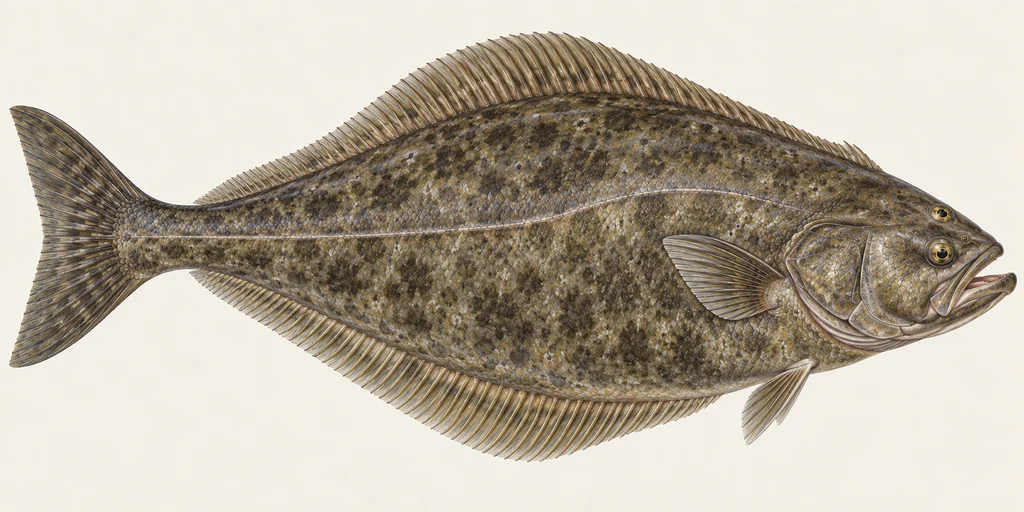
- Elongated, powerful body with a large, wide-gaping mouth
- Both eyes lie on the right side of the body
- Triangular, slightly notched tail fin
Catch chances through the year
- Hardly any chance
- Possible
- Good
- Peak season
- Spawning (observe the closed season)
Editorial assessment for waters in Germany, not a measured value and no guarantee. Spawning time is not the same as the legal closed season.
Species profile and sources in the catch calendarAll species compared month by monthThe rules of your federal state
How to recognise it
The halibut is a right-eyed flatfish: both eyes sit on the upper side, and that side is the right one. It is long and slim, less round than other flatfish. In addition it has a large, wide-gaping mouth, a curved lateral line and a notched tail fin. According to the US fisheries agency NOAA, these features separate it from other right-eyed flatfish.
The eyed side is dark brown to olive-grey, the blind side pale. Young halibut have paler spots or a marbled pattern on top. Norwegian marine researchers give up to three metres and 300 kilograms for females, and more than one and a half metres and up to 50 kilograms for males. Such giants are very rare today.
Age, too, has to be read with caution. Around 38 years are documented, a maximum age of about 50 years is estimated, but in today’s stock animals over 35 years are rare. In Norway the fish is called kveite.
The Greenland halibut (Reinhardtius hippoglossoides) stays much smaller, at about one metre and 20 kilograms. Unlike the other flatfish of Norway it is also coloured on the blind side. It lives mainly in cold water below four degrees and usually deeper than the Atlantic halibut.
Plaice and flounder look rounder by comparison and come nowhere near it in size. Anyone playing a large, slim flatfish with a gaping mouth in Norway has a halibut on the line.
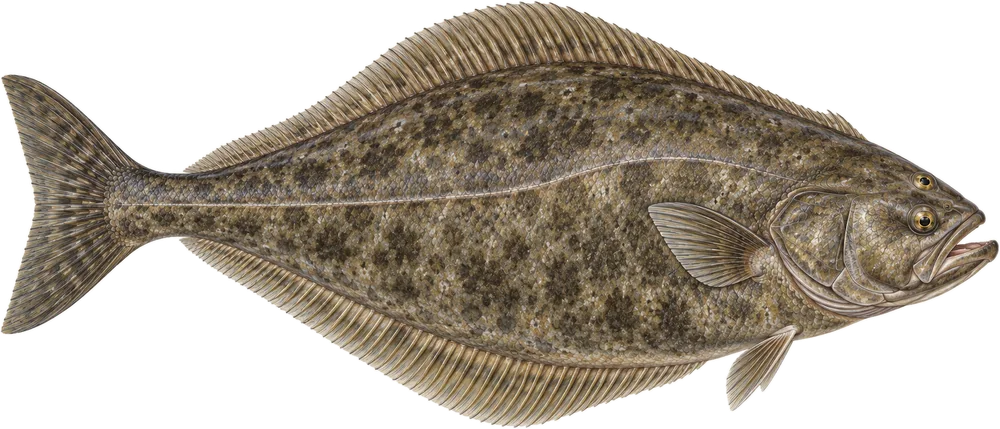
Side by side
AI-generated illustrations.
Where it holds
The halibut occurs on both sides of the North Atlantic, in Europe from Spitsbergen and Iceland to the Bay of Biscay. It is also found in the North Sea and the Skagerrak; in the Baltic Sea it is rare and appears only occasionally in the south-west.
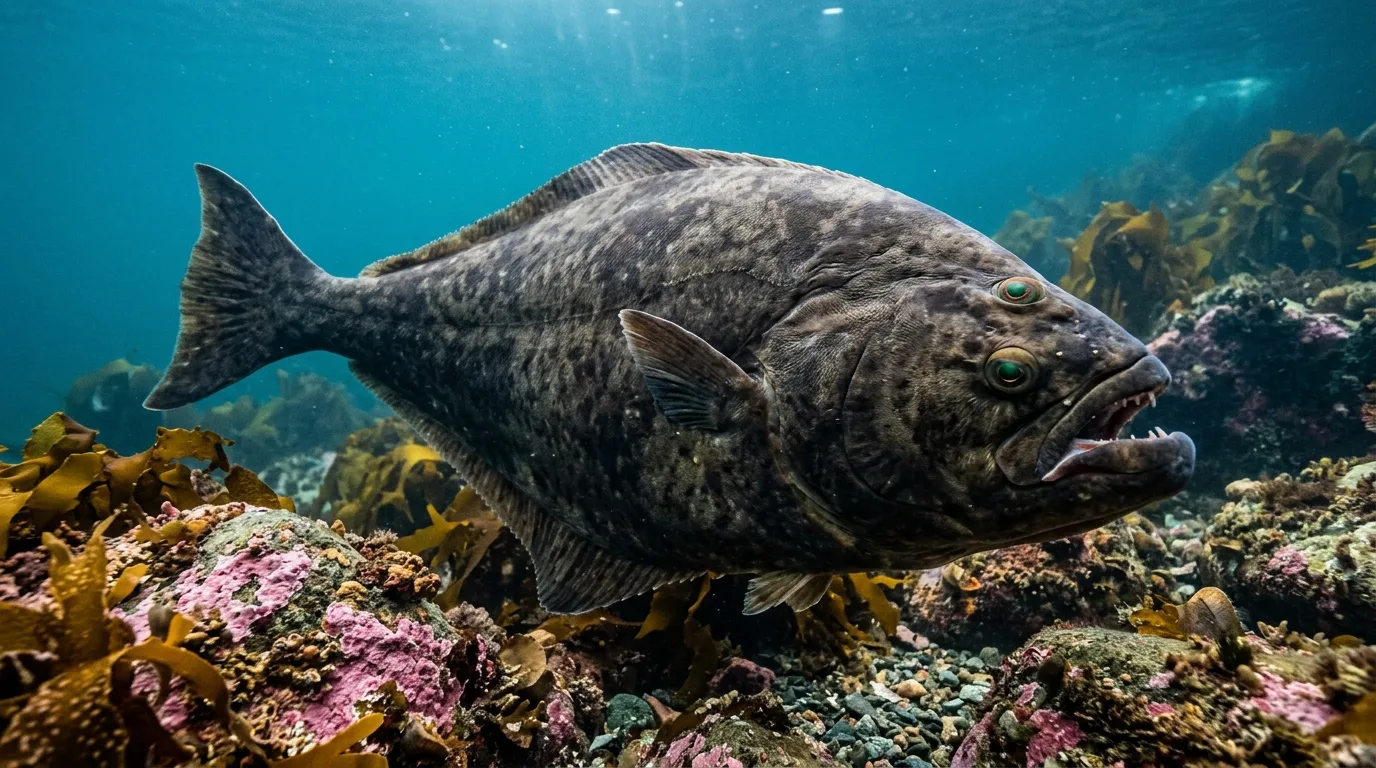
As a bottom fish it stays on or just above sand, gravel and clay, according to FishBase at depths of 50 to 2000 metres. Swedish sources also mention rocky, stony and muddy bottoms. There it often lies buried so that only the eyes show.
Young halibut live close to the coast in fairly shallow water, large fish stand in fjords and on the open sea. The fish are largely site-faithful. They do, however, move between deep spawning grounds in winter and shallower feeding grounds in summer. Tagging trials from Norway show that individual fish can migrate far, for example from north to south.
Holding spots in the picture
Choose the season and time of day: the picture shows where the species stands then. Spots outlined in red apply only in the chosen season. Tap a fish or a spot in the list to bring it closer. The picture is schematic and AI-generated, every water is different.
Catch chance in springpossibleSpawning season, observe closed seasons
Catch chance in summergood
Catch chance in autumngood
Catch chance in winterslimSpawning, observe closed seasons
- J
- F
- M
- A
- M
- J
- J
- A
- S
- O
- N
- D
Spawning season
Time of day There is no uniform day-night pattern in the halibut: tagged fish were partly more active by day, partly at night, and activity by day occurred most often in spring and summer.
On the coast
Sandy bottom
Halibut are found here only in spring, summer and autumn.
Drop-off
Halibut are found here only in spring, summer and autumn.
Deep, colder water
Halibut are found here only in winter.
Open water, mid-water
Halibut are found here only in spring, summer and autumn.
The halibut lives on the bottom, on soft as well as hard ground, and at times hunts in open water. Sand and gravel flats, channels and edges, and places where different bottoms border each other are worthwhile. It is especially active in current and around the change of tide.
Spring: catch chance according to the catch calendar slim in March, possible in April, peak season in May. This is when spawning falls, so observe the closed seasons. May and June are among the productive months in Norway.
Summer: catch chance according to the catch calendar peak season in June, good in July and August. In summer the halibut holds on shallower feeding grounds. It is often caught shallower than expected, individual large fish in only a few metres of depth.
Autumn: catch chance according to the catch calendar good in September and October, possible in November. Fish are caught well into autumn; the warm half of the year ends for anglers at the end of October.
Winter: catch chance according to the catch calendar possible in December, hardly any in January and February. Spawning falls in this period, so observe the closed season (Schonzeit). In winter the big fish move down to spawn, into the hollows on the offshore banks and into the fjords.
Depth: Young halibut live along the coast in fairly shallow water. They are often caught at 10 to 50 metres, and spawning takes place in winter at 300 to 700 metres.
Size comparison: AI-generated drawing, schematic.
How it hunts and spawns
The halibut is an out-and-out predator. It eats cod, haddock, sand eel, herring and capelin, plus squid and large crabs. Young fish up to about 30 centimetres live almost entirely on invertebrates. The share of fish rises with size, and from around 80 centimetres they eat almost nothing but fish.
It hunts close to the bottom, lying horizontally. But it also hunts in open water, according to Swedish sources sometimes right up to the surface, and then stands upright. For the angler that means the bait does not always have to lie on the bottom.
Spawning takes place in winter, from December to March according to the Norwegian marine research institute, up to April according to FishBase, at depths of 300 to 700 metres and 5 to 7 degrees. The fish gather in hollows on the fishing banks and in fjords. There they are easy prey, and that is exactly why the winter closed season exists. A large female lays several million eggs. They rise to the surface, and the larvae later change into flatfish: eyes, organs and mouth move to one side of the body.
Maturity comes late. According to Norwegian marine researchers, males mature at about 7 years and 70 centimetres, females at about 9 years and 100 centimetres. Swedish sources give 12 to 13 years at 125 centimetres as the most common value for females. FishBase rates the species‘ vulnerability to fishing as very high.
When it bites
Good catches come from the end of April to October. Blinker names May and June as the best months in Norway, and good fish are still caught in many places into September. North of Stad you may fish for halibut again from 21 April, and from 20 December it is protected; south of it, it is protected all year. In winter the big fish disappear into the depths to spawn. That fits the migrations: in summer they stand shallower on their feeding grounds and are within reach of boat anglers.
How much of it you can use is determined by Norway through the winter closed season and the areas where targeted fishing is allowed. Details are in the rules below.
Today’s catch index needs JavaScript. Season and spawning time are in the catch calendar.
You will find the monthly overview of all species and the water temperature check in the catch calendar.
What you catch it with
Step by step: Halibut fishing in Norway: baits, depth & rigs – season, spots, bait, tackle and rules on one page.
Halibut are fished for almost always from a boat and on the troll. In western Norway large baits are the norm, preferably a whole mackerel. A proven rig carries three hooks at different heights: the lowest holds the whole mackerel, the other two often carry only a large black rubber worm or a big piece of fish strips. The basics are shown in the natural bait rig.
When trolling, the running depth is changed constantly, from the bottom to about twenty metres above it. The weight is one to two kilograms depending on the weather. Halibut are also caught when jigging with a pilker, using large chrome-coloured pilkers whose treble also carries a piece of fish strips.
The tackle has to suit the fish. With light jigging gear you have no chance against a fully grown halibut. According to Blinker, Norwegian experts fish with 50 lb boat rods (that is the line class for heavy sea tackle) and braided line of 0.40 millimetres, which holds over 30 kilograms, on multiplier reels in size 6/0 or 9/0. More on sea rods, multiplier reels and braided line.
The huge fish often bite surprisingly gently. When the reel then pays out line, many take the pull for a snag and tighten the drag. The line usually breaks then. Leave the drag set so that the fish can pull.
Agree who does what before the bite: A big halibut thrashes its tail at the boat so hard that it can damage gear and boat. Share out the jobs before the fish arrives and have a sturdy rope ready. Also decide beforehand what happens to a very large fish: in Norway it stays in the water.
Heavy tackle for cod jigging too: Where halibut occur, one can end up on any rig. Fish there with stronger tackle from the start so that an unexpected fish does not overpower you.
Release large fish gently: Very large halibut are mostly females and matter for the spawning stock. Remove the hook in the water with a long disgorger and read releasing fish beforehand.
Suitable lures
Large soft plastics or a whole baitfish.
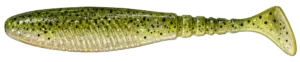
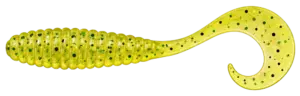

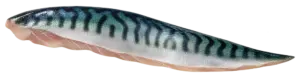
AI-generated illustrations. A click opens the lure’s page.
Rigs for these baits: natural bait rig for the sea.
What the halibut puts on the plate, and when to pass
The flesh and skin of the blind side are usually snow-white in the halibut. The fish is used fresh, salted, smoked or frozen. How to gut and fillet the fish is shown in gutting fish and filleting fish; for smoking, smoking fish helps.
More important than the preparation is the size. The halibut lives long and eats other fish, so it accumulates pollutants such as mercury and dioxins. In a study by the Norwegian marine research institute, organic pollutant levels exceeded the limit in less than one percent of halibut under 40 kilograms, but in 60 percent of fish over 120 kilograms. The Norwegian food safety authority advises against eating halibut of more than about two metres. This is not medical advice.
What you need to observe
Closed seasons, minimum sizes and harvest slots are set by the federal states (Bundesländer) and by the fisheries authorities of the neighbouring countries on the coast (Denmark, Norway, Poland). They vary by type of water, stretch of coast and time of year. We only give figures together with the date and source; the fisheries regulation of your federal state and your fishing permit (Erlaubnisschein) are always what is binding. You will find a list of links to the official sources in the catch calendar.
A fish of legal size that you want to keep you stun and kill at once, in line with animal welfare rules. Protected, undersized fish or fish too large under a harvest slot you unhook, if possible still in the water and with wet hands, and release gently. What exactly applies is regulated by state law and your fishing permit (Erlaubnisschein).
Norway regulates halibut fishing strictly (as of October 2026). South of Stad (62° N), fishing for halibut is banned all year. North of it a closed season applies from 20 December to 20 April, and one area on the Sklinnabanken is closed all year. The minimum size has been 84 cm since 2025. Every halibut over 2 metres, or over 1.6 metres without the head, you return to the sea, even if it is already dead, because large animals contain a lot of pollutants. The Fiskeridirektoratet is the binding authority.
On protection status the sources differ. According to FishBase, the International Union for Conservation of Nature (IUCN) lists the halibut worldwide as potentially threatened (Near Threatened, assessment 2021). On the Norwegian Red List it is rated as not threatened, according to the encyclopaedia Store norske leksikon.
What closed season, minimum size and harvest slot mean and where to find them is explained on the page Closed season and minimum size explained.
Frequently asked questions (FAQ)
May I fish for halibut deliberately in Norway?
Only north of Stad (62° N) and only outside the closed season from 20 December to 20 April. South of Stad the halibut is protected all year, and so it is on part of the Sklinnabanken. You may keep fish from 84 cm; halibut over 2 metres must go back into the sea (as of October 2026).
What tackle do I use for halibut?
Heavy boat tackle: a strong boat rod, a large multiplier reel and strong braided line. Light jigging gear is not enough for a fully grown halibut; the line breaks.
Can I eat a large halibut?
The Norwegian food safety authority advises against eating halibut of more than about two metres, because large, old animals contain many pollutants such as mercury. Smaller fish are far less contaminated. This is no substitute for medical advice.
Sources
The rating of catch chances is an editorial assessment. The facts come from these sources, and the text is worded in our own words. The illustration is an original design by Angel Momente in the style of a natural history plate (AI-generated, see the AI notice).
- FishBase: Hippoglossus hippoglossus
- Havforskningsinstituttet: Atlantisk kveite (Heilbutt)
- Havs- och vattenmyndigheten: Hälleflundra (Laichzeit, Laichgebiet)
- NOAA Fisheries: Atlantic Halibut (Erkennungsmerkmale: großes Maul, eingebuchtete Schwanzflosse, gebogene Seitenlinie)
- Blinker: Steckbrief Heilbutt
- Fiskeridirektoratet: Sea angling in Norway, regulations (geschonte Arten, Ausfuhrquote)
- Store norske leksikon: Kveite (Atlantischer Heilbutt)
- Fiskeridirektoratet: Meeresangeln in Norwegen, Regeln für ausländische Besucher
- Store norske leksikon: Blåkveite (Schwarzer Heilbutt)
- Fiskeridirektoratet: Discard order for halibut and ban on fishing (Fangverbot 20.12.–20.4., Sklinnabanken, Rückwurf über 2 m)
- Fiskeridirektoratet: Kveite for fritidsfiskarar (ganzjährig verboten südlich von Stad, Winterschonzeit nördlich, Sklinnabanken)
- Blinker: Heilbutt angeln, 10 Tipps vom Profi
- Blinker: Angeln in Norwegen (Zielfische, Tiefen, Reisezeit)
- Boulanger et al. 2026, Journal of Fish Biology: Individual variability in activity patterns in Atlantic halibut (Hippoglossus hippoglossus) revealed using pop-up satellite tags
Created with AI support from the sources listed. Figures only appear in the text if a source gives them. Last updated: 23 November 2026. Found a mistake? Write to us. Who is behind this site: About me.
More in the lexicon
- All fish species at a glance
- Catch calendar – month, water temperature and profile for 93 species
- Line calculator – breaking strain after the knot, drag guideline, backing
- Angling methods