
Knowledge · Tackle
Braided line: Thin, low stretch, sensitive
A braided line consists of several fine polyethylene fibres plaited into one thread. It hardly stretches and is thinner than nylon at the same breaking strain. In return it needs suitable knots, a hooklength and a more finely set drag.
Construction: UHMWPE fibres
Almost all braided lines consist of UHMWPE, an ultra-high-molecular-weight polyethylene. A doctoral thesis from TU Chemnitz on fibre ropes describes these fibres as light and flexible, with a tensile strength like steel. At the same diameter, braid carries clearly more than a monofilament nylon line.
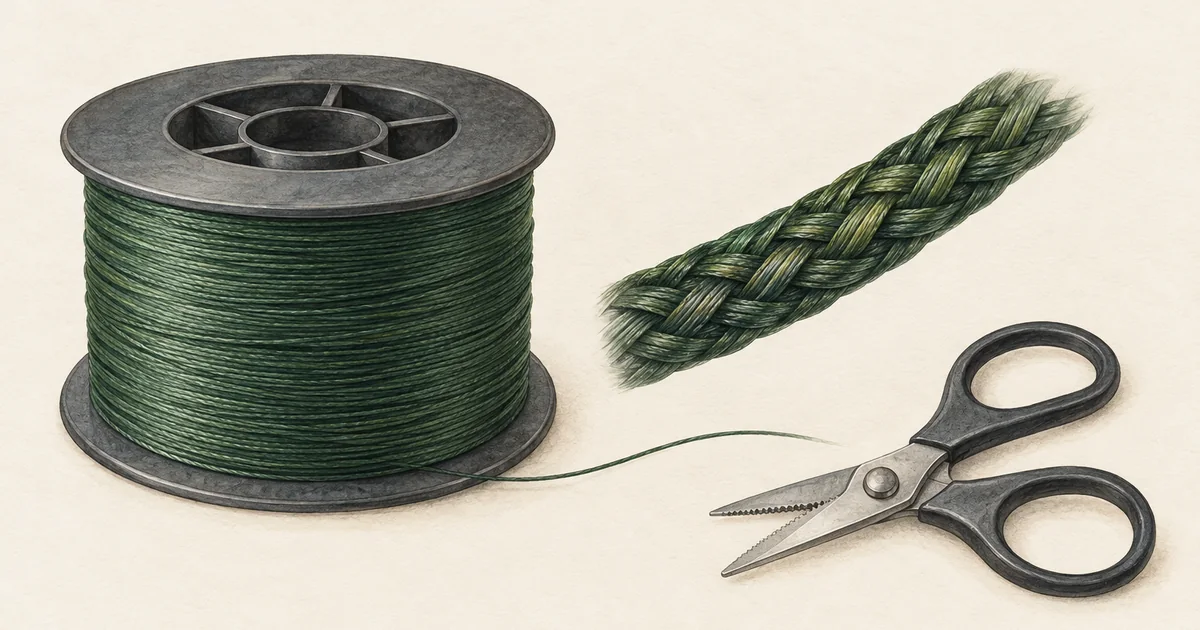
Several strands of fibre are plaited into one thread. There are braids made of four to sixteen individual strands; four, eight or twelve are common. How tight the weave is shows in the number of plaits per centimetre: the more, the tighter and the more laborious to make. Not every spool states this value.
Some lines carry a coating, for example of PTFE or silicone. It makes the surface feel smoother and reduces the uptake of water and dirt. In return many coated lines feel more wiry and stiffer, and the coating does not add breaking strain.
Four-strand or eight-strand
As the number of strands changes, it is mainly the surface that changes. The more strands, the smoother and rounder the braid becomes. Four-strand lines audibly saw at the ring inserts and are considered clearly noisier and stiffer than eight-strand ones.
| Feature | 4-strand | 8-strand |
|---|---|---|
| Surface | rougher, coarser | smoother, rounder |
| In the rod rings | audible, stiffer | quieter, more supple |
| Abrasion | slightly tougher | slightly more sensitive |
| Typical use | passive fishing, carp | spinning, most uses |
Twelve or sixteen strands make the surface a little smoother still, but the price rises noticeably. Eight-strand braid is regarded as the best compromise between softness and price.
Little stretch: direct contact with the lure
Nylon gives under load, braid hardly at all. Tentative bites therefore arrive one to one and can be felt right down to the handle of the rod. The strike, the jerk that sets the hook, is also transmitted without loss. That counts with the bony mouth of pike and zander.
The advantage grows with depth and distance. On a baitcasting reel you reach almost exclusively for braid, because beyond seven to eight metres of depth you can no longer feel bites reliably otherwise. The thin line offers less surface to the current and casts further. Typical uses are spinning with artificial lures, feeder fishing at distance and sea fishing.
No cushion in the fight
Monofilament absorbs runs and head shakes, braid does not. With hard-fighting fish such as lake trout, the lack of stretch can mean a lost fish.
You therefore set the drag clearly lighter than with monofilament. How to find the starting value with a spring balance is described under Setting the reel drag.
For fish with a soft mouth such as trout, perch, asp or chub, Rute & Rolle recommends a monofilament shock leader two to three times the length of the rod in front of the braid. It cushions the final phase of the fight.
Diameter and PE number
The diameter on the spool is only an estimate for braid. Under the microscope the thread is not round; it has hills and craters. The diameters of the individual strands are often added up, and loosely plaited lines trap air. There is no uniform basis for the figure.
In the Blinker test, five lines stated as 0,08 mm had measured diameters of 0,09 to 0,14 mm. As a rule of thumb the editors give a 10 to 20 % allowance for high-quality lines and 40 to 50 % for cheap ones, often four-strand. The breaking strain is right more often because it is measured on tensile testing machines. In the same test, though, it was 21 and 38 % below the stated figure for two of the five lines.
From practice: In the same test a spool printed 200 m at 0,20 mm was already full after 150 m of braid stated as 0,15 mm. So calculate the fill in the line calculator with a diameter allowance.
Many reels print a PE number on the spool rim as well as millimetres, for example PE 1. PE stands for polyethylene, and the number sorts braids into classes. According to the overview in Blinker, PE 0,2 corresponds to a braid of 0,08 mm, PE 1 to one of 0,165 mm and PE 6 to one of 0,40 mm. On lines from the German trade the number is rarely printed.
Knots on smooth fibre
Braid is smooth, so a knot finds little friction. In a series of measurements with a home-built testing machine, published by Fisch & Fang, no knot slipped through. The two braids tested held, once knotted, only 54 and 59 % of their breaking strain on average. The improved clinch knot reached about 81 % on monofilament and about 64 % on braid. A No-Knot, a wrapped wire connector, reached about 89 % on braid.
- Palomar knot for hooks and swivels: it is easy to tie and also suitable for braid. When tightening, the strands should lie parallel.
- FG knot to the hooklength: the braid is laid in cross wraps around the fluorocarbon, which itself is not knotted. It adds hardly any bulk and passes through the rod rings.
- Albright knot: made for lines of different thickness, for example braid to a thick shock leader.
- No-Knot for swivels and snaps when as much breaking strain as possible should be kept.
Hooklength, backing and cutting
A piece of fluorocarbon or monofilament is often added in front of the braid. It serves as protection against visibility and abrasion: braid is easy to see in clear water, and on mussels or stones it can part under tension at the slightest touch. As a buffer Blinker gives about 1 to 1,5 m of hooklength. Pike have rules of their own, see pike hooklength.
On the smooth spool core braid can slip. A layer of cheap monofilament underneath prevents this. The steps are described under Spooling a reel correctly.
Scissors with a serrated blade are best for shortening. They cut the fibres cleanly and without fraying. Small clippers are the first choice for trimming line ends precisely.
Common mistakes
- Trusting the diameter on the spool. The reel fills up sooner, and a line that is too thick is caught by the current. The soft plastic then no longer stays on the bottom and a heavier jig head becomes necessary.
- Setting the drag as for monofilament. With no stretch in the system, the line breaks under too much pressure or the fish is lost.
- Fishing without a hooklength over mussels and stones. Braid under tension breaks at the slightest touch.
- Spooling without backing. Braid can slip on the smooth spool core.
- Fishing in frost as in summer. According to Rute & Rolle, ice crystals can form on braid and stiffen the line. For ice fishing many people therefore rely on monofilament.
Frequently asked questions
Is eight-strand braid always better than four-strand?
No. Eight-strand braid is smoother and quieter, and you can clearly feel that when spinning. Four-strand is slightly more abrasion-resistant and cheaper, and is enough for passive fishing, for example as a mainline for carp fishing.
What does PE 1 on the spool mean?
The PE number is a class for braided line made of polyethylene. According to the table, PE 1 corresponds to about 0,165 mm and PE 2 to about 0,235 mm. Because the number is hardly ever found on braids sold in Germany, the diameter with the allowance mentioned above is usually what helps you compare.
How long should the hooklength in front of the braid be?
About 1 to 1,5 m of fluorocarbon or monofilament counts as a buffer. If a shock leader is to cushion the fight, Rute & Rolle gives two to three times the length of the rod.
Which scissors suit braid?
Scissors with a serrated blade are best, cutting braid without fraying. Scissors reach their limits with steel and titanium; for those there are side cutters or angling pliers with cutting jaws.
Related
- Fishing lines compared: monofilament, braid and fluorocarbon side by side
- Fluorocarbon: the material for the hooklength
- Monofilament line: the stretchy alternative to braid
- Spooling a reel correctly: backing, tension and fill level
- Setting the reel drag: starting value with a spring balance
- FG knot: joining braid and hooklength step by step
- Line calculator: strength after the knot and spool filling
- Spinning rod: the rod that braid mostly goes on
Sources
- Blinker: Geflochtene Angelschnur im Test (Material, Fadenzahl, Beschichtung, gemessene Durchmesser und Tragkräfte, Unterlage)
- Rute & Rolle: Die richtige Schnur, Monofile oder geflochtene? (Bisserkennung, Anhieb, Einsätze, Schlagschnur, Abrieb, Frost) und Rute & Rolle: Schnur, Verbindung zum Fisch (Fasern, vierfach lauter und steifer, Durchmesserangaben, Puffer)
- Blinker: Angeln mit der Baitcaster-Rolle (Bisse in der Tiefe, Puffervorfach, feinere Bremse, Sichtigkeit)
- Blinker: Wie viel Schnur passt auf eine Angelrolle? (PE-Nummer auf dem Spulenrand, Tabelle PE zu Millimetern)
- Fisch & Fang: Kleine Knotenkunde (Palomar, Albright) und Fisch & Fang: Knoten im Vergleich, Messreihe (PDF) (Knotentragkraft, No-Knot)
- Blinker: Fluorocarbon-Knoten (Sicht- und Abriebschutz, FG-Knoten) und Blinker: So bindet ihr den FG-Knoten (schlank durch die Ringe)
- Blinker: Immer gut abschneiden (Schere für Geflecht, Clipper, Seitenschneider)
- TU Chemnitz: Untersuchungen zum Einsatz von ultrahochmolekularen Polyethylenfasern in Seilen für die Fördertechnik (Dissertation) (Eigenschaften der Fasern)
Text AI-assisted, drawing AI-generated. Sources opened and checked in October 2026; no graphics taken from the sources.
All figures are guide values without guarantee. Diameter, breaking strain and knot strength depend on the line, the weave and the coating; test knots with a pull test before fishing.