
Knowledge · Tackle
Setting the reel drag – with a spring balance and a guide value
A well-adjusted reel drag gives line before the rig breaks, and still holds enough pressure for a secure fight. Here is how you can set the reel drag: with a starting value from the line calculator, a spring balance and a few rules for target fish and fight.
What the reel drag is for
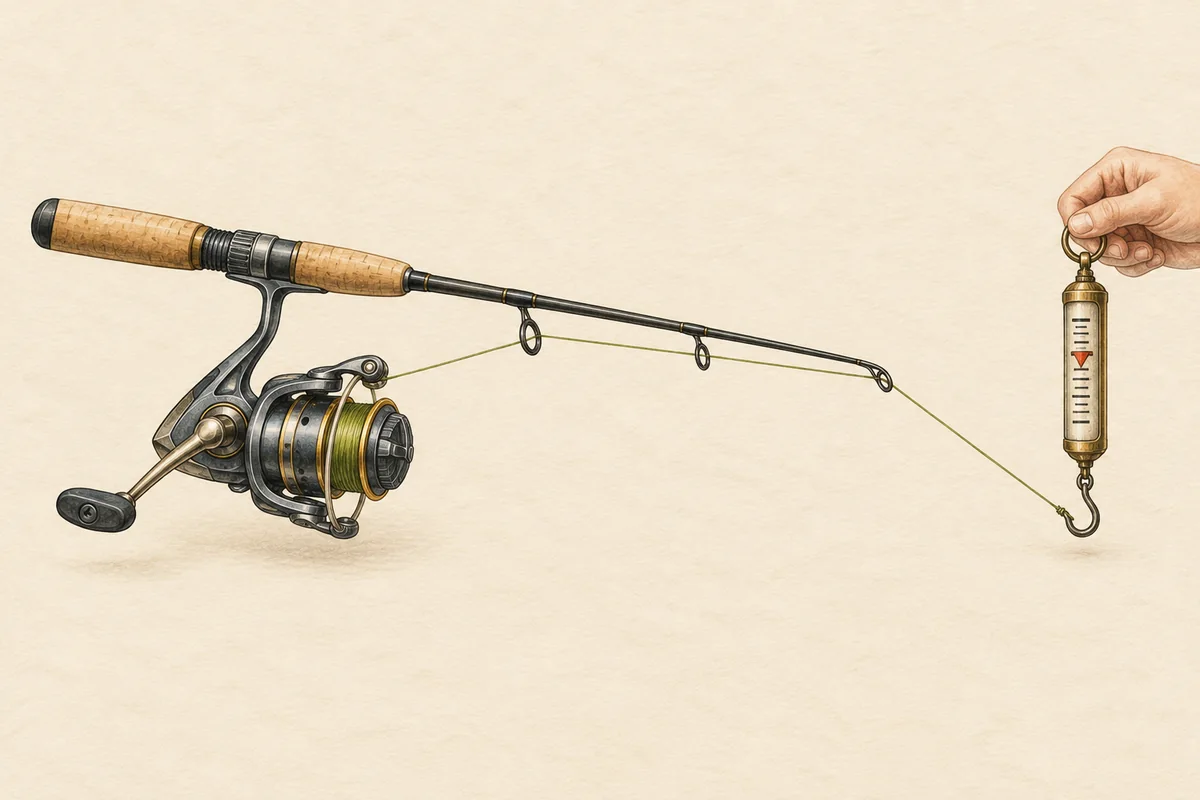
The drag determines how much pull on the line is needed before the spool turns and releases line. If it is too tight, it does not start immediately or releases line with a judder, the hook tears out or the line breaks. If it is too loose, the strike does not set securely, and you lack control of the fish in the fight.
The Landesfischereiverband Baden-Württemberg describes the principle like this: if the force of the fish exceeds the breaking strength of the line, the drag should release line, and the fish tires against the resistance. The angling exam also takes it up. According to the Bavarian catalogue, the setting depends on the breaking strength of the line, and the line drag is the part most likely to prevent a line break in the fight. In the Hessian catalogue, the pull test with setting the drag counts as the most important tackle test before fishing.
Construction: how the drag brakes
Inside, a stack of washers sits on the axle. A knob or lever presses it together; more pressure means more friction. The spool only turns once the pull on the line exceeds the frictional resistance, and it keeps braking until the pull falls below it again. The friction material is now mostly felt, Teflon or carbon-like materials, rarely solid carbon. Between the friction washers there are usually steel washers that distribute the load.
Felt in particular loses braking force after a while, see care below. A good drag system can be regulated finely and releases line under load without juddering. How wet and cold affect the drag is not documented by the sources checked. If conditions change markedly, you therefore repeat the pull test at the water.
Front drag, rear drag, fighting drag, free spool
| Design | Position | Strength | Limit |
|---|---|---|---|
| Front drag | on the spool | large washers, fine adjustment, easier to clean | not always easy to reach during the fight |
| Rear drag | at the back of the housing | quickly reached by hand during the fight | usually less finely adjustable, line release can judder |
| Fighting drag | Rear drag with lever | lever switches quickly to a second setting | only on some reels |
| Free spool | second, very light drag | fish pulls off line with almost no resistance | switch off with one turn of the handle before striking |
According to the LFV Baden-Württemberg, free spool is worthwhile for very fast first runs, for example with carp, or when the fish should be given time to take the bait, for example with pike and zander. More on this at Baitrunner reel. A variation is the quick-drag system: it has no true free spool, but a front drag that can be set markedly tighter with a small turn. The transition is smoother, which is meant to reduce fish coming off.
Multiplier reels and baitcasters brake in the fight via a star wheel near the handle, which serves there as the fighting drag, or via a sliding lever. As an emergency brake against a surprisingly violent pull there is thumb braking: press the free-spool button and slow the spool in a controlled way with your thumb. Details at Baitcaster and multiplier reel.
Starting value: breaking strain and weakest link
There is no universal setting. The training material for the angling exam (Fischerprüfung) gives as a rule to set the drag before fishing to the breaking strain of the line, to avoid a line break. Rute & Rolle points out that breaking strain alone often says little, because the rod more often breaks than the line, and the hook can tear out of a soft mouth. Both apply together: breaking strain provides the upper limit, fish, rod and hook push it down.
For multiplier reels, Blinker gives as a rule that the set drag force should not exceed a third of the line’s breaking strength. The line calculator works with its own cautious starting value: it takes the breaking strength after the knot as a basis and shows 25 to 33 % of it. That is not a standard value but a starting point for the pull test. The weakest link of the rig is decisive, that is main line, hooklength, knot or swivel. If needed, you convert the breaking strength from lb to kg with the unit converter.
With braid you set the drag more finely than with monofilament, because the line hardly stretches. A hooklength of 1 to 1,5 m of fluorocarbon or monofilament serves as a buffer there. Anyone fishing with fine lines also needs a drag that starts smoothly, otherwise the fish is quickly lost.
Worked example: Your line is rated at 6 kg on the spool, you tie a knot that keeps about 85 % of its strength (an assumption, the line calculator shows the value). That gives around 5,1 kg. 25 to 33 % of that is about 1,3 to 1,7 kg. You start the pull test with this range. With a soft mouth or a fine hook you start looser.
Setting it with the spring balance
- Put the reel on the rod and thread the line through all the rings.
- Attach the end of the line to a digital spring or luggage scale.
- Hold the rod in the playing position and pull steadily, not in jerks.
- Adjust the drag so that the spool releases line evenly at the target value.
- Measure several times until the reading reliably hits the target value.
If the spool only shows an lb figure, you convert first. An example: 12 lb is around 5,4 kg. With a knot at about 85 % residual strength, around 4,6 kg remains, and 25 to 33 % of that gives 1,2 to 1,5 kg as the target range for the scale. Again: this is a cautious starting value, not a limit. If you later switch to a thinner hooklength, its breaking strength determines the calculation.
Without a scale, a practice fight helps, as Rute & Rolle describes it: screw the reel onto the intended rod, tie the line to a tree and pull a little on the rod. If it threatens to break, the drag is too tight. If the drag gives so easily that the rod stays almost straight, you tighten it a little. This is less accurate than the scale, but it shows whether the drag runs smoothly.
In the fight: rod, drag and hook
Drag and rod share the load. If line strength and hook size suit the size of the fish, then according to AngelWoche the drag and the springy rod normally take up part of the load, so that the hook is less strongly stressed. With soft-mouthed fish both matter: many perch are lost in the fight, so the rod should not be too stiff and the drag not too hard. With bream the hook tears out faster than with zander, with their bony plates in the jaw.
The drag should be set before the cast; in the fight you change it only in small steps. Front drags are hard to reach, while rear drags can be adjusted quickly by hand. That is what the fighting drag is for. You do not free snags through the reel with the drag screwed shut, because the forces on the line roller and gearing are enormous. Hooks straighten most often on snags on the bottom, especially with braid, and in the fight only under brutal loads.
If a fish comes off in the fight, according to the sources three causes come into question: a drag that is too tight, where the hook tears out of the soft mouth; one that is too loose, where the hook was not set securely; and a rod that is too stiff. An overloaded hook that straightens is rather the exception.
Target fish and situation
The fish species plays a big part. A guide, not a law:
| Situation | Tendency | Bottom |
|---|---|---|
| Pike, hard strike | rather tight | The hook should bite into the hard mouth |
| Asp, bream | rather loose | soft mouth, the hook tears out |
| Sitting it out for coarse fish | rather loose | fine rig, soft strike |
Many pike anglers screw the drag almost fully shut for the strike and open it a little once the fish is hooked. In the fight it is adjusted only carefully.
Looking after the drag washers
Oil does not belong on the washers, otherwise friction is lost. Reel servicing specialists instead recommend cleaning felt and, after some time, carbon washers too, and greasing them only very lightly on both sides so that the braking force does not fall. You clean felt with a dry cloth, carbon with cleaning alcohol. What is allowed for your reel is in the instructions. After the fishing day you loosen the drag and store the reel like that, which relieves the components. When rinsing after salt water the drag is closed beforehand, and the reel is not submerged.
Common mistakes
- Drag too tight: the line breaks, the hook tears out.
- Drag too loose: The strike does not go through, the fish gains line into snags.
- Not reset after changing the spool: With a front drag the setting is lost when you unscrew it, see Spare spool.
- Only by feel: Without a pull test you only find out during the fight whether the value is right.
- Thick mainline, thin hooklength: The thinnest link determines the value, not the mainline.
- Drag with braid as with monofilament: braid hardly stretches and needs a finer setting.
- Snag freed through the reel: this puts enormous strain on gearing and line roller.
Frequently asked questions
When do I set the drag?
Before fishing, that is before the rig goes into the water. After every change of line, hooklength or spool you check the value again.
How tight should the drag be for pike?
Rather tight, so that the strike gets through in the hard mouth. Many open it a little after hooking. The upper limit remains the breaking strain of the weakest link.
Do I have to readjust during the fight?
Only carefully. Front drags are hard to reach during the fight, rear drags can be adjusted quickly by hand. Change the setting in small steps.
Why does my drag judder?
Worn or dirty washers, especially felt ones, lose braking force and run unevenly. Cleaning and greasing lightly according to the manufacturer’s instructions helps; oil on the washers does harm.
Why do fish come off in the fight?
Common causes are a drag that is too tight with a soft mouth, a hook not set securely because the drag is too loose, and a rod that is too stiff. Check your setting with the pull test first.
Related
- Fishing reels: types and specifications at a glance
- Fixed-spool reel: how front and rear drags are built
- Spooling a fishing reel: tension and fill level
- Fishing lines compared: stretch and breaking strain
- Pike hooklength: the weakest link when fishing for pike
- Spare spool: reset the drag after changing
- Free-spool reel: giving line freely when sitting and waiting
- Line calculator: starting value from the breaking strain
Sources
- Rute & Rolle: Bremsmanöver, die richtige Einstellung (Funktion, keine allgemeingültige Einstellung, Fischart, Kampfbremse, Probedrill, kein Öl)
- Rute & Rolle: Angel-Basics, die Bremse (Front- und Heckbremse, Erreichbarkeit, Freilauf)
- Blinker: Multirolle, Kraftpakete im Einsatz (ein Drittel der Schnurtragkraft)
- Blinker: Angelrolle, mehr als nur ein Schnurspeicher (Bremssysteme, fein regulierbar, blockierte Bremse)
- Blinker: 9 Profitipps zur Rollenpflege (Scheibenmaterial, Pflege, Hänger, Lagerung, Salzwasser)
- Blinker: Angeln mit der Baitcaster-Rolle (Sternrad, Daumenbremse, Geflecht und Bremse)
- Blinker: Die Freilaufrolle (Quick-Drag, Freilauf)
- Blinker: Aufgebogene Angelhaken (Bremse und Rutenfederkraft entlasten den Haken)
- Blinker: Barschangeln, 10 Tipps (weiches Maul, Rute und Bremse)
- Blinker: Rollen für den Forellensee (weich anlaufende Bremse bei feiner Schnur)
- Landesfischereiverband Baden-Württemberg: Präsentation Gerätekunde (PDF) (Prinzip, Front- und Heckbremse, Kampfbremse, Freilauf)
- LfL Bayern: Fragenkatalog Fischerprüfung 2023/2024 (PDF) (Bremseinstellung nach Tragfähigkeit, Schnurbremse im Drill)
- Land Sachsen-Anhalt: Fragenkatalog zur Fischerprüfung (Export) (Schnurbremse verhindert Schnurbruch)
- Fischereiverein Löningen: Zusammenfassung Gerätekunde (PDF) (Bremse auf die Tragkraft der Schnur einstellen)
- Hessisches Landwirtschaftsministerium: Fragenkatalog zur Fischerprüfung (PDF) (Zweck der Schnurbremse, Zugprobe)
- Wikipedia: Fishing reel (Aufbau der Bremse, ergänzend)
Text AI-assisted, drawings AI-generated. Sources opened and checked in November 2026, no graphics taken from the sources.
All figures are guide values without guarantee. The setting depends on line, knot, hooklength, hook, rod and target fish.