
Knowledge · Tackle
Freespool reel: Giving line freely on a session
A free-spool reel is a fixed-spool reel with a second drag that is very easy to set lightly. When you sit out, a fish takes line from it even though the bail arm is closed. A lever or a turn of the handle switches to the fighting drag, which you use to play the fish.
Two drags in one reel
A free-spool reel differs from an ordinary fixed-spool reel by an additional braking system that can be set and switched separately. According to Blinker, the fish pulls line off the spool against the adjustable resistance of this free-spool drag. Its adjustment wheel sits at the back of the body, next to a switch for changing over. The main drag is also called the fighting drag during the fight. On high-quality reels it is a finely adjustable front drag on the spool.
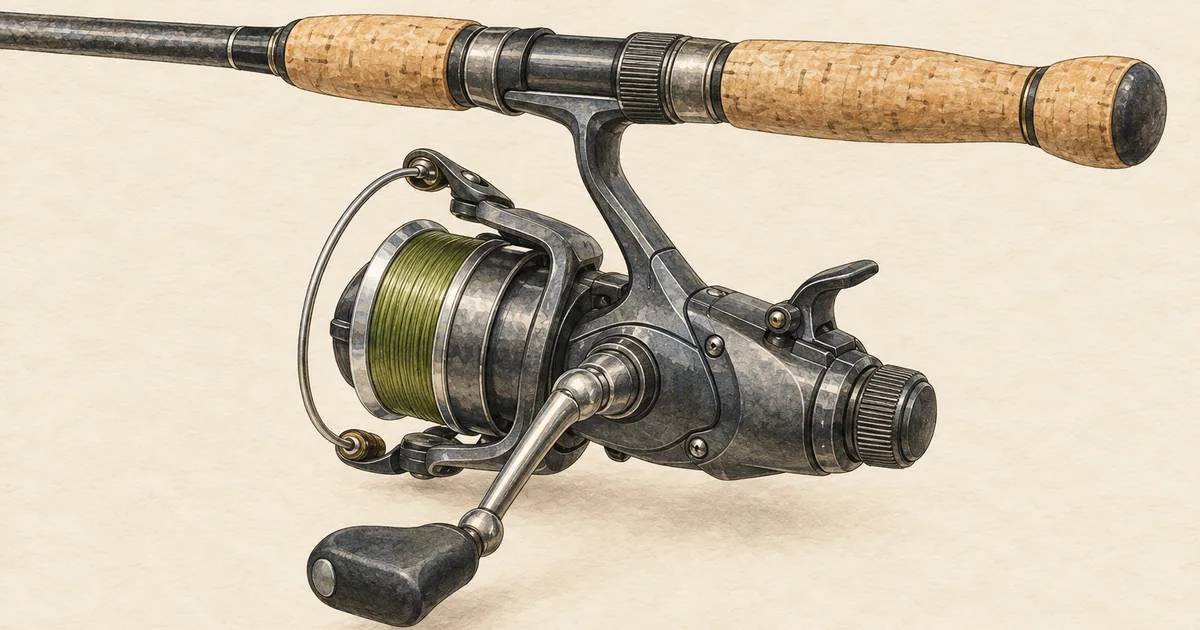
The Saxon question catalogue for the angling exam (Fischerprüfung) sums up the principle in one sentence: with the bail arm closed, the fish pulls line off against low resistance. You go back to the fighting drag in two ways, with the free-spool lever or with the handle. On modern reels half a turn of the handle is often enough. Cheaper models show weaknesses here, such as play or a delay when switching.
A variant manages without a true free spool. Its front drag can be adjusted especially quickly: if you turn the wheel at the front of the spool just a little further, it grips noticeably harder. The change from little to a lot of braking power is smoother and less abrupt, which is meant to reduce lost fish.
What the free spool is for when sitting out
When a fish bites, the reel releases line against a resistance you set beforehand. That gives you more control over cautious fish, and if you want, they take line with almost no resistance.
- Carp: According to Blinker, the free-spool reel is almost standard in carp fishing, together with electronic bite alarms. After casting, the free spool is switched on, and off again for the fight.
- Zander and eel: When sitting out with a bait fish, the fish takes line before you strike. For cautious zander the resistance should be as low as possible.
- Pike: Laying bait fish on the bottom with an electronic bite alarm requires the drag or free spool to be set very finely, so that the pike feels hardly any resistance when it bites.
- Sizes: Small free-spool reels are recommended for tench, trout and coarse fish, large ones for pike, carp and eel.
Setting the free spool
It is set with the wheel at the back of the reel. Two limits apply: set too loose, you risk tangles and uncontrolled runs. Too tight, and the free spool loses its purpose. The rule of thumb is: the fish should be able to pull line off, but feel noticeable resistance when it pulls hard. You set the main drag to the fighting value before the bite; guideline values are given under Setting the reel drag and in the Line calculator.
| Time | Free spool |
|---|---|
| Bait fish for zander or pike | very light |
| Carp with a fixed lead | much tighter than with a bait fish |
| Carp right in front of snags | a little firmer from the start |
| Current, wind or drifting weed | gradually firmer |
A fixed-lead rig needs more resistance, because the carp is meant to run against the lead and hook itself, see Hair rig. If current, wind or drifting weed pull on the line, you turn the free spool gradually firmer until the line stays taut and no longer runs off by itself.
Free spool, open bail or long-distance reel
The simple alternative is the open bail. Blinker describes it for pike on the bottom: with the reel open, the line is clipped under a rubber band, and the fish pulls it out when it bites. Its drawback: wind or current can pull the line off by themselves. With the free spool switched on, that does not happen.
For carp, two reel types are named side by side: free-spool reels and, for long distances, surf reels with a large spool. Long-cast spools are also available for free-spool reels, though, so the boundary is blurred.
Working together with the bite indicator
When sitting out, the free-spool reel often works with an electronic bite alarm that beeps and lights up on a bite. The free spool makes sure the line can run. An additional hanger on the line keeps the main line under tension. Only then do fine plucks and drop-backs, where the fish swims towards the rod, show up. Which indicators exist and how the rod lies for this is explained under Bottom rod.
Supervision: A bite indicator does not replace paying attention. The Sächsische Fischereiverordnung expressly states that hand-held rods must be supervised constantly and that electronic bite alarms do not replace supervision. What applies in your federal state (Bundesland) is set by state law and your fishing permit (Erlaubnisschein).
Fish welfare: strike in good time
The free spool tempts you to let a fish run for a long time. With natural bait that is risky. For pike that are to be returned, the Integrative Fisheries Management group at Humboldt University Berlin recommends striking immediately when fishing with natural bait and preferring to fish actively rather than passively, to reduce deep hooking. When fishing with a pike float, the warning applies: if a pike takes the bait unnoticed, it can swallow the hooks so deeply that they can no longer be removed without fatal injury.
If you present bait fish on the bottom, you shorten the waiting time with two small trebles: the hooks then sit at the front of the mouth. How to present the bait fish for this is shown in the Bait fish rig. If a hook has been swallowed deeply after all, Landing and unhooking a fish will help.
Common mistakes
- Free spool as loose as possible. Then tangles and uncontrolled runs are likely. In current or wind it should also be a little firmer.
- Setting the main drag only during the fight. After switching over, the fighting drag takes hold immediately. If it is too tight or too loose, you only notice when the fish is on.
- Waiting too long with a bait fish. For pike, the Humboldt University group advises striking immediately to avoid deep hooking.
- Using the free-spool reel as a spinning reel. The higher weight and the more delicate mechanics are drawbacks; for active techniques such as spinning it is regarded as poorly suited.
- Packing the reel away wet. The second drag needs more care. After rain or dust, the reel should at least be cleaned on the outside and dried. Whether the drag discs may be greased is stated in the instructions.
Frequently asked questions
Do I have to switch off the free spool by hand before the strike?
Not on most reels. A short turn of the handle switches the free spool off, and on modern reels half a turn is often enough. The lever at the back does the same. Check regularly that the switch engages cleanly.
Do I need a free-spool reel for sitting out for eel?
It helps. When sitting out for eel at night, too, the free spool is seen as an advantage, especially with bait fish: the eel can take line before you strike. Rute & Rolle counts eel fishing among the uses of large free-spool reels.
Does a carp hook itself even with the free spool switched on?
Yes, if the resistance is right. When carp fishing with a self-hooking rig, the drag or free spool is set much tighter than when fishing for predators with a bait fish. When the line runs, the fish is usually already hooked.
Related
- Fishing reels: all reel types at a glance
- Setting the reel drag: starting value for the fighting drag with a spring balance
- Carp rod: length, test curve and action of the right rod
- Bottom rod: bite indicator and rod rest on lake and river
- Carp fishing: fixed lead, feeding spot and fight
- Bait fish rig: bait fish on the bottom for zander and pike
- Returning a fish: what matters when returning fish and what is allowed
- Line calculator: breaking strain after the knot and line quantity on the spool
Sources
- Blinker: Die Freilaufrolle, feine Technik für den erfolgreichen Ansitz (zweite Bremse, Einstellrad und Schalter hinten, Umschalten per Hebel oder halbe Kurbelumdrehung, Einsatz bei Karpfen, Zander und Aal, Einstellung, Weitwurfspulen, Vor- und Nachteile, Pflege) und Blinker: Freilaufrolle im Test (Freilauf bei Strömung, Wind und Kraut fester stellen)
- Blinker: Karpfenangeln, Tipps für eine erfolgreiche Fangstrategie (Freilauf strammer als beim Köderfisch, Freilaufrollen und Brandungsrollen), Blinker: Karpfen-Kickstart (läuft die Schnur, hängt der Fisch meist schon) und Blinker: Bissanzeiger richtig nutzen (Einhänger hält die Schnur auf Spannung, Fallbisse)
- Blinker: Einsteiger-Guide, wie fange ich einen Hecht (Schnur unter Gummi am offenen Bügel, 5 bis 10 Sekunden bis zum Anhieb) und Blinker: Hechtpose (tief geschluckte Haken)
- Humboldt-Universität zu Berlin, Fachgebiet Integratives Fischereimanagement: Waidgerecht, Pike (sofortiger Anhieb mit Naturköder, aktiv statt passiv)
- Freistaat Sachsen, LfULG: Fragen für die fischereiliche Sachkundeprüfung, Gerätekunde (Begriff Freilaufrolle) und Sächsische Fischereiverordnung (§ 4, Aufsicht und Bissanzeiger)
- Rute & Rolle: Angel-Basics, die Bremse (Größen und Zielfische der Freilaufrollen, Kurbel schaltet den Freilauf aus) und Rute & Rolle: Hecht erfolgreich mit Köderfisch (fein einstellbarer Freilauf, kleine Drillinge, rascher Anhieb)
Text AI-assisted, drawing AI-generated. Sources opened and checked in October 2026; no graphics taken from the sources.
All figures are guidelines without guarantee. How finely the free spool should run depends on reel, rig, current and target fish; your reel’s instructions apply.